

 Product
 Brand
Brand Articles
 Tools
Tools

Saumitra Jagdale
Saumitra Jagdale is a Backend Developer, Freelance Technical Author, Global AI Ambassador (SwissCognitive), Open-source Contributor in Python projects, Leader of Tensorflow Community India, and Passionate AI/ML Enthusiast
Sort by
 Efficiency-Related Issues in GaN and SiC Power Systems
06 February 2023
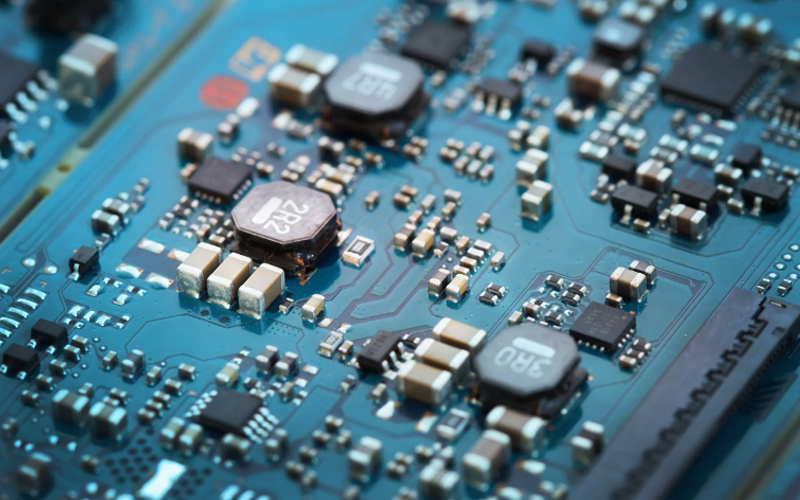
This paper presents the efficiency-related issues of GaN and SiC power systems in two parts: Reliability in GaN Power Devices and Reliability in SiC Power Devices. Silicon Carbide: The Future of Power Electronics
06 March 2023
Silicon-based power-switching devices have made it possible for systems to produce more power while operating at a higher efficiency thanks to the development of MOSFETs and IGBTs. This article mainly introduces the features and advantages of SiC over Si, the operation of SiC devices, and the characteristics of various SiC power devices. Silicon Carbide Substrate Manufacturing: Advancing Technology to New Heights
08 June 2023
In recent years, the development of electronic systems and products has skyrocketed. With the rapidly evolving industrial landscape, certain materials are emerging as game-changers, pushing the boundaries of technology and transforming various sectors. One such material is silicon carbide (SiC). Exploring the Strengths and Hurdles of Wide Bandgap Devices in Alternating Current Electric Drives
19 January 2024
Wide-bandgap materials have emerged as pioneers in the era of power devices, altering the performance and efficiency of electronic systems. Silicon, the traditional semiconductor material, has limitations that become apparent as power requirements escalate. WBG materials, such as silicon carbide and gallium nitride, possess high switching frequency, low losses and high-temperature operating capability making them an ideal choice in power devices.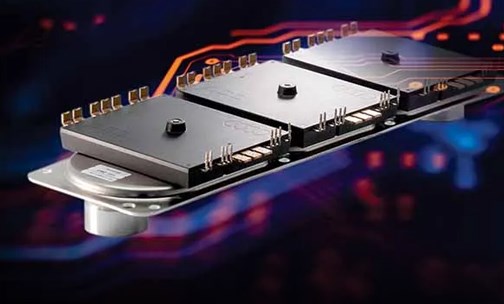 Optimizations and applications of wide-band gap (wbg) semiconductor devices for ev systems
28 October 2022
Silicon Carbide (SiC) and Gallium Nitride (GaN) are the WBG semiconductors that are widely used these days. Although there is a lot more scope for the development of WBG semiconductors, they are recognized as more efficient and reliable devices. Transfer Learning Method for detailed defect classification in semiconductor manufacturing based on Convolution Neural Network
13 January 2023
Based on certain tests, the convolutional neural network(CNN) transfer learning method (a deep learning technology) was considered the best method for defect classification.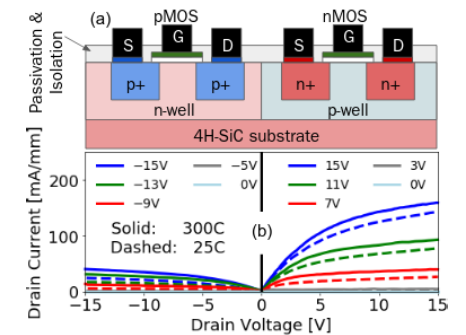 Advanced CMOS Devices with Wide Bandgap and Ultrawide Bandgap Technologies
15 March 2024
Power and radio frequency electronics play an increasingly important role in energy-efficient and collaborative future as there is always a demand for faster, smaller, high-voltage and more conductive transistors. Traditionally, silicon has been the semiconductor of choice due to its extensive research and manufacturing history, and natural abundance. While silicon power devices continue to maximize performance, many applications are now integrating wider-band gap semiconductors. These materials offer a significantly higher voltage-conducting capacity, surpassing silicon's limits in tradeoffs related to ON-resistance, capacitances, and breakdown voltage. Revolutionizing DC Link Bus Design: Unleashing High Frequency, High-Temperature Converter Potential
11 July 2023
Hello everyone, welcome to the new post today. Si vs SiC Diodes: A Performance Study of Interleaved Boost Converters for PV Applications
14 March 2023
Hello everyone, welcome to the new post today.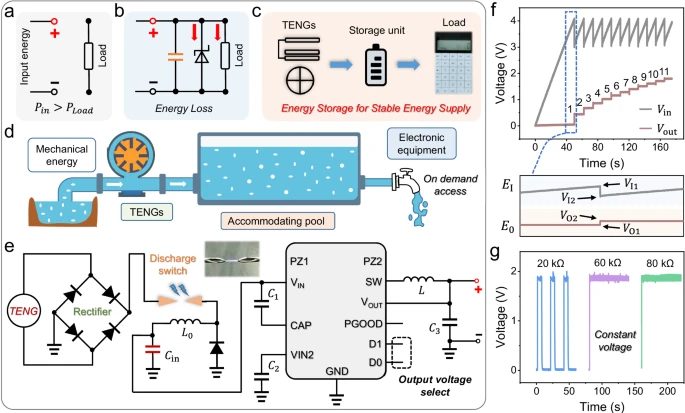 Improving the Energy Conversion Efficiency of Triboelectric Nanogenerators
19 November 2024
There is a huge growth in demand for self-sustaining electronic devices, as the traditional power-generating devices fail in remote and harsh environments due to the periodic requirement of battery changes. Also, these devices are frequency specific; some work only in high frequency and some in low frequency. Triboelectric nanogenerators (TENGs) provide a promising solution by efficiently converting mechanical energy into electricity as they are versatile, compact, and cheap, making them a popular choice.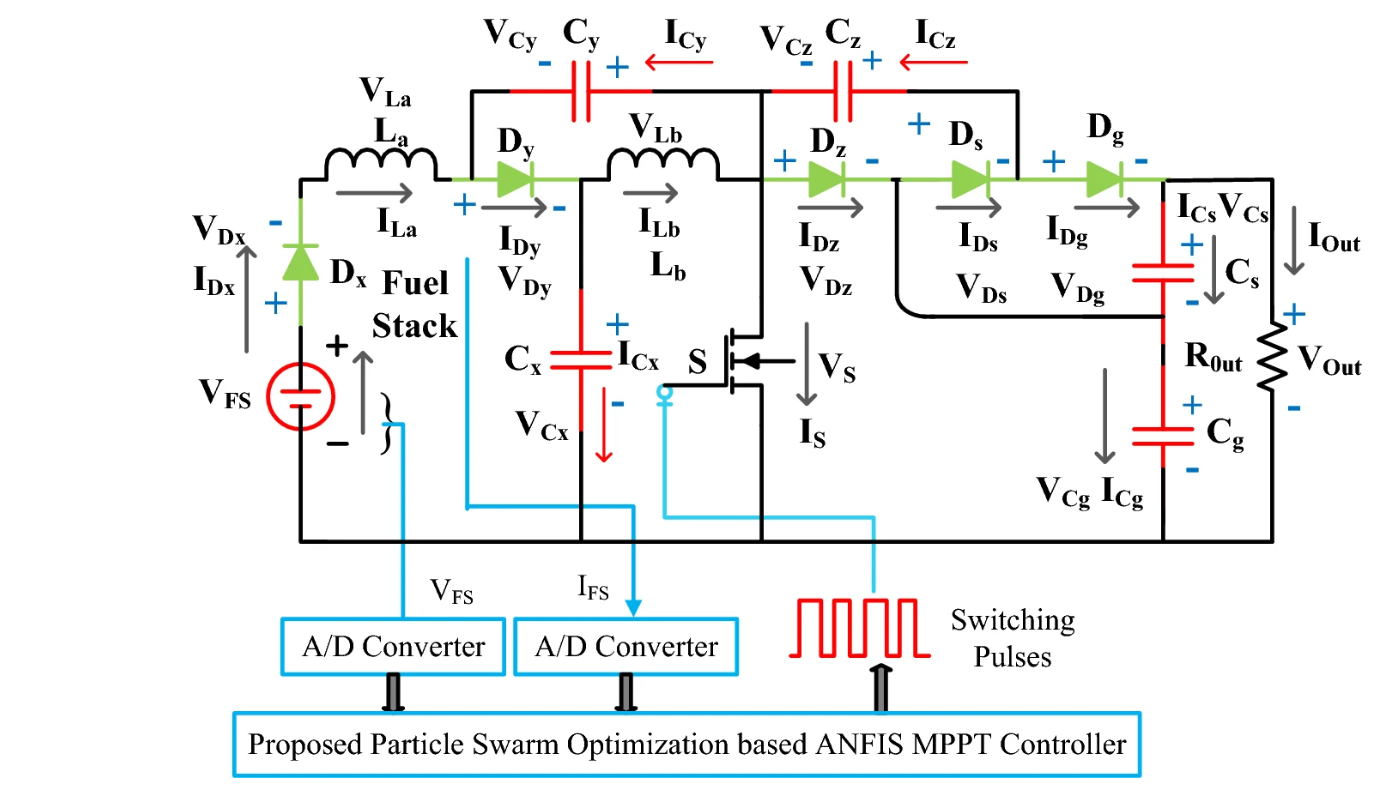 Methodologies for Increasing Efficiency of Fuel Stack Technology for Energy Generation
19 November 2024
Presently, power companies are moving towards renewable energy systems. Conventional energy sources are more expensive because they require a vast network to be maintained and huge human resources. Also, they harm the environment by releasing several harmful gases. As the industry’s focus shifts toward renewable energy sources, energy systems powered by Proton Exchange Membrane Fuel Stacks (PEMFS) are gaining traction.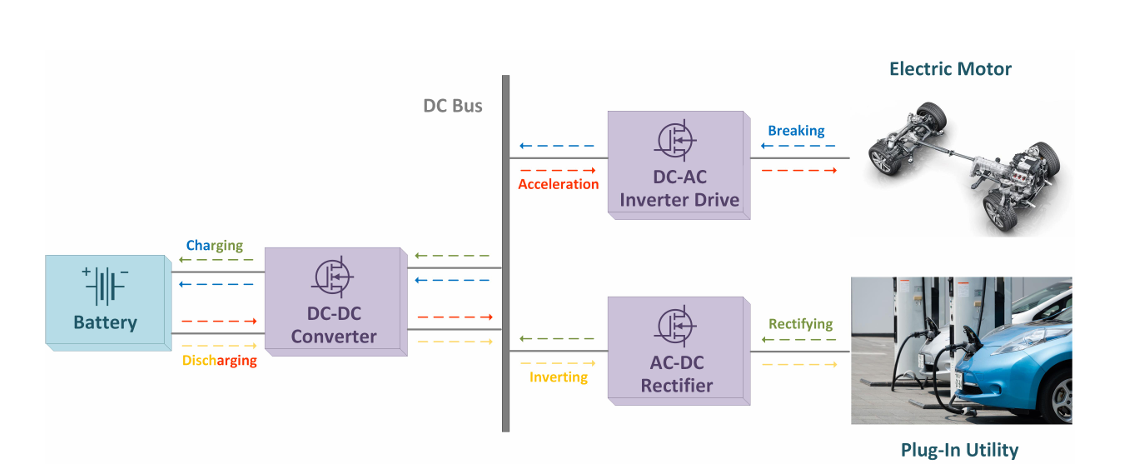 A Hybrid SiC and GaN-Based DC-DC Converter for EVs
20 September 2024
Across the globe, there is an increase in the usage of EVs, as they are an environmentally friendly way of commuting daily. The performance of these vehicles depends on the power electronics that manage the energy flow efficiently. On this front, there are two types of EVs, BEV (Battery Electric Vehicle) and HEV (Hybrid Electric Vehicle). Both types have a Plug-in variation equipped with a charging port to be connected to the power grid.