Product
 Brand
Brand Articles
 Tools
Tools
Semiconductor Market Poised for Strong Rebound in 2024, Predicts WSTS
The semiconductor market is expected to experience a significant rebound in 2024, according to a report by the World Semiconductor Trade Statistics (WSTS). The report forecasts a growth of 13.1% in sales, with the memory sector playing a crucial role in driving this growth. Regional markets worldwide are also expected to see double-digit year-over-year growth. The semiconductor market has faced various challenges in recent times, including supply chain disruptions, geopolitical tensions, and shifting consumer demands. However, the industry has shown resilience and adaptability, with consistent growth over the last two decades. From $139 billion in 2001, annual sales have soared to $573.5 billion in 2022, representing a 313% increase. Despite ongoing challenges, the semiconductor market has performed better than initially projected. The revised forecast by WSTS anticipates a contraction of 9.4% in 2023, followed by a strong rebound in 2024. The industry is expected to reach a valuation of $588 billion in 2024, a 13.1% increase from the previous year. The memory sector is expected to be the primary driver of growth, with projected sales of around $130 billion in 2024, representing a significant increase of over 40% from the previous year. Other segments, including discrete, sensors, analog, logic, and micro, are also expected to record single-digit growth rates. From a regional perspective, all markets are poised for ongoing expansion in 2024. The Americas and Asia Pacific regions, in particular, are forecasted to demonstrate significant double-digit growth on a year-over-year basis. This positive outlook is supported by SEMI, in partnership with TechInsights, which also predicts a recovery in the global semiconductor industry in 2024. International Data Corporation (IDC) is even more optimistic, forecasting accelerated growth in the semiconductor market in the coming year. While 2023 is expected to see a decline of 12% in worldwide semiconductor revenue, IDC predicts a year-over-year growth of 20.2% in 2024, reaching a valuation of $633 billion. WSTS notes that specific end-markets will see improvements in 2023, with discrete semiconductors, particularly power semiconductors, expected to see a 5.8% year-over-year growth. However, all integrated circuit categories, including analog, micro, logic, and memory, are projected to experience an 8.9% decline compared to the previous year. In terms of regional performance, only the European market is anticipated to grow in 2023, with a 5.9% increase. The Americas, Asia Pacific, and Japan are expected to face downturns. However, improved visibility in semiconductor growth is expected in 2024 as the extended inventory correction concludes in major market segments like PCs and smartphones. Looking ahead, IDC predicts that elevated inventory levels in the automotive and industrial sectors will normalize in the second half of 2024, driven by the ongoing electrification trend. The introduction of AI PCs and AI smartphones, as well as improvements in memory ASPs and DRAM bit volume, are also expected to contribute to semiconductor growth. Despite short-term challenges, the semiconductor market is on track for revitalization and dynamic growth in the years to come. The industry's resilience and capacity for innovation will continue to drive its success, creating new opportunities and shaping a vibrant semiconductor landscape.
 UTMEL
UTMEL
We are the professional distributor of electronic components, providing a large variety of products to save you a lot of time, effort, and cost with our efficient self-customized service. careful order preparation fast delivery service
 Power Semiconductor Procurement After the Nexperia Shake-Up—NXP for Stability, ON for Technology, or Nexperia for Value?UTMEL04 November 20254828
The recent supply chain turmoil surrounding Netherlands-based Nexperia has sent shockwaves through the global semiconductor industry, forcing procurement professionals to re-evaluate their sourcing strategies.
Read More AI Computing Power Gap: How Token Consumption is Reshaping Server Component SourcingUTMEL23 June 2026898
As global token consumption drives the transition to high-density 100kW+ AI data centers, power delivery networks require advanced Wide-Bandgap semiconductors (SiC/GaN) and high-capacitance MLCCs. This shift has triggered a component procurement crisis with lead times exceeding 24 weeks. To bypass shortages, hardware buyers must abandon just-in-time manufacturing and leverage independent global distributor networks to secure critical power and passive components.
Read More The BSPDN Revolution: Overcoming IR Drop in Sub-2nm GAAFET Nodes with Backside Power DeliveryUTMEL25 June 2026818
As semiconductor manufacturing enters the sub-2nm era, Backside Power Delivery Networks (BSPDN) are replacing traditional front-side routing to overcome critical IR drop bottlenecks. By separating power and signal delivery, chipmakers like Intel and TSMC drastically improve performance and density in GAAFET designs. However, this radical shift introduces manufacturing complexities, thermal challenges, and demands advanced packaging and power management solutions.
Read More Power Management ICs Trends 2026: AI Demand, Supply Risks, and Sourcing StrategiesUTMEL06 July 20261300
As AI server racks surpass 100kW by 2026, data centers are shifting toward wide-bandgap semiconductors like SiC and GaN. However, this demand has triggered a critical shortage of mature-node Power Management ICs (PMICs). To prevent production halts, sourcing teams must abandon 'just-in-time' models, implement proactive 'just-in-case' strategies, and rapidly qualify pin-to-pin alternative components to secure their supply chains.
Read More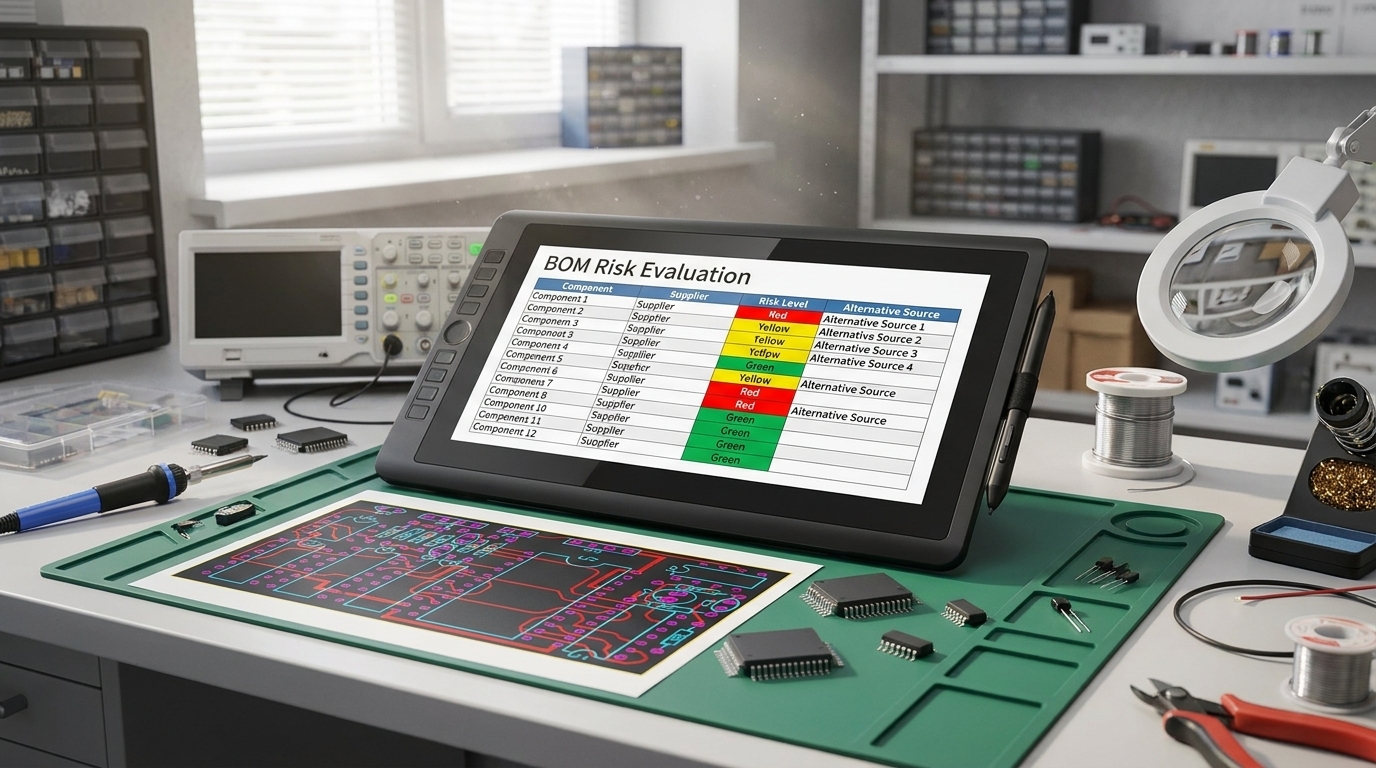 onsemi Synaptics Acquisition Impact: BOM Risk Checklist and Second-Source Strategy for Edge AI DesignsUTMEL27 July 2026296
The onsemi acquisition of Synaptics provides hardware program managers a 12-to-18-month window before potential product cancellations occur in mid-2027. This guide outlines how to audit BOM exposure across overlap and non-core product lines, calculate Last-Time-Buy volumes including hidden storage costs, establish proactive second-sourcing triggers, and implement supply chain monitoring to prevent line-down events.
Read More
Subscribe to Utmel !
![10207101009]() 10207101009
10207101009Littelfuse Inc.
![BLM03AX601SZ1D]() BLM03AX601SZ1D
BLM03AX601SZ1DMurata Electronics
![74AHC74D,118]() 74AHC74D,118
74AHC74D,118Nexperia USA Inc.
![02540101Z]() 02540101Z
02540101ZLittelfuse Inc.
![CJ25-82010]() CJ25-82010
CJ25-82010Nidec Copal Electronics
![162GB-16F18-11PB]() 162GB-16F18-11PB
162GB-16F18-11PBAmphenol
![H200X064H1T-2-B]() H200X064H1T-2-B
H200X064H1T-2-BPanduit Corp
![SLB-25MG3F]() SLB-25MG3F
SLB-25MG3FROHM Semiconductor
![PEC11R-4220F-S0024]() PEC11R-4220F-S0024
PEC11R-4220F-S0024Bourns Inc.
![BLM03AX121SZ1D]() BLM03AX121SZ1D
BLM03AX121SZ1DMurata Electronics