Product
 Brand
Brand Articles
 Tools
Tools
IATF 16949 for Automotive Electronics: Quality Requirements, Standards Alignment, and Certification Guide
Electronics, semiconductors, and embedded software systems account for approximately 40% to 50% of the total manufacturing cost of modern vehicles, with projections surpassing 50% as software-defined and battery-electric architectures dominate the market. For automotive engineers and quality managers operating across Tier 1, Tier 2, and semiconductor supply chains, managing this complexity requires adherence to rigorous defect-prevention frameworks. IATF 16949 automotive electronics compliance serves as the definitive global benchmark for establishing process reliability, end-to-end traceability, and zero-defect manufacturing disciplines.
IATF 16949:2016[1] is the foundational Quality Management System (QMS) standard for the automotive industry, established by the International Automotive Task Force in alignment with ISO 9001:2015[6]. Rather than serving as an isolated hardware test, the standard governs organizational, design, and manufacturing processes to eradicate systematic defects, control variation, and eliminate supply chain waste. Achieving compliance requires engineering teams to integrate the five Automotive Core Tools while synchronizing hardware qualification (AEC-Q), functional safety lifecycles (ISO 26262), and software process maturity models (Automotive SPICE).
This technical guide analyzes the structural requirements of IATF 16949 for electronic hardware, printed circuit board assembly (PCBA), and semiconductor manufacturing. It details the interaction of overlapping automotive standards, breaks down specific clauses for embedded firmware and shop-floor environmental controls, examines the operational updates enforced under IATF Rules 6th Edition, and provides a structured remediation blueprint for common audit non-conformances.
Understanding IATF 16949: Structure, Scope, and ISO 9001 Foundation
The ISO 9001:2015 Annex SL Foundation and Automotive Overlay
IATF 16949:2016 cannot be implemented or audited as an independent, standalone standard. It is structured as an automotive-sector overlay that operates directly on top of the International Organization for Standardization's ISO 9001:2015 standard[6]. It adopts the standardized 10-clause Annex SL High-Level Structure (HLS), ensuring a common framework across organizational management systems:
Clause 1–3: Scope, Normative References, Terms and Definitions
Clause 4: Context of the Organization
Clause 5: Leadership
Clause 6: Planning
Clause 7: Support
Clause 8: Operation
Clause 9: Performance Evaluation
Clause 10: Improvement
While ISO 9001 establishes baseline principles for quality management, customer satisfaction, and continuous improvement, IATF 16949 supplements these generic clauses with stringent automotive requirements. For electronics suppliers, these additions mandate formalized contingency planning, explicit competencies for internal and second-party auditors, embedded software validation, and total productive maintenance (TPM) across high-speed surface-mount technology (SMT) and automated test lines.
Zero Defects, Defect Prevention, and Variation Reduction Principles
The automotive industry operates under a zero-defect paradigm. In visual stress tests and operational teardowns across tier-level manufacturing environments, the cost of quality failures is readily apparent. While traditional manufacturing might tolerate scrap yards of discarded mechanical castings, structural stampings, or failed sub-assemblies, a single latent defect in an automotive electronic control unit (ECU) can result in catastrophic roadside failures, thermal events, or multi-million-dollar field recalls.
Consequently, IATF 16949 shifts the operational focus from retrospective quality control (inspecting failed boards at the end of the line) to proactive defect prevention and variation reduction. This discipline mandates statistical validation of every manufacturing process step—from solder paste stencil deposition and component placement accuracy to reflow thermal profiling and automated optical/X-ray inspection.
IATF 16949 Explained | Automotive Quality with PJR
Customer-Specific Requirements (CSRs) and Supply Chain Scope
A compliant IATF 16949 QMS requires the systemic integration of Customer-Specific Requirements (CSRs). Automotive original equipment manufacturers (OEMs) such as BMW, Ford, General Motors, Stellantis, and Volkswagen publish proprietary quality manuals that impose supplementary mandates over and above the baseline standard.
Under IATF 16949, CSRs hold normative status: an auditor assesses whether the supplier has systematically mapped and implemented each customer's unique testing cadences, escalation procedures, packaging guidelines, and submission portals into its standard operating procedures (SOPs). Furthermore, Tier 1 and Tier 2 electronics suppliers are legally and operationally required to cascade these quality and safety mandates down through their sub-tier component, bare-board, and passive suppliers.
The Automotive Electronics Standards Matrix: IATF 16949, AEC-Q, ISO 26262, and ASPICE
A frequent failure mode in automotive engineering programs is conflating process quality management with physical component reliability and functional safety. Achieving full automotive qualification requires navigating a tripartite engineering framework alongside the overarching quality management system.
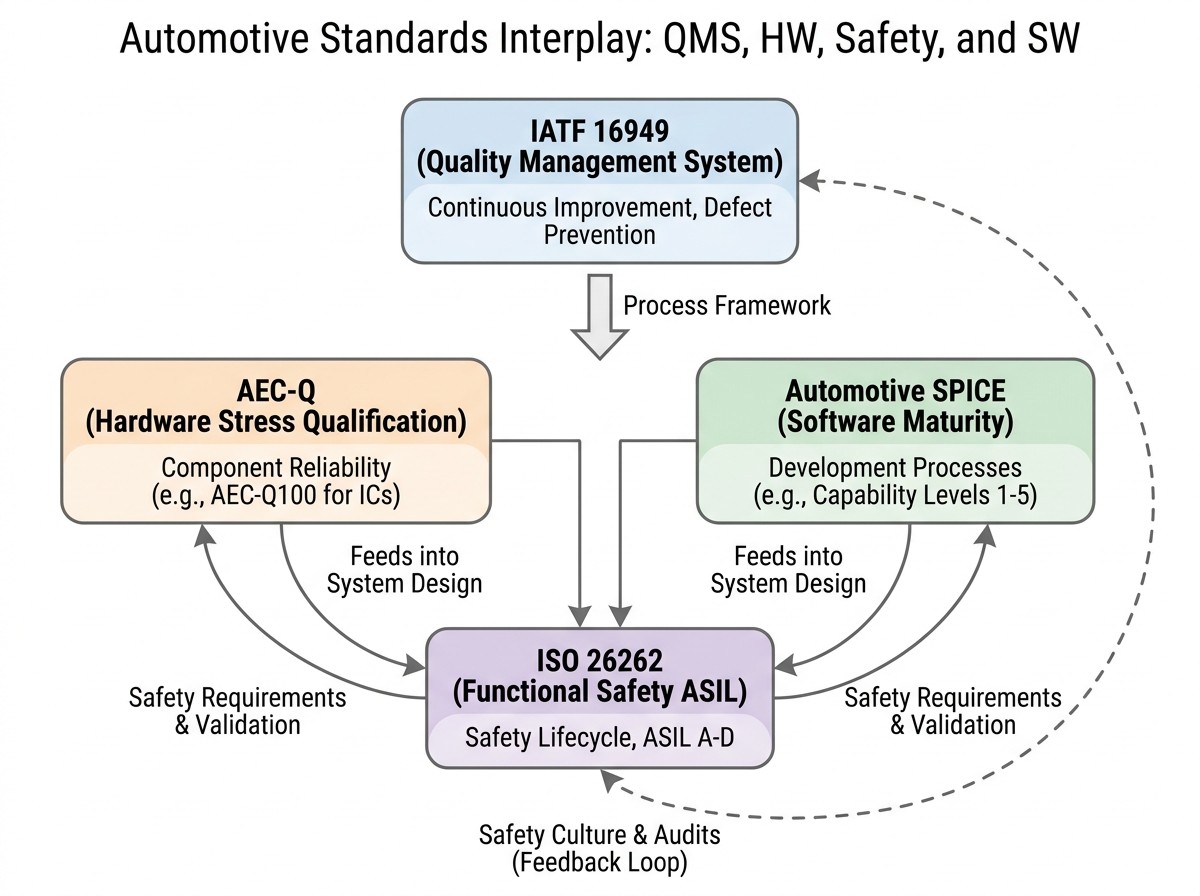
Differentiating Management Systems, Hardware Qualification, and Functional Safety
Each automotive standard governs a distinct domain of the product lifecycle:
IATF 16949 standardizes the organizational and manufacturing processes. It ensures that the facility produces parts consistently, controls engineering changes, maintains measurement integrity, and executes rigorous root-cause problem solving.
AEC-Q Series standardizes the physical hardware qualification. It validates whether a specific component can withstand the harsh electrical, thermal, and mechanical stresses of automotive operating environments.
ISO 26262 standardizes the system-level functional safety lifecycle. It ensures that hazards caused by electrical and electronic system malfunctions are systematically analyzed and mitigated through rigorous architecture, diagnostic coverage, and fail-safe mechanisms.
Automotive SPICE (ASPICE) evaluates software engineering process maturity. It benchmarks the rigor of requirements management, architectural design, verification, and validation for automotive software systems.
Component-Level Stress Testing: The Role of AEC-Q Qualification
Established by the Automotive Electronics Council (AEC), the AEC-Q component qualification specifications[5] define the baseline environmental and accelerated stress test requirements for electronic components. These qualifications must be executed and documented as technical prerequisites during the Part Submission Warrant (PSW) process under IATF 16949:
AEC-Q100: Stress test qualification for integrated circuits (ICs), microcontrollers, system-on-chips (SoCs), and silicon sensors. It defines operating temperature grades ranging from Grade 0 (−40∘C to +150∘C) for harsh under-hood environments down to Grade 3 (
to
) for passenger cabin applications.
AEC-Q101: Stress test qualification for discrete semiconductors, including diodes, transistors, MOSFETs, and IGBTs.
AEC-Q102: Stress test qualification for optoelectronic components, including LEDs, laser diodes, and phototransistors used in automotive lighting and LiDAR.
AEC-Q104: Stress test qualification for multichip modules (MCMs) and system-in-package (SiP) devices, evaluating thermal-mechanical strain and substrate reliability.
AEC-Q200: Stress test qualification for passive components, covering surface-mount capacitors, inductors, resistors, transformers, and quartz crystals.
A common pitfall among commercial component suppliers is assuming that passing AEC-Q stress tests qualifies an organization as an automotive supplier. AEC-Q validates hardware endurance; without an IATF 16949-certified QMS governing production, those components cannot be accepted into production automotive supply chains.
Functional Safety (ISO 26262) and Software Process Capability (Automotive SPICE)
Modern vehicle electronics require systemic integration between IATF risk management, ISO 26262 functional safety, and ASPICE software frameworks:
ISO 26262 (Road Vehicles — Functional Safety)[7]: Hardware and software development must align with determined Automotive Safety Integrity Levels (ASIL A through ASIL D). While IATF 16949 Clause 8.3 governs general design controls, ISO 26262 mandates specialized engineering artifacts: Hazard Analysis and Risk Assessment (HARA), Functional Safety Concepts (FSC), quantitative Failure Modes, Effects, and Diagnostic Analysis (FMEDA), and safety-case documentation.
Automotive SPICE (ASPICE PAM/PRM)[4]: For electronic control modules containing embedded code, IATF 16949 Clause 8.3.2.3 requires a structured software quality assurance process. Suppliers implement ASPICE Level 2 (Managed) or Level 3 (Established) processes to ensure end-to-end bidirectional traceability from customer software requirements down to unit-level code implementation and validation test vectors.
The Automotive Electronics Standards Quad-Pillar Matrix
| Standard / Framework | Primary Domain | Governance Focus | Target Artifact / Milestone | Failure Mode Addressed |
|---|---|---|---|---|
| IATF 16949:2016 | Quality Management System (QMS) | Organizational and manufacturing processes | Control Plans, APQP/PPAP packages, MSA/SPC studies, 8D containment records | Systematic manufacturing defects, process variation, supply chain drift |
| AEC-Q Series (Q100/101/102/104/200) | Hardware Component Qualification | Physical and environmental stress endurance | Environmental stress test qualification reports (HTOL, ESD, thermal shock) | Physical hardware wear-out, thermal degradation, electrical breakdown in vehicle environments |
| ISO 26262 | Functional Safety (FuSa) | Electrical/Electronic (E/E) system safety lifecycle | Safety Case, HARA, ASIL decomposition, FMEDA quantitative metrics | Systematic hardware/software design faults and random hardware failures causing vehicle hazards |
| Automotive SPICE (ASPICE) | Software Engineering Process Maturity | Software development and verification processes | Software architecture documents, traceability matrices, assessment reports | Undetected firmware bugs, unverified code changes, regression errors, insufficient test coverage |
Applying the 5 Automotive Core Tools to Electronics and PCBA Manufacturing
Execution of IATF 16949 centers on the five Automotive Quality Core Tools[3] defined by AIAG and VDA QMC. Within SMT assembly, wafer fabrication, and electronics packaging, these tools must be configured for high-speed, high-density manufacturing environments.
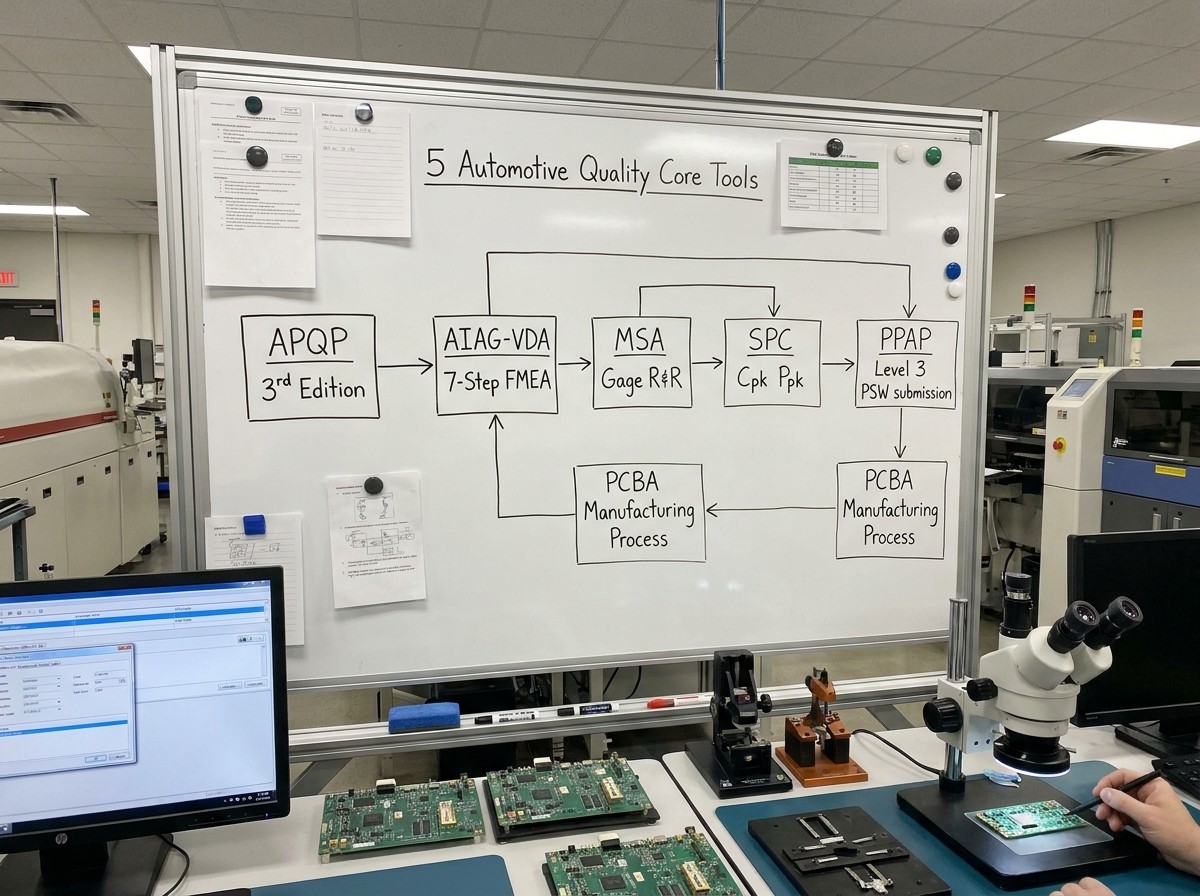
APQP (3rd Edition) and PPAP Level 3 Submission
Advanced Product Quality Planning (APQP) structures the product introduction lifecycle into five distinct phases, moving from initial concept through production validation to feedback and corrective action. AIAG released the APQP 3rd Edition alongside the standalone Control Plan 1st Edition manual. This revision introduced explicit mandates for high-automation electronics lines, establishing mandatory "Safe Launch" containment protocols, formal stage-gate approval reviews, and enhanced sourcing risk assessments.
The Production Part Approval Process (PPAP) validates that the manufacturing process is capable of producing components that consistently meet design intent at declared production run rates. In automotive electronics, the standard default requirement is PPAP Level 3, which requires full submission to the customer of all documentation, including:
Design records and approved schematics
Process Flow Diagrams (PFD)
Process Failure Mode and Effects Analysis (PFMEA)
Process Control Plans (covering Prototype, Pre-launch/Safe Launch, and Production)
Measurement Systems Analysis (MSA) studies
Initial Process Capability (
) reports
AEC-Q stress qualification test reports
Material composition declarations (IMDS - International Material Data System)
Part Submission Warrant (PSW) signed by authorized quality leadership
AIAG-VDA 7-Step FMEA for Hardware, Firmware, and SMT Assembly Lines
Failure Mode and Effects Analysis evaluates risk across circuit design (DFMEA) and production lines (PFMEA). The harmonized AIAG-VDA FMEA standard replaces traditional Risk Priority Numbers (RPN) with a structured 7-Step Process and an Action Priority (AP) logic (High, Medium, Low):
Planning and Preparation: Scope definition and baseline boundary limits.
Structure Analysis: Visualizing the assembly tree (e.g., SMT Stencil
Solder Paste Application
Pick-and-Place
Reflow Oven
Automated Optical Inspection).
Function Analysis: Mapping electrical, mechanical, and thermal functions.
Failure Analysis: Identifying potential failure modes (e.g., solder bridging, tombstoning, head-in-pillow, voiding, component cracking).
Risk Analysis: Scoring Severity (S), Occurrence (O), and Detection (D) on standard 1–10 automotive scales.
Optimization: Defining corrective actions for all High and Medium Action Priority items.
Results Documentation: Formalizing final risk reduction and verification.
Expert Decision Note: For automotive PCBAs, SMT processes that yield Action Priority "High" ratings (such as solder voiding under critical BGA ground pads or excessive intermetallic layer growth) must incorporate automated, mistake-proof interlocks (Poka-Yoke) directly tied to line shut-off mechanisms, rather than relying on manual operator visual inspection.
Statistical Process Control (SPC) and Measurement Systems Analysis (MSA)
Electronics manufacturing processes generate massive statistical data streams requiring rigorous validation:
Statistical Process Control (SPC): IATF 16949 requires suppliers to demonstrate process stability and capability. For critical product and process characteristics (identified by symbols such as
, SC, or CC), long-term capability indices must achieve
, while short-term capability must maintain
. Parameters evaluated include solder paste deposit height and volume (measured via 3D SPI), reflow peak zone temperatures, component placement offsets (
), and ultrasonic wire bonding shear/pull strengths.
Measurement Systems Analysis (MSA - Clause 7.1.5.1.1): Electronics manufacturers frequently encounter audit findings by failing to validate automated inspection equipment. Variable and attribute Gage Repeatability and Reproducibility (Gage R&R) studies must be conducted on:
3D Solder Paste Inspection (SPI) systems
Automated Optical Inspection (AOI) machines
Automated X-ray Inspection (AXI) units
In-Circuit Testers (ICT) and final Functional Test (FCT) electronic load fixtures
Under standard automotive MSA guidelines, a Total Gage R&R error below 10% indicates an acceptable measurement system, while errors between 10% and 30% may be conditionally acceptable based on customer approval; any measurement system exceeding 30% error is strictly non-compliant.
Critical Electronics-Specific Clauses and Compliance Challenges
Clause 8.3.2.3 and 8.4.2.3.1: Embedded Software Development and Sub-Tier Quality Assurance
Modern automotive electronic assemblies depend heavily on internal microcode, bootloaders, and application software. IATF 16949 explicitly regulates this domain:
Clause 8.3.2.3 (Development of Products with Embedded Software): Mandates that organizations producing automotive parts containing embedded software implement and maintain a formal software quality assurance process. Suppliers must conduct internal software process capability self-assessments (such as ASPICE) and retain documented records of these evaluations.
Clause 8.4.2.3.1 (Automotive Software-Related Products): Extends these requirements across the sub-tier supply base. If a Tier 1 or Tier 2 supplier integrates microcontrollers with third-party software stacks, AUTOSAR drivers, or licensed IP cores, it must verify that those sub-tier software vendors maintain documented software quality assurance systems.
In commercial electronics, rapid iterative firmware patching is common. Under IATF 16949, unverified code updates deployed without formal stage-gate validation represent direct violations of design controls.
Clause 8.5.2: Reel-Level Traceability, MSL Controls, and ANSI/ESD S20.20 Compliance
Traceability in automotive electronics must extend far beyond basic work-order tracking. On the shop floor, multi-tiered verification systems must capture real-time material routing:
2D UID Matrix Laser Marking: Individual bare PCBs must feature laser-etched DataMatrix codes scanned at each line workstation.
Feeder-Level Reel Traceability: SMT pick-and-place feeders must be electronically interlocked with barcoded component reels. If an operator attempts to load a reel with an incorrect internal part number, lot code, or expired floor life, the SMT feeder interlock halts the line.
Moisture Sensitivity Level (MSL) Controls: Handled in accordance with IPC/JEDEC J-STD-033, tracking ambient cleanroom exposure times and dry storage baking cycles to prevent delamination during reflow.
Electrostatic Discharge (ESD) Protection: The facility must operate within ANSI/ESD S20.20 or IEC 61340-5-1 standards, requiring daily continuous monitoring of wrist straps, dissipative flooring, ionizing blowers, and grounded soldering stations.
Clause 8.5.6 and 8.3.6.1: Engineering Change Management and Process Change Notifications (PCN)
Commercial consumer electronics routinely implement silicon stepping updates, component end-of-life (EOL) substitutions, or fabrication plant transfers with minimal customer notification. In automotive electronics, unapproved changes represent severe non-conformances that can trigger instant certificate suspensions and component quarantines.
Under IATF Clauses 8.5.6 and 8.3.6.1, any change affecting design, software, manufacturing location, sub-tier supplier, tooling, or SMT line layout requires prior formal customer notification and written authorization. Suppliers utilize the Process Change Notification (PCN) protocol structured under standards like ZVEI (Zentralverband Elektrotechnik- und Elektronikindustrie) or JEDEC J-STD-046. A major revision triggers a complete re-validation cycle, including new AEC-Q stress tests, revised PFMEAs, and updated PPAP Level 3 resubmissions prior to shipping production volume.
Clause 4.4.1.2: Product Safety Management and the Role of the PSCR
IATF 16949 Clause 4.4.1.2 mandates documented management processes for products and manufacturing processes related to automotive safety. Electronic systems governing braking, steering, battery management (BMS), and advanced driver assistance systems (ADAS) fall directly under this requirement.
Suppliers must assign and train a Product Safety and Conformity Representative (PSCR). The PSCR operates with organizational authority to halt production lines, lead rapid escalation protocols upon detecting safety anomalies, ensure compliance with statutory automotive regulations across global markets, and maintain end-to-end traceability records for a minimum of 15 to 30 years to support liability investigations.
Certification Pathways, Rules 6th Edition Updates, and Audit Non-Conformance Remediation
Navigating an IATF 16949 audit requires an understanding of the administrative regulations governing certification bodies and audited facilities.
IATF Rules 6th Edition: Key Operational Changes Effective 2025
The International Automotive Task Force issued the Rules for Achieving and Maintaining IATF Recognition, 6th Edition[2], which entered into full mandatory effect on January 1, 2025, replacing Rules 5th Edition. The 6th Edition introduced strict operational revisions:
Surveillance Audit Intervals: Fixed at a strict 12-month interval (
from the anniversary date). The optional 6-month and 9-month surveillance frequencies previously available under Rules 5th Edition were eliminated.
Auditor Working Day Caps: Auditor working time is capped at a maximum of 10 hours per day, including audit time, documentation, and site transit.
Stage 1 to Stage 2 Spacing: The gap between the Stage 1 Readiness Review and the Stage 2 Initial Certification Audit must be between 20 and 90 calendar days. If non-conformances identified during Stage 1 cannot be resolved within 90 days, Stage 1 must be repeated.
Extended Manufacturing Site (EMS) Restrictions: To qualify as an EMS under a single primary site certificate, the secondary facility must operate within a maximum distance of 16 km (10 miles) and 60 minutes travel time from the main certified site, while sharing centralized management and QMS oversight. Facilities exceeding these parameters must obtain standalone site certifications.
Certification Pathways for Fabless Semiconductor Companies, Design Centers, and EMS Providers
A frequent hurdle for electronics and semiconductor firms is determining certification eligibility under IATF Rules 6th Edition Section 1.0:
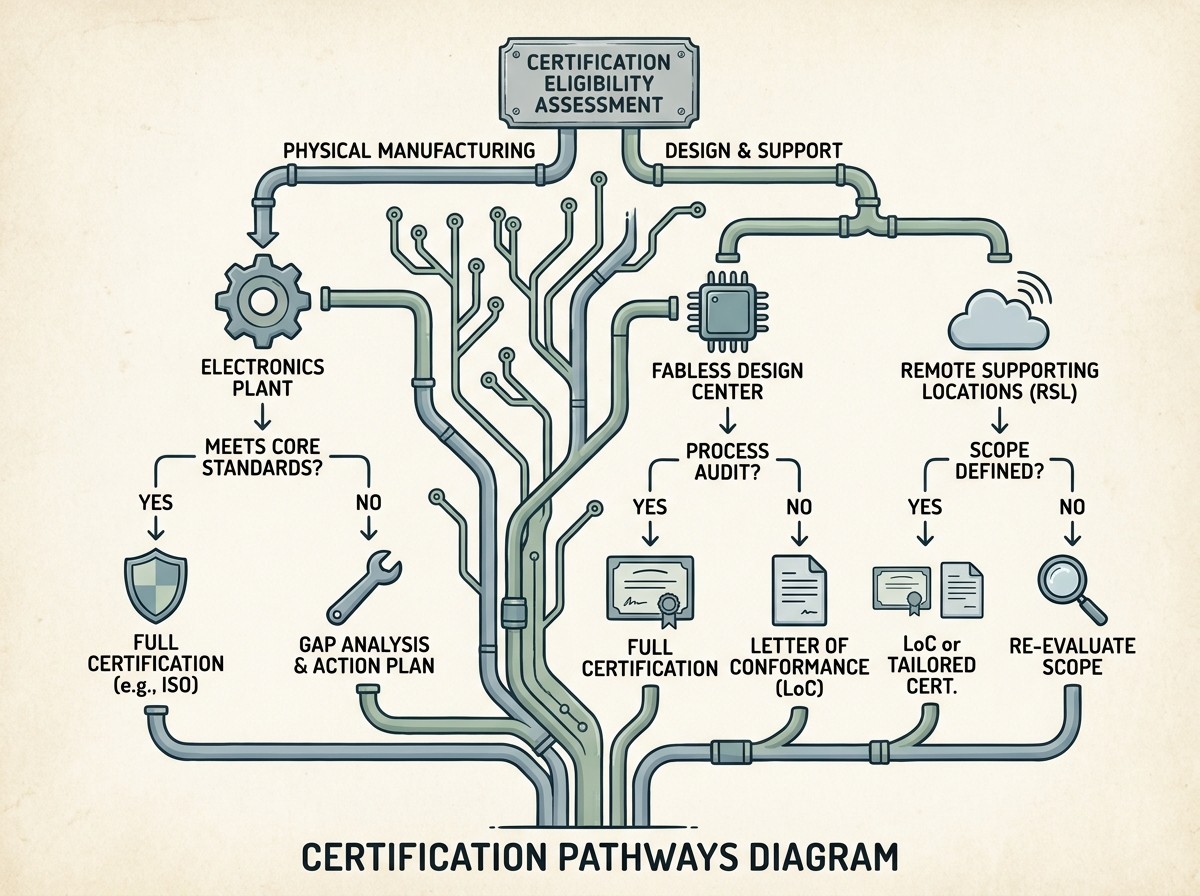
Scenario A: Physical Production Lines (Contract Manufacturers & IDMs): Facilities executing physical electronic manufacturing processes (SMT, automated wire bonding, packaging, wafer fabrication) with at least 12 continuous months of automotive production and audit data qualify for full IATF 16949 Site Certification.
Scenario B: Fabless Semiconductor Companies and Standalone Software Centers: Pure design firms, fabless chip architects, and remote firmware teams that do not operate physical manufacturing lines cannot obtain a standalone IATF 16949 site certificate. Instead, they must be audited as Remote Supporting Locations (RSLs) annexed directly to their certified Outsourced Semiconductor Assembly and Test (OSAT) or foundry manufacturing partner's certificate. Alternatively, they must maintain an ISO 9001:2015 certification accompanied by an IATF Letter of Conformance (LoC).
Scenario C: New Facilities Without Historical Automotive Data: Newly established electronic manufacturing facilities without 12 months of operational automotive performance data undergo Stage 1 and Stage 2 audits to receive an IATF Letter of Conformance (LoC), which transitions to full site certification once production volume thresholds are achieved.
Top IAOB Audit Non-Conformances in Electronics and Corrective Action Blueprints
Annual global non-conformance metrics published by the International Automotive Oversight Bureau (IAOB) identify recurring audit failure points across electronics suppliers. Quality managers must construct robust internal compliance controls around these areas:
1. Clause 10.2.3: Problem Solving (~9.9% to 10.1% of All Major Non-Conformances)
The Audit Failure: Auditors frequently issue major non-conformances for superficial 8D problem-solving reports. Common failures include identifying human error as a root cause without investigating systemic management failures, failing to verify containment effectiveness, or closing 8Ds without updating the corresponding PFMEA and Control Plan.
Remediation Blueprint: Institutionalize rigorous problem-solving methodologies (5-Why analysis, Ishikawa diagrams, Is/Is-Not matrices). Ensure that root causes address three distinct levels: the occurrence root cause, the non-detection root cause, and the systemic/management root cause. Mandatory closure criteria must require documented updates to PFMEA failure occurrence scores and Control Plan inspection frequencies.
2. Clause 8.5.1.1: Control Plans
The Audit Failure: Disconnects between the Process Flow Diagram (PFD), PFMEA, and Control Plan. For example, a high-density SMT line may specify a 100% 3D SPI check in the PFMEA, but the live production Control Plan lists it as a periodic sample check, or line operators fail to document reaction plans when process limits drift.
Remediation Blueprint: Enforce digital traceability across the "Core Tools Trinity" (PFD
PFMEA
Control Plan). Utilize the AIAG Control Plan 1st Edition reference framework to structure distinct Pre-Launch/Safe Launch control plans with elevated sample frequencies before transitioning to steady-state serial production.
3. Clause 7.1.5.1.1: Measurement Systems Analysis (MSA)
The Audit Failure: Electronics lines deploying complex Automated Optical Inspection (AOI), Automated X-Ray (AXI), and In-Circuit Test (ICT) fixtures without conducting proper Gage R&R studies, or using attribute Gage R&R methods that fail to evaluate false-accept and false-reject rates across marginal boundary units.
Remediation Blueprint: Establish comprehensive MSA calibration schedules. For all variable electrical and optical measurement systems, execute 10-part, 3-operator, 3-trial variable Gage R&R studies. For automated attribute pass/fail testers, implement 50-part attribute study methodologies utilizing standard boundary-limit sample coupons (golden and silver boards) to validate detection repeatability.
Practical Implementation Roadmap and Frequently Asked Questions
Practical Engineering Checklist for IATF 16949 Readiness
Organizational Gap Assessment:
Map current QMS architecture against ISO 9001:2015 Annex SL and IATF 16949:2016 requirements.
Extract and integrate all OEM and Tier 1 Customer-Specific Requirements (CSRs) into standard operating procedures.
Core Tools Alignment:
Update new product development workflows to the AIAG APQP 3rd Edition standard.
Execute AIAG-VDA 7-Step FMEAs for all hardware, firmware, and SMT lines, addressing all High Action Priority items.
Structure dedicated Safe Launch and serial Control Plans in accordance with the AIAG Control Plan 1st Edition.
Perform variable and attribute Gage R&R studies on all automated inspection equipment (SPI, AOI, AXI, ICT) per MSA guidelines.
Cleanroom and Shop-Floor Controls:
Establish continuous ANSI/ESD S20.20 electrostatic grounding verification across all automated lines.
Deploy J-STD-033 Moisture Sensitivity Level (MSL) baking, floor-life tracking, and sealed dry packaging controls.
Interlock SMT feeders with 2D component reel barcodes to guarantee reel-to-board traceability.
Embedded Software and Functional Safety Integration:
Implement an Automotive SPICE (ASPICE PAM/PRM) capability assessment framework for all embedded software teams (Clause 8.3.2.3).
Align hardware safety architectures with ISO 26262 ASIL targets and maintain FMEDA documentation.
Appoint and empower a certified Product Safety and Conformity Representative (PSCR - Clause 4.4.1.2).
Audit Readiness and Certification Execution:
Verify facility eligibility under IATF Rules 6th Edition (12 months of production data for sites; RSL/LoC pathways for fabless/design houses).
Schedule Stage 1 Readiness Review with an accredited certification body, allowing a 20- to 90-day window before the Stage 2 Initial Certification Audit.
Frequently Asked Questions
Can a fabless semiconductor company receive a standalone IATF 16949 certificate?
Under Section 1.0 of IATF Rules 6th Edition, pure design houses and fabless semiconductor companies without physical manufacturing facilities cannot obtain independent, standalone IATF 16949 site certificates. They must be audited as Remote Supporting Locations (RSLs) tied directly to the site certificates of their manufacturing foundries or OSAT partners, or maintain ISO 9001:2015 certification supplemented by an IATF Letter of Conformance (LoC).
Does AEC-Q100 qualification make an integrated circuit supplier IATF 16949 certified?
No. AEC-Q100 is a component-level environmental and accelerated stress test standard developed by the Automotive Electronics Council. IATF 16949 is an organizational Quality Management System standard governing manufacturing and business operations. An automotive IC supplier requires both: an IATF 16949-compliant QMS to govern its processes and AEC-Q100 test data to satisfy PPAP Level 3 customer submissions.
What are the critical operational changes in IATF Rules 6th Edition effective 2025?
Effective January 1, 2025, IATF Rules 6th Edition eliminated 6-month and 9-month surveillance audit frequencies to establish a fixed 12-month interval. It caps auditor daily work at a maximum of 10 hours per day, enforces a 20- to 90-calendar-day interval between Stage 1 and Stage 2 audits, and strictly restricts Extended Manufacturing Sites (EMS) to facilities located within 16 km (10 miles) and a 60-minute drive from the primary site.
How does IATF 16949 regulate firmware updates and embedded software?
Under Clause 8.3.2.3 and Clause 8.4.2.3.1, suppliers developing embedded software must maintain a formal software quality assurance methodology (typically Automotive SPICE) and conduct internal process capability evaluations. Uncontrolled firmware modifications are strictly prohibited; any code alteration requires formal engineering change management (Clause 8.5.6), regression testing, and customer Process Change Notification (PCN) approval prior to production deployment.
What occurs when an electronics manufacturer receives a Major Non-Conformance during an audit?
A Major Non-Conformance initiates the formal IATF certificate suspension and decertification process. The supplier has 20 calendar days from the audit closing meeting to submit initial containment actions and root-cause analysis, and 60 calendar days to implement and provide documented evidence of verified corrective actions (typically structured in an 8D report). The certification body must conduct an on-site follow-up verification within 90 days to confirm implementation and lift the suspension.
References
IATF 16949:2016 Automotive Quality Management System Standard — International Automotive Task Force
Rules for Achieving and Maintaining IATF Recognition (Rules 6th Edition) — International Automotive Task Force
Automotive Quality Core Tools (APQP, PPAP, FMEA, MSA, SPC) — Automotive Industry Action Group (AIAG)
Automotive SPICE (Process Assessment and Reference Model) — VDA QMC (Verband der Automobilindustrie Quality Management Center)
AEC Documents and Component Qualification Specifications (AEC-Q100, AEC-Q200) — Automotive Electronics Council
ISO 9001:2015 Quality Management Systems - Requirements — International Organization for Standardization
ISO 26262: Road Vehicles - Functional Safety — International Organization for Standardization
 UTMEL
UTMEL
We are the professional distributor of electronic components, providing a large variety of products to save you a lot of time, effort, and cost with our efficient self-customized service. careful order preparation fast delivery service
 Modeling Wide Band-Gap Semiconductors for Enhanced PerformanceRakesh Kumar, Ph.D.31 January 20243869
The article delves into the challenges faced by silicon-based power electronic devices and highlights the potential of wide band-gap semiconductors. It also emphasizes the importance of modeling power semiconductor devices and provides insights into various models. For electrical energy conversion to be dependable and effective, power electronics and semiconductor device technologies are essential.
Read More Optimizing Energy Management with Non-Isolated DC-DC ConvertersRakesh Kumar, Ph.D.04 February 20243503
The article classifies DC-DC converters and discusses the benefits and limitations of them. It proposes a modified DC-DC converter topology that combines the Cuk and Positive Output Super Lift Luo topologies to achieve a higher voltage gain with fewer components.
Read More ‘6G Networks’ - Pioneering the Next Era of Connectivity And InnovationRakesh Kumar, Ph.D.18 March 20243834
The article provides a comprehensive overview of the evolving landscape of mobile networks, the requirements that will shape the future of mobile communication, and the innovative technologies driving the transition to 6G.
Read More Review of IoT-Based Smart Home Security Systems- Part 1Rakesh Kumar, Ph.D.28 March 20244312
The article discusses the evolution of IoT-based smart home security systems, integrating advanced technologies like Raspberry Pi, PIR sensors, and voice recognition for enhanced user experience and efficiency.
Read More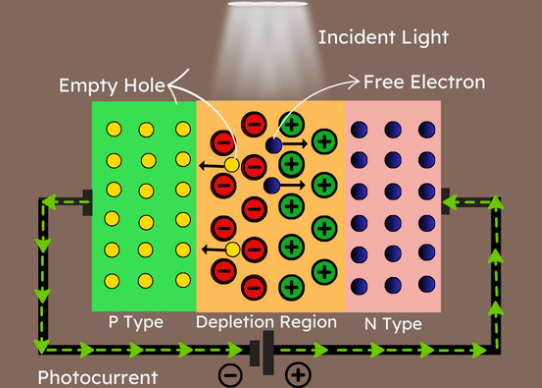 Understanding Photodiodes: Working Principles and Applications - Part 2Rakesh Kumar, Ph.D.24 May 20245573
The article provides a comprehensive overview of photodiodes, focusing on their operational principles, key factors affecting their efficiency, advantages, and disadvantages, and highlights their diverse applications.
Read More
Subscribe to Utmel !
![LM26CIM5XTPANOPB]() LM26CIM5XTPANOPB
LM26CIM5XTPANOPBNational Semiconductor
![JA-10]() JA-10
JA-10ECG
![SW02-50]() SW02-50
SW02-50NTE ELECT
![SW04-25]() SW04-25
SW04-25NTE ELECT
![1000-3NF]() 1000-3NF
1000-3NFMenda
![T0051403499]() T0051403499
T0051403499Apex Tool Group
![S02-08-R-4]() S02-08-R-4
S02-08-R-4TE Connectivity
![S02-08-R-90-65-T]() S02-08-R-90-65-T
S02-08-R-90-65-TTE Connectivity
![D-101-35]() D-101-35
D-101-35TE Connectivity
![BA14E6M]() BA14E6M
BA14E6MAmphenol