Product
 Brand
Brand Articles
 Tools
Tools
Introduction to EPROM and EEPROM

Solid State Memory - PROM, EPROM, EEPROM
Executive Summary: EPROM vs. EEPROM in 2026
The core difference lies in the erasure method and granularity: EPROM (Erasable Programmable Read-Only Memory) requires strong ultraviolet (UV) light to erase data and must be erased entirely. EEPROM (Electrically Erasable Programmable Read-Only Memory) uses electric signals for erasure and allows for byte-level modification without removing the chip from the circuit.
Modern Context: While Flash memory has largely superseded both for mass storage, EEPROM remains vital in 2026 for storing configuration parameters in embedded systems (IoT), whereas EPROM is now a legacy technology found primarily in vintage computing and industrial restoration.
Table of Contents
| |
Ⅰ What is EPROM?
EPROM (Erasable Programmable Read-Only Memory) is a type of non-volatile memory chip that retains data without power but requires ultraviolet (UV) light for erasure. Unlike modern Flash memory, an EPROM chip is easily identifiable by the transparent quartz glass window on its package. Through this window, the silicon die is visible, allowing UV radiation to reset the memory cells. Once programmed, this window is typically covered with an opaque sticker to prevent accidental data corruption from ambient sunlight.
Historically serving as a bridge between permanent ROM and volatile RAM, EPROM chips solved the "write-once" limitation of older PROM technology. To program an EPROM, a dedicated device (programmer) applies a high voltage (VPP = 12V~24V) to inject electrons into the floating gate.
Identification: Model numbers often start with "27" (e.g., the 27C020 is a 2M-bit EPROM).
Default State: A blank (erased) EPROM reads as all "1s" (high level).
Erasure: Requires 15-20 minutes of exposure to strong UV light.
1. Key Features of EPROM
EPROM technology relies on physical external hardware for its lifecycle management. A "programmer" device generates the specific high-voltage pulses required to trap electrons in the memory cells. The system writes data row-by-row, a process significantly slower than modern 2026 standards.
Despite its obsolescence in consumer tech, EPROM offers robust data retention:
Longevity: A programmed EPROM can retain data for decades (often cited as 10-20+ years) without power.
Read Cycles: Unlimited read endurance, making it ideal for firmware storage in legacy industrial machines.
Legacy Use: Before Flash memory became ubiquitous, EPROM was the standard for BIOS chips on PC motherboards.
2. Working Principle (Hot Electron Injection)
EPROM operates using a Floating Gate Transistor architecture. This structure, a precursor to modern Flash, uses a double-layer gate design to trap electrical charge.
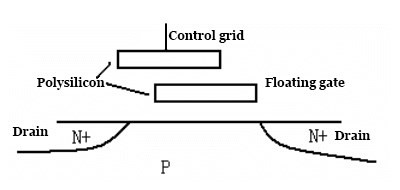
Figure 1: Double-layer grid structure of EPROM
The Switching Mechanism:
State "1": No electrons in the floating gate. The control gate attracts electrons in the substrate, opening the channel (conductive).
State "0": Electrons are injected into the floating gate. This negative charge blocks the control gate's field, closing the channel (non-conductive).
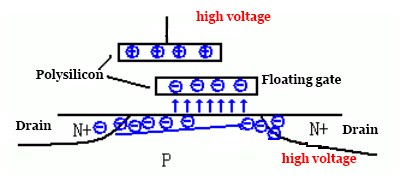
Figure 2: EPROM writing process (Hot Electron Injection)
Writing Data (Avalanche Injection): When a high voltage is applied to the drain, electrons gain immense kinetic energy ("hot electrons"). These energetic electrons punch through the thin SiO2 insulating barrier and become trapped in the floating gate. They remain there for years until UV light provides enough photon energy to allow them to escape, effectively erasing the chip.
Ⅱ What is EEPROM?
EEPROM (Electrically Erasable Programmable Read-Only Memory) is a user-modifiable ROM that can be erased and reprogrammed using electrical signals, eliminating the need for UV light. Unlike EPROM, EEPROM allows for byte-level modification, meaning individual bytes of data can be changed without erasing the entire chip. This capability makes it indispensable in modern 2026 electronics for storing calibration data, configuration settings, and user preferences.
1. Evolution from ROM to EEPROM
The memory hierarchy evolved to solve the "update problem" in electronics:
Mask ROM: Data burned at the factory. Cannot be changed. Low cost for millions of units, but zero flexibility.
PROM (Programmable ROM): Blank chips that users could write once. If an error occurred, the chip was scrapped.
EPROM: Erasable via UV light. Reusable, but required physical removal from the circuit board to erase.
EEPROM: Erasable in-circuit via electricity. The standard for parameter storage in modern embedded systems.
2. Working Principle (Fowler-Nordheim Tunneling)
EEPROM utilizes the quantum mechanical principle known as Fowler-Nordheim Tunneling to move electrons. This allows operation at lower voltages compared to EPROM and enables on-board programming.
Modern motherboards and microcontrollers use this capability to update firmware or BIOS settings safely. By applying a specific programming voltage (often generated internally by the chip's charge pump from a standard 3.3V or 5V supply), the system can push or pull electrons through the oxide barrier.

Figure 3: Electron tunneling in EEPROM
The Tunneling Effect: The Silicon Dioxide (SiO2) layer surrounding the floating gate in EEPROM is engineered to be extremely thin. When a high electric field is applied, electrons can "tunnel" through this barrier without damaging the physical structure, allowing for substantially higher write cycles (typically 100,000 to 1 million cycles) compared to EPROM.

Figure 4: Erasure process (removing electrons)
Ⅲ Key Differences: EPROM vs. EEPROM
In 2026, understanding the distinction is critical for engineers working on legacy system maintenance (EPROM) versus modern embedded IoT design (EEPROM).
1. Performance & Erasure Comparison
The fundamental difference lies in the erasure mechanism and granularity:
| Feature | EPROM | EEPROM |
|---|---|---|
| Erasure Method | Ultraviolet (UV) Light | Electric Signal |
| Granularity | Full Chip (All or Nothing) | Byte-level (Individual Bytes) |
| In-Circuit Reprogramming | No (Must remove chip) | Yes (Can stay on board) |
| Package Type | Ceramic with Quartz Window | Standard Plastic (SOP, DIP) |
2. Application Scenarios in 2026
EEPROM Use Cases:
While heavy storage is handled by Flash (NAND/NOR), EEPROM dominates the "small data" sector. It is used in smart meters, automotive sensors, and IoT devices to store network keys, calibration variables, and user settings (e.g., preserving volume levels when a TV is unplugged). It communicates via simple protocols like I2C or SPI.
EPROM Use Cases:
EPROM is effectively obsolete for new designs. However, it remains relevant for:
Restoration: Repairing vintage computing hardware (Apple II, Commodore 64).
Industrial Legacy: Maintaining 1980s/90s era CNC machines and avionics that were certified with specific EPROM parts.
Education: Teaching the physics of semiconductors and memory states.
Related Resources:
 UTMEL
UTMEL
We are the professional distributor of electronic components, providing a large variety of products to save you a lot of time, effort, and cost with our efficient self-customized service. careful order preparation fast delivery service
1.What is difference between eprom and eeprom?
The main difference between EPROM and EEPROM is that, the content of EPROM is erased by using UV rays. On the other hand, the content of EEPROM is erased by using electric signals. In EPROM, UV light is used to erase the EPROM's content. In EEPROM, electric signal is used to erase the EEPROM's contents.
2.How does an Eprom work?
EPROM (UV Erasable Programmable Read Only Memory) is a special type of ROM that is pro- grammed electrically and yet is erasable under UV light. The EPROM device is programmed by forcing an electrical charge on a small piece of polysilicon material (called the floating gate) located in the memory cell.
3.What do you mean by Eprom?
Alternative Title: erasable programmable read-only memory. EPROM, in fullerasable programmable read-only memory, Form of computer memory that does not lose its content when the power supply is cut off and that can be erased and reused.
4.What is the advantage of eeprom over Eprom?
EEPROMs are designed to be programmed and erased within the hardware it was designed into. An EPROM requires a UV light to erase (if not a one time programmable) and an external programmer for programming. There are advantages to both. For an OEM, an EPROM offers better protection to their program.
5.What is difference between flash and eeprom?
The main difference between EEPROM and flash memory is that most EEPROM devices can erase any byte of memory at any time. Flash memory can only erase an entire chunk, or "sector", of memory at a time. This means that flash memory can wear out faster than EEPROM.
 High-Capacity HDDs in the AI Era: Sourcing Massive Storage for Cold DataUTMEL04 July 2026591
As generative AI and LLMs drive an explosion of unstructured data, high-capacity enterprise HDDs remain the most cost-effective solution for cold storage. Despite rising prices and supply chain bottlenecks, mechanical drives offer a massive cost-per-gigabyte advantage over SSDs. Technologies like HAMR and SMR enable capacities beyond 24TB, though deploying these drives requires robust RAID 6 strategies and secured IC supply chains to mitigate rebuilding and procurement risks.
Read More LPDDR5 Memory 2026: Lead Times, HBM Impact, and Procurement StrategiesUTMEL17 July 20263621
Global semiconductor fabrication facility managing advanced memory production. In Q2 2026, contract prices for 12GB LPDDR5X modules surged 89% quarter-over-quarter, jumping from $77.10 to $145.90, while lead times for advanced memory components stretched to 40–58 weeks. A vehicle platform designed in 2023 with specific memory requirements must ship in 2026, regardless of spot market conditions.
Read More 2026 DRAM and the 3-to-1 HBM Rule: Market Supply Analysis and B2B Procurement GuideUTMEL23 July 20264837
This technical report explains how the physical "3-to-1 wafer penalty" of High Bandwidth Memory (HBM) production has cannibalized standard DRAM capacity, causing severe shortages of DDR4 and DDR5 in 2026. As major hardware OEMs pass these soaring component costs directly to enterprise buyers, procurement teams must abandon Just-in-Time models in favor of rolling safety stocks and strategic long-term distributor agreements to protect budgets.
Read More Automotive vs. Industrial Memory: How to Verify Grade Codes Before Sourcing In this guideUTMEL06 August 2026357
Memory ordering codes can look almost identical while representing different temperature limits, packages, revisions, qualification evidence, or lifecycle commitments. For automotive and long-life industrial designs, the safe purchasing unit is the complete manufacturer ordering code, not a base part number plus a familiar-looking suffix.
Read More How to Use an External Hard Drive?UTMEL24 June 20219382
The external hard drive is a compact and portable hard drive storage which can be plugged in or unplugged at any time. It mainly uses USB or IEEE1394 interfaces. It can transmit data with the system at a higher speed. The IEEE 1394 interface transfer rate is 50-100 MB/s.
Read More
Subscribe to Utmel !