Product
 Brand
Brand Articles
 Tools
Tools
LDR/Light Dependent Resistor: Working Principle, Types and Applications
Light Dependent Resistors (LDR): Working Principle
Executive Summary (2026 Update): A Light Dependent Resistor (LDR) is a passive electronic component that decreases resistance as light intensity increases. While largely replaced by photodiodes in high-speed 2026 consumer electronics due to environmental regulations (RoHS), LDRs remain the gold standard for simple, low-cost night-sensing circuits in street lamps and educational robotics. This guide covers the working principles, modern circuit integration, and specifications for engineering applications.
Catalog
| I. Features & Working Principle | 1. Working Principle |
| 2. Construction | |
| 3. Circuit Diagram | |
| 4. Electrical Characteristics | |
| II. Types of LDRs | |
| III. Modern Applications | |
I. What are the Key Features of LDRs in 2026?
1. How Does an LDR Work? (Principle of Photoconductivity)
An LDR operates on the principle of photoconductivity, where the material's electrical resistance decreases as it absorbs light photons. It functions as a variable resistor: in darkness, it acts as an insulator, but when illuminated, it becomes a conductor.
Specifically, when light falls on the LDR, the photons transfer energy to the electrons in the material's valence band. If the photon energy exceeds the material's bandgap energy, these valence electrons jump to the conduction band. This excitation creates electron-hole pairs, drastically increasing the material's conductivity and allowing current to flow.
For this transition to occur, the incident light energy must be greater than the bandgap ($E_g$) of the semiconductor material. In 2026, intrinsic semiconductor materials like Cadmium Sulfide (CdS) remain the most common choice for visible light detection due to their spectral response matching the human eye, despite emerging ROHS-compliant alternatives.

2. How is an LDR Constructed?

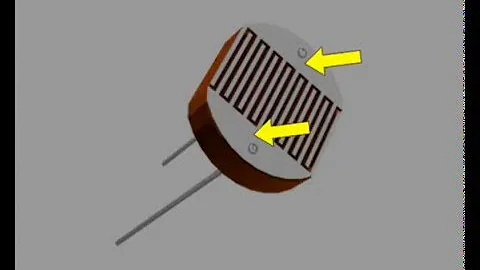
The construction of an LDR involves depositing a light-sensitive semiconductor film (typically Cadmium Sulfide) onto an insulating ceramic substrate. To maximize the surface area exposed to light while keeping the device compact, the material is patterned into a zigzag or serpentine track.
Metal Ohmic contacts are placed on either side of this zigzag track to facilitate connection. To ensure sensitivity, the resistance of these contacts is negligible compared to the photo-material. Note on Safety: As of 2026, many classic LDRs contain Cadmium, which is restricted under RoHS (Restriction of Hazardous Substances). While still used in industrial and aerospace sectors, consumer designs often favor lead-free phototransistors.
3. How Do You Build a Basic LDR Circuit?

A standard LDR circuit functions as a light-activated switch, commonly used to control relays for street lights. The core mechanism is a voltage divider formed by the photoresistor (LDR) and a fixed resistor (R1).
In Darkness: The LDR resistance is extremely high (Megaohms range). This drops most of the voltage across the LDR, resulting in near-zero base bias at the transistor TR1. The transistor remains "OFF," and the relay is de-energized.
In Light: As light intensity increases, LDR resistance drops to a few hundred ohms. This causes the voltage at the base of TR1 to rise. Once it crosses the threshold (typically 0.7V for silicon transistors), TR1 turns "ON," activating the relay and powering the external load.
Calibration: To make the switching point adjustable (e.g., to trigger at twilight rather than deep darkness), replace the fixed resistor R1 with a potentiometer (VR1). For high-precision applications in 2026, an Operational Amplifier (Op-Amp) is often used as a comparator instead of a single transistor to provide a cleaner digital switching signal.
4. What are the Electrical Characteristics?
Understanding LDR datasheets requires familiarity with these eight core parameters:
(1) Light Resistance (Bright Resistance): The resistance value when illuminated by a standard light source (usually measured at 100 Lux or 10 Lux). Typical values range from 400Ω to 10kΩ.
(2) Dark Resistance: The resistance when no light is present (0 Lux). This is typically very high, ranging from 1MΩ to 10MΩ, preventing current leakage in the "OFF" state.
(3) Sensitivity (Activeness): The ratio or relative change between Dark Resistance and Light Resistance. Higher sensitivity allows the device to detect subtler changes in ambient lighting.
(4) Spectral Response: The sensitivity of the LDR to different light wavelengths. CdS LDRs peak around 520nm-600nm, closely matching the human eye's sensitivity to visible light.
(5) Illumination Characteristic (Gamma): The relationship between resistance and illuminance is non-linear (logarithmic). As light intensity increases, resistance drops sharply at first and then plateaus.
(6) Voltage Rating: The maximum voltage the device can handle (typically 100V to 320V DC for standard components).
(7) Temperature Coefficient: LDRs are temperature sensitive. Resistance drifts as temperature rises, which can cause inaccuracies in extreme environments unless compensated.
(8) Response Time (Latency): Unlike fast photodiodes (nanoseconds), LDRs have a slow response (10ms to 50ms). This "memory effect" is actually beneficial for street lights, as it prevents flickering due to lightning or passing car headlights.
II. What Types of LDRs Are Available?
1. Based on Semiconductor Material:
Intrinsic LDRs: Made from pure semiconductor materials (like Silicon or Germanium) without doping. These require high-energy photons to activate.
Extrinsic (Doped) LDRs: Impurities are added to the material to create new energy bands. These are more efficient and are the standard for most commercial applications in 2026.
2. Based on Spectral Response (Wavelength):
| Type | Materials | Primary Use Cases |
|---|---|---|
| UV LDR | Cadmium Sulfide, Cadmium Selenide | Ultraviolet light detection, flame detection. |
| Visible Light LDR | CdS, Selenium, Silicon | Smart lighting, camera exposure meters, display backlights. |
| Infrared LDR | Lead Sulfide (PbS), Indium Antimonide | Thermal imaging, missile guidance, infrared astronomy. |
III. Where are LDRs Used in Modern Electronics?
Despite the rise of digital sensors, LDRs remain popular due to their low cost and simplicity. They are the component of choice for detecting the simple "presence or absence" of light. Common applications include alarm clocks, burglar alarms, and particle counters.
Case Study: Smart City LED Street Lighting (2026)
Traditional HID lamps wasted vast amounts of energy by running at full power regardless of ambient conditions. Modern smart lighting systems utilize LDRs (or phototransistors) for intelligent dimming:
Daytime: The LDR detects high light intensity; resistance drops, signaling the microcontroller to keep lights OFF.
Dusk: Resistance increases. The controller detects this shift and activates LEDs at 100% brightness for peak traffic hours.
Late Night (Post-Midnight): To conserve energy when roads are empty, the system uses Pulse Width Modulation (PWM) to dim lights to 50% intensity.
Dawn: The LDR detects rising sunlight, and the system shuts down automatically.
When combined with solar panels, this LDR-based regulation creates a self-sustaining, net-zero energy lighting solution.
Frequently Asked Questions (2026 Edition)
code Code download content_copy expand_less
LDR vs. Photodiode: Which is better for my project?
It depends on the application. Choose an LDR for simple, slow-switching tasks like night lights where low cost and high current handling are needed. Choose a Photodiode for high-speed detection (like fiber optics or remote controls) and precision measurement, as they have faster response times (nanoseconds) and better linearity.
Are LDRs banned under RoHS regulations?
Most traditional Cadmium Sulfide (CdS) LDRs are not RoHS compliant due to cadmium content. In the EU and consumer markets, they have been largely replaced by phototransistors or specialized RoHS-compliant photo-resistors. However, CdS LDRs are still permitted in specific aerospace, medical, and spare-part applications.
Can an LDR be used to measure exact Lux levels?
Generally, no. LDRs are best for detecting relative light changes (light vs. dark). They have low accuracy, high tolerance variations (±30%), and significant "memory effect" (hysteresis). For precise Lux measurement in 2026, digital ambient light sensors (ALS) with I2C interfaces are the standard choice.
 UTMEL
UTMEL
We are the professional distributor of electronic components, providing a large variety of products to save you a lot of time, effort, and cost with our efficient self-customized service. careful order preparation fast delivery service
What are the advantages of LDR?
High sensitivity (due to the large area it can cover). Easy employment. Low cost. There is no union potential. High light-dark resistance ratio.
What are the drawbacks of LDR?
Following are the disadvantages of Light sensor : ➨LDRs are highly inaccurate with high response time (about 10s or 100s of milliseconds). ➨Resistance varies continuosly (analog) in photoresistor and are rugged in nature. ➨Photodiodes are temperature sensitive and are uni-directional unlike photoresistors.
Which material is used in LDR?
Cadmium Sulphide. As its name implies, the Light Dependent Resistor (LDR) is made from a piece of exposed semiconductor material such as cadmium sulphide that changes its electrical resistance from several thousand Ohms in the dark to only a few hundred Ohms when light falls upon it by creating hole-electron pairs in the material.
Why does LDR resistance increase?
The light energy produces more free electrons which increases the current for a certain voltage across the LDR which means a drop in resistance. Very little current will flow through it when it is cold. This means that its resistance increases as the temperature falls.
 What are the Differences Between Pull up and Pull down Resistors?UTMEL22 October 202538073
Pull up is to clamp an uncertain signal to a high level with a resistor, and the resistor also acts as a current limiter. In the same way, pull down means to clamp the uncertain signal to a low level through a resistor. To pull up is to input current to the device, and the pull-down is to output the current.
Read More Rheostat Basics: Types, Principle and FunctionsUTMEL25 December 202517815
A rheostat is a device that can adjust the size of the resistance and can be connected to the circuit to adjust the size of the current. A general rheostat is composed of a wire with a larger resistance and a device that can change the contact point to adjust the effective length of the resistance wire. Rheostat can limit the current and protect the circuit, and change the voltage distribution in the circuit.
Read More Basic Introduction to Metal Film ResistorUTMEL28 August 202013755
Metal film resistors are a kind of film resistors. Metal film resistors are resistors in which special metals or alloys are used as resistor materials, and the resistor film layer is basically formed on ceramic or glass by vacuum evaporation or sputtering.
Read More Varistor: Definition, Function, Working and TestingUTMEL03 April 202583287
A varistor is a device with a non-linear volt-ampere characteristic. When the voltage applied to the varistor is lower than its threshold value, the current flowing through it is extremely small, which is equivalent to a resistor with infinite resistance, vice versa. The most common varistor is a metal oxide varistor (MOV).
Read More Photoresistor Basics: Types, Principles and ApplicationsUTMEL16 October 202545398
The article introduces the photoresistor’s main characteristics and principles including the working principle and structural principle. There are three types of photoresistor: ultraviolet photoresistors, infrared photoresistors, visible light photoresistors. Dimming circuit and light switch are the two applications of the photoresistor.
Read More
Subscribe to Utmel !
![CC2640F128RGZT]() CC2640F128RGZT
CC2640F128RGZTTexas Instruments
![CYW43438KUBGT]() CYW43438KUBGT
CYW43438KUBGTCypress Semiconductor Corp
![4816P-1-472LF]() 4816P-1-472LF
4816P-1-472LFBourns Inc.
![LT5400BCMS8E-1#PBF]() LT5400BCMS8E-1#PBF
LT5400BCMS8E-1#PBFLinear Technology/Analog Devices
![SX1231IMLTRT]() SX1231IMLTRT
SX1231IMLTRTSemtech Corporation
![ATMEGA1284RFR2-ZUR]() ATMEGA1284RFR2-ZUR
ATMEGA1284RFR2-ZURMicrochip Technology
![LT5581IDDB#TRMPBF]() LT5581IDDB#TRMPBF
LT5581IDDB#TRMPBFLinear Technology/Analog Devices
![SI4010-C2-GS]() SI4010-C2-GS
SI4010-C2-GSSilicon Labs
![CC1101RTKR]() CC1101RTKR
CC1101RTKRTexas Instruments
![AX5243-1-TW30]() AX5243-1-TW30
AX5243-1-TW30ON Semiconductor