Product
 Brand
Brand Articles
 Tools
Tools
The Complete Guide to 12 Gauge Wire: Ampacity, Load Limits, and NEC Rules
Choosing the wrong wire gauge is a direct path to overheating, appliance damage, and electrical fires. Standard 12 gauge (12 AWG) copper wire is rated for 20 amps and safely handles a peak load of 2,400 watts on a 120V circuit, but is strictly restricted to 1,920 watts for continuous loads.
Physical Specifications and Types of 12 Gauge Wire
12 AWG wire is the standard conductor for 20-amp residential and commercial circuits. Understanding its physical properties is the first step in ensuring code-compliant installation.
Dimensions and Visual Identification
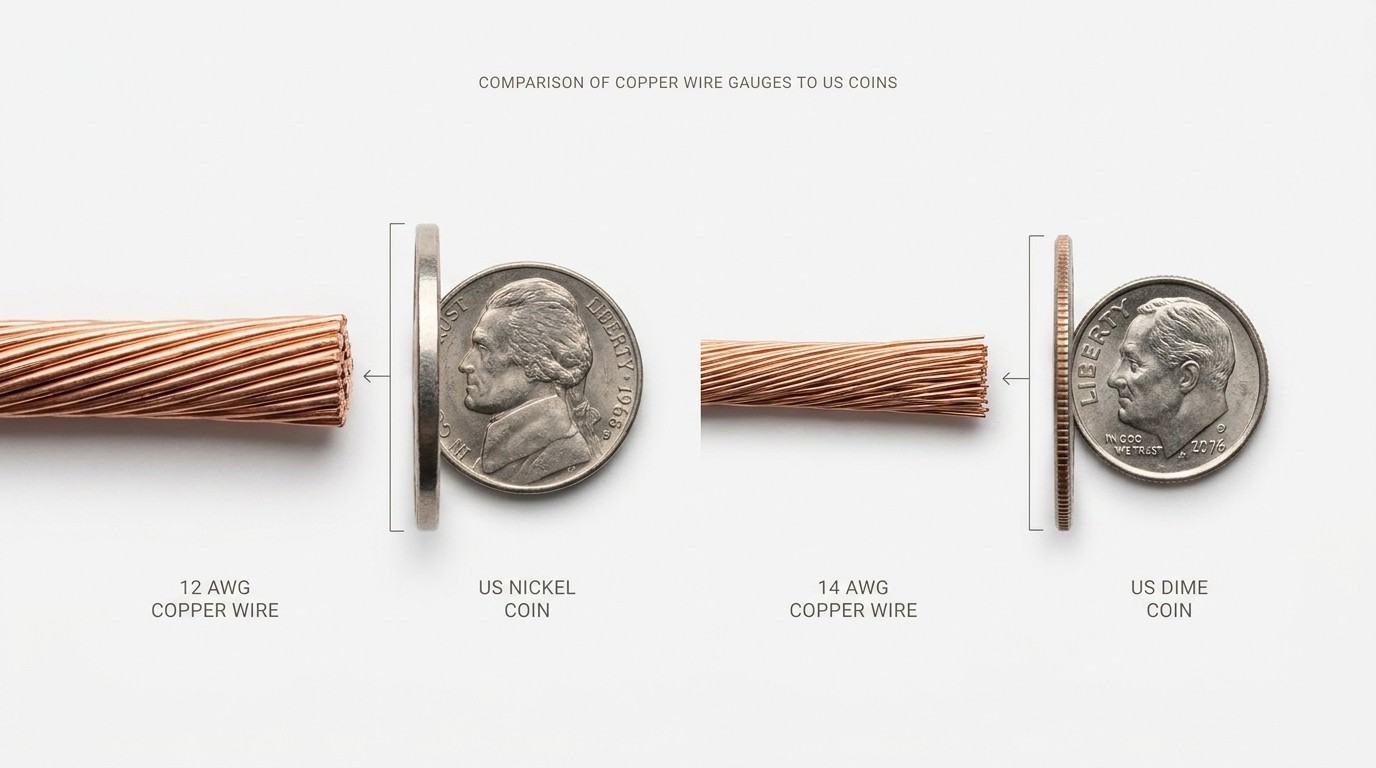
12 AWG solid copper wire has a diameter of 2.05 mm (0.0808 inches) and a cross-sectional area of 6,530 circular mils. Because measuring wire diameter in the field is impractical, experts point out that a quick visual heuristic can be used: stripped 12 AWG copper wire is roughly the thickness of a nickel, whereas 14 AWG wire aligns with the edge of a dime.
Furthermore, modern non-metallic sheathed cable (NM-B) utilizes an industry-standard color-coding system. 12 AWG NM-B cable features a yellow outer jacket, while 14 AWG utilizes a white jacket.
NM-B vs. THHN/THWN Insulation
The environment dictates the required insulation type:
NM-B (Romex): Non-metallic sheathed cable is designed exclusively for dry, indoor residential wiring inside wall cavities.
THHN/THWN: These are individual, insulated conductors designed to be pulled through conduit. THWN is water-resistant and required for outdoor or underground conduit runs.
Solid vs. Stranded 12 AWG
Solid 12 AWG wire consists of a single, thick copper core. It holds its shape well, making it the standard for residential in-wall wiring and terminating at standard receptacles. Stranded 12 AWG wire consists of multiple smaller copper threads bundled together. While 14 AWG is easier to bend, 12 AWG stranded wire is highly flexible and is the superior choice for pulling through complex conduit bends or in environments subject to vibration, such as industrial machinery.
12 AWG Ampacity and Wattage Limits
Ampacity is the maximum current a conductor can carry continuously without exceeding its temperature rating.
NEC Ampacity Ratings by Insulation Type
Under NEC Table 310.16, 12 AWG copper is rated for 20A at 60°C, 25A at 75°C, and 30A at 90°C.
However, a critical distinction exists for residential wiring. NEC 334.80 mandates that NM-B (Romex) cable ampacity must not exceed the 60°C column (20A) for final load calculations, despite the internal conductors possessing 90°C insulation. Consequently, 12 AWG NM-B can never be placed on a 25A or 30A breaker in standard residential applications.
Calculating Peak vs. Continuous Wattage
Users on community forums often report tripped breakers despite their appliances drawing less than 20 amps. This occurs due to a misunderstanding of the NEC 80% rule.
Peak Capacity: On a 120V circuit, a 20A breaker paired with 12 AWG wire yields a maximum peak capacity of 2,400 watts (20A × 120V).
Continuous Capacity: NEC 210.19(A) dictates that continuous loads (devices running for three hours or more, such as space heaters or EV chargers) must not exceed 80% of the circuit's rating. Therefore, the continuous limit for 12 AWG is 16 amps, or 1,920 watts.
With 1,920W of continuous capacity, a user can safely run a 1,500W space heater indefinitely. However, adding a 600W desktop computer to that same circuit will exceed the continuous limit and eventually trip the breaker.
12 AWG Ampacity and Load Limit Table
| Insulation Type | Environment | Max Temp Rating | Max Amps (Breaker) | Max Peak Wattage (120V) | Max Continuous Wattage (120V) |
|---|---|---|---|---|---|
| NM-B (Romex) | Indoor / In-Wall | 60°C (per NEC 334.80) | 20A | 2,400W | 1,920W |
| UF-B | Direct Burial | 60°C | 20A | 2,400W | 1,920W |
| THHN / THWN-2 | Conduit | 90°C | 20A (Standard) | 2,400W | 1,920W |
Circuit Breaker Sizing Rules and Exceptions
The overcurrent protection device (OCPD) protects the wire, not the appliance. If the breaker is oversized, the wire will overheat and melt its insulation before the breaker trips.
The Standard 20-Amp Rule
NEC 240.4(D)(5), known as the "Small Conductor Rule," strictly limits 12 AWG copper wire to a maximum 20-amp circuit breaker for general-purpose branch circuits. Understanding the Circuit Breaker: Working Principle, Types and Structure is essential for diagnosing why a 20A breaker trips when a 12 AWG wire is overloaded.
The Danger of Mixing 12 AWG and 14 AWG
Mixing 12 AWG and 14 AWG wire on the same circuit is legally permitted under the NEC, but the circuit breaker must be sized to protect the smallest conductor. If a circuit contains both gauges, it must be placed on a 15-amp breaker.
In visual stress tests, experts point out the severe consequences of ignoring this rule. As one educator noted regarding mismatched breakers: "If you're not intentional about the type of wire you choose, you can build something that will need repairs down the road, you could hurt yourself, or you could even start a fire. You have to have the right wire for the job." Placing a mixed 12/14 AWG circuit on a 20A breaker means the 14 AWG segment will overheat before the breaker detects a fault.
📺 Types of Romex Explained - 14/2 14/3 12/2 and 12/3 ...
Advanced NEC Exceptions: Motor Loads
While most guides state 12 AWG can never exceed a 20A breaker, professional workflows require understanding NEC Article 430.
For dedicated motor loads (such as an A/C compressor), the short-circuit breaker can be sized up to 250% of the motor's full-load current to handle brief inrush spikes. In these specific industrial or HVAC scenarios, 12 AWG wire can legally be protected by a 30A or 40A breaker. This is safe because the motor's internal overload device protects the 12 AWG wire from continuous overheating, while the oversized breaker only handles instantaneous short circuits. This principle scales up to heavy-duty industrial protection, such as a Vacuum Circuit Breaker, which manages massive inrush currents without damaging the downstream conductors.
Voltage Drop and Maximum Distance Limits
Wire possesses inherent electrical resistance. The longer the wire run, the more voltage is lost as heat before reaching the receptacle.
Why Voltage Drop Matters
Excessive voltage drop causes motors to draw more current to compensate for the lack of voltage, leading to overheating and premature failure in refrigerators, air compressors, and power tools.
Maximum Distance for 12 AWG at 120V
To maintain the NEC-recommended maximum 3% voltage drop (3.6V) on a fully loaded 120V, 20A circuit, a 12 AWG copper wire run should not exceed 50 feet.
If a 12 AWG run extends to 100 feet under a full 20A load, the voltage drop reaches approximately 6.6%. This drops the delivered voltage to roughly 112V, which falls outside the safe operating tolerance of many sensitive electronics.
Calculating Runs for Detached Garages
If you prioritize long-distance power delivery—such as wiring a detached garage 100 feet from the main panel—12 AWG is not the correct choice. You must upsize the feeder wire to 10 AWG to mitigate the voltage drop, even if the circuit will remain on a 20A breaker.
12/2 vs. 12/3 Wire: Configurations and Applications
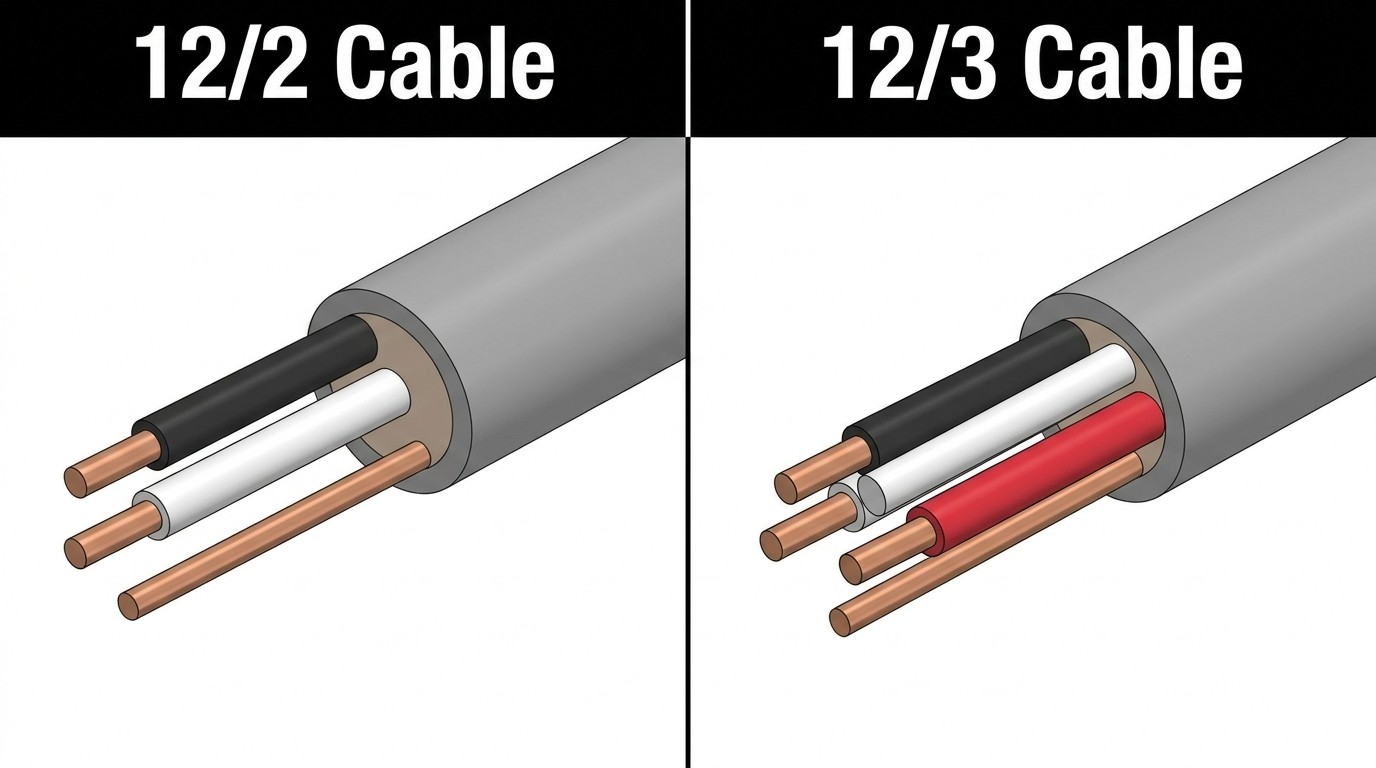
When purchasing NM-B cable, the numerical designation dictates the internal configuration. The second number indicates the quantity of insulated, current-carrying wires. The bare copper ground wire is present in both types but is not counted in the designation.
Anatomy of the Cables
12/2 Cable: Contains a black wire (hot), a white wire (neutral), and a bare copper wire (ground).
12/3 Cable: Contains a black wire, a white wire, a bare ground, and adds a red insulated wire.
When to Use 12/2 vs. 12/3
If you are wiring standard 120V wall outlets or a pure 240V load (like a baseboard heater where the white wire is re-identified as a second hot), 12/2 is the correct choice.
Conversely, 12/3 is required for two specific scenarios:
120/240V Appliances: Devices like electric dryers that require 240V for the heating element but 120V for the digital display require both hot legs (black and red) and a neutral return (white).
Multi-Way Switching: The red wire acts as a "traveler wire" required when setting up 3-way or 4-way light switches, allowing multiple switches to control a single fixture.
Safe Splicing and Installation Best Practices
12 AWG solid wire is stiff and requires proper mechanical connections to prevent arcing.
Choosing the Right Connectors
Twisting 12 AWG solid copper requires lineman's pliers and properly sized, UL-listed wire nuts. Alternatively, modern lever-style connectors provide secure, visually verifiable splices without the physical strain of twisting stiff conductors. For a detailed breakdown of secure connection methods, review How Top Wire Splice Connector Brands Stack Up This Year.
Pigtailing and Box Fill Limits
Because 12 AWG wire is thicker than 14 AWG, it consumes more physical space inside a junction box. NEC box fill calculations assign a volume of 2.25 cubic inches for every 12 AWG conductor. Overcrowding a small electrical box with 12 AWG wire forces the conductors against the receptacle terminals, creating a severe short-circuit risk. When multiple 12 AWG wires meet in a single box, pigtailing—connecting a single short wire from the splice to the receptacle—is the safest method to manage wire stiffness and ensure secure terminal connections.
Summary and Next Steps
12 AWG copper wire is the backbone of 20-amp circuitry. Adhering to its physical limits ensures a safe, code-compliant electrical system.
Installation Checklist:
Verify the circuit breaker does not exceed 20 amps for standard branch circuits.
Ensure continuous loads (running 3+ hours) do not exceed 1,920 watts.
Limit 120V/20A wire runs to 50 feet to maintain a maximum 3% voltage drop.
Never place a mixed 12 AWG and 14 AWG circuit on a 20-amp breaker.
Frequently Asked Questions
Can I use 12 gauge wire on a 15-amp circuit breaker?
Yes. Upsizing the wire to 12 AWG on a 15A breaker is entirely safe, exceeds code requirements, and reduces voltage drop over long distances.
What happens if I connect 12 gauge wire to a 30-amp breaker?
For standard residential outlets, this creates a severe fire hazard because the wire will overheat before the breaker trips. This is only legal under specific NEC Article 430 exceptions for dedicated motor loads.
Can 12 gauge wire be used for both standard outlets and lighting?
Yes. However, 14 AWG is the industry standard for dedicated lighting circuits because it is more cost-effective and significantly easier to bend and fold into ceiling junction boxes.
Is standard 12 gauge NM-B wire suitable for outdoor conduit?
No. NM-B cable contains paper wrapping and is rated strictly for dry, indoor use. For outdoor conduit, THWN or UF-B wire must be used.
 UTMEL
UTMEL
We are the professional distributor of electronic components, providing a large variety of products to save you a lot of time, effort, and cost with our efficient self-customized service. careful order preparation fast delivery service
 How Big is the DV/DT and DI/DT of the Power Device?UTMEL24 April 202211698
Hello everyone, I am Rose. Welcome to the new post today. This article describes how big the dv/dt and di/dt of high-speed power devices are?
Read More Why is 50 ohms?UTMEL13 June 202211666
Hello everyone, I am Rose.Welcome to the new post today. Today We will discuss why impedance is 50ohm, not 30ohm, 75ohm or 100ohm?
Read More What is Cat 7 Cable?UTMEL04 January 20228586
Cat 7 cable is the latest twisted pair in the ISO/IEC 11801 Cat 7 / Class F standard, which is designed to accommodate the application and development of 10 Gigabit Ethernet technology.
Read More What is a USB Data Cable?UTMEL27 August 202115331
The USB data cable is used for the connection and communication of the computer and external devices. It can also be used for the charging of the phone and the external connection. It is popular for transmitting data and charging.
Read More Understanding of Coaxial CableUTMEL06 August 202139994
Coaxial cable is a broadband transmission line with low loss and high isolation characteristics. This blog introduces the classification, structure, working principle, parameters, and characteristics of coaxial cables.
Read More
Subscribe to Utmel !
![LFXTAL002113Bulk]() LFXTAL002113Bulk
LFXTAL002113BulkIQD Frequency Products
![LFSPXO056277Cutt]() LFSPXO056277Cutt
LFSPXO056277CuttIQD Frequency Products
![LFXTAL059652Cutt]() LFXTAL059652Cutt
LFXTAL059652CuttIQD Frequency Products
![SIT8002AC-23-25E-14.31818Y]()
![SIT8002AC-13-25E-16.00000Y]()
![SIT8002AC-13-25E-14.31818Y]()
![SIT8102AC-43-25E-13.56000Y]()
![SIT8102AC-13-25E-10.00000Y]()
![SIT8102AI-23-25E-50.00000Y]()
![CRBV55BE-1550-1650]() CRBV55BE-1550-1650
CRBV55BE-1550-1650Crystek Corporation