Product
 Brand
Brand Articles
 Tools
Tools
Nickel-Cadmium Battery: Construction, Features and Working Principle
Electro-chemistry / Secondary Cells /Nickel Cadmium battery/Lead–acid storage battery
Summary: A nickel-cadmium (Ni-Cd) battery is a highly durable rechargeable power source utilizing nickel oxide hydroxide and metallic cadmium. While largely phased out of consumer electronics by 2026 due to environmental regulations, Ni-Cd batteries remain essential in aviation, emergency backup systems, and extreme-temperature industrial applications due to their unmatched reliability and high discharge rates.
Catalog
| I. Construction |
| II. Features |
| III. Working Principle |
A nickel-cadmium (Ni-Cd) battery is a robust rechargeable power source that utilizes nickel oxide hydroxide and metallic cadmium as its primary electrodes. While it has been largely displaced by lithium-ion and lead-acid batteries in consumer markets due to environmental regulations, it retains a critical 2026 market share in aviation and industrial backups. It is highly durable and capable of delivering surge currents, making it ideal for heavy-duty applications. It generates a steady DC voltage through a redox chemical reaction between the cadmium anode and nickel cathode, separated by an alkaline electrolyte. As battery technologies have evolved, the internal structure of Ni-Cd cells has become highly compact to maximize energy density.
In a nickel-cadmium battery, the redox material serves as the nucleus, with a nickel sheet and a separator surrounding it. The nominal voltage of a single nickel-cadmium cell is exactly 1.2 V. As three or four cells are connected in sequence (series), the output voltage ranges from 3.6 V to 4.8 V.

I. How is a Nickel-Cadmium Battery Constructed?
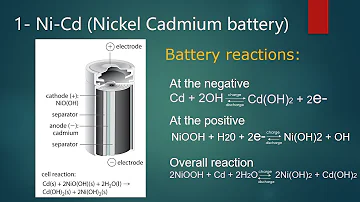
A nickel-cadmium battery is constructed using a positive nickel oxide hydroxide electrode, a negative metallic cadmium electrode, and an alkaline electrolyte separator housed within a protective metal casing. The operation of a nickel-cadmium battery relies on these specific materials to maximize discharge performance. Since a battery is a DC voltage source, it must have two potential points: positive and negative, commonly known as the cathode and anode.
To understand the internal architecture, here are the primary structural components:
Cathode (Positive Electrode): A coating of nickel oxide (NiO2) is held around the redox center. This nickel layer acts as the positive electrode collector.
Separator: A layer soaked in Potassium Hydroxide (KOH) or Sodium Hydroxide (NaOH) is held above the nickel oxide layer. This separator must remain wet to provide the chemical reaction with the required OH negative ions while preventing short circuits.
Anode (Negative Electrode): Cadmium is mounted above the separator plate, functioning as the negative electrode collector.

A safety valve, sealing pad, insulation ring, insulation gasket, and an exterior case round out the package. The insulator ring's job is to keep the two active layers apart by providing physical insulation. The insulator gasket is where the insulation ring is held securely in place, attached to the separator plate.
The outer case serves to shield the inner layers from external causes such as physical impact and mishandling. It should be remembered that working with the raw internals of the battery is unsafe due to the toxic chemical reactions that occur inside. The battery case should never be opened, as exposure to cadmium and potassium hydroxide can cause severe injury. When the unit reaches the end of its lifecycle, it must be recycled at a certified facility.
Nickel-Cadmium Battery Equations
The chemical equations that represent the redox reaction are as follows:
2NiOOH + 2H2O + 2e" => 2 Ni (0H)2 + 2 OH
Cd + 2 OH' => 2 Cd (OH)2 + 2e-
2NiOOH + Cd + 2H2O <-> 2 Ni (OH)2 + Cd (OH)2
The reaction between the cathode layer nickel and the separator is described by the first equation. It produces Nickel oxide and OH ions as an output. As previously stated, the separator layer is used to provide the OH ions needed for the chemical reaction. For the initial reaction, the separator layer is soaked in water to provide H2O. As a result, one of the byproducts is H2O.
The cadmium layer is also mixed with OH ions derived from the separator layer on the anode side. Cadmium oxide and electrons are generated as a result of this process. It's worth noting that the electrons in both equations balance out. OH ions are also canceled. The third equation, in which nickel is mixed with cadmium and water, is the remainder equation. Nickel oxide and cadmium oxide are the final end products.
II. What Are the Key Features of Ni-Cd Batteries?
Nickel-Cadmium Battery Temperature Range
During charging, the safe temperature range for nickel-cadmium batteries is 0 to 45 degrees Celsius, and during discharging, the temperature range is an impressive -20 to 65 degrees Celsius. The battery should not be operated outside of this temperature range, as extreme thermal stress introduces a risk of venting or explosion.
Nickel-Cadmium Battery Toxicity
Nickel-cadmium batteries are extremely toxic to the human body and the environment. Cadmium is a heavy metal that poses severe health threats to humans, leading to strict global bans on consumer Ni-Cd products. Cadmium has been seen to have a biochemical effect on the body, accumulating in the kidneys and liver. It affects the digestive system directly if ingested. Nickel, like lead, is also toxic to the human respiratory system if inhaled as a dust or fume.
Nickel-Cadmium Battery Voltage and Performance
Each individual cell voltage for a Nickel-cadmium battery is exactly 1.2 V. To obtain higher necessary voltages, multiple cells are connected in series or parallel. To understand how Ni-Cd compares to alternative nickel-based chemistries, review the performance metrics below:
| Battery Type | Specific Energy (Wh/kg) | Specific Power (W/kg) | Energy Efficiency (%) |
|---|---|---|---|
| Nickel-Cadmium (Ni-Cd) | 50 - 60 | ~200 | 70 - 75% |
| Nickel-Iron (Ni-Fe) | 30 - 50 | ~100 | 60 - 70% |
| Nickel-Metal Hydride (NiMH) | 60 - 120 | 170 - 1000 | 70 - 80% |
Nickel Cadmium Battery Types
Physical size and usable voltage are used to classify nickel-cadmium batteries. They may be manufactured in AAA, AA, A, Cs, C, D, or F sizes, depending on the industrial requirement. The output voltage parameters and milliamp-hour (mAh) capacities for all of these sizes are different. Some industrial variants are housed in a rectangular box-shaped outer case, while most commercial cells are in a cylindrical pipe-shaped outer case.
Advantages and Disadvantages of Nickel Cadmium Battery
Advantages:
Delivers extremely high surge currents, ideal for motor starters.
Highly tolerant to overcharging and deep discharging.
It can handle between 500 and 2,000 charging cycles depending on maintenance.
Disadvantages:
Cadmium is a highly toxic heavy metal that is severely harmful to the environment, leading to widespread bans.
Suffers from the "memory effect," requiring full discharges to maintain maximum capacity.
III. How Does a Nickel-Cadmium Battery Work?
A nickel-cadmium battery works by converting chemical energy into electrical energy through a reversible redox reaction between the cadmium anode and the nickel oxide hydroxide cathode. The battery, which acts as a reliable DC voltage source, is made up of these two active ports. The cadmium coating is kept on the redox center first when producing the battery. The cathode terminal is the cadmium layer. Cadmium is a heavy metal of excellent electrical conductivity. Separator layers are held above the cadmium layer.
The separator layer's job is to provide the required OH ions for the chemical reaction. The reaction between the cathode layer nickel and the separator requires OH ions. It produces Nickel oxide and OH ions as an output. As previously stated, the separator layer is used to provide the OH ions needed for the chemical reaction. For the initial reaction, the separator layer is soaked in water to provide H2O.
As a result, one of the byproducts is H2O. The cadmium layer is also mixed with OH ions derived from the separator layer on the anode side. Cadmium oxide and electrons are generated as a result of this process. It's worth noting that the electrons in both equations balance out. OH ions are also canceled. The third equation, in which nickel is mixed with cadmium and water, is the remainder equation. Nickel oxide and cadmium oxide are the end products. A surge of electrons follows the chemical reaction, causing a potential difference between the two terminals and delivering power to the connected load.
Frequently Asked Questions
Why are nickel-cadmium batteries banned in many countries?
Nickel-cadmium batteries are banned or heavily restricted in many regions, including the European Union, due to the extreme toxicity of cadmium. Improper disposal leads to severe environmental contamination, prompting a global shift toward safer lithium-ion and NiMH alternatives for consumer electronics.
What is the memory effect in Ni-Cd batteries?
The memory effect is a phenomenon where a Ni-Cd battery loses its maximum energy capacity if it is repeatedly recharged after being only partially discharged. The battery "remembers" the smaller capacity, which is why periodic deep discharges are recommended for maintenance.
How long do nickel-cadmium batteries last?
With proper maintenance and periodic deep cycling, industrial nickel-cadmium batteries can last up to 20 years in standby applications. In standard cyclic use, they typically handle between 1,000 and 2,000 full charge and discharge cycles before degrading.
Can I replace a Ni-Cd battery with a NiMH battery?
Yes, in most consumer applications, a Nickel-Metal Hydride (NiMH) battery can directly replace a Ni-Cd battery. NiMH batteries offer higher capacities and do not suffer from the memory effect, though you must ensure your charger is compatible with NiMH chemistry.
 UTMEL
UTMEL
We are the professional distributor of electronic components, providing a large variety of products to save you a lot of time, effort, and cost with our efficient self-customized service. careful order preparation fast delivery service
What is a nickel cadmium battery used for?
A nickel-cadmium battery (NiCd or NiCad) is a rechargeable battery used for portable computers, drills, camcorders and other small battery-operated devices requiring an even power discharge. NiCds use electrodes made of nickel oxide hydroxide, metallic cadmium and an alkaline electrolyte of potassium hydroxide.
How long do nickel cadmium batteries last?
15 to 20 years. The normal lifetime of a Nicd battery, in a typically harsh environment back-up power application, is in the range of 15 to 20 years. Occasionally, Saft batteries exceed their normal life expectancy by more than 35%.
How do you recharge a nickel cadmium rechargeable battery?
The cheapest way to charge a nickel cadmium battery is to charge at C/10 (10% of the rated capacity per hour) for 16 hours.. So a 100 mAH battery would be charged at 10 mA for 16 hours. This method does not require an end-of-charge sensor and ensures a full charge.
 Power Converter with Inbuilt Charging technology using WBG DevicesSaumitra Jagdale18 January 20242755
Although plug-in electric vehicles (PEVs) have gained traction globally, reducing cost, weight, and volume, while enhancing power conversion efficiency in chargers remains crucial. PEVs, recognized by governments for curbing fossil fuel consumption and emissions, rely on sizable battery packs for substantial all-electric range coverage.
Read More SR626SW Battery Equivalent: Technical Specs, Chemistries, and Selection GuideUTMEL26 May 20261905
This comprehensive technical guide details the SR626SW battery, a widely used 1.55V silver oxide cell. It explains regional naming conventions, cross-referencing equivalents like the 377 and LR626, and highlights the performance differences between silver oxide and alkaline chemistries. Additionally, it offers product engineers and technicians essential handling best practices to avoid voltage drops and ensure device longevity.
Read More How to Choose the Best Deep Cycle Battery in 2024 | Reviews and Buying GuideUTMEL21 July 20253052
You will learn about deep-cycle batteries in this post, including their main characteristics, things to think about while selecting one, and more.
Read More CR123A vs 123A Batteries Explained for 2025UTMEL27 May 20255818
CR123A and 123A batteries differ in capacity, lifespan, and compatibility. Learn how these differences affect your device's performance and safety.
Read More A Guide to the Best AG13 Battery SubstitutesUTMEL27 May 20253297
Discover the top AG13 battery equivalents for 2025, including LR44, SR44, 357, and A76. Compare performance, compatibility, and cost for your devices.
Read More
Subscribe to Utmel !
![1063971310]() 1063971310
1063971310Molex
![52437-2571]() 52437-2571
52437-2571Molex
![R191325000]() R191325000
R191325000Radiall USA, Inc.
![R125055702]() R125055702
R125055702Radiall USA, Inc.
![52044-1445]() 52044-1445
52044-1445Molex
![45-1327G6-BK]() 45-1327G6-BK
45-1327G6-BKAnderson Power Products, Inc.
![54550-0471]() 54550-0471
54550-0471Molex
![75454-5001]() 75454-5001
75454-5001Molex
![M4380-003]() M4380-003
M4380-003Glenair
![52207-2660]() 52207-2660
52207-2660Molex