Product
 Brand
Brand Articles
 Tools
Tools
The Complete Guide to DPDT Switches: Function, Wiring, and Applications
A Double Pole Double Throw (DPDT) switch is an electromechanical component that simultaneously controls two independent circuits. By mechanically linking two Single Pole Double Throw (SPDT) switches under a single actuator, a DPDT switch allows operators to route signals, switch between power sources, or reverse polarity with a single physical movement. This guide breaks down the internal anatomy, standard wiring configurations, physical variations, and selection criteria for circuit designers, maintenance technicians, and component buyers.
What is a DPDT Switch? (Core Function and Anatomy)
To understand a DPDT switch, it helps to break down the terminology:
Pole: Refers to the active contact or the number of independent circuits the switch can control. A "Double Pole" switch controls two separate circuits simultaneously.
Throw: Refers to the number of stationary contact positions each pole can connect to. A "Double Throw" switch gives each circuit two possible output paths.
Physically, a standard DPDT switch features six terminals arranged in a 2x3 grid. The two middle terminals are typically the Common (COM) inputs, while the top and bottom pairs serve as the Normally Open (NO) and Normally Closed (NC) outputs.
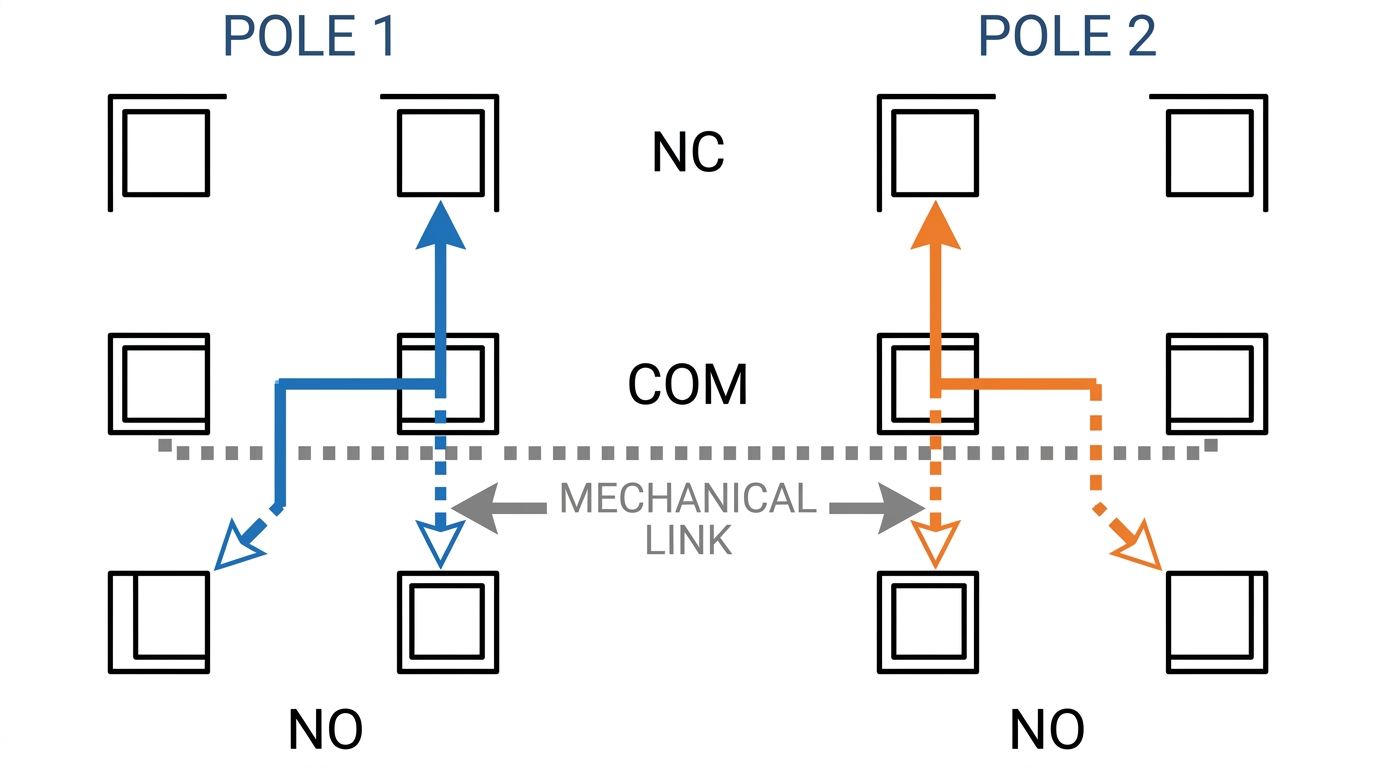
While the two poles switch synchronously because they are attached to the same mechanical lever, they remain completely electrically isolated. Expert multimeter demonstrations on the back of DPDT switches confirm this: while there is vertical continuity along a pole when the switch is thrown, there is absolutely zero horizontal continuity between the left and right sets of terminals. This isolation is what allows a single switch to handle a 12V DC motor on one side and a 5V logic signal on the other without interference.
Switch Configurations: ON-ON vs. ON-OFF-ON
DPDT switches generally come in two primary operational configurations, each serving distinct engineering needs:
ON-ON (Two-Position): This switch has no neutral state. The common terminals are always connected to either the top throws or the bottom throws. This is ideal for simple A/B routing, such as switching a stereo audio signal between two sets of speakers.
ON-OFF-ON (Three-Position): This switch includes a center "OFF" position where the common terminals are disconnected from all throws. This "center-off" state acts as a critical safety buffer. For example, when switching a single output between two different live power sources, the center position ensures both sources are completely disconnected before the new one is engaged, preventing dead shorts or power surges. It also prevents mechanical damage in motor control by forcing the motor to coast to a stop before reversing direction.
Common DPDT Wiring Diagrams and Applications
Because of its dual-circuit nature, the DPDT switch is highly versatile. However, wiring it incorrectly can lead to catastrophic circuit failures.
1. DC Motor Polarity Reversal (The "X" Pattern)
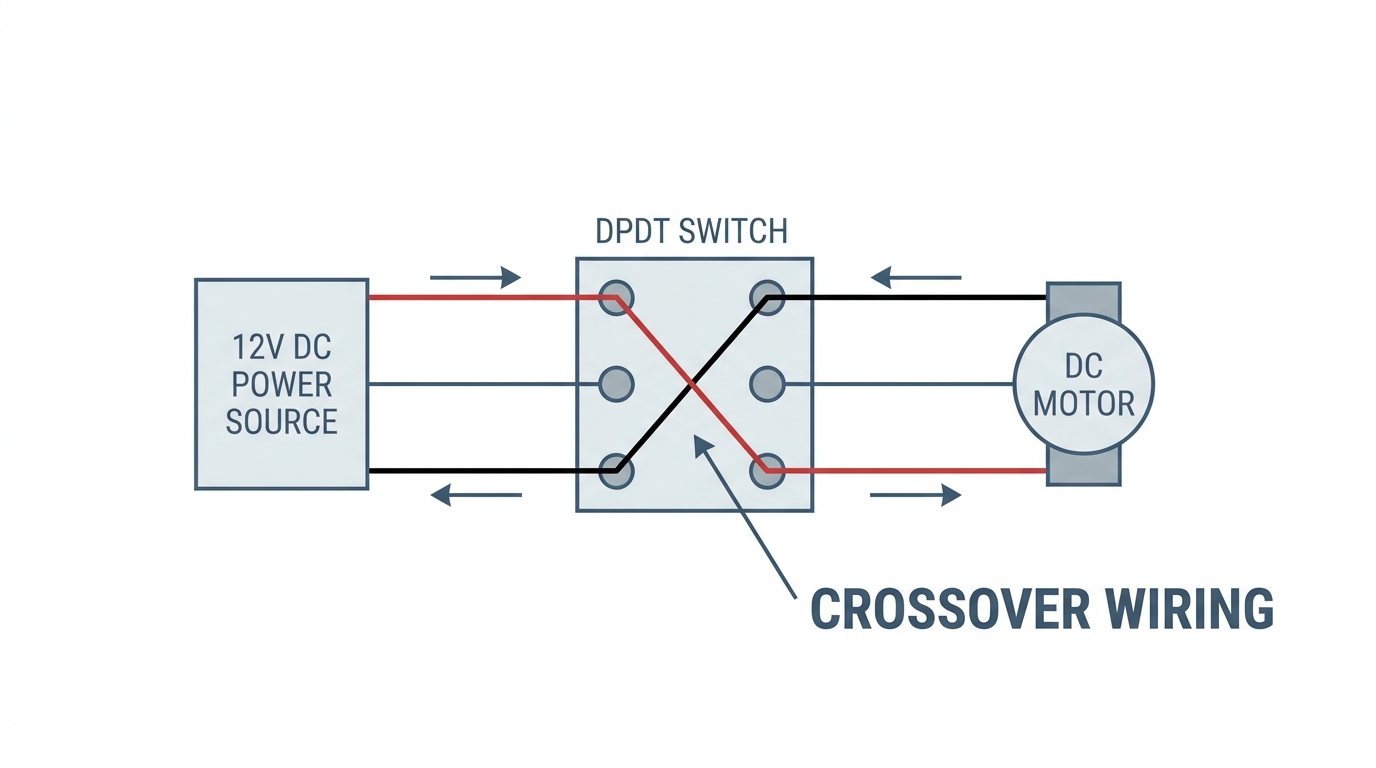
The most common industrial application for a DPDT switch is reversing the direction of a DC motor. This requires swapping the positive and negative polarity of the voltage reaching the motor.
The Wiring: The power source connects to the two center COM terminals. You then wire an "X" crossover pattern on the outer terminals: connect the top-left terminal to the bottom-right terminal, and the top-right terminal to the bottom-left terminal. The motor leads are then attached to either the top or bottom pair of terminals.
The Result: Live bench tests show that flipping the toggle instantly reverses the voltage (e.g., from +5.00V to -5.00V), causing the motor to spin in the opposite direction.
Note: While a DPDT switch provides excellent manual control over motor direction, automated speed-based switching (such as disengaging a starter winding in a single-phase motor) requires a Centrifugal Switch.
2. A/B Source Selection (No Crossover)
If you want to power a single device using two different power sources (e.g., switching a control panel between main power and battery backup), the wiring changes entirely.
The Wiring: The device connects to the center COM terminals. Power Source A connects to the top two terminals, and Power Source B connects to the bottom two terminals.
The Warning: A major beginner mistake is assuming every DPDT switch requires the "X" crossover wiring. If you apply the crossover pattern to an A/B source selector, you will create a dead short between your two power sources the moment the switch is thrown.
3. Directional Agnosticism
When wiring a DPDT switch for polarity reversal or source selection, the switch is directionally agnostic. Because the internal mechanism simply bridges the contacts, current can flow in either direction. You can input power to the center terminals and output from the outer terminals, or input power to the outer terminals and output from the center.
📺 Wiring A DPDT Switch - 2 Methods Explained
Physical Types and Mounting Options
DPDT switches are manufactured in various physical formats to suit different operational environments and panel designs:
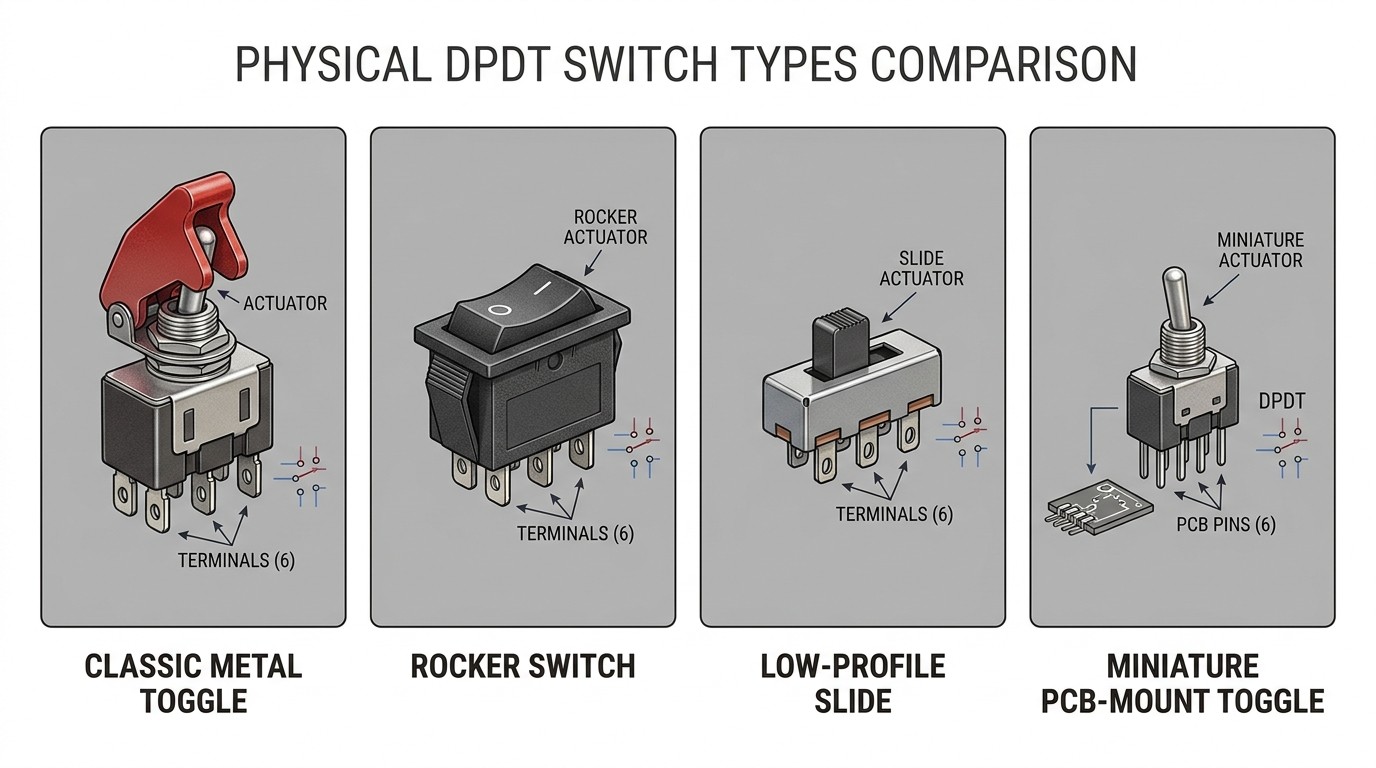
Toggle Switches: The standard lever-actuated switch. Heavy-duty versions often feature "Missile Style" safety guard covers to prevent accidental actuation in industrial or aerospace environments.
Locking Switches: A specialized toggle that requires the operator to physically pull the lever outward before it can be moved to the next position. This is critical for high-vibration environments where machine resonance might otherwise cause a standard toggle to flip.
Rocker Switches: Flush-mounted switches common in automotive, marine, and consumer appliance applications.
Slide Switches: Low-profile switches often used for dual-circuit routing directly on printed circuit boards (PCBs). While slide DPDT switches are great for simple board-level routing, complex PCB configurations requiring multiple independent toggles are better suited for a DIP Switch: Introduction and Classification.
DPDT Switch Selection Criteria
Component buyers and circuit designers must evaluate several technical specifications before selecting a DPDT switch for a project:
Voltage and Current Ratings: Switches are rated for maximum AC and DC loads. Exceeding the current rating will cause the internal contacts to arc, weld together, or melt the housing. For industrial motors that exceed a standard DPDT switch's current rating, use the switch to send a low-voltage logic signal to a Solenoid Switch: Working Principle, Types and Applications or contactor, which safely handles the heavy load.
Contact Material: Standard switches use silver-alloy contacts, which are excellent for high-current power applications. However, for low-voltage logic or audio signals (where oxidation can cause signal loss), gold-plated contacts are required to ensure reliable conductivity.
Environmental Protection (IP Rating): For marine, automotive, or outdoor industrial use, switches must carry an IP65 or IP67 rating, indicating they are sealed against dust ingress and water jets/submersion.
Terminal Style: Panel-mount switches typically use screw terminals, quick-connect spades, or solder lugs. PCB-mount switches use straight PC pins or right-angle pins for wave soldering.
Troubleshooting Common DPDT Switch Failures
Maintenance technicians can use the following matrix to diagnose and resolve common DPDT switch issues in the field.
| Symptom | Potential Cause | Diagnostic Step / Solution |
|---|---|---|
| Intermittent or flickering operation | Loose terminal connections or oxidized internal contacts. | Check screw torque/solder joints. If contacts are oxidized (common in low-voltage circuits using silver contacts), replace with a gold-plated switch. |
| Switch feels "mushy" or won't latch | Broken internal spring or melted actuator housing. | Disconnect power. Test mechanical throw. If housing is warped, the switch was subjected to overcurrent and must be replaced. |
| Dead short when switching sources | Incorrect crossover wiring applied to an A/B selector circuit. | Inspect wiring. Remove any "X" crossover wires if the switch is being used to toggle between two distinct power sources. |
| Motor snaps violently when reversing | Using an ON-ON switch for motor control instead of ON-OFF-ON. | Replace the ON-ON switch with an ON-OFF-ON switch to allow the motor to coast to a stop in the center position before reversing. |
| One circuit works, the other is dead | One pole has failed, or horizontal wiring was mistakenly used. | Use a multimeter to check vertical continuity on both poles. Ensure wires are not connected horizontally across the isolated poles. |
What to Ignore When Selecting DPDT Switches
When researching or purchasing DPDT switches, filter out the following noise:
Proprietary Series Names as Standards: Ignore manufacturer-specific prefixes (like MTS, SMTS, or KN3) when looking for universal replacements. Focus entirely on the pole/throw count, current rating, and mounting hole diameter.
The "6-Pin Guarantee": Do not assume that every switch with six pins is a DPDT switch. Some Double Pole Single Throw (DPST) switches use six-pin housings with dummy pins for manufacturing efficiency. Always check the schematic printed on the side of the switch housing.
"Universal" AC/DC Ratings: Ignore claims that a switch can handle the same amperage for both AC and DC. DC voltage sustains an arc much longer than AC voltage. A switch rated for 15A at 125V AC might only be rated for 10A (or less) at 30V DC. Always read the specific DC rating for battery-powered projects.
Frequently Asked Questions (FAQs)
Can I use a DPDT switch as a simple SPDT or SPST switch?
Yes. Because the two poles are completely isolated, you can simply wire one side of the switch and leave the other side empty. To use it as an SPST (simple ON/OFF), wire only the common terminal and one of the throw terminals on a single pole.
What is the difference between a DPDT and a DPST switch?
A DPST (Double Pole Single Throw) switch controls two circuits but only has one "ON" position (typically 4 terminals). It simply turns two circuits on or off at the same time. A DPDT switch gives each of those two circuits two different routing options (6 terminals).
Why does my DPDT switch have 8 terminals instead of 6?
If a switch has 8 terminals, it is likely a DPDT switch with an integrated LED indicator. The extra two terminals are dedicated to powering the internal light (usually labeled + and -), while the standard 6 terminals handle the switching logic.
Does it matter which way current flows through a DPDT switch?
No. Electromechanical DPDT switches are passive, bidirectional components. Current can flow from the common terminals out to the throws, or from the throws into the common terminals.
Can a DPDT switch handle both AC and DC simultaneously?
Technically, yes. Because the two poles are electrically isolated, you could run a 120V AC circuit through the left pole and a 12V DC circuit through the right pole. However, this is generally discouraged in panel design due to the safety risks of high-voltage AC and low-voltage DC wiring being in such close physical proximity.
 UTMEL
UTMEL
We are the professional distributor of electronic components, providing a large variety of products to save you a lot of time, effort, and cost with our efficient self-customized service. careful order preparation fast delivery service
 The Complete Guide to DPDT Switches: Function, Wiring, and ApplicationsUTMEL23 May 20262807
This comprehensive guide explores Double Pole Double Throw (DPDT) switches, explaining their core anatomy, distinct ON-ON and ON-OFF-ON configurations, and essential wiring methods like DC motor polarity reversal and A/B source selection. It also covers various physical designs, selection criteria such as ratings and materials, and effective troubleshooting steps to resolve common circuit failures.
Read More Long Life Small Volume Detector Switch for Intelligent ApplicationsUTMEL16 March 20224979
Hello everyone, I am Rose. Welcome to the new post today. This article will introduce what is a detection switch, how to choose a detection switch and where to use a detection switch.
Read More Analog Switch: Types and ApplicationUTMEL25 March 202115902
The analog switch is mainly to complete the signal switching function in the signal chain. The switching mode of the MOS tube is adopted to realize the switching off or on of the signal link.
Read More Toggle Switches: Features, Types and ApplicationsUTMEL23 January 202111417
Toggle switch adopts integrated circuit technology and SMT appearance device technology to manufacture a new generation of photoelectric switch devices. It has intelligent functions such as delay, expansion, external synchronization, anti-interference, high reliability, stable working area, and self-diagnosis. This novel photoelectric switch is an active photoelectric detection system electronic switch that uses pulse modulation. The cold light source used is infrared light, red light, green light and blue light, etc., which can be quickly and without contact and damage Control the state and action of various solid, liquid, transparent, black, soft, smoke and other substances.
Read More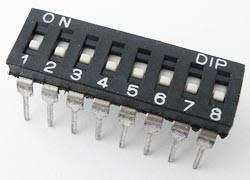 DIP Switch: Introduction and ClassificationUTMEL20 January 202117492
DIP switch is an address switch used for operation control, using the principle of 0/1 binary coding. It is a miniature switch that can be toggled by hand. Dip switches are widely used in data processing, communication, remote control and anti-theft automatic alarm systems and other products that require manual programming.
Read More
Subscribe to Utmel !
![R948140602]() R948140602
R948140602Radiall
![P3032-KPA]() P3032-KPA
P3032-KPAFLUKE
![62103-1304]() 62103-1304
62103-1304Extech
![70006246741]()
![0M-13352]() 0M-13352
0M-13352American Power Conversion
![98044062507]()
![154955]() 154955
154955Eaton
![TE-MA254-OE-1]() TE-MA254-OE-1
TE-MA254-OE-1TE Connectivity
![Z60-10-IS420-U]()
![ZUP60-7/U]() ZUP60-7/U
ZUP60-7/UTDK