Product
 Brand
Brand Articles
 Tools
Tools
HDMI RF Modulators: Architecture, Setup, Types, and Commercial Applications
For AV technicians, embedded hardware engineers, and commercial installers, HDMI RF modulators solve a critical physics problem: standard HDMI transmission degrades rapidly over long distances. While native HDMI is limited to roughly 50 feet without active amplification, an RF-modulated signal can travel up to 600 feet over coaxial cable, enabling multi-room, high-definition distribution without the need to tear open walls to run new network or fiber cables.
This guide breaks down the internal architecture, modulation standards, setup workflows, and commercial applications of HDMI RF modulators.
Internal Architecture and Hardware "Pinout"
In the context of enclosed AV equipment, the "pinout" refers to both the external physical interface layout and the internal PCB architecture that drives the signal conversion.
If you are wondering How much do you know about HDMI Cable, you likely know that it carries uncompressed digital data. The modulator's job is to compress and package that data for a single-wire analog medium.
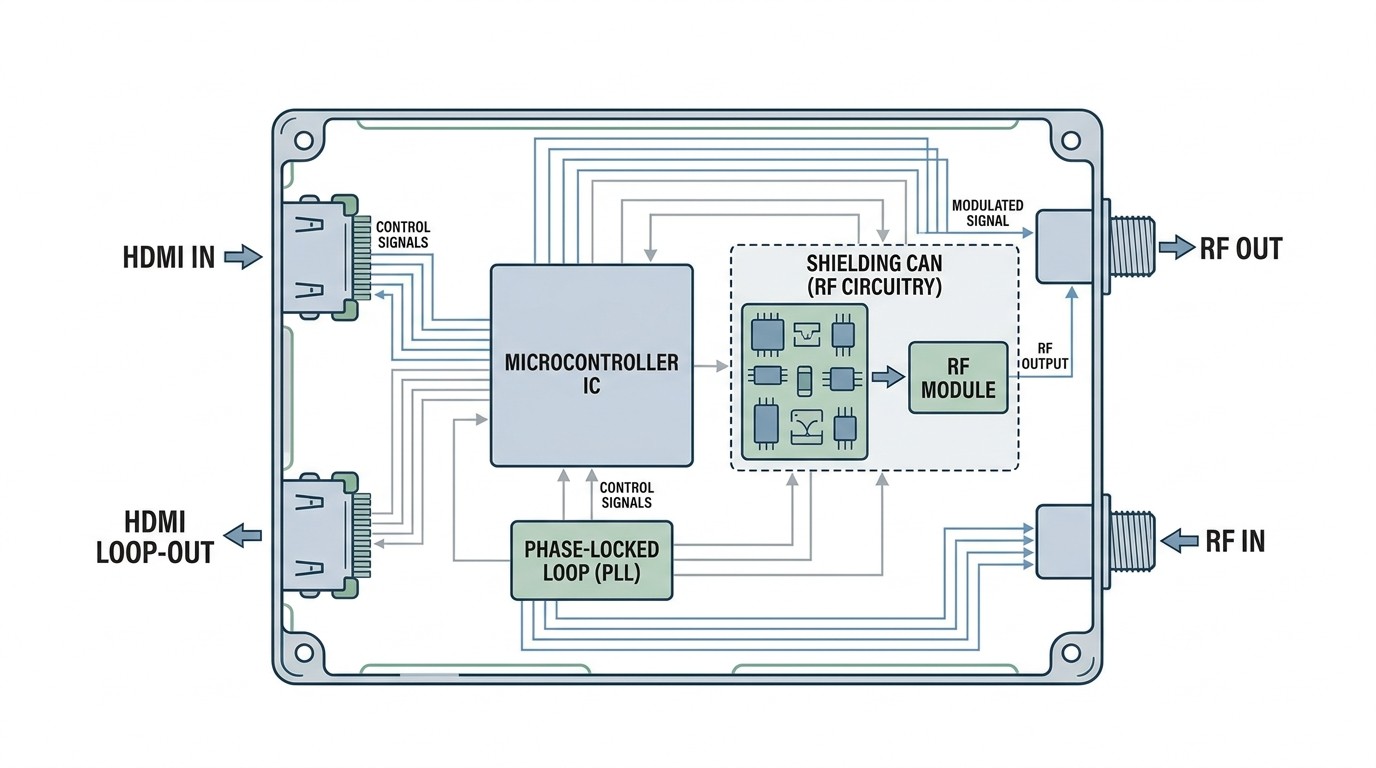
Internal PCB Components:
Microcontroller/Encoder IC: The core processor responsible for taking the uncompressed HDMI signal and encoding it into a compressed format, typically MPEG-2, H.264, or H.265.
Modulator IC (PLL): Uses a Phase-Locked Loop (PLL) to generate the precise carrier frequency. This chip modulates the encoded digital stream onto the selected RF frequency using techniques like QAM (Quadrature Amplitude Modulation) or PSK (Phase-Shift Keying).
Crystal Oscillator: Provides the precise timing clock required for stable frequency generation.
Shielding Can: Essential for preventing electromagnetic interference (EMI) from leaking out of the RF circuitry or external noise from degrading the internal signal.
External Interface Layout:
HDMI IN: Receives the source video and audio.
HDMI Loop-Out: A pass-through port allowing local monitoring of the source signal before modulation.
RF OUT (TO TV): The primary 75-ohm F-type connector that outputs the modulated signal to the coaxial network.
RF IN (ANT IN / Combiner): A pass-through port. Visual hardware demonstrations of standard modulators frequently highlight this port as a point of confusion. It is designed to accept an existing antenna or cable feed and combine it with the newly modulated HDMI signal, allowing both to travel down the same output cable.
NMS / LAN Port: A network management port used to access the device's web GUI for advanced configuration.
The Modulation Process: How It Works
The conversion from HDMI to RF is a two-step process: encoding and modulation. To understand the physics behind this, it helps to look at the RF Modulator: Working Principle and Development Trend.
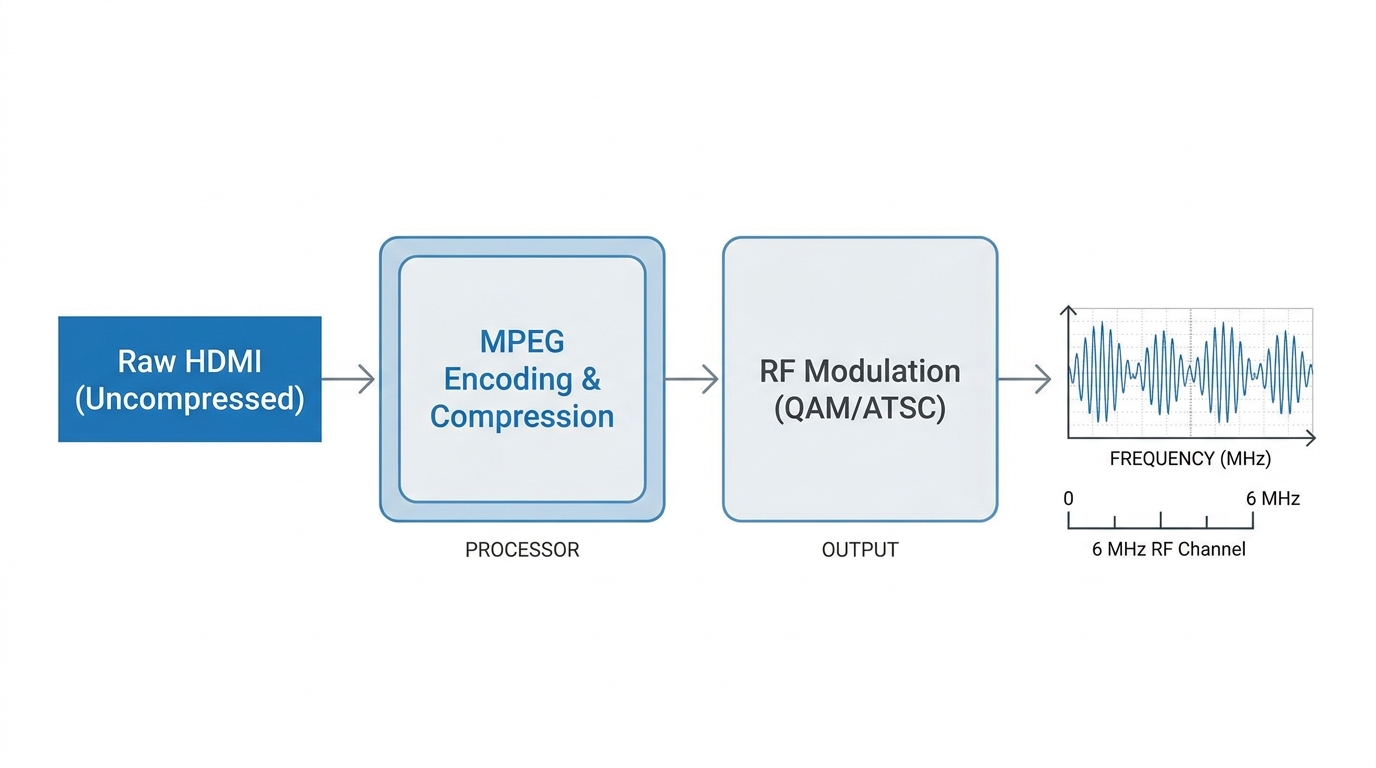
Encoding: The raw HDMI signal is too large to fit into a standard 6 MHz (or 8 MHz) RF channel bandwidth. The internal encoder compresses the video into an MPEG Transport Stream (TS). Audio is simultaneously encoded into compatible formats like AC-3 (Dolby Digital) or AAC.
Modulation: The compressed Transport Stream is then modulated onto a carrier wave. The standard used depends on the region and application:
ATSC (8VSB): The standard for over-the-air (OTA) broadcast in North America. TVs will recognize this signal as a standard digital antenna channel.
QAM (J.83B/A/C): The standard for digital cable systems. QAM is highly efficient and widely used in commercial closed-circuit systems.
DVB-T / ISDB-T: International standards used in Europe, Asia, and South America.
Types of HDMI RF Modulators
Modulators are categorized by their signal output and physical form factor:
Analog vs. Digital: Legacy analog modulators take composite/component video and output standard-definition analog RF (typically hard-switched to Channel 3 or 4). Modern digital HDMI RF modulators output high-definition (1080p or 4K) digital RF signals that require a digital tuner to decode.
Standalone Units: Compact, single-channel devices designed for residential use, digital signage, or small sports bars. They often feature keyhole slots molded into the chassis, allowing installers to mount them securely under desks or behind server racks for clean cable management.
Commercial Rack-Mount (Multi-Channel): 1U or 2U rack-mounted chassis that can accept 4, 8, or 16 HDMI inputs simultaneously. These are used to create custom "headends" for hotels or campuses, multiplexing multiple HDMI sources into a single combined RF output.
Step-by-Step Setup and Configuration Workflow
Setting up a commercial HDMI RF modulator requires strict attention to signal routing and frequency planning.
📺 How to Setup RF Modulator
Physical Connections: Connect the HDMI source. Next, connect the coaxial output. Visual workflow tests consistently reveal a common beginner mistake: confusing the "ANT IN" and "TO TV" ports. The output cable must be threaded onto the "TO TV" (RF Out) port. Plugging the destination cable into the "ANT IN" port will result in a dead signal. Ensure you are using a high-quality RF Connector and 75-ohm RG6 coaxial cable.
Power Management: Connect the DC power supply. In rack environments, avoid daisy-chaining power supplies, as modulators draw continuous, steady power that can overload shared circuits.
Frequency and Channel Planning: Access the device's front panel or web GUI. You must select an output frequency (e.g., UHF Ch 14 at 473 MHz). Crucial Rule: The selected RF channel must be at least 3 to 4 channels away from any existing active channels on the coaxial network to prevent crosstalk and interference.
MPEG TS Configuration: For embedded engineers and advanced installers, commercial units require configuring Transport Stream parameters:
Network ID (NID) & Transport Stream ID (TSID): Identifies the network and stream to the receiving TV.
Program Map Table (PMT) & Packet Identifiers (PIDs): You must assign unique Video PIDs and Audio PIDs so the receiving television knows exactly how to separate and decode the multiplexed data streams.
Power Loss Budgeting: If installing multiple modulators, use an RF combiner. Calculate the attenuation (signal loss) across the coaxial run and adjust the modulator's RF output power (typically between 70-100 dBµV) to ensure the signal arrives at the television within the acceptable receiver threshold.
Commercial Applications: IP vs. RF
While AV-over-IP (multicast streaming) is highly popular, HDMI RF modulation remains the superior choice for specific commercial applications due to two factors: zero network dependency and zero latency distribution.
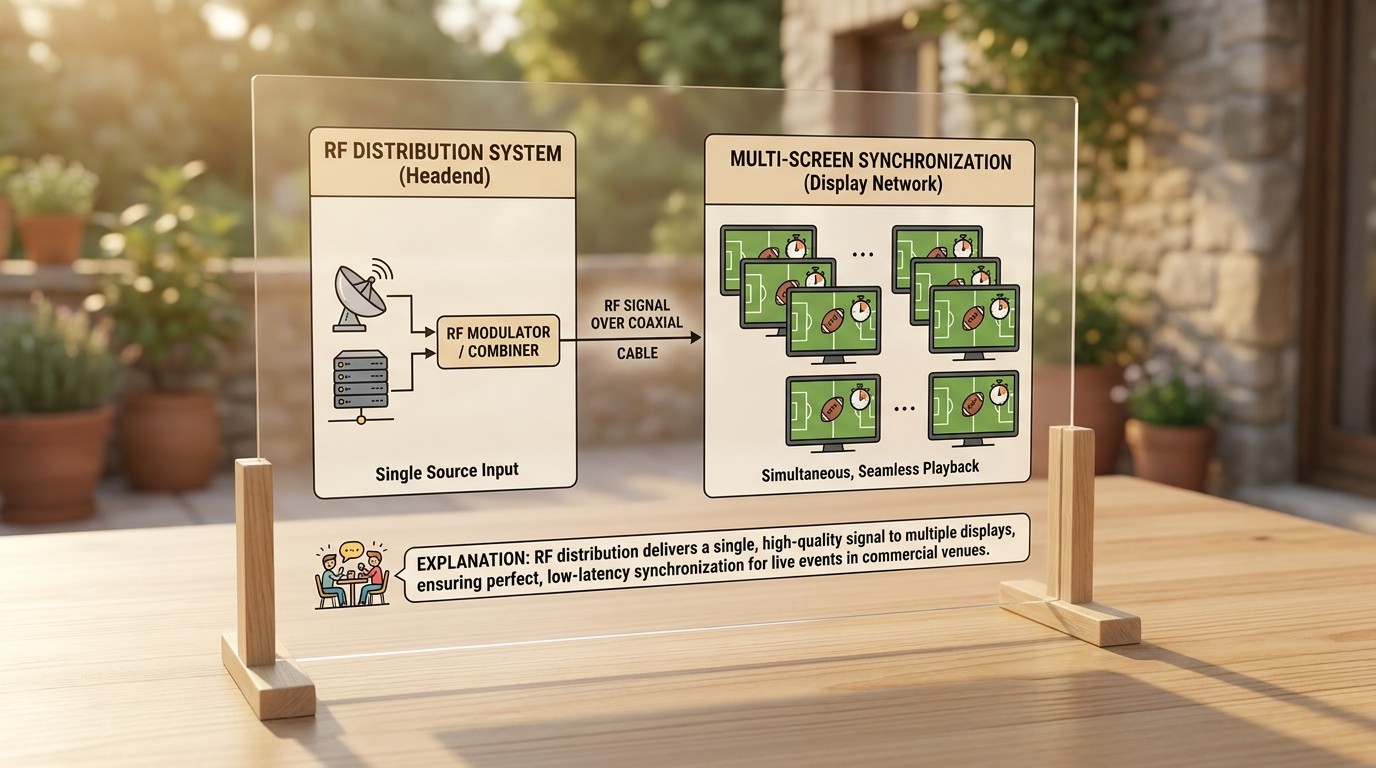
Hospitality and Hospitals: Hotels and healthcare facilities often have miles of legacy coaxial cable in the walls. RF modulators allow them to inject modern HDMI sources (like a digital signage PC or a premium satellite receiver) into the existing coax network, turning it into a custom TV channel available in every room without upgrading to smart TVs or IP networks.
Sports Bars and Entertainment Venues: RF distribution allows a single high-definition sports broadcast to be sent to 50+ televisions simultaneously with absolute zero-second drift between screens. IP streaming often suffers from buffering, causing screens in the same room to fall out of sync.
Troubleshooting Matrix
When integrating an HDMI RF modulator into an existing network, use this decision aid to isolate common failures:
| Symptom | Potential Cause | Technical Solution |
|---|---|---|
| No Picture / "No Signal" on TV | Incorrect port usage or TV tuner mismatch. | Verify the coax is in the "RF OUT" port, not "RF IN". Ensure the TV tuner is set to the correct mode (Cable/QAM vs. Air/ATSC) and perform a full channel rescan. |
| Macroblocking / Pixelation | Signal attenuation or low-quality infrastructure. | Replace lossy, outdated RG59 cables with shielded RG6. Check the RF output power level; if the run is over 600 feet, an inline drop amplifier may be required. |
| Audio Present, No Video | Unsupported HDMI resolution or HDCP handshake failure. | Lower the source HDMI resolution to 1080p/60Hz. Verify the modulator supports the HDCP version of the source device. |
| Interference / Ghosting | Adjacent channel interference. | Shift the modulator's output frequency so it is at least 3-4 channels away from existing broadcast channels on the network. |
What to Ignore in the Consumer Market
When researching HDMI RF modulators, filter out consumer-grade marketing that claims these devices are universally "plug-and-play." While true for a single TV, commercial multi-room setups require precise impedance matching, power budgeting, and PID configuration.
Furthermore, ignore advice suggesting that old RG59 coaxial cable is "good enough" for modern installations. RG59 was designed for low-bandwidth analog video; pushing high-frequency digital QAM/ATSC signals through RG59 will result in severe signal degradation over long runs. Always upgrade to RG6 or RG11 for HD RF modulation.
Frequently Asked Questions (FAQs)
What is the maximum distance an HDMI RF modulator can transmit?
Over high-quality RG6 coaxial cable, a modulated digital RF signal can typically travel up to 600 feet before requiring an active inline RF amplifier.
What is the difference between QAM and ATSC modulation?
ATSC is the standard for over-the-air (OTA) antenna broadcasts, while QAM is the standard for closed-circuit cable television. You must select the standard that matches the tuners built into your destination televisions.
Can I use multiple HDMI RF modulators on the same coaxial network?
Yes. You can use an RF combiner/multiplexer to merge the outputs of multiple modulators onto a single cable. However, you must assign each modulator a distinct frequency and ensure adequate channel spacing to prevent interference.
Why is there a slight delay between the HDMI source and the TV output?
While the RF transmission itself happens at the speed of light, the internal microcontroller requires milliseconds to encode the raw HDMI video into an MPEG Transport Stream, and the TV requires milliseconds to decode it. This results in a slight, unavoidable encoding latency.
What is the purpose of the "RF IN" or "ANT IN" port?
It acts as a pass-through combiner. It allows you to take an existing cable TV or antenna feed, plug it into the modulator, and combine it with your new HDMI-to-RF channel. Both the existing channels and the new custom channel are then sent down the single "RF OUT" cable to the television.
 UTMEL
UTMEL
We are the professional distributor of electronic components, providing a large variety of products to save you a lot of time, effort, and cost with our efficient self-customized service. careful order preparation fast delivery service
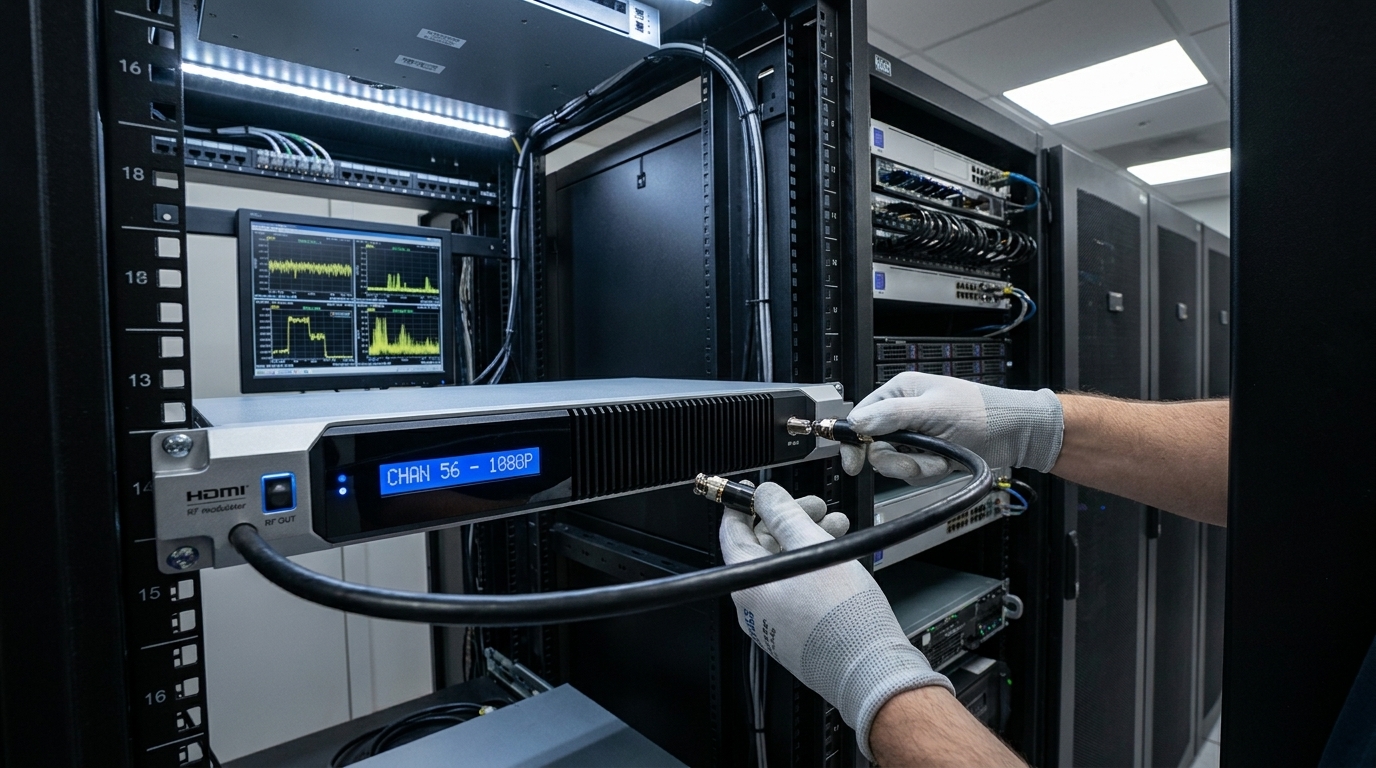 HDMI RF Modulators: Architecture, Setup, Types, and Commercial ApplicationsUTMEL18 May 202645
An HDMI RF modulator is a specialized hardware device designed to encode and modulate baseband digital audio and video signals into radio frequency (RF) formats. By converting an HDMI source into an RF signal, these devices allow high-definition content to be distributed over standard coaxial cable infrastructure.
Read More Explain in Detail the Three Sharp Weapons to Eliminate EMC: Capacitors/Inductors/Magnetic BeadsUTMEL24 December 20214773
Filter capacitors, common mode inductors, and magnetic beads are all typical components in EMC design circuits, and they're the three main tools for reducing electromagnetic interference.The notion of removing the three principal EMC weapons from the design is examined in-depth in this article.
Read More Everything You Need to Know about RF ChipUTMEL14 January 202619915
RF chip is one of the most important cores of cell phone terminals. The RF chip is responsible for RF transceiver, frequency synthesis, and power amplification.
Read More What are Electromagnetic Waves?UTMEL07 December 20215437
Hello everyone, I am Rose. Today I will introduce Electromagnetic waves to you. Electromagnetic waves are a type of electromagnetic energy.It can be considered the most perfect signal carrier because it can be carried without restriction in open space, as well as through metal transmission lines and controlled freely.
Read More Is Electromagnetic Radiation from Base Stations Terrible?UTMEL06 December 20214798
Hello everyone, I am Rose. Today I will introduce electromagnetic radiation to you. Through this article, I hope that everyone can better understand electromagnetic radiation and protect themselves better.
Read More
Subscribe to Utmel !
![HEDS-9701-C51]() HEDS-9701-C51
HEDS-9701-C51Broadcom Limited
![E2E-X10ME1-M1]() E2E-X10ME1-M1
E2E-X10ME1-M1Omron Automation and Safety
![AS5047D-ATSM]() AS5047D-ATSM
AS5047D-ATSMams
![PN5120A0HN1/C2,151]() PN5120A0HN1/C2,151
PN5120A0HN1/C2,151NXP USA Inc.
![MPXY8020A6U]() MPXY8020A6U
MPXY8020A6UNXP USA Inc.
![MT9M034I12STC-DPBR]() MT9M034I12STC-DPBR
MT9M034I12STC-DPBRON Semiconductor
![ATA5577M2330C-DBQ]() ATA5577M2330C-DBQ
ATA5577M2330C-DBQMicrochip Technology
![ACS715LLCTR-30A-T]() ACS715LLCTR-30A-T
ACS715LLCTR-30A-TAllegro MicroSystems
![AR0132AT6C00XPEA0-TPBR]() AR0132AT6C00XPEA0-TPBR
AR0132AT6C00XPEA0-TPBRON Semiconductor
![MT9V024IA7XTM-DR1]() MT9V024IA7XTM-DR1
MT9V024IA7XTM-DR1ON Semiconductor