Product
 Brand
Brand Articles
 Tools
Tools
Is Electromagnetic Radiation from Base Stations Terrible?

Understanding Electromagnetic Radiation! | ICT #5
Ⅰ. What is electromagnetic radiation?
When we talk about electromagnetic waves, we're talking about how much convenience they bring to our lives, especially in the age of 5G and the Internet of Everything. Our mobile phones, computers, iPads, and children's watches are the best examples of electromagnetic wave applications, and they're also the electromagnetic waves that are closest to us. When electromagnetic waves are given a new name, however, everyone may become uneasy. Electromagnetic waves are, in reality, a type of electromagnetic radiation. The word "radiation" stands out in particular. Students who have seen the American television drama Chernobyl must be afraid of the enormous harm that nuclear radiation causes.
Ionizing and non-ionizing electromagnetic radiation are the two types of electromagnetic radiation that exist. Electromagnetic radiation, in a broad sense, covers a large frequency range and wavelength distribution, ranging from tens of meters for longwave radiation to a few angstroms for gamma rays. Radio waves and microwaves, which are utilized in television transmission and wireless communications, as well as ultraviolet, infrared, visible light, X-rays, and gamma rays, are all examples. Ionizing radiation can extract electrons from an object's atoms, modify the object's chemical structure, and cause direct damage to cells in biological matter, whereas non-ionizing radiation cannot. Ionizing radiation includes things like UV, X-rays, and gamma rays. Fortunately, the radio waves and visible light to which we are most exposed in our daily lives are non-ionizing radiation, which is less damaging to human health. We can't, however, turn a blind eye to what's going on.
Ⅱ. What are the health risks associated with mobile phone radiation?
As indicated in the graphic below, the article "Cell phones: Modern Man's Nemesis?" details the forms of damage that mobile phone electromagnetic radiation can bring to the human body:

The cardiovascular system is harmed.
In a 1998 experiment, Braun et al. exposed human volunteers to RF-EMW at 900 MHz for 35 minutes and found elevated blood pressure (systolic and diastolic). Due to vascular depletion, blood pressure increased by 5°10 mmHg, accompanied by a considerable drop in capillary perfusion.
Harm to sleep
Despite finding no significant changes in sleep quality in an experiment conducted by Huber and others in 2000, exposure to 900MHz electromagnetic radiation for 30 minutes will greatly increase the time it takes to fall asleep and cause insomnia for a long period.
Affect neurohormonal secretion
Increase the probability of cancer
One of these is the carcinogenic potential of mobile phone radiation, which has been the subject of numerous research undertaken by various organisations. Hardell et al. (2006) conducted a study based on epidemiological questionnaires in response to public concern that cell phone exposure may cause cancer, and found that astrocytoma (grade III-IV) and acoustic neuroma do show a positive link with mobile phone usage.
There was a woman with multifocal breast cancer in one case. This is odd because she has never had a history of cancer. Despite the fact that this is still a possibility, her doctor observed an unusual pattern in her cancer cells. I examined it more closely and saw that it was the outline of her cellphone. They are perplexed by this. The woman, on the other hand, claimed that she frequently slips her phone in her bra. As a result, they will be able to connect the dots between her cell phone and her cancer cells.
Affect male fertility
Many reports on the impact of mobile phone electromagnetic radiation on the male reproductive system have yet to be clarified. But, do you think you've got what it takes to carry out this experiment? A study of 150 males who had worn their phones on their belts for a long time was conducted in 2009. Scientists discovered that the bone mineral density of the pelvic bone on the side where the phone was carried was lowered in these males.
Ⅲ. Why the weaker the signal, the greater the mobile phone radiation?
Why can't our cell phones communicate wirelessly? The fundamental reason for this is that your mobile phone can communicate with the base station, which then sends your signal to the mobile phone you want to call.
The downlink signal sent by the mobile base station to your mobile phone and the uplink signal sent by the mobile phone to the mobile base station is the two types of electromagnetic radiation involved here. In other words, when we make a phone call, we are exposed to two types of electromagnetic radiation: the base station's radiation and the mobile phone's radiation. Everyone may be more concerned about the base station's radiation, hence there have been many incidents of the base station being demolished in the cell. After all, life and health are the most important considerations. I was terrified when I saw this object above my head.
First, let's discuss the base station's radiation. The average power of a single channel in a modern 5G base station is roughly 5 watts, and it is 320 watts under 64 channels, which is about 55 dBm. It appears to be extremely enormous, however since electromagnetic wave path loss is equal to the square of the distance,

The distance is d, the frequency is f, and the speed of light is c. The path loss is proportional to the distance and frequency traveled.
Let's see how much radiation a 5G base station operating at 2.6G has on us under perfect conditions, using the route loss model above. Based only on free-space path loss, the following is an optimum power value. We can observe that even if the distance between the base station and the human body is only 10 meters, only 0.2 milliwatts of base station radiation reaches the human body.

In fact, 5G base stations emit significantly less radiation to the human body. According to China Telecom, the power and radiation of 5G base stations are intrinsically low, and they are within the state's safety parameters. Within 10 meters of the 5G base station, the current observed radiation is at 1-1.5 uW/cm.
However, because the distance is shorter, the influence of mobile phones on the human body is considerably larger. Many people currently wear their cellphones on their bodies at all times and in all places. According to the current 5G mobile phone transmit power standard, power level 3 in the Sub6G spectrum is 23dBm; power level 2 is 26dBm; power level 1, the potential power is bigger, and there is no specification yet, according to the definition of 3GPP. Currently, commercial use of 5G is mostly centered on the eMBB service provided by mobile phones operating in the Sub6G frequency band. The following will mostly focus on this scenario, dividing the mainstream 5G frequency bands into six categories (such as FDD n1, n3, n8, etc., and TDD n41, n77, n78, etc.). To explain.
5G FDD (SA mode): The maximum transmit power is level 3, which is 23dBm;
5G TDD (SA mode): The maximum transmit power is level 2, which is 26dBm;
5G FDD + 5G TDD CA (SA mode): The maximum transmit power is level 3, which is 23dBm;
5G TDD + 5G TDD CA (SA mode): The maximum transmit power is level 3, which is 23dBm;
4G FDD + 5G TDD DC (NSA mode): The maximum transmit power is level 3, which is 23dBm;
4G TDD + 5G TDD DC (NSA mode): The maximum transmit power defined by R15 is level 3, which is 23dBm, and the maximum transmit power supported by the R16 version is level 2, which is 26dBm.

That is, the worse the mobile phone's signal, the more power that must be transmitted, and the aim of communicating with the base station has been accomplished. This implies that when the signal is weak, your phone's full power is used, which is around 26dBm, or 398 milliwatts, or nearly 1000 times the radiation of a 10-meter base station. According to telecommunications tests, the mobile phone's standby radiation value is about 17.1 microwatts/square centimeter, and it is about 93.1 microwatts/square centimeter during a call. The worse the signal and the higher the radiation rating during a call, the further the phone is from the base station. So, if you're truly scared, instead of destroying the base station, you might as well shatter your phone.
However, rest assured that even when the phone's power increases, its radiation remains inside acceptable limits. Many professionals in the local communications business have indicated that my country's mobile communications base station radiation requirements are compliant with IEC, EU, and US standards; yet, Japan's regulations are 12 to 15 times higher. The reason for this is that selecting base stations in the aforementioned countries and locations is extremely challenging. The base stations offer a wide range of coverage and high transmit power. The United States and Japan are 600 microwatts/square centimeter, the EU is 450 microwatts/square centimeter, and China is 40 microwatts/square centimeter, according to mobile communication base station radiation standards issued by various countries.

In actuality, the base station's radiation is significantly lower than the Chinese requirement, as well as European and American standards. At the same time, 5G base stations are denser, with lower transmit power, higher frequency, and increased propagation loss for each base station. The observed radiation within 10 meters of the 5G base station is roughly 1-1.5 microwatts/cm2, according to actual measurements. The transmit power will be reduced adaptively for terminals close to the base station.
Not only that, but the base station's radiation level is lower than that of many common household equipments. A microwave oven with a reasonably high radiation dose emits 268 microwatts per square centimeter at a distance of 1 meter, yet China's standard for base station radiation emits only 1/6 of the microwave oven radiation.
As a result, the base station isn't terrible. The radiation sources that surround us should be given more consideration.

 UTMEL
UTMEL
We are the professional distributor of electronic components, providing a large variety of products to save you a lot of time, effort, and cost with our efficient self-customized service. careful order preparation fast delivery service
1. How big is the base station's radiation and what is its scope of influence?
The radiation range of the base station is generally based on the base station power setting. In the urban area, there are many users, which is more important than signal quality. Generally, the power is small and there are many base stations. The coverage area is 500m in the suburban area. There are few users, which is more important than signal coverage. Larger, fewer base stations, and a coverage radius of about 10 kilometers.
2. What is the difference between the electromagnetic radiation of 1G, 2G and 3G mobile communication base stations?
Radiation is only related to the working frequency, transmitting frequency, and receiving frequency of the equipment.
Generally speaking, the degree of radiation 1G>2G>3G
The attributes are all electromagnetic radiation.
3. Does 5G base station signal radiation affect the human body?
At present, the signal radiation of 5G base stations is still within the controllable range and does not have much impact on the human body. According to the explanation by the person in charge of the Shenzhen Monitoring Center, in our daily life, there is a lot of radiation, which is mainly divided into two types: ionizing radiation and non-ionizing radiation. Non-ionizing radiation generally refers to radio waves. The energy of this radiation is very low and is not enough to destroy the chemical bonds of substances in the organism. It is safe. What the 5G base station uses is radio waves, that is, non-ionizing radiation. This kind of radio waves, like broadcasting and wireless TV, have no effect on the human body and cause no harm.
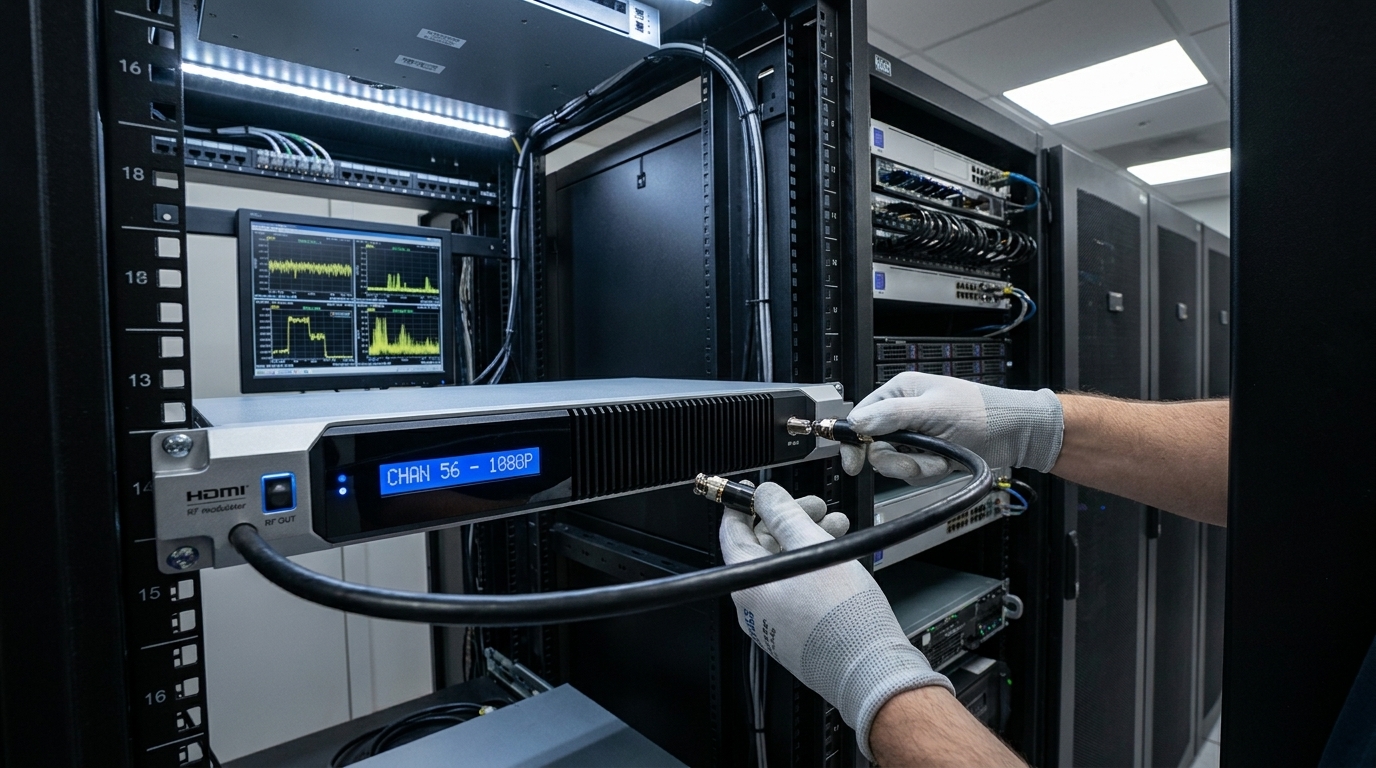 HDMI RF Modulators: Architecture, Setup, Types, and Commercial ApplicationsUTMEL18 May 2026695
An HDMI RF modulator is a specialized hardware device designed to encode and modulate baseband digital audio and video signals into radio frequency (RF) formats. By converting an HDMI source into an RF signal, these devices allow high-definition content to be distributed over standard coaxial cable infrastructure.
Read More Smartphone RF Chips Availability Forecast 2026: Lead-Time Risks and AlternativesUTMEL14 July 2026419
In 2026, the smartphone supply chain faces intense pressure as generative AI chips monopolize wafer and packaging capacity. Consequently, mobile manufacturers endure rising BOM costs and a projected 13.9% drop in shipments. While RF front-end lead times hover at 16 to 26 weeks, procurement teams must adopt multi-sourcing strategies, leverage specialized nodes like RF-SOI, and transition to "Just-in-Case" inventory models to survive.
Read More Explain in Detail the Three Sharp Weapons to Eliminate EMC: Capacitors/Inductors/Magnetic BeadsUTMEL24 December 20214938
Filter capacitors, common mode inductors, and magnetic beads are all typical components in EMC design circuits, and they're the three main tools for reducing electromagnetic interference.The notion of removing the three principal EMC weapons from the design is examined in-depth in this article.
Read More Everything You Need to Know about RF ChipUTMEL14 January 202621384
RF chip is one of the most important cores of cell phone terminals. The RF chip is responsible for RF transceiver, frequency synthesis, and power amplification.
Read More What are Electromagnetic Waves?UTMEL07 December 20215739
Hello everyone, I am Rose. Today I will introduce Electromagnetic waves to you. Electromagnetic waves are a type of electromagnetic energy.It can be considered the most perfect signal carrier because it can be carried without restriction in open space, as well as through metal transmission lines and controlled freely.
Read More
Subscribe to Utmel !
![ENT1J-D28-L00128L]() ENT1J-D28-L00128L
ENT1J-D28-L00128LBourns Inc.
![M24SR16-YMC6T/2]() M24SR16-YMC6T/2
M24SR16-YMC6T/2STMicroelectronics
![LTSR 25-NP]() LTSR 25-NP
LTSR 25-NPLEM USA Inc.
![NOIP1FN2000A-QTI]() NOIP1FN2000A-QTI
NOIP1FN2000A-QTION Semiconductor
![BME680]() BME680
BME680Bosch Sensortec
![E6CP-AG5C-C]() E6CP-AG5C-C
E6CP-AG5C-COmron Automation and Safety
![NOIP1SE0300A-QDI]() NOIP1SE0300A-QDI
NOIP1SE0300A-QDION Semiconductor
![ACS781LLRTR-050U-T]() ACS781LLRTR-050U-T
ACS781LLRTR-050U-TAllegro MicroSystems
![ASX340AT3C00XPED0-DPBR]() ASX340AT3C00XPED0-DPBR
ASX340AT3C00XPED0-DPBRON Semiconductor
![E3Z-L86-IL3]() E3Z-L86-IL3
E3Z-L86-IL3Omron Automation and Safety