
 Product
 Brand
 Articles
 Tools

2026 Q4 Electronic Components Market Analysis Report: Supply, Pricing, and Procurement Outlook
Quick Answer: Are we back in an electronic components shortage in Q4 2026? No—this 2026 Q4 electronic components market analysis shows the industry is experiencing a sharp structural bifurcation rather than a uniform, 2021-style shortage. While Deloitte projects global semiconductor revenue to reach a record US$975 billion in 2026[3], that expansion is heavily concentrated in high-margin AI silicon and High Bandwidth Memory (HBM). Procurement teams face multi-quarter allocation risks and contract price hikes in HBM-impacted DRAM, specialized power semiconductors, mature-node automotive/industrial ICs, and high-capacitance MLCCs, even as standard commercial logic and commodity SMD passives remain broadly balanced.
Upfront Decision Rule for Buyers
Do not apply a single blanket buffer strategy across your Bill of Materials (BOM) during Q4 2026 budgeting. Before locking Q1 and Q2 2027 purchase orders, separate structural capacity cannibalization—where wafer foundries and component makers permanently convert legacy production lines or face fixed 8-inch equipment bottlenecks—from temporary logistics or seasonal ripples. Buffer and dual-source only the structurally constrained lines while keeping commodity components on disciplined, demand-driven replenishment schedules.
Executive Takeaways for Q4 2026 Planning
Macro Value vs. Volume Divergence: Record industry dollar revenues are propelled by high average selling price (ASP) AI accelerators and advanced memory, masking modest physical silicon-wafer shipment growth across traditional nodes.
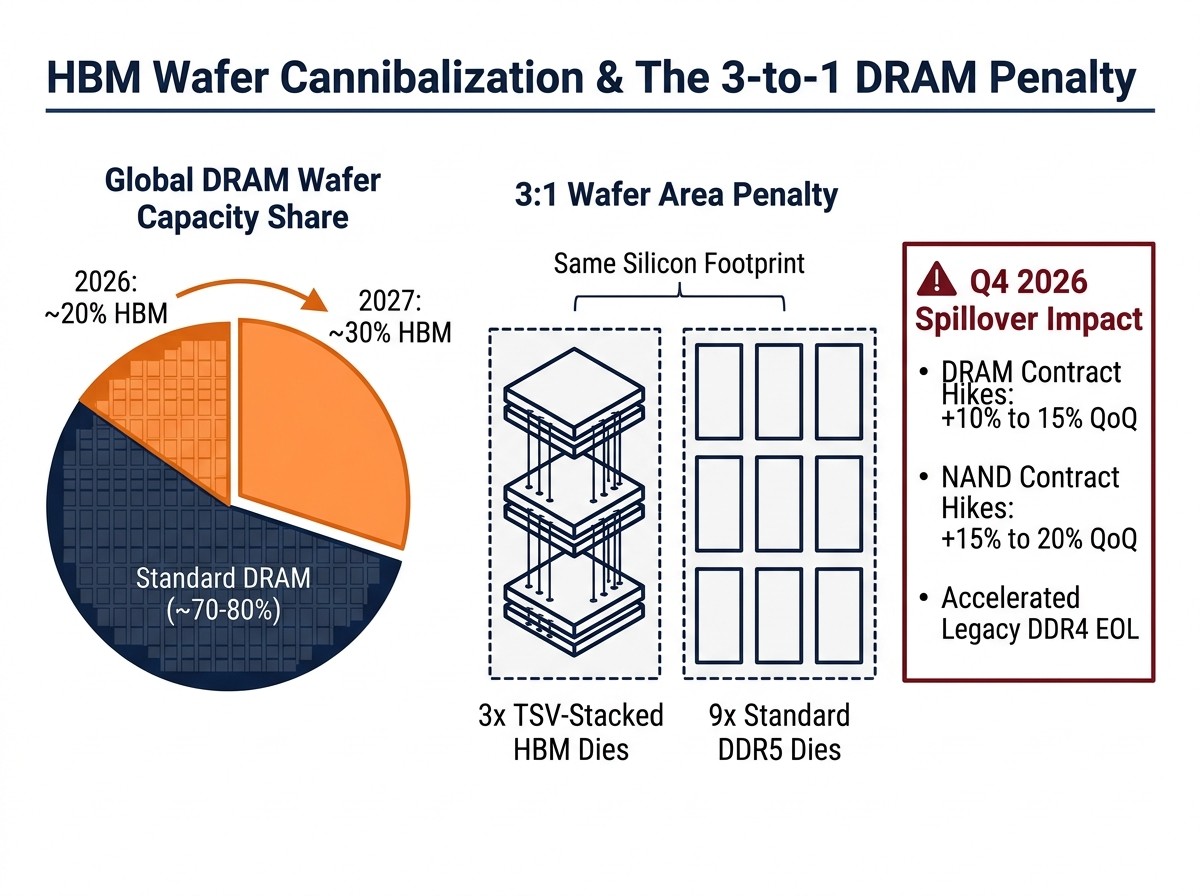
Memory Spillover & Contract Hikes: According to TrendForce, HBM consumes roughly 20% of global DRAM wafer capacity in 2026 and is projected to approach nearly 30% in 2027[4]. Combined with a 3-to-1 wafer area penalty, this reallocation is tightening conventional DDR5, LPDDR5, and legacy DDR4 supply while driving Q4 contract price hikes.
The 8-Inch & Specialty Bottleneck: Power discretes, industrial power management ICs (PMICs), automotive microcontrollers (MCUs), and high-reliability multi-layer ceramic capacitors (MLCCs) face localized strain driven by wafer-size mismatches and dense per-system socket requirements.
Targeted Mitigation Over Panic Buying: Protecting 2027 production schedules requires MPN-level BOM triage, proactive Approved Vendor List (AVL) expansion, dual-footprint PCB layouts, and hybrid sourcing that pairs authorized distribution with vetted independent channel support.
Macro Market Reality Check: Why Record 2026 Semiconductor Revenue Masks Selective Supply Risk
Headline semiconductor revenue growth in 2026 creates a dangerous optical illusion for electronics buyers: record dollar sales suggest either a market-wide component shortage or a massive wave of across-the-board fab capacity expansion. In reality, 2026 revenue growth is overwhelmingly concentrated in low-volume, high-cost AI infrastructure silicon, leaving legacy and standard commercial component capacity largely unexpanded—and vulnerable to line conversions.
Value Concentration vs. Physical Wafer Shipments
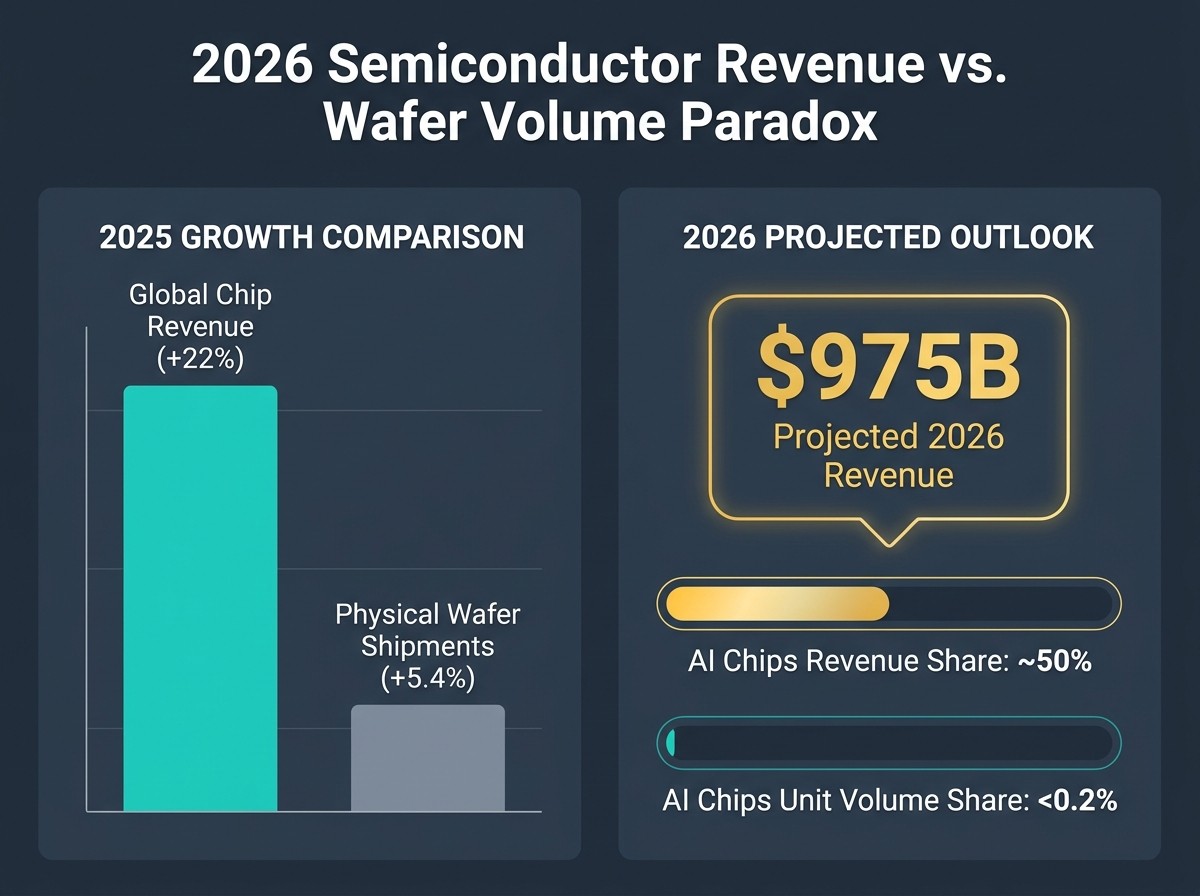
To understand why certain parts are on strict allocation while others sit in distributor inventory, procurement leaders must examine the Revenue vs. Wafer Volume Paradox. In its 2026 Global Semiconductor Industry Outlook, Deloitte projects global semiconductor sales to climb roughly 25%–26% year-over-year to an all-time high of US$975 billion in 2026. Crucially, Deloitte notes that high-margin generative AI chips account for nearly half of total industry revenue while representing less than 0.2% of total semiconductor unit volume[3].
This divergence was already visible entering the year: Deloitte reports that while global chip revenues rose an expected 22% in 2025, physical silicon-wafer shipments increased by only an estimated 5.4%. Because capital expenditure is heavily funneled into leading-edge 12-inch logic, Through-Silicon Via (TSV) HBM stacks, and advanced packaging, physical wafer output for mature-node analog, discrete, and legacy memory devices is growing slowly—or actively shrinking as lines are repurposed.
Sentiment Shifts and Cooling Momentum Outside AI Hotspots
Industry survey data underscores this uneven landscape. Earlier in the year, the ECIA February 2026 Industry Pulse survey recorded an overall electronic component sales sentiment index of 139.7[8] (up from 138.0 in January), with 71% of surveyed industry participants projecting positive sales growth in Q1 and 72% in Q2. However, even amid that optimism, the share of respondents reporting increasing semiconductor lead times eased from 52% down to 39%—meaning 61% of participants saw lead times holding steady or improving across standard categories, with persistent tightness concentrated in advanced memory.
Furthermore, historical ECIA survey analysis reported by EE Times illustrates how rapidly broader electronic component sales momentum stalls[7] when traditional industrial and manufacturing purchasing manager indices (PMI) soften outside high-growth technology pockets. For Q4 2026 buyers, the lesson is clear: macro industry growth does not translate into uniform supply tightness, nor does sluggish general demand protect specialized BOM lines from AI-driven capacity cannibalization.
Why Market Forecasts and AI Summaries Disagree on 2026 Market Size
When presenting Q4 market intelligence to executive leadership, procurement managers frequently encounter conflicting 2026 market valuations across search engines and industry reports—ranging from under US$100 billion to US$975 billion or well over US$1.5 trillion. These discrepancies stem from three structural reporting differences:
Pure Semiconductors vs. Broader Component Ecosystems: Official trade statistics bodies such as the World Semiconductor Trade Statistics (WSTS)[1] and the Semiconductor Industry Association (SIA)[2], along with consulting outlooks like Deloitte's US$975 billion projection, track active semiconductors (integrated circuits, discretes, optoelectronics, and sensors). By contrast, broader market research aggregators either isolate sub-segments (such as standalone passive and interconnect components) or bundle active chips together with electromechanical assemblies, printed circuit boards, and contract electronics manufacturing services (EMS).
Release-Cycle Revisions: Official bodies like WSTS update their Blue Book historical data and seasonal forecasts multiple times a year as quarterly fab billings are finalized. Comparing an early-year baseline against a late-year revision produces sharply different growth percentages.
ASP Inflation vs. Unit Output: Because DRAM and NAND contract prices are rising quarter-over-quarter, dollar-denominated market forecasts expand even when total bit or unit shipments remain flat. Buyers should benchmark Q4 procurement strategies against wafer and packaging allocation rather than headline dollar CAGRs.
Q4 2026 Procurement Decision Framework: Structural vs. Temporary Tightness
Effective risk management in Q4 2026 requires classifying every critical BOM line by its shortage root cause before negotiating 2027 supplier agreements. Structural tightness occurs when manufacturers permanently reallocate wafer capacity toward higher-margin products or face rigid equipment boundaries (such as 8-inch versus 12-inch wafer lines), whereas temporary tightness arises from seasonal Q4 order bunching, regional transit delays, or short-term distributor buffer depletion.
Key Technical and Commercial Variables to Evaluate
Before locking orders, engineering and procurement teams should score components across three operational dimensions:
Fab Node & Wafer Substrate: Is the component produced on expanding 12-inch advanced nodes, constrained 8-inch mature analog/BCD (Bipolar-CMOS-DMOS) lines, or specialized wide-bandgap substrates like Silicon Carbide (SiC) and Gallium Nitride (GaN)?
Packaging & Dielectric Complexity: Does the device rely on bottlenecked back-end assembly—such as advanced CoWoS/TSV packaging for AI silicon or high-layer-count, high-temperature ceramic firing kilns for automotive and server MLCCs—or standard surface-mount device (SMD) packaging?
AVL & Pin-to-Pin Flexibility: Is the part a single-source, firmware-locked proprietary IC (such as a custom PMIC or functional-safety MCU) or a multi-source, industry-standard footprint with drop-in replacements already validated on your Approved Vendor List?
The 2x2 Q4 2026 BOM Triage Matrix
Use the matrix below to match each BOM tier to the appropriate purchasing and engineering action for Q4 2026 and H1 2027:
| Shortage Root Cause | Single-Source / Custom Footprint (Low Design Flexibility) | Multi-Source / Standard Footprint (High Design Flexibility) |
|---|---|---|
| Structural Tightness (Fab line conversion, 8-inch wafer limits, specialty dielectrics) | Quadrant 1: Critical Structural Risk • Examples: Custom server/automotive PMICs, AEC-Q100 MCUs, high-density LPDDR5/DDR5, SiC traction modules. • Q4 Action: Lock rolling 2027 forecasts now; establish targeted safety stock; initiate dual-footprint PCB redesigns for next board spin. | Quadrant 2: Allocation & Price-Hike Risk • Examples: Legacy DDR4 memory, high-capacitance X7R/X6S MLCCs, 8-inch power MOSFETs and IGBTs. • Q4 Action: Expand AVL immediately; pre-qualify drop-in alternates; split allocations across authorized and vetted independent channels. |
| Temporary or Balanced Supply (Seasonal Q4 demand ripples, logistics delays, stable capacity) | Quadrant 3: Localized Delivery Risk • Examples: Niche sensors, specialized connectors, or commercial FPGAs facing short-term Q4 packaging slips. • Q4 Action: Use authorized or vetted independent spot stock for immediate bridge builds; avoid multi-quarter take-or-pay volume locks. | Quadrant 4: Standard Commodity Flow • Examples: Standard 0402/0603 SMD resistors, general commercial op-amps, standard 74-series logic. • Q4 Action: Maintain normal Just-in-Time (JIT) cadence; benchmark quarterly pricing without inflating buffer inventory. |
Who Should NOT Buffer in Quadrant 4: OEMs and EMS providers with high working-capital carrying costs or rapid product revision cycles should strictly avoid building multi-quarter safety stocks on Quadrant 4 commodity parts. Tying up cash in abundant SMD resistors or standard logic starves budget needed for Quadrant 1 structural bottlenecks and distorts upstream demand signals.
Q4 2026 Category-by-Category Supply, Lead-Time, and Pricing Outlook
Supply risk entering 2027 is defined by intra-category divergence: components that look similar on a spreadsheet behave in opposite ways depending on their voltage rating, dielectric grade, or wafer node. The master comparison table below summarizes the Q4 2026 outlook across the four core component groups.
| Component Category | Constrained Sub-Tiers (High Risk) | Balanced Sub-Tiers (Low / Moderate Risk) | Primary Structural Driver | Q4 Pricing & Allocation Trend | Recommended Sourcing Strategy & Who Should Avoid Long Locks |
|---|---|---|---|---|---|
| Memory (HBM & DRAM) | HBM3e/HBM4, high-density server DDR5, mobile/embedded LPDDR5, legacy industrial DDR4 | Standard consumer/PC configurations, low-density commodity flash | HBM absorbing ~20% of DRAM wafers in 2026 (rising toward ~30% in 2027); 3-to-1 wafer penalty | Upward: Analyst-projected double-digit QoQ contract hikes across DRAM and NAND Flash in Q4 | Lock 2027 rolling allocations and DDR4 bridge stock; consumer OEMs with flexible BOMs should avoid fixed peak-price multi-quarter locks. |
| Power Semiconductors | High-voltage SiC MOSFETs, GaN FETs, automotive IGBT modules, 8-inch power discretes | Low-voltage commercial silicon diodes, standard small-signal transistors | AI server power delivery (PUE) + EV traction/bidirectional inverters + 8-inch fab constraints | Selective Tightness: Firm pricing and extended multi-quarter factory allocations on specialty power | Qualify secondary discrete footprints and secure buffer stock; buyers of low-voltage consumer discretes can remain on standard schedules. |
| MCUs & PMICs | Automotive AEC-Q100 MCUs (some >20 weeks), multiphase server PMICs, 8-inch BCD analog ICs | General-purpose 8-bit/32-bit commercial MCUs, standard LDO linear regulators | 2023–2024 underinvestment in mature 8-inch fabs + high socket density in EVs and AI racks | Bifurcated: Stable on commercial nodes; selective allocation and firm pricing on mature 8-inch/auto grades | Audit MPN wafer nodes and pre-qualify pin-compatible alternates; commercial appliance builders should cross-reference rather than overpay. |
| Passive Components | High-capacitance X6S/X7R MLCCs, AEC-Q200 auto MLCCs, high-current power inductors | Standard commercial 0402/0603 SMD resistors and general-purpose capacitors | Line reallocation toward high-margin AI server & EV passives; flat standard capacity & rising material costs | Targeted Strain: Allocation pressure on high-cap/high-temp MLCCs; stable pricing on commodity SMD | Pre-approve multiple MLCC vendors on AVL for high-cap values; never panic-order commodity SMD passives. |
Memory & HBM Spillover (Server DDR5, LPDDR5, and Legacy DDR4)
The memory sector represents the single largest driver of structural supply tightness and price inflation in Q4 2026. According to industry capacity projections reported by TrendForce, High Bandwidth Memory (HBM) accounts for roughly 20% of total industry DRAM wafer capacity in 2026 and is on track to approach nearly 30% in 2027.
Why does a 20% to 30% capacity share create such acute spillover across the rest of the memory market? The answer lies in the 3-to-1 wafer penalty: because HBM dies are physically larger, incorporate complex Through-Silicon Via (TSV) interconnects, and experience lower multi-die stacking yields than conventional memory, producing one bit of HBM consumes roughly three times the silicon wafer area of standard DDR5. For a deeper technical breakdown of how this ratio reshapes supplier roadmaps, see our dedicated analysis on 2026 DRAM and the 3-to-1 HBM Rule: Market Supply Analysis and B2B Procurement Guide.
As Samsung, SK Hynix, and Micron dedicate cleanroom space to high-margin HBM and enterprise server DDR5, conventional DRAM bit shipment growth remains restricted. Research from TrendForce on memory supplier pricing power[5] and 2027 DRAM structural tightness[6] confirms that suppliers are enforcing substantial contract price increases and dynamically balancing wafer allocations based on negotiated pricing—driving analyst-projected double-digit quarter-over-quarter contract price hikes (frequently estimated around 10%–15% QoQ for DRAM and 15%–20% QoQ for NAND Flash) in Q4 2026.
Application Boundary & Spillover: This wafer reallocation directly squeezes two adjacent buyer groups:
Mobile, Edge AI, and Embedded Systems: Low-power memory lines face mounting lead-time and allocation pressure as fabs juggle LPDDR5X/LPDDR5 output against HBM priorities. Procurement teams sourcing low-power memory can review specific mitigation tactics in our guide to LPDDR5 Memory 2026: Lead Times, HBM Impact, and Procurement Strategies.
Legacy Industrial & Networking OEMs: Because memory makers are converting older DDR4 lines to advanced nodes, industrial, medical, and telecom platforms designed around fixed DDR4 densities face accelerating Product Change Notifications (PCNs) and Last-Time-Buy (LTB) windows.
Best For / Who Should Not Overcommit: Industrial OEMs bound to legacy DDR4 or single-density LPDDR5 must secure bridge inventory and validate second-source die revisions immediately. Conversely, consumer electronics buyers with modular storage architectures should avoid locking long-term fixed-price contracts at peak Q4 spot premiums without quarterly downward price-adjustment clauses.
Power Semiconductors (SiC, GaN, Discretes, and the 8-Inch Wafer Divide)
Power semiconductors are experiencing selective, application-driven tightness entering 2027. On the demand side, two megatrends are colliding: hyperscale AI data centers are overhauling rack-level power delivery architectures to improve Power Usage Effectiveness (PUE) under extreme GPU thermal loads, while electric vehicles and renewable grid storage installations continue to absorb high-voltage switching capacity.
On the supply side, the industry faces a structural equipment divide highlighted in semiconductor manufacturing analysis (OEMstron): while digital compute (CPUs, GPUs) and memory chips have long scaled onto high-throughput 12-inch (300mm) silicon wafers, a massive share of power discretes, MOSFETs, IGBTs, and rectifiers remain anchored to mature 8-inch (200mm) wafer lines or specialized 6-inch/8-inch Silicon Carbide (SiC) and Gallium Nitride (GaN) substrates. Because 8-inch fab capacity saw limited capital expansion during the 2023–2024 inventory correction, surging demand from AI server power supplies and automotive electronics quickly tightens factory allocations.
Real-World OEM BOM Case Study (2026 EV Powertrain & Bidirectional Architecture): To see why automotive power semiconductor consumption remains structurally elevated even when global vehicle unit growth moderates, consider the production architecture of the 2026 Audi Q4 e-tron. Rather than relying on a single motor inverter, its all-wheel-drive high-voltage architecture integrates dual traction drive units—a rear Permanent-Magnet Synchronous Machine (
APP550) featuring dense hairpin stator windings and a dedicated top-mounted power electronics inverter housing, paired with a front Asynchronous Motor (AKA150) and its own power electronics module. Beyond traction, the vehicle's On-Board Charger and AC-DC voltage converter support full bidirectional Vehicle-to-Home (V2H) solar storage integration as well as Vehicle-to-Load (V2L) discharging (delivering up to 2.3 kW via a standard exterior adapter or 3.6 kW via a camping adapter and an integrated trunk domestic AC socket), alongside a high-voltage auxiliary heater and high-voltage A/C compressor. Every one of these subsystems multiplies the per-vehicle BOM count of high-voltage SiC/IGBT switches, isolated gate drivers, and current-sensing discretes.Sourcing Options: Buyers managing extended factory allocations on high-voltage MOSFETs, IGBTs, or wide-bandgap devices should consult our full breakdown in Power Semiconductors Shortage Outlook 2026: Supply, Lead Times, and Sourcing Options.
The video below provides a real-world engineering walkthrough of the 2026 Audi Q4 e-tron platform, illustrating how dual-motor inverter housings, bidirectional V2H/V2L charging hardware, battery management controllers, and multi-display digital cockpits expand per-vehicle power semiconductor, MCU, and PMIC socket counts:
Audi Q4 e-tron redesign 2026 features specs
Microcontrollers (MCUs) and Power Management ICs (PMICs)
In Q4 2026, the MCU and PMIC landscape is sharply divided between normalized commercial silicon and constrained mature-node controllers. Following underinvestment in 8-inch wafer fab capacity during the 2023–2024 downturn, market commentary from Astute Group notes that selective tightness has returned across analog ICs, discrete power devices, and automotive/industrial microcontrollers—with certain specialized MCU lead times extending beyond 20 weeks and pressuring second-half manufacturing schedules.
While general-purpose 8-bit and 32-bit consumer MCUs and standard linear regulators remain readily available, multiphase server PMICs, industrial analog controllers, and automotive-grade (AEC-Q100) MCUs fabricated on mature 8-inch BCD processes or constrained QFN/BGA back-end packaging lines require close lead-time monitoring.
Real-World OEM BOM Case Study (Battery Management, Multi-Display Cockpits & Digital Lighting): The trickle-down of flagship electronic features into compact and mid-size platforms is dramatically expanding MCU and PMIC socket density per assembly. In the 2026 Audi Q4 e-tron technical breakdown, the liquid-cooled high-voltage lithium-ion battery pack (63 kWh or 82 kWh gross) relies on a central Battery Management Controller (BMC) coordinating multiple module-level Cell Management Controllers (CMCs). During bidirectional V2H home energy storage operation, this BMC/CMC network must actively regulate bidirectional load curves within a strict 20% to 80% State of Charge (SOC) corridor to preserve cell longevity, enforce a hard 20% Minimum SOC threshold cutoff during grid-outage emergency backup, and execute automated departure-timer overrides (halting home discharge at 04:00 AM to pull grid power and reach 100% target SOC by 06:00 AM).
Simultaneously, interior and exterior digitization adds dozens of specialized controller and driver sockets: a curved cockpit pairing an 11.9-inch Virtual Cockpit with a 12.8-inch MMI touch center display, a 10.9-inch / 12-inch front passenger display, an Augmented Reality (AR) Head-Up Display, cloud swarm-data ADAS with Trained Parking and smartphone Remote Park Assist, and Second-Generation Digital OLED rear lights comprising six digital OLED panels that drive 284 individually controlled segments via dedicated PCBs and control electronics.Who Should / Should Not Lock Allocations: Automotive Tier-1 suppliers and industrial automation OEMs subject to strict AEC-Q100 or functional-safety qualifications must maintain multi-quarter rolling visibility. Conversely, commercial appliance and consumer device manufacturers using general-purpose MCUs should prioritize pin-compatible cross-referencing over paying spot-market premiums. Review validated cross-reference strategies in our MCU & Power Management Availability Forecast 2026: Lead-Time Risks and Alternatives.
Passive Components: High-Reliability MLCCs vs. Commodity SMD
Passive components represent the most frequent "boundary trap" in Q4 2026 BOM audits. As highlighted in supply-chain analysis by Fusion Worldwide, passive component risk in 2026 is not a broad-based shortage like 2018 or 2021–2023, but a targeted capacity shift. Tier-1 passive manufacturers are actively redirecting kiln and production line capacity toward high-margin, high-capacitance, high-temperature MLCCs (such as specialized X6S, X7R, and AEC-Q200 automotive grades) and high-current power inductors demanded by AI GPU server boards and EV powertrains. Meanwhile, capacity expansion for standard commercial passives remains flat and raw material costs continue to edge upward.
Constrained vs. Balanced Boundary: High-layer-count decoupling MLCCs used around AI accelerators, custom ASICs, and automotive inverters face localized allocation pressure and firm pricing. By contrast, standard commercial SMD chip resistors and general-purpose low-capacitance MLCCs (0402/0603 commercial grades) remain broadly accessible.
Sourcing Guidance: Do not treat "passives" as a single procurement bucket. Pre-qualify multiple manufacturer part numbers (MPNs) for every high-capacitance, high-voltage, or automotive-grade passive on your BOM while keeping standard commercial SMD parts on automated replenishment. Explore full category guidance in our SMD Components Outlook 2026: Supply, Lead Times, and Sourcing Options.
Hidden Risks, Outdated Advice, and Common Procurement Mistakes Entering 2027
Applying pandemic-era blanket inventory buffers—or reacting to alarmist spot-broker marketing claiming an across-the-board 40-plus-week semiconductor crisis—exposes OEMs to severe working-capital bloat on commodity parts while leaving single-source structural bottlenecks completely unprotected. Procurement and supply-chain leads should guard against five operational traps in Q4 2026:
Falling for Broker-Seeded "Blanket Shortage" Narratives: A significant portion of online market commentary and social media chatter is published by gray-market brokers generalizing worst-case AI memory or specialty automotive lead times across the entire electronics landscape to trigger panic buying. Cross-checking those claims against ECIA survey data reported by Passive Components Blog and EE Times confirms that general component momentum outside AI and high-spec tiers has moderated.
Relying on Category Averages Instead of MPN Granularity: A PCB assembly that is 98% populated by readily available commodity SMD parts will still suffer a costly line-down if a single multiphase PMIC, battery management controller, or high-capacitance X7R MLCC enters allocation (Astute Group). Category-level lead-time averages hide MPN-level pinch points.
Triggering the Bullwhip Effect on Commodity Lines: When buyers place duplicate buffer orders across multiple distributors out of generalized shortage anxiety, distorted demand information ripples upstream from distributors to component manufacturers. This bullwhip effect creates artificial short-term allocation spikes followed by painful inventory write-downs in 2027.
Missing Accelerated EOL and Last-Time-Buy (LTB) Windows: Because memory and analog fabs are actively converting legacy DDR4 and older 8-inch production lines toward higher-margin AI and power products (TrendForce), supplier Product Change Notification (PCN) and End-of-Life (EOL) timelines are compressing. Waiting until Q1 2027 to respond to an LTB notice often forces an emergency board redesign.
Ignoring Trim Fragmentation and Unvetted Spot-Market Traceability: Complex hardware platforms increasingly suffer from option-mix volatility. In our 2026 EV case study, for instance, headline electronics—such as the AR Head-Up Display, front passenger screen, Digital OLED 2.0 rear lighting, V2H DC wallbox hardware dependencies, and peak DC fast-charging tiers (160 kW base vs. 165 kW mid-tier vs. 185 kW on top quattro performance models)—are split across optional equipment packages and trim tiers. When sudden customer demand shifts toward high-trim configurations catch procurement teams short on specialized ICs, turning to unvetted gray-market brokers introduces severe risks of counterfeit remarks, compromised Moisture Sensitivity Level (MSL) packaging, and missing manufacturer lot traceability.
Actionable Q4 2026 Procurement & Engineering Playbook (Preparing for 2027)
To protect Q1 and Q2 2027 production schedules without inflating working capital, OEM and ODM teams should execute a synchronized four-pillar operational playbook: locking rolling forecasts on structurally constrained silicon, expanding AVLs before allocation hits, designing dual-footprint PCBs, and deploying a hybrid authorized-plus-independent distribution strategy.
Pillar 1: Tiered Rolling Forecasts and Targeted Buffer Sizing
Segment your BOM using the 2x2 Triage Matrix. Share rolling 6-to-12-month demand forecasts and build targeted safety stocks exclusively for Quadrant 1 and Quadrant 2 structural bottlenecks—specifically HBM-impacted DRAM (DDR5, LPDDR5, legacy DDR4), SiC/GaN and 8-inch power discretes, and mature-node automotive/industrial MCUs and PMICs. Weigh inventory carrying costs directly against the daily revenue loss of a production line shutdown.
Pillar 2: Proactive AVL Expansion and Pre-Qualified Drop-In Alternates
Do not wait for a formal factory allocation notice in Q1 2027 to begin qualifying second sources. During Q4 2026, instruct component engineering teams to validate at least two to three approved alternates on the AVL for every high-capacitance MLCC (X6S/X7R/AEC-Q200), power inductor, discrete MOSFET, and standard voltage regulator.
Pillar 3: Design-for-Availability and Dual-Footprint PCB Layouts
Bridge the organizational silo between hardware design engineers and commodity buyers during schematic capture and board layout. Where single-source MCUs, PMICs, or power stages cannot be avoided, implement dual-footprint PCB layouts (overlapping or adjacent pad geometries and configurable resistor straps) capable of accepting alternate package types or pinouts without requiring a multi-month PCB re-spin and EMC re-certification. Also pay close attention to ergonomic and mechanical BOM shifts—such as the automotive industry's return from capacitive touch surfaces to tactile physical steering-wheel roller controls—which alter switch and sensor qualification lists.
Pillar 4: Hybrid Channel Sourcing and Lifecycle Verification with Utmel Electronic Components
Relying on a single sourcing channel creates blind spots in a bifurcated market. Comparing the three primary procurement models highlights why leading OEMs adopt a hybrid approach:
Authorized Franchise Only:
Strengths: Direct factory warranty, predictable contract pricing, and guaranteed provenance.
Drawbacks: Rigid allocation ceilings, inflexible minimum order quantities (MOQs), and multi-quarter factory lead times when structural capacity shifts occur.
Best For: Baseline rolling production schedules and long-horizon scheduled orders.
Unvetted Spot Brokers:
Strengths: Immediate claims of hard-to-find stock.
Drawbacks: High exposure to counterfeit or remarked components, degraded MSL integrity, zero lifecycle support, and predatory spot pricing.
Who Should Not Choose This: Any OEM building mission-critical automotive, medical, industrial, or enterprise hardware where field failures carry safety or warranty liability.
Hybrid Authorized & Vetted Independent Distribution (Utmel Electronic Components):
Strengths: Combines authorized channel reliability with agile, market-aware independent sourcing across a broad catalog of active semiconductors, memory, power devices, and passive components.
Best For: Procurement teams that need real-time lead-time benchmarking, cross-reference engineering support, bridge inventory during factory allocation pinches, and strict incoming quality and lot-traceability verification. Partnering with Utmel Electronic Components allows B2B buyers to resolve single-line BOM shortages and navigate EOL transitions without compromising quality standards.
Final Datasheet, Lifecycle & Order Verification Checklist (For Q4 2026 / Q1 2027 Locks)
Run every critical MPN through this five-point verification checklist before signing Q4 2026 and Q1 2027 purchase commitments:
Factory vs. Distributor Lead-Time Split:
YES: You have verified both current distributor buffer stock and raw factory fabrication/assembly lead times for the exact MPN and package code.
NO: Request an MPN-level lead-time breakdown before assuming category averages apply to your build schedule.
Wafer & Node Vulnerability Audit:
YES: You have identified whether the component relies on a constrained 8-inch mature analog/BCD line, a legacy DRAM node (DDR4) undergoing HBM conversion, or a specialty SiC/high-capacitance dielectric line.
NO: Flag the part for engineering review and move it into Quadrant 1 or 2 buffer planning.
Lifecycle, PCN & LTB Status Check:
YES: You have confirmed active production status and screened for recent Product Change Notifications (PCNs), die shrinks, or Last-Time-Buy (LTB) notices.
NO: Audit lifecycle status immediately with your distribution partner to prevent mid-2027 obsolescence surprises.
Datasheet Parametric & Qualification Boundary Review:
YES: Proposed AVL alternates have been verified across voltage derating curves, thermal resistance, ceramic temperature coefficients (e.g., ensuring X7R or X6S stability under DC bias), and AEC-Q100/Q200 environmental ratings.
NO: Treat proposed cross-references as candidates for engineering sign-off rather than guaranteed drop-in replacements.
Traceability & Incoming Quality Protocol:
YES: Any bridge inventory sourced outside standard factory rolling schedules includes documented manufacturer lot traceability, date-code verification, MSL packaging inspection, and RoHS/REACH compliance records.
NO: Do not release the shipment to the SMT production floor until independent laboratory and visual inspection are completed.
Frequently Asked Questions (Q4 2026 Components Outlook)
Are we back in an electronic components shortage situation in Q4 2026?
No. Q4 2026 is a structurally bifurcated market, not a universal 2021-style shortage. While Deloitte projects global semiconductor revenue to reach US$975 billion in 2026 due to high-value AI chips, ECIA survey data shows lead-time pressure easing for most standard parts. Supply tightness is strictly concentrated in HBM-impacted DRAM, specialized power semiconductors, mature 8-inch MCUs/PMICs, and high-capacitance MLCCs.
How is HBM demand affecting standard DRAM and LPDDR5 pricing in late 2026?
According to TrendForce, HBM accounts for roughly 20% of industry DRAM wafer capacity in 2026 and is projected to approach nearly 30% in 2027. Because HBM requires roughly three times the wafer area per bit of conventional DRAM, this capacity reallocation restricts standard bit supply and enables memory makers to push through analyst-projected double-digit QoQ contract hikes across DRAM and NAND Flash in Q4 2026.
What occurs when distorted demand information ripples through the electronics supply chain, and how can buyers avoid it?
When distorted demand signals ripple from OEMs through distributors to component fabs, it triggers the bullwhip effect—where panic double-ordering creates artificial short-term shortages followed by severe inventory gluts. Buyers can avoid this by restricting safety buffers strictly to structurally constrained MPNs (such as legacy DDR4, SiC power devices, and custom PMICs) while keeping commodity SMD passives on normal replenishment schedules.
What does it mean to break down and reduce component lead time for 2027 production?
Total component lead time consists of front-end wafer fabrication, back-end assembly and test, transit logistics, and internal engineering qualification. Because buyers cannot compress a foundry's physical wafer cycle, reducing effective lead-time risk for 2027 requires pre-qualifying drop-in AVL alternates, designing dual-footprint PCB layouts, and partnering with hybrid distributors like Utmel Electronic Components for buffered, traceable stock.
Sources and references used for this guide
World Semiconductor Trade Statistics (WSTS)
Source type: industry institution
Used for: Official industry baseline for global semiconductor trade statistics and historical Blue Book market tracking.
Caution: Official statistical body; note that published forecasts vary by release cycle and scope.Semiconductor Market Data | SIA
Source type: industry institution
Used for: Industry association benchmark data on global and regional semiconductor sales.
Caution: Macro semiconductor industry resource; does not track distributor spot pricing or SKU-level lead times.2026 Global Semiconductor Industry Outlook
Source type: research source
Used for: Supports the US$975 billion 2026 global semiconductor sales projection and the 2025 divergence between chip revenue growth (22%) and silicon-wafer shipment growth (5.4%).
Caution: Single authoritative consulting outlook for these specific figures; attribute explicitly to Deloitte.[News] Samsung Sees HBM Taking Nearly 30% of Industry DRAM Capacity in 2027, Up from 20% Currently
Source type: research source
Used for: Supports the structural reallocation of DRAM wafer capacity toward HBM (~20% in 2026 projected to approach nearly 30% in 2027).
Caution: Market research report citing industry capacity projections; attribute directly to TrendForce.HBM Suppliers Seize Pricing Power as AI Demand Fuels ...
Source type: research source
Used for: Supports analysis of memory supplier contract price hikes and capacity balancing between HBM and conventional DRAM.
Caution: TrendForce research summary; use to support directional pricing and allocation power rather than spot-market quotes.Analyzing 2027 DRAM Structural Tightness and NAND ...
Source type: research source
Used for: Supports forward-looking structural tightness in DRAM supply entering 2027.
Caution: TrendForce research summary; pair with MPN-level verification for specific memory configurations.Component Sales Momentum Stalls
Source type: reputable professional source
Used for: Demonstrates via monthly ECIA survey coverage that broader electronic component sales momentum cooled outside AI-driven segments.
Caution: Reflects broad component market sentiment at the time of the survey rather than SKU-specific allocation.ECIA February 2026 Signals Strong Component Growth
Source type: reputable professional source
Used for: Provides context on early-2026 ECIA Industry Pulse growth sentiment for electronic and passive components.
Caution: Early-2026 sentiment baseline; contrast with later EE Times ECIA coverage to show market bifurcation.
 UTMEL

We are the professional distributor of electronic components, providing a large variety of products to save you a lot of time, effort, and cost with our efficient self-customized service. careful order preparation fast delivery service
 Modeling Wide Band-Gap Semiconductors for Enhanced PerformanceRakesh Kumar, Ph.D.31 January 20243882
The article delves into the challenges faced by silicon-based power electronic devices and highlights the potential of wide band-gap semiconductors. It also emphasizes the importance of modeling power semiconductor devices and provides insights into various models. For electrical energy conversion to be dependable and effective, power electronics and semiconductor device technologies are essential.
Read More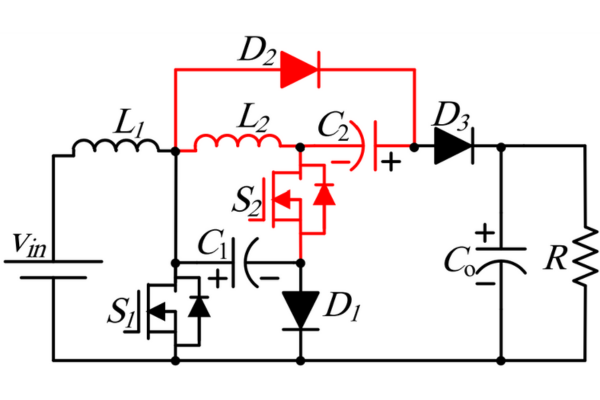 Optimizing Energy Management with Non-Isolated DC-DC ConvertersRakesh Kumar, Ph.D.04 February 20243509
The article classifies DC-DC converters and discusses the benefits and limitations of them. It proposes a modified DC-DC converter topology that combines the Cuk and Positive Output Super Lift Luo topologies to achieve a higher voltage gain with fewer components.
Read More ‘6G Networks’ - Pioneering the Next Era of Connectivity And InnovationRakesh Kumar, Ph.D.18 March 20243843
The article provides a comprehensive overview of the evolving landscape of mobile networks, the requirements that will shape the future of mobile communication, and the innovative technologies driving the transition to 6G.
Read More Review of IoT-Based Smart Home Security Systems- Part 1Rakesh Kumar, Ph.D.28 March 20244316
The article discusses the evolution of IoT-based smart home security systems, integrating advanced technologies like Raspberry Pi, PIR sensors, and voice recognition for enhanced user experience and efficiency.
Read More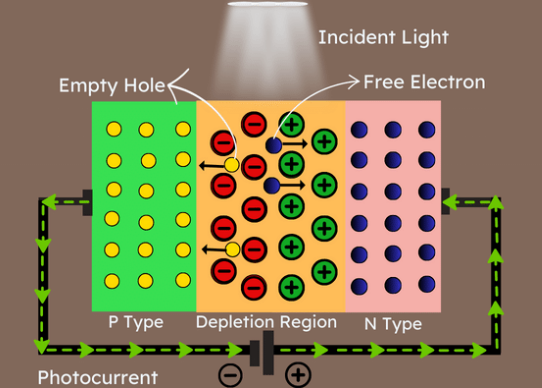 Understanding Photodiodes: Working Principles and Applications - Part 2Rakesh Kumar, Ph.D.24 May 20245587
The article provides a comprehensive overview of photodiodes, focusing on their operational principles, key factors affecting their efficiency, advantages, and disadvantages, and highlights their diverse applications.
Read More
Subscribe to Utmel !
![FC110075924]()
![OT-200-M6-L22]() OT-200-M6-L22
Blockmaster
![T30UXIA-806636]() T30UXIA-806636
Banner Engineering
![MC000750]() MC000750
Multicomp
![MC000775]() MC000775
Multicomp
![MC000773]() MC000773
Multicomp
![M83519/2-18]() M83519/2-18
TE Connectivity
![63-0000-0197]() 63-0000-0197
Amphenol
![148783-EA]() 148783-EA
Alpha Wire
![0054414499]() 0054414499
Apex Tool Group