Product
 Brand
Brand Articles
 Tools
Tools
Smd Components Outlook 2026: Supply, Lead Times, and Sourcing Options
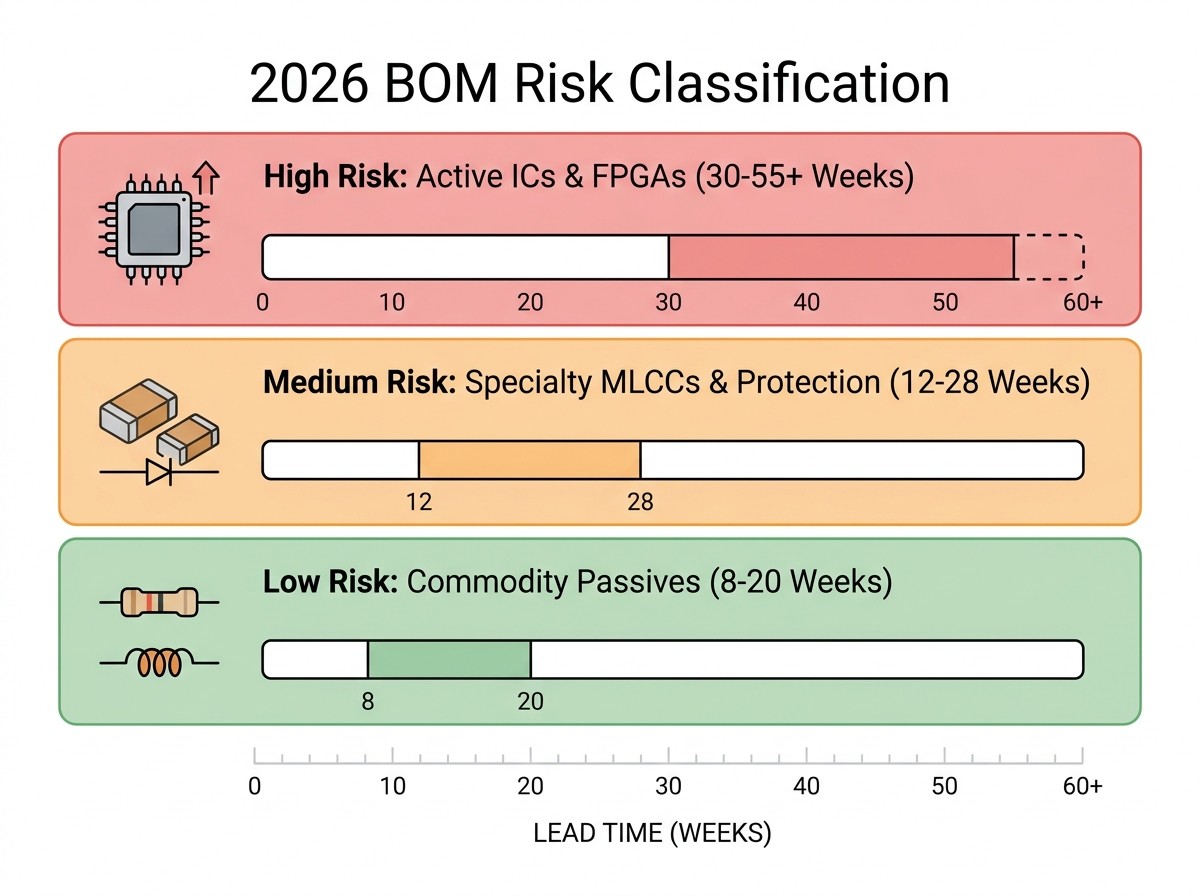
Quick Answer: The 2026 shortage is not a repeat of the 2020–2022 crisis. It is a highly selective supply crunch driven by AI infrastructure buildout and automotive electrification. Active ICs — MCUs, power management ICs, FPGAs — face lead times of 30–55+ weeks. In contrast, commodity SMD passives (standard MLCCs, general-purpose resistors) remain relatively stable at 12–20 weeks. However, specialty MLCCs, high-reliability resistors, and circuit protection components are tightening rapidly due to demand from AI servers and EV charging infrastructure. Procurement teams that treat the entire BOM as a single risk block will waste capital and miss critical windows. The winning approach: extend planning horizons to 18–24 months, integrate pin-compatible substitutions into the design phase, and secure passive-component buffers through vetted distributors.
Reader’s Decision Framework: Triage Your BOM Risk
| Risk Level | Component Category | Typical Lead Time (Early 2026) | Recommended Action |
|---|---|---|---|
| High | MCUs, Power ICs, FPGAs, High-Bandwidth Memory | 30–55+ weeks | Secure 18‑month pipeline; qualify alternates immediately |
| Medium | High-capacitance automotive MLCCs, power inductors, TVS diodes, fuses | 12–28 weeks | Dual‑source now; lock in distributor allocations |
| Low | Standard consumer-grade resistors, commodity MLCCs (0402/0603, X7R, C0G) | 8–20 weeks | Maintain standard buffer stock; monitor for trend changes |
The 2026 Electronic Component Market: What’s Actually in Shortage?
The narrative of a “global component shortage” is misleading. What we are seeing is a concentrated demand shock from two sectors: hyperscaler AI infrastructure and automotive electrification.
Hyperscaler CapEx is absorbing production bandwidth. Combined capital spending on AI infrastructure by Amazon, Microsoft, Alphabet, and Meta is projected to reach $635–$725 billion in 2026, according to industry market reports. That level of investment monopolizes leading-edge foundry capacity — especially TSMC’s 3nm and 4nm nodes — and the advanced packaging (CoWoS) needed to assemble AI accelerators.
The hidden bottlenecks are not in the fabs. Real choke points are in raw materials and specialty substrates. Industry reports indicate that China accounts for a dominant share of the global refined gallium supply, with some estimates as high as 98%, and U.S. gallium prices rose sharply in early 2026 following tightened export restrictions, adding pressure to rising electronic component costs, according to market sources. Gallium is critical for GaN power chips used in AI server racks, and its shortage directly constrains the power-delivery chain — affecting the attached SMD components (inductors, MLCCs, circuit protection) that surround those chips.
At the same time, automotive demand remains structurally high. Every EV uses thousands of MLCCs and circuit protection devices, and 55% of TVS diode demand growth in 2026 comes directly from EV penetration and high‑voltage charging infrastructure, according to Business Research Insights.
Bottom line: The shortage is real, but it is selective. Know which components on your BOM are actually at risk.
The Next Chip Shortage: Warning Signs Already Appearing in 2026
Lead Time Breakdown: Active ICs vs. Passive Components
Lead times fluctuate weekly, but the following ranges are based on distributor reports and market intelligence from early 2026. Use them as planning benchmarks, not guarantees.
| Estimated Lead Time (Q1–Q2 2026) | Supply Trend | Risk Level |
|---|---|---|
| Automotive MCUs (ST, NXP, Infineon): 40–55+ weeks | Extending | High |
| Power Management ICs (PMICs, GaN drivers): 30–50 weeks | Tightening | High |
| FPGAs / CPLDs: 40–52 weeks | Stable, long | High |
| High-Bandwidth Memory (HBM, DDR5): 26–52 weeks | Constrained | High |
| Specialty / Automotive MLCCs (high temp, low loss): 12–28 weeks | Tightening | Medium |
| TVS Diodes, Fuses, Varistors (circuit protection): 12–24 weeks | Extending | Medium |
| Standard MLCCs (X5R, X7R, consumer grade): 8–20 weeks | Stable | Low |
| Thick Film Resistors, General‑Purpose Inductors: 8–16 weeks | Stable | Low |
Key insight: The gap between active IC lead times and passive component lead times is the largest it has been since 2021. While engineers wrestle with 50+ week MCU allocations, commodity passives can often be sourced within three to five months — but only if you plan ahead.
SMD Components Trends 2026: MLCCs and Circuit Protection
MLCC Capacitors Trends 2026
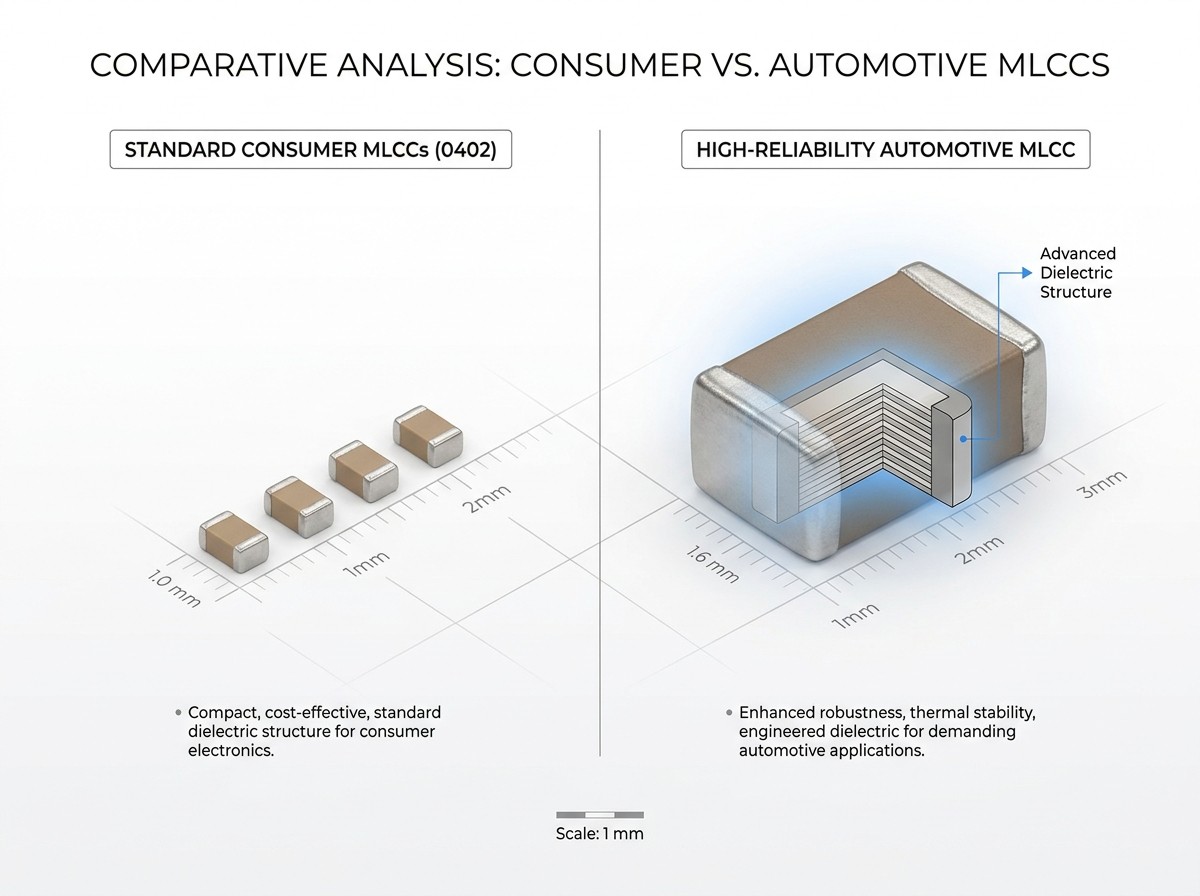
The MLCC market is splitting into two distinct lanes. Standard consumer-grade MLCCs (0402/0603, low capacitance, X5R/X7R) remain a buyer’s market. Supply is ample, pricing is competitive, and lead times hover in the 8–20‑week range.
Specialty MLCCs are a different story. The Asia-Pacific special MLCC market — high‑temperature, low‑loss, high‑voltage parts used in AI servers and EV inverters — is forecast to grow from $1.29 billion in 2026 to $2.72 billion by 2034 (13.4% CAGR) per Intel Market Research. This growth is outpacing capacity additions from top manufacturers. As a result, lead times for these parts are drifting toward the 20–28‑week mark, and spot pricing is rising.
If your design uses AI server‑grade MLCCs — for example, the high‑density power delivery stages in NVIDIA GB200 or Rubin racks — you should plan for extended lead times. UTMEL’s guide on AI server MLCCs explains why a single rack can require over 600,000 capacitors.
When evaluating substitution options, pay close attention to dielectric type and voltage rating. A good refresher is the ceramic capacitor basics article — it covers what to check when swapping X7R for C0G or vice versa.
Circuit Protection Components Trends 2026
Circuit protection — TVS diodes, fuses, PTC resettable devices, varistors — is experiencing a structural tightening. The driver is twofold:
Automotive electrification: High‑voltage EV charging and onboard power distribution demand more robust protection devices. As noted, 55% of TVS demand growth comes from EV infrastructure.
Industrial and telecom surge requirements: Newer Ethernet standards and 5G base stations require tighter clamping voltages and higher energy absorption.
Lead times for many TVS diodes and fuses are now in the 12–24‑week range, and allocated capacity is common for automotive‑qualified parts. Buyers who treat circuit protection as a low‑priority, last‑minute BOM item are being caught short.
Tip: Before finalizing a board design, identify every protection component and verify its lifecycle status. Components near end‑of‑life (EOL) or on allocation will be harder to replace later. If your design uses a ballast resistor, review the ballast resistor classification and working principle to ensure your spec can be matched by an alternative.
Common Sourcing Mistakes in 2026
Mistake 1: Panic Buying and Double Ordering
When lead times stretch, the instinct is to order double quantities from multiple distributors. That behavior — logistics directors stockpiling in parallel — is exactly what turned a minor substrate pinch in Q3 2020 into a $210B global shortage in 2021. Don’t repeat the cycle. Instead, invest in accurate forecasting and single‑source commitments with vetted distributors.
Mistake 2: Treating the BOM as a Monolith
Applying a blanket “everything is in shortage” assumption wastes money on commodity passives while leaving critical active ICs under‑sourced. Use the triage framework above to allocate procurement effort proportionally.
Mistake 3: Ignoring Counterfeit Risk on the Open Market
When authorized channels show 50‑week lead times, buyers often turn to unvetted brokers. The risk of counterfeit or substandard parts spikes in such conditions. Always require traceability, Certificates of Conformance (CoC), and incoming inspection per ISO 9001 / AS6081. UTMEL’s fast RFQ process includes verification of supply chain authenticity.
4 Procurement Strategies to Manage Extended Lead Times
1. Extend Horizons to 18–24 Months
The era of placing orders for critical components four weeks before assembly is over. Provide your electronics manufacturing service (EMS) or contract manufacturer (CM) with rolling 18‑ to 24‑month demand forecasts. This allows them to secure factory allocations and book substrate capacity.
2. Design for Flexible Footprints
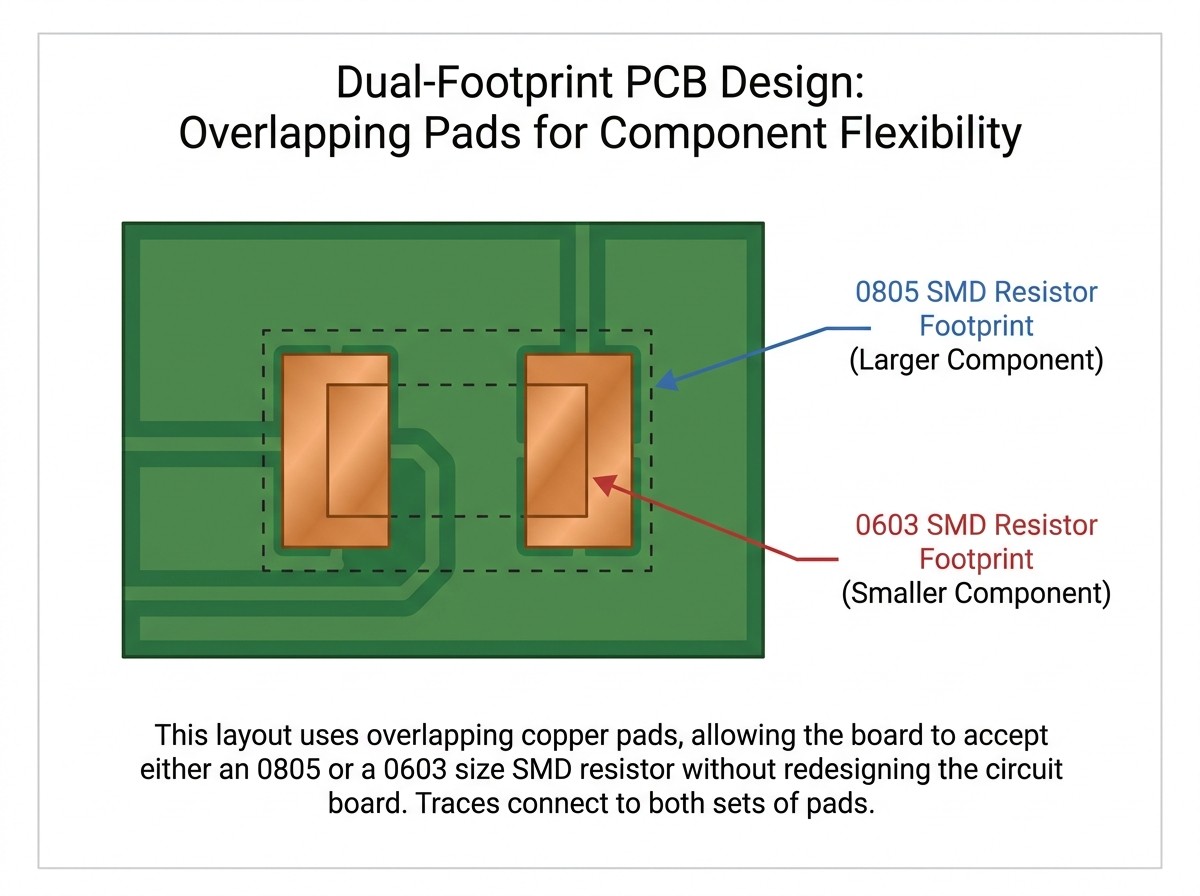
Hardware engineers should layout PCB pads so that pin‑compatible or form‑fit‑function equivalents can be dropped in without a board spin. Multi‑footprint layouts for MCUs and power ICs are a proven hedge. For resistors, standard case sizes and common values increase the pool of drop‑in replacements — the 2.2k ohm resistor color code guide is a handy reference when verifying alternates.
3. Implement Dual Sourcing During Design
Qualifying a secondary source before production begins turns a 55‑week lead time into a simple purchasing switch. Engage with distributors like UTMEL early to identify form‑fit‑function equivalents for each BOM line.
4. Monitor Lifecycle and EOL Continuously
Many OEMs use parts with years left in the market until a sudden EOL notice from the manufacturer. Track lifecycle status (Active, NRND, EOL, Obsolete) at the part‑number level. Build strategic buffer stock for components flagged as “Last Time Buy” or in allocation.
The Role of BOM-Level Substitution and Reliable Sourcing
BOM‑level substitution is not about swapping parts blindly — it’s about making safe, verified replacements that keep production running while you wait for original parts.
When to substitute:
When the original part is on allocation with a 40+ week lead time.
When a pin‑compatible, electrically equivalent alternative is available from a reputable manufacturer.
When the application is non‑safety‑critical (or after proper re‑qualification for safety‑critical designs).
When a full redesign is required:
If the form factor changes (e.g., different package footprint).
If critical electrical parameters (voltage rating, capacitance value, temperature range) cannot be matched.
If the part is obsolete and no drop‑in exists.
UTMEL specializes in providing in‑stock capacitors, resistors, inductors, and circuit protection with real‑time lead‑time checks and fast RFQ quotes. Our BOM‑level substitution support helps engineers find equivalent parts from multiple manufacturers, reducing the risk of single‑source dependencies.
Final Checklist for Electronics Sourcing Teams
[ ] Verify lifecycle status of every active IC and critical passive component (NRND, EOL, allocated)
[ ] Cross‑reference dielectric material (X7R vs. C0G) and voltage rating before approving MLCC substitutions
[ ] Confirm traceability and Certificates of Conformance (CoC) for all open‑market purchases
[ ] Update procurement forecasts for memory, MCU, and high‑capacitance passive part numbers to an 18‑month horizon
[ ] Engage with a trusted distributor (like UTMEL) for passive-component buffer stock and substitution support
[ ] Design flexible PCB footprints and qualify alternates during the design phase — not after production starts
Frequently Asked Questions
Which SMD components are facing the worst shortages in 2026?
Active ICs — automotive MCUs, power management ICs, and FPGAs — have the longest lead times (30–55+ weeks). Specialty MLCCs for AI servers and EVs are tightening, while standard commodity passives remain relatively stable.
Why are electronic component costs rising?
Raw material constraints, particularly gallium and antimony, along with increased logistics costs and capacity prioritization for high‑margin sectors (AI, automotive), are driving cost increases across the supply chain.
How can I source allocated or obsolete SMD components safely?
Work with a franchised or vetted distributor that can supply traceable, certified parts. Avoid unvetted brokers. Use BOM‑level substitution to find form‑fit‑function alternatives from different manufacturers.
Sources and references used for this guide
Electronic Component Lead Times 2026: Full Guide | GlobX
Source type: vendor article
Used for: Estimated lead time ranges for active and passive components in 2026.
Caution: Distributor blog; use for general market sentiment, not official manufacturer guarantees.Why Electronic Component Costs Are Rising in 2026
Source type: vendor article
Used for: Context on rising component costs and the need for continuous lifecycle tracking.
Caution: Software vendor blog; use for procurement strategy context.State of the Electronic Components Market: March 2026
Source type: vendor article
Used for: Data on lead time index volatility and market shifts in early 2026.
Caution: Market intelligence vendor; represents aggregated data trends.Electronic Component Shortage Update: March 2026
Source type: vendor article
Used for: Specific examples of extended MCU lead times (up to 55 weeks).
Caution: Distributor blog; lead times fluctuate daily.Electronic Component Shortage 2026: Vishay, Onsemi & Infineon Risks
Source type: vendor article
Used for: Context on passive and discrete component stability compared to peak shortage years.
Caution: Distributor blog; not an official statement from Vishay or Onsemi.
 UTMEL
UTMEL
We are the professional distributor of electronic components, providing a large variety of products to save you a lot of time, effort, and cost with our efficient self-customized service. careful order preparation fast delivery service
 Pull-Down Circuit Guide: Working Principle, Resistor Value, Circuit Design, and ApplicationsUTMEL26 June 2026640
Learn how pull-down circuits work, how to choose a pull-down resistor value, and how to design reliable microcontroller inputs, MOSFET gates, reset pins, and sensor interfaces.
Read More Smd Components Outlook 2026: Supply, Lead Times, and Sourcing OptionsUTMEL21 July 20261440
The 2026 electronic component market faces a selective shortage driven by AI infrastructure and electric vehicles. While active ICs face lead times up to 55 weeks, commodity SMD passives remain stable at 12–20 weeks. This procurement guide details key trends in MLCCs and circuit protection, outlining actionable strategy solutions like dual-sourcing and flexible footprints to mitigate supply chain risks.
Read More Decoupling Capacitor Placement Guide: Maximizing Power Integrity in High-Speed Digital PCBsUTMEL12 August 2026696
This technical guide details how to optimize decoupling capacitor layout to maximize Power Integrity (PI) in high-speed digital PCBs. It explains how switching ICs induce power rail noise, the physics of parasitic loop inductance, and the impact of stackup plane separation. Layout engineers will find practical strategies for via placement, anti-resonance mitigation across multi-value capacitor networks, and sourcing reliable low-ESR MLCCs.
Read More sar-adc-reference-driver-selection-managing-dynamic-kickback-noise-loop-stabilityUTMEL17 September 2026466
Precision SAR ADCs present high-speed dynamic switched-capacitor loads that demand instantaneous transient currents during bit trials. This guide details how to size local decoupling capacitors accounting for MLCC DC bias derating, stabilize reference buffers using dual-loop in-loop compensation, and minimize multiplicative noise degradation. It also provides layout directives and dynamic bench verification protocols across sampling rate sweeps and burst modes.
Read More HF PCB Circuit Design 10 QuestionsUTMEL16 March 20225590
Hello everyone, I am Rose. Today I want to give you a full explanation about PCB design. I Hope the following ten questions will give you a satisfied answer.
Read More
Subscribe to Utmel !
![PEC550-12-074RD]() PEC550-12-074RD
PEC550-12-074RDBel Power
![CQB75-300S05-C]() CQB75-300S05-C
CQB75-300S05-CCincon
![ABC601-1T28]() ABC601-1T28
ABC601-1T28Bel Power
![CR00140-02]() CR00140-02
CR00140-02Trenz Electronic
![MS-10-12]() MS-10-12
MS-10-12TDK Lambda
![MDR-100-15]() MDR-100-15
MDR-100-15Advantech
![101188004]() 101188004
101188004Integrated Power Designs
![101191901]() 101191901
101191901Integrated Power Designs
![IMP4-1U0-4LL-4QE-00-A]() IMP4-1U0-4LL-4QE-00-A
IMP4-1U0-4LL-4QE-00-AArtesyn Embedded Power
![MP1-97503]() MP1-97503
MP1-97503Vicor