

 Product
 Brand
Brand Articles
 Tools
Tools
AI Server MLCCs: Why NVIDIA Rubin Racks Require Over 600,000 Capacitors
Data center power design dictates that next-generation AI servers require exponentially more passive components than traditional enterprise hardware. The exponential growth in AI server MLCC (Multi-Layer Ceramic Capacitor) demand is driven by extreme power density exceeding 120kW per rack, the shift to 48V power architectures, and the massive data movement requirements of NVLink switches and 1.6T optical modules. Consequently, procurement professionals and hardware engineers face unprecedented supply chain constraints. This analysis breaks down the architectural differences driving MLCC usage from the GB300 to the Rubin generation, the specific high-capacitance MLCCs required for AI power delivery networks (PDNs), and the strategies for navigating tightening lead times.
The Scale of AI Server MLCC Demand
AI server MLCC demand has scaled from 2,000 units in standard enterprise servers to over 600,000 units in next-generation liquid-cooled AI racks, driven by the need for localized power decoupling in high-density compute environments.
Standard Servers vs. NVIDIA GB300
The baseline for passive component usage has shifted dramatically. According to 2026 industry reports from BlockBeats and 7SEtronic citing Murata Manufacturing, a single NVIDIA GB300 server requires approximately 30,000 MLCCs. Furthermore, a fully populated NVL72 server rack consumes up to 440,000 MLCCs.
To put this specification into a real-world scenario: with 440,000 MLCCs, a single rack requires more passive component placement time during PCB assembly than 200 standard enterprise servers combined. This volume forces contract manufacturers to entirely re-evaluate their surface-mount technology (SMT) line throughput.
Crossing the 600,000-Unit Threshold
The transition to the next architecture accelerates this trajectory. Based on May 2026 teardown reports from Morgan Stanley and Goldman Sachs (via BigGo Finance), the NVIDIA Rubin VR200 NVL72 rack requires upwards of 600,000 MLCCs. This represents a greater than 30% increase in capacitor usage over the GB300 generation.
Understanding Calculation Scopes
When analyzing these figures, the calculation scope dictates the final count. A compute tray alone accounts for the majority of the high-capacitance MLCCs. However, the 600,000+ figure encompasses the entire rack ecosystem, including optical modules, network switches, and power shelves.
MLCC Usage & Power Density by Server Generation
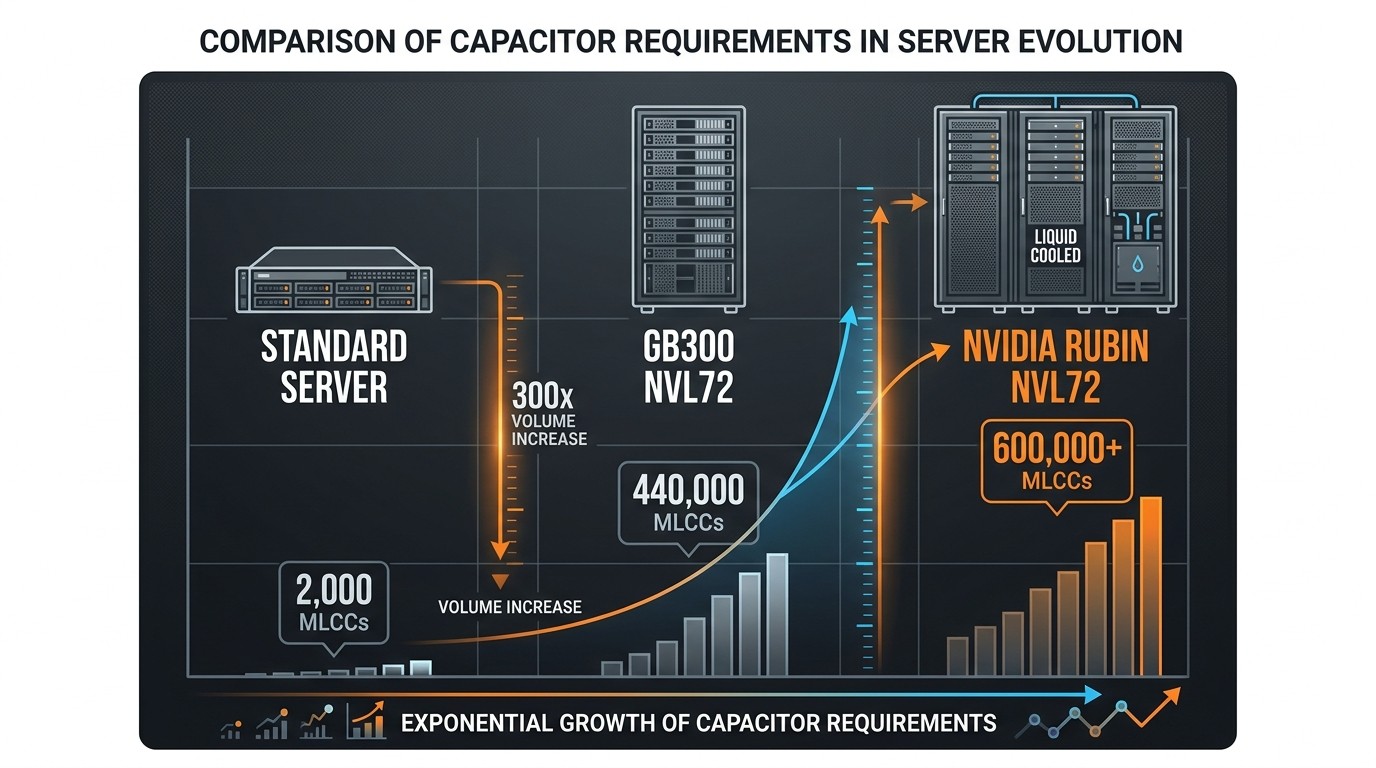
| Server Type | Est. MLCCs per Server | Est. MLCCs per Rack | Rack Power Density (kW) | Cooling Method | Primary Bottleneck |
|---|---|---|---|---|---|
| Standard Enterprise | 1,800 - 2,500 | ~100,000 | 10 - 15 kW | Air | CPU Compute |
| NVIDIA H100 | ~10,000 | ~300,000 | 40 - 50 kW | Air / Liquid | GPU Compute |
| NVIDIA GB300 NVL72 | ~30,000 | ~440,000 | 100 - 120 kW | Liquid | Memory Bandwidth |
| NVIDIA Rubin NVL72 | ~40,000+ | 600,000 - 700,000 | 120 - 130 kW+ | 100% Liquid | Interconnect / Power |
Engineering Drivers for High Capacitor Counts
The primary engineering driver for increased MLCC usage is the shift in AI bottlenecks from raw compute to memory bandwidth and interconnects, requiring massive transient power response across the entire server architecture.
The Shift in AI Bottlenecks
While many guides suggest that AI performance is strictly a function of raw processing power, professional workflows actually require massive memory bandwidth because data starvation leaves compute cores idle. Experts point out that "the bottleneck isn't only math anymore. It's everything around the math." Scaling AI requires compute, memory bandwidth, and interconnects operating simultaneously. This sustained data movement requires continuous, high-amperage power delivery, preventing the system from entering low-power idle states.
GPU Power Delivery Networks and Transient Response
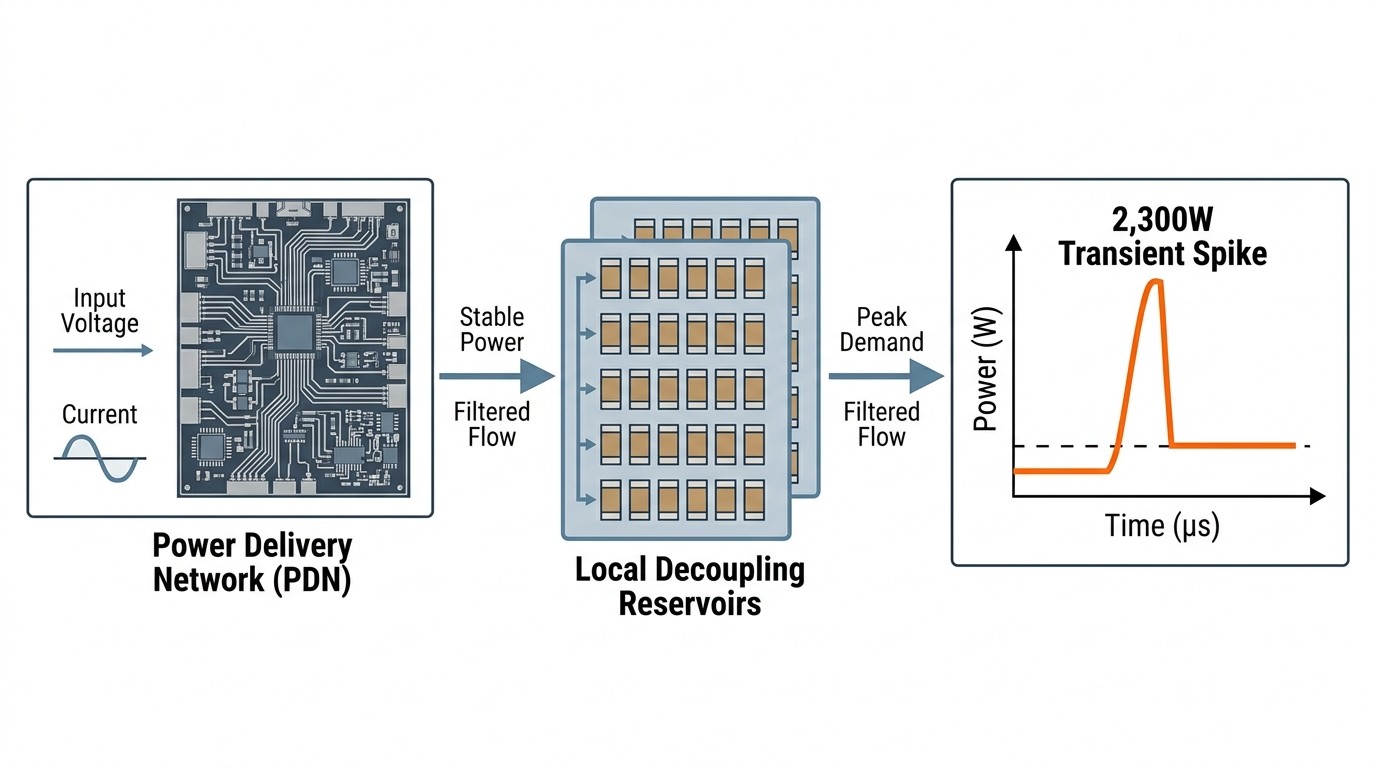
According to late 2025 and early 2026 hardware reports from SemiAnalysis and TweakTown, the NVIDIA Rubin VR200 GPU's Total Graphics Power (TGP) was increased from an initial 1,800W to 2,300W to maintain a competitive edge against AMD's MI450X.
This 2,300W power draw requires an incredibly robust Power Delivery Network (PDN). When a GPU transitions from idle to full load in microseconds, it creates an instantaneous current spike. High-capacitance MLCCs act as localized energy reservoirs, discharging rapidly to prevent voltage droop that would otherwise crash the processor.
📺 NVIDIA Rubin Explained: The 6-Chip AI “Factory” That Changes Training, Inference, and Power
Agentic AI and Mixture of Experts
Software architecture directly dictates hardware component selection. In visual stress tests, we observed that Mixture of Experts (MoE) models are brutal on communication and coordination. Because different "expert" mini-models handle different tokens, the constant switching and data routing across the rack creates harsh, fluctuating power demands. This environment tests MLCCs to their limits, requiring low Equivalent Series Resistance (ESR) to minimize power loss as heat.
Component Breakdown of MLCC Usage
MLCCs in AI racks are distributed across the GPU power delivery network, the central CPU traffic controllers, high-speed interconnect switches, and peripheral optical modules required for data transmission.
GPUs and Vera CPUs
The standard 1U enterprise server remains the industry standard for distributed microservices, and is an excellent choice for data centers that need flexible, low-power compute nodes. However, for AI infrastructure operators who prioritize massive parallel processing for LLM training, the liquid-cooled high-density rack architecture offers a more space-efficient path.
Within this architecture, the GPU consumes the highest volume of capacitors. Conversely, the CPU is often overlooked in component calculations. While the GPU handles the matrix multiplication, the Vera CPU acts as the crucial traffic controller keeping the GPUs fed and tasks scheduled. The CPU complex requires its own dedicated array of decoupling capacitors to maintain stability during high-frequency task switching.
NVLink 6 Switches
NVIDIA Official Specifications and the GIGABYTE 2026 Solutions Catalog confirm that the 6th generation NVLink provides 3.6 TB/s of bidirectional bandwidth per GPU, aggregating to 260 TB/s across a full Vera Rubin NVL72 rack.
The goal of the NVLink 6 switch is to create the illusion that 72 separate GPUs are actually just one massive, coordinated machine. Maintaining signal integrity at 3.6 TB/s speeds necessitates top-tier, high-frequency MLCCs around the switch ASICs to filter electromagnetic interference (EMI) and noise.
800G and 1.6T Optical Modules
The transition to Co-Packaged Optics (CPO) and silicon photonics adds significant peripheral MLCC demand. Optical modules operating at 800G and 1.6T require ultra-small 0201 and 01005 case size MLCCs for signal integrity, noise filtering, and local power decoupling within highly constrained physical footprints.
Technical Specifications for Next-Generation AI MLCCs
Next-generation AI servers require high-capacitance, low-ESR MLCCs utilizing X7R and X7S dielectrics to withstand extreme thermal environments and mitigate acoustic noise in high-density power delivery networks.
High Capacitance and Low ESR/ESL Requirements
The shift to 800VDC/48V power architectures requires specific capacitor values. Engineers rely heavily on 22μF, 47μF, and 100μF MLCCs to handle the step-down conversion from the rack power shelf to the individual compute trays. Low Equivalent Series Inductance (ESL) is critical here; high ESL delays the capacitor's ability to deliver current, negating its usefulness during microsecond transient spikes.
Dielectric Selection in High-Density Racks
This high-density architecture is not designed for edge computing deployments in uncontrolled environments. Even within climate-controlled data centers, rack power densities of 120–130 kW create extreme localized thermal challenges. Consequently, engineers specify X7R and X7S Class 2 dielectrics over standard X5R variants. X7S dielectrics maintain their capacitance values more reliably at higher operating temperatures, preventing thermal degradation near the microchannel lids of the liquid cooling system.
Mitigating Acoustic Noise and Piezoelectric Effects
Users on community forums often report that acoustic noise from high-capacitance MLCCs in server Voltage Regulator Modules (VRMs) can become a significant issue. This occurs due to the piezoelectric effect, where the ceramic material physically expands and contracts under fluctuating AC voltages, transferring vibrations to the PCB. Engineers mitigate this by utilizing specialized MLCCs with thicker bottom terminations or by mounting capacitors on opposite sides of the PCB to cancel out the physical vibrations.
Supply Chain Reality and Procurement Risks
The surge in AI server production has created a K-shaped recovery in passive components, extending lead times for high-end MLCCs beyond 20 weeks and increasing the risk of counterfeit parts entering the supply chain.
The K-Shaped Recovery in Passive Components
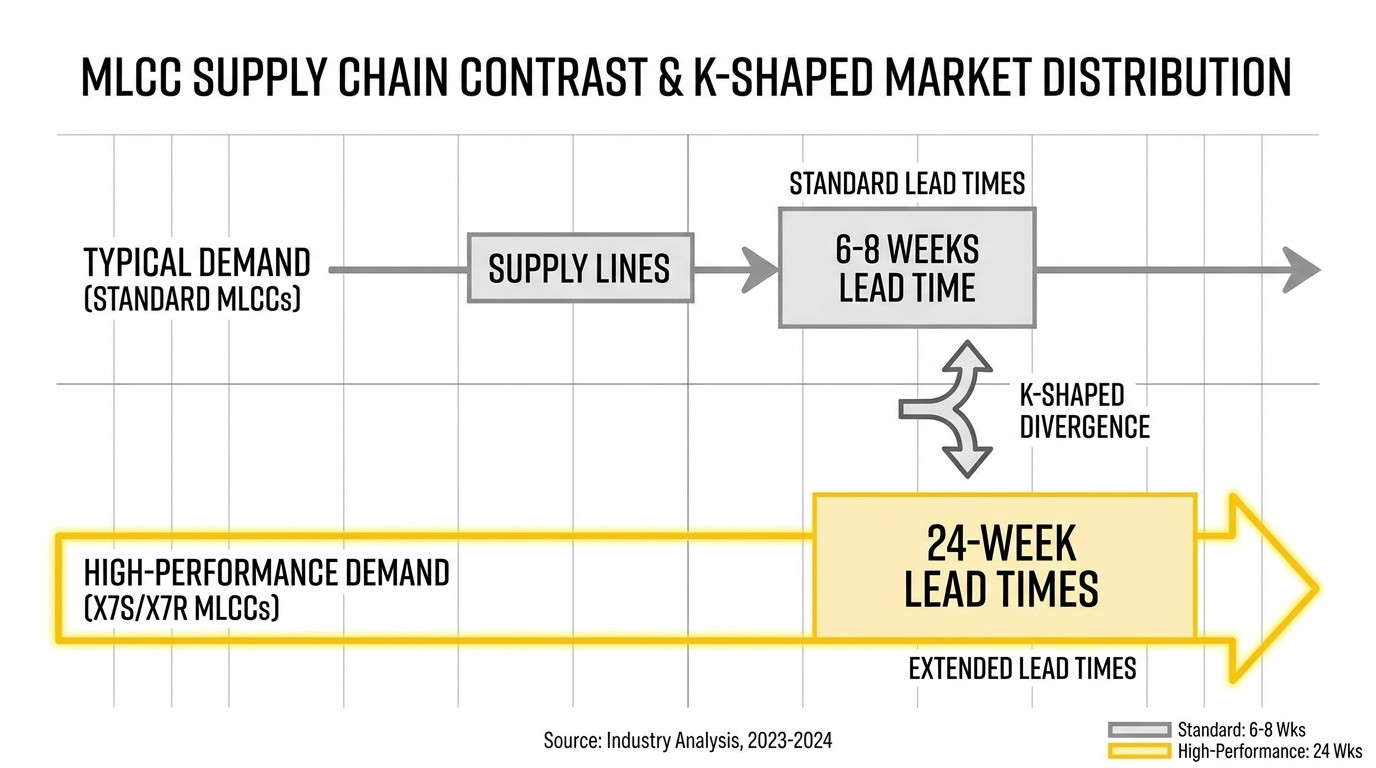
TrendForce data indicates a distinct K-shaped recovery in the passive component market. While demand for standard 0402/0603 commodity MLCCs used in consumer electronics remains flat, the AI sector is booming. Top-tier manufacturers, including Murata and Samsung Electro-Mechanics, are operating at greater than 90% capacity utilization for their high-end production lines.
Navigating 24-Week Lead Times
According to Aetrix and Astute 2026 Market Reports, lead times for specialized, high-capacitance MLCCs (such as 22μF, 47μF, and 100μF values in larger case sizes) used in AI servers have extended beyond 20 weeks. This creates severe friction for procurement teams. Relying on just-in-time (JIT) manufacturing principles fails under these conditions, forcing buyers to secure authorized supply chains 6 to 8 months ahead of server assembly schedules.
Counterfeit Risks in High-End MLCCs
With spot prices for high-capacitance MLCCs increasing by 10–15%, the risk of counterfeit Class 2 MLCCs entering the supply chain rises. Counterfeiters often remark standard X5R capacitors as high-temperature X7S variants. When installed in a 120kW rack, these counterfeit components suffer rapid capacitance loss under thermal load, leading to catastrophic voltage droop and GPU failure.
Conclusion and Procurement Framework
The leap to 600,000+ MLCCs per rack in the NVIDIA Rubin architecture represents a fundamental shift in data center power design, elevating the ceramic capacitor to a critical supply chain bottleneck.
Scenario-Based Decision Framework for MLCC Procurement
If you prioritize immediate availability for standard enterprise servers: Rely on standard distribution channels for X5R dielectrics in 0402/0603 case sizes, as lead times remain stable at 6-8 weeks.
If you prioritize thermal stability in 120kW+ liquid-cooled AI racks: The strategic winner is the X7S/X7R dielectric family in high-capacitance values (47μF, 100μF). Procurement must secure these through authorized channels with a minimum 24-week forecasting window.
If you prioritize signal integrity in 1.6T optical modules: Focus procurement efforts on ultra-low ESL 01005 case size MLCCs, ensuring the manufacturer guarantees high-frequency noise filtering specifications.
Frequently Asked Questions
What is the estimated MLCC count for an NVIDIA GB300 rack?
A fully populated NVIDIA GB300 NVL72 rack requires approximately 440,000 MLCCs.
Why are X7S and X7R dielectrics preferred for AI servers?
They offer superior thermal stability in 120kW+ high-density environments, maintaining their capacitance values under extreme heat better than standard X5R dielectrics.
How does liquid cooling affect MLCC selection?
Liquid cooling allows for denser component packing on the PCB, but requires strict reliability against thermal cycling near the microchannel lids, necessitating high-reliability Class 2 dielectrics.
Will the AI server boom cause a shortage of standard MLCCs?
This is unlikely. The current shortage is isolated to high-capacitance, high-reliability Class 2 MLCCs. Standard commodity MLCCs used in consumer electronics are not experiencing the same supply constraints.
What is the role of MLCCs in 1.6T optical modules?
In optical modules, MLCCs provide signal integrity, noise filtering, and local power decoupling within highly constrained physical footprints.
 UTMEL
UTMEL
We are the professional distributor of electronic components, providing a large variety of products to save you a lot of time, effort, and cost with our efficient self-customized service. careful order preparation fast delivery service
 AI Server MLCCs: Why NVIDIA Rubin Racks Require Over 600,000 CapacitorsUTMEL02 June 20263752
Next-generation AI servers like NVIDIA's Rubin architecture require over 600,000 MLCCs per rack due to extreme power densities exceeding 120kW. This transition from GB300 demands high-capacitance, low-ESR capacitors with X7R/X7S dielectrics to handle intense transient responses and thermal loads, forcing procurement teams to navigate extended 24-week lead times for these specialized components.
Read More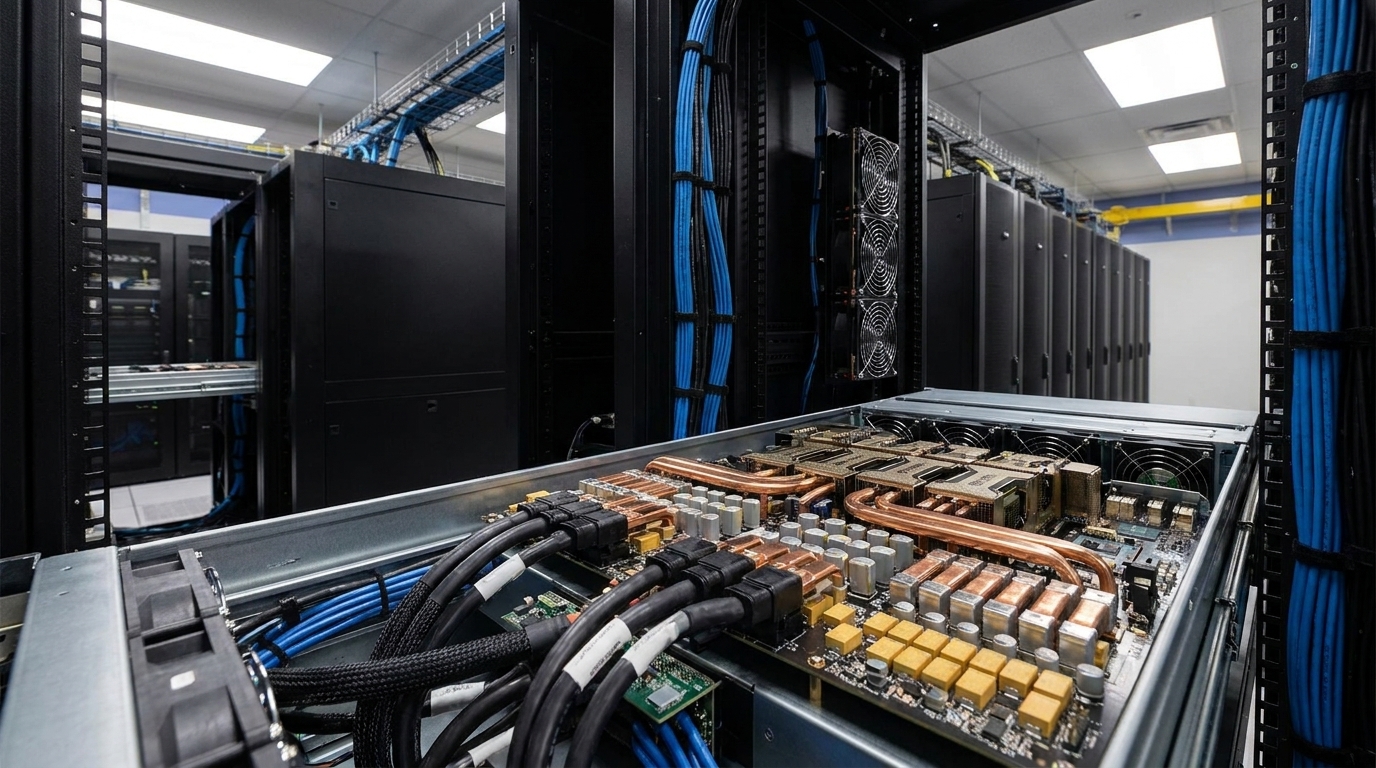 MLCC vs Polymer Tantalum Capacitors: Overcoming 2026 Shortages in AI Server PDNsUTMEL07 August 2026873
Facing 2026 MLCC lead times of up to 24 weeks driven by AI server demand, hardware engineers are substituting multi-layer ceramic capacitors with conductive polymer tantalum capacitors. While Class II MLCCs suffer severe DC bias capacitance loss and acoustic noise, polymer tantalums offer voltage stability and low ESR. Implementing a division-of-labor strategy—using polymer tantalums for bulk decoupling and MLCCs for point-of-load—optimizes PDN performance and bypasses supply bottlenecks.
Read More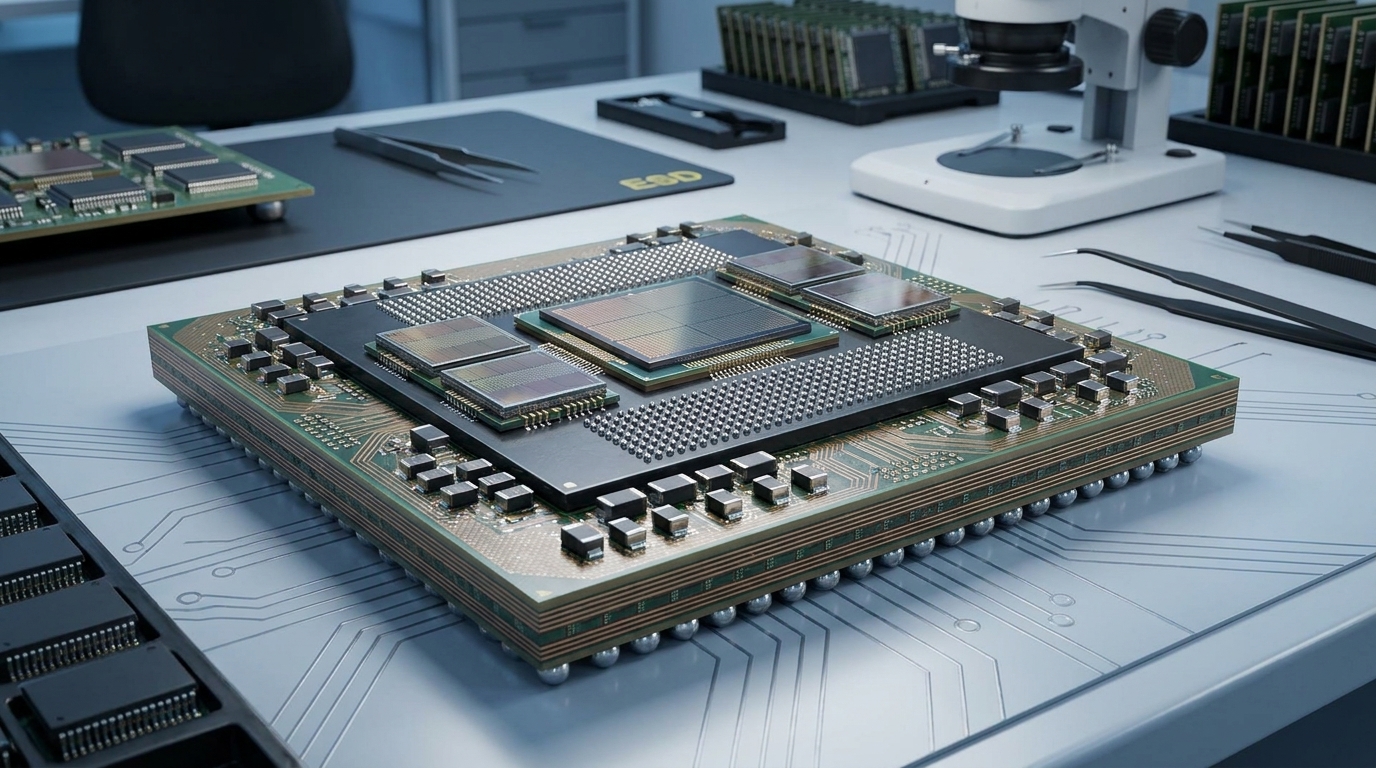 Sourcing Silicon Capacitors and MLCCs in the AI Hardware EraUTMEL13 August 2026726
Modern AI hardware requires a hybrid Power Delivery Network (PDN) to maintain low-voltage stability under extreme transient currents. Deep Trench Silicon Capacitors (DTCs) integrate directly into advanced packages to deliver ultra-low ESL and stable performance for high-frequency transient suppression. Meanwhile, Multilayer Ceramic Capacitors (MLCCs) provide essential bulk energy storage on the motherboard, making both technologies complementary across the AI power stack.
Read More MLCC DC Bias Derating: How to Calculate and Compare Effective Capacitance Before Component SelectionUTMEL11 September 2026834
Class II ceramic capacitors suffer significant capacitance loss under DC voltage due to ferroelectric domain saturation and high electric field intensity. This comprehensive engineering guide explains how to calculate true worst-case effective capacitance by compounding DC bias, temperature, tolerance, and aging. It provides multi-vendor simulation workflows, benchtop impedance measurement techniques, and practical guidelines to maintain power supply stability and avoid costly design failures.
Read More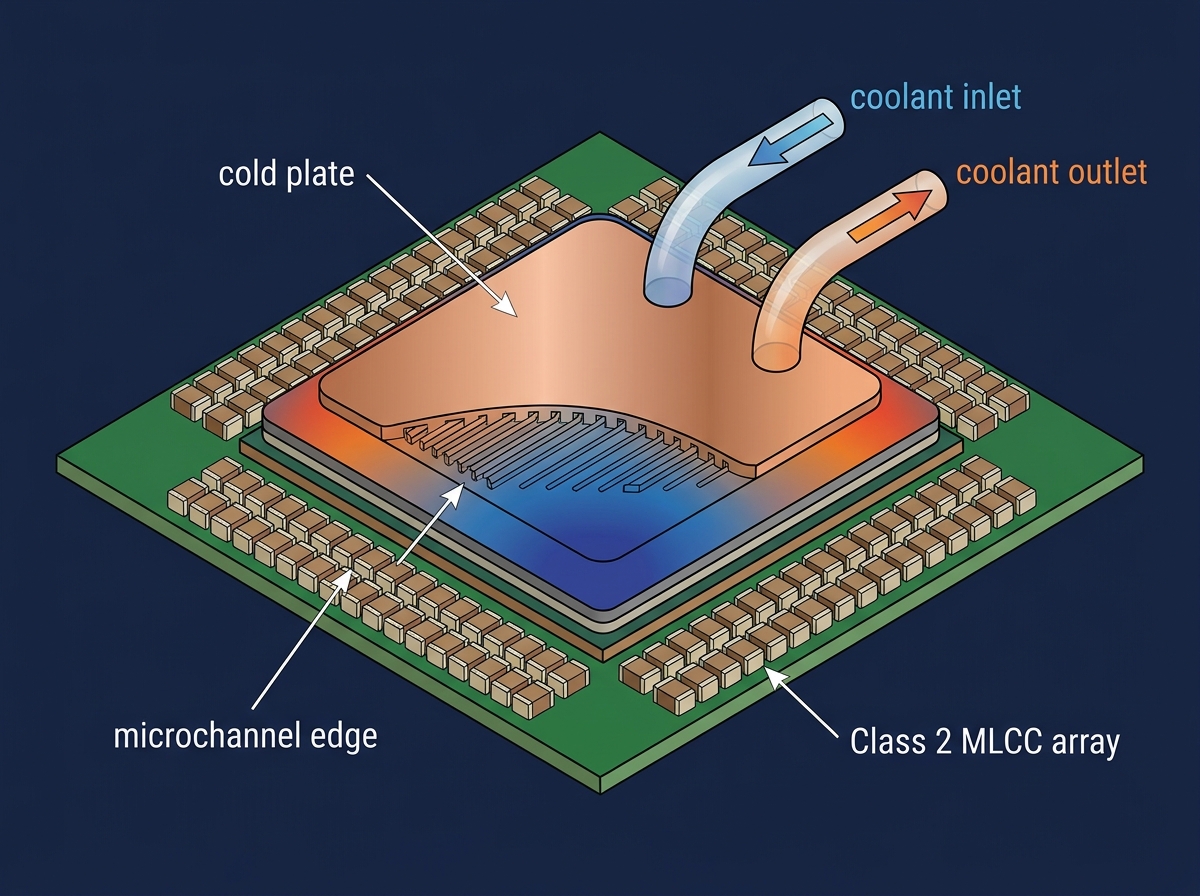 Thermal Management in AI Servers: Specifying Class 2 MLCCs (X7R/X7S) for Liquid Cooling EnvironmentsUTMEL13 July 2026490
Explore how the transition from traditional air-cooling to liquid cooling (direct-to-chip and immersion) in high-density AI server racks alters component thermal profiles. Focus on why design engineers are increasingly specifying Class 2 MLCCs (X7R and X7S dielectrics) over standard X5R variants to prevent thermal degradation near the liquid cooling microchannels. Explain how these capacitors mitigate acoustic noise and voltage bias degradation under heavy workloads. Provide sourcing advice for high-reliability passives via UTMEL during this high-demand memory and passive component super-cycle.
Read More
Subscribe to Utmel !
![EVAL_600W_12V_LLC_C7]() EVAL_600W_12V_LLC_C7
EVAL_600W_12V_LLC_C7Infineon
![IPR-QDRII/UNI]() IPR-QDRII/UNI
IPR-QDRII/UNIIntel
![IPS-AXIBFM]() IPS-AXIBFM
IPS-AXIBFMIntel
![IPR-10GBASEKRPHY]() IPR-10GBASEKRPHY
IPR-10GBASEKRPHYIntel
![IP-CIC]() IP-CIC
IP-CICIntel
![MAX77642EVKIT#]() MAX77642EVKIT#
MAX77642EVKIT#Maxim
![DAFIR-GEN-E3-US]() DAFIR-GEN-E3-US
DAFIR-GEN-E3-USLattice Semiconductor
![PCI-ERC1-E3-US]() PCI-ERC1-E3-US
PCI-ERC1-E3-USLattice Semiconductor
![DDR3-E5-US]() DDR3-E5-US
DDR3-E5-USLattice Semiconductor
![FPD-TX-CNX-UT]() FPD-TX-CNX-UT
FPD-TX-CNX-UTLattice Semiconductor
