Product
 Brand
Brand Articles
 Tools
Tools
2026 ADAS Sensors: Supply Outlook and Alternative Sourcing
The automotive industry faces a structural semiconductor deficit in 2026, driven not by pandemic-era demand shocks but by AI data centers absorbing global foundry capacity on legacy nodes (40nm-90nm) where 95% of automotive-grade components are manufactured. Simultaneously, the transition to electric vehicles with multiphase drives and unified ADAS architectures is tripling per-vehicle chip demand, creating a two-front supply crisis. This brief outlines the macro drivers of the shortage, projected lead times for AEC-Q qualified parts, and a practical framework for verifying drop-in replacements without triggering PCB redesigns or failing ISO 26262 certifications.
The "Automotive Chip Shortage 2.0": Why AI is Starving Legacy Nodes
The 2026 shortage differs fundamentally from the 2020-2023 disruption. The pandemic-era crisis was a demand surge coupled with logistics failures. The current crisis is structural: foundries are permanently reallocating capital and capacity toward high-margin AI accelerators, leaving the mature nodes required for automotive ICs chronically underinvested.
The Shift in Foundry Capital
According to industry forecasts from UBS and Enki AI, AI data centers are projected to consume up to 70% of all memory chips produced by 2026. This diversion translates directly into production constraints—analysts warn the capacity gap could result in as many as 600,000 fewer vehicles built in 2026. Market leaders TSMC and Samsung have publicly stated that AI-related orders now command priority wafer allocation, and their 2025-2027 capital expenditure plans overwhelmingly favor 3nm, 5nm, and advanced packaging lines.
Procurement teams accustomed to the "new normal" of 2023 should not extrapolate stability. The consumer electronics supply chain (smartphones, PCs) operates on advanced nodes that are decoupled from automotive supply. When a procurement manager hears "the chip shortage is over," that message applies to 2nm processors, not to 40nm radar sensor ASICs or 65nm CAN bus transceivers.
The Vulnerability of 40nm-90nm Nodes
Automotive-grade components overwhelmingly rely on mature nodes. MCUs, radar sensor signal processors, power management ICs, and CAN transceivers are fabricated on 40nm, 65nm, and 90nm processes. These nodes offer the reliability, thermal stability, and long product life cycles that automotive qualification demands—but they also offer foundries razor-thin margins compared to AI chips.
The result is a capacity squeeze with no near-term relief. Foundries have little incentive to add 40nm-90nm capacity when every wafer produced on a 3nm line generates 3-5x the revenue. Automotive buyers are effectively competing with hyperscale data centers for a shrinking share of legacy-node output.
The EV Multiplier: Power Semiconductors and Multiphase Drives
The demand side of the shortage equation is equally punishing. Electric vehicles require dramatically more semiconductor content than internal combustion engine vehicles, and the shift toward multiphase drive architectures is multiplying the component count per vehicle.
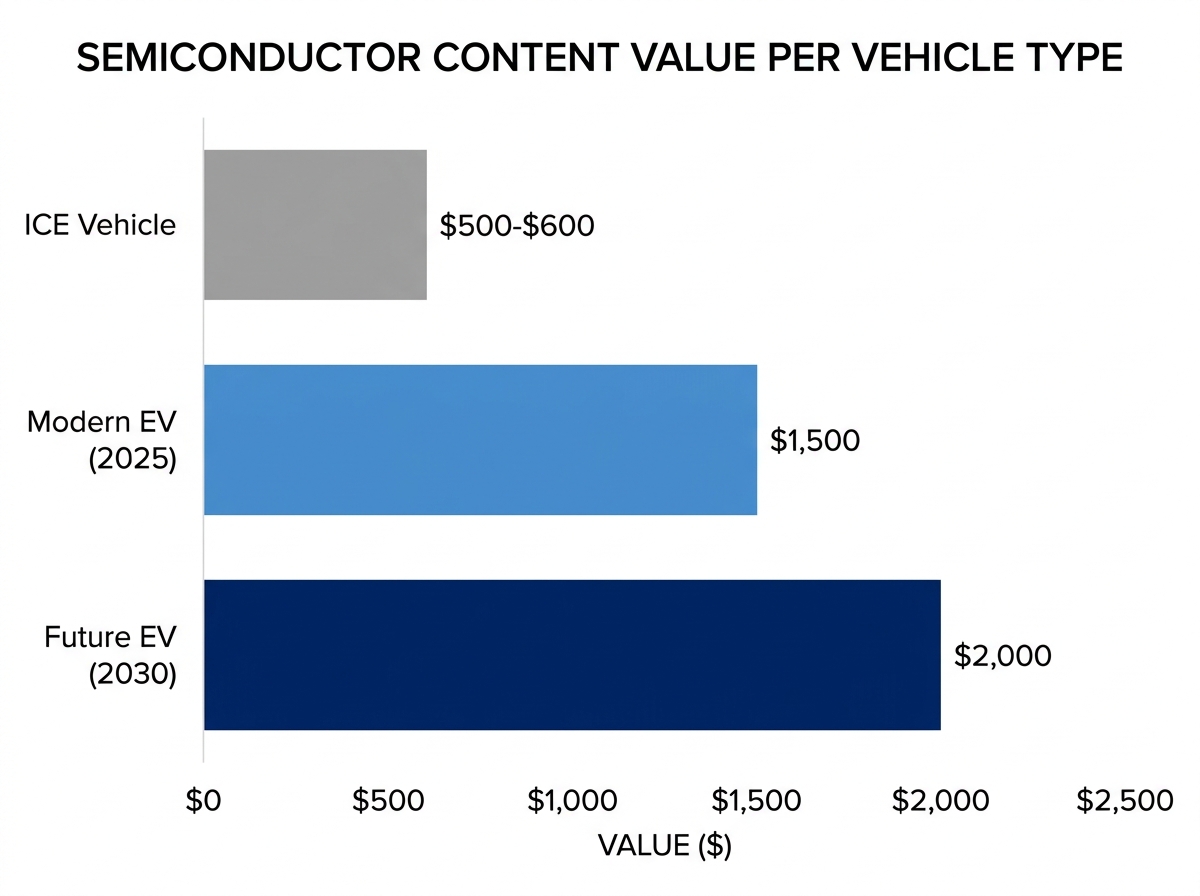
The $2,000 Semiconductor Content Multiplier
Industry benchmarks from AlixPartners and Deloitte place the semiconductor content of a traditional ICE vehicle at $500-$600. For a modern EV, that figure surpasses $1,500 by 2025 and is projected to reach $2,000 by 2030. This is not a linear increase—it represents a tripling of baseline demand for automotive-grade chips per unit.
Every EV requires:
Power management ICs and gate drivers for the traction inverter
Battery management system controllers
DC-DC converter controllers
Multiple radar and LiDAR sensor ASICs
High-voltage isolation components
CAN and Ethernet transceivers for vehicle networks
For a procurement team managing a 200,000-unit-per-year EV program, the semiconductor demand jumps from roughly $110 million (at ICE content levels) to over $300 million annually.
Multiphase Drives and Power Module Demand
The technical shift toward multiphase drives compounds this strain. As documented in peer-reviewed research from MDPI's Energies journal, 5-phase and 6-phase traction drives distribute power across more phases than traditional 3-phase systems. While this improves fault tolerance and torque density, it requires a proportionally higher number of individual power semiconductor modules per vehicle.
Each additional phase requires its own inverter leg—meaning additional IGBTs or SiC MOSFETs, gate driver ICs, and isolated power supplies. For a 6-phase drive, the power module count effectively doubles compared to a 3-phase system. This multiplies the strain on an already constrained supply chain for AEC-Q101 qualified discrete power semiconductors.
Pro Tip:** If your program is evaluating a shift to multiphase drives for 2027-2028 production, begin allocating power module supply now. The SiC substrate shortage may have eased, but device fabrication and packaging remain yield-constrained through 2026.
ADAS Evolution: Unified Architectures and Sensor Demand
The ADAS sensor landscape is undergoing a generational architecture shift that further strains component supply. Sensors are no longer isolated subsystems—they are integrated into unified platforms that manage lateral and longitudinal control simultaneously.
The Shift to Unified Sensor Platforms
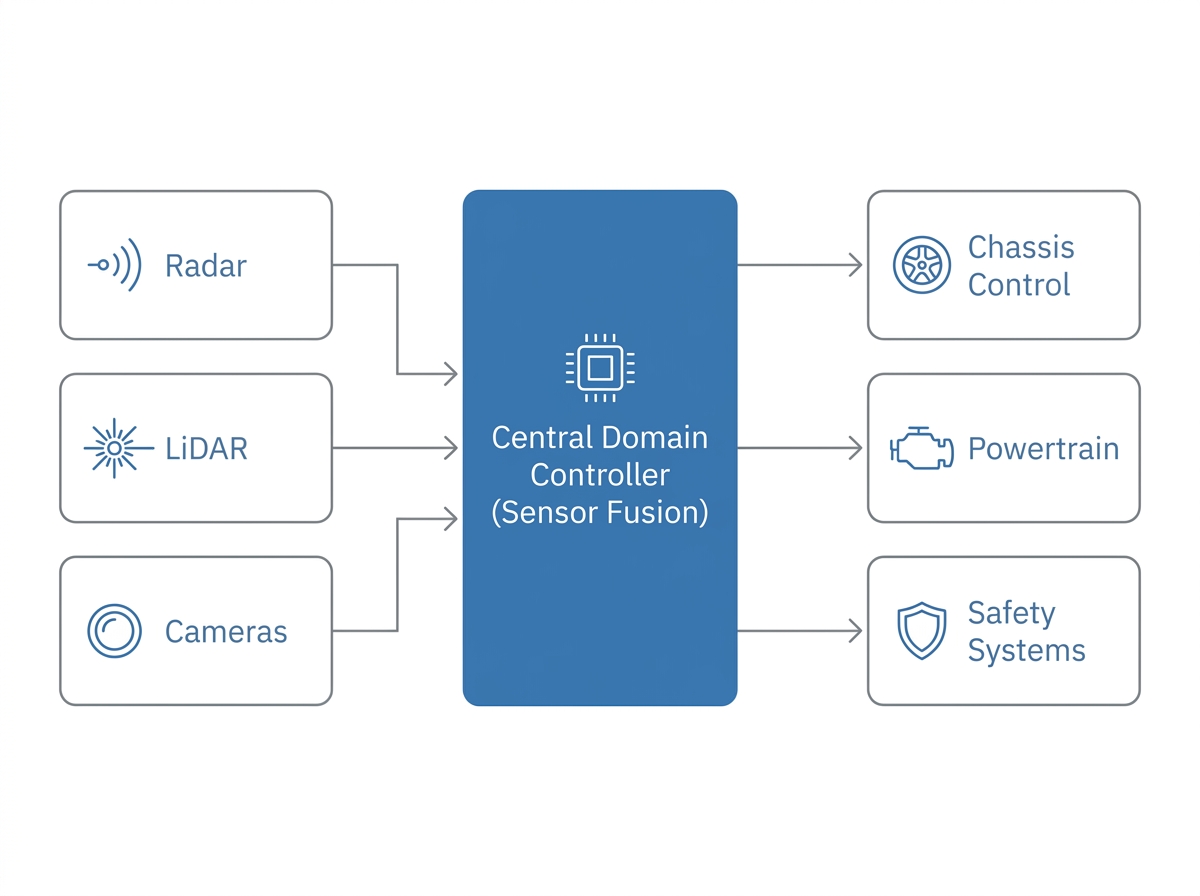
By 2026, production vehicles increasingly deploy unified ADAS architectures where a central domain controller processes data from redundant arrays of cameras, radar, and LiDAR. This architecture, visualized in engineering presentations from Bosch and Continental, shows how safety and chassis systems, powertrain controllers, and body electronics all feed into a shared sensor fusion pipeline.
The practical consequence for supply chain teams: a shortage of a single radar sensor type—say, a 77GHz radar front-end IC—can stall the entire unified platform. These systems require matched, calibrated sensor sets. You cannot substitute a different radar module without requalifying the entire fusion algorithm, triggering months of validation work.
AI Predictive Mapping and OTA Calibration
Next-generation ADAS uses deep learning for predictive hazard detection. Video demonstrations of these systems show a "machine view" overlay with red crosshairs tracking pedestrian movement and sudden cut-ins before traditional collision thresholds are triggered. This requires sensors capable of capturing exponentially more data—higher resolution, faster frame rates, and wider dynamic range.
A critical nuance shared by automotive diagnostic experts: over-the-air (OTA) software updates can alter a vehicle's calibration requirements well after it leaves the factory floor. As Christian Hinton notes, "Software changes can affect calibration status long after a repair is completed." This means the component qualification burden extends beyond initial manufacturing. Sensors must maintain stable performance across software revisions that continuously refine perception algorithms.
3 New ADAS Technologies Coming In 2026
Counter-Intuitive Fact: While most engineers assume higher resolution always benefits ADAS, for radar sensors used in Level 2+ systems, consistent noise floor performance across temperature is more critical than peak resolution. A sensor with lower noise variance often produces more reliable fusion outputs than a higher-resolution sensor with thermal drift.
Lead Times and Supply Constraints for AEC-Q Qualified Components
Lead times for automotive-grade components have entered a new regime of allocation and uncertainty.
Current and Projected Lead Times
According to the Accuris March 2026 Lead Time Report, average semiconductor lead times spiked to 40 weeks in early 2026, with highly allocated discrete components and analog ICs stretching to 48-52+ weeks. This means orders placed today for AEC-Q100 qualified parts may not ship until early 2027.
The bottleneck is compounded by qualification cycles. Any new automotive-grade component requires 18-24 months for AEC-Q certification and ISO 26262 functional safety validation. Procurement teams cannot simply "find another supplier"—switching requires requalification, which is measured in quarters, not weeks.
The parts most severely affected include:
40nm radar sensor ASICs (used in 77GHz long-range radar modules)
CAN bus transceivers (AEC-Q100 Grade 0 and Grade 1)
Power management ICs for traction inverters
Gate driver ICs for SiC MOSFET modules
Isolation amplifiers and ADCs for battery management
The Bottleneck of Requalification
Here is the core friction that many procurement teams underestimate: finding a drop-in replacement is not the same as finding a functional equivalent. A pin-compatible replacement that electrically matches the original part may still require software re-verification, thermal simulation updates, and electromagnetic compatibility retesting—each a potential project delay of 8-12 weeks.
Experienced engineering teams now maintain "qualification buffers" in their production schedules, planning for 6-9 months of validation time when introducing an alternative-sourced component, even one advertised as a direct drop-in.
Alternative Sourcing: Avoiding PCB Redesigns and Line-Downs
When your primary AEC-Q qualified part is on allocation with a 52-week lead time, the question shifts from "Can we get the original?" to "How do we safely verify an alternative without halting production?"
Franchised vs. Independent Stocking Distributors
The independent distribution market offers inventory that franchised channels cannot access. However, procurement teams face legitimate concerns about counterfeit parts and component pedigree. The key is to work with distributors who provide:
Full traceability to the original manufacturer lot
AEC-Q qualification documentation for each part shipped
Test reports verifying electrical parameters match datasheet specifications
ISO 9001 or AS9120 quality management certification
The independent market is not inherently risky—it is simply a different channel that requires more rigorous verification. The risk comes from skipping verification steps, not from the channel itself.
Verifying Drop-In Replacements for CAN Bus Systems
Consider a concrete example: your production line needs AEC-Q100 qualified CAN bus transceivers. The ISO 11898-2 standard mandates that a CAN bus must be terminated with a 120-ohm resistor at each physical end, creating a 60-ohm parallel equivalent. This matches the cable's characteristic impedance and prevents signal reflections that cause data corruption.
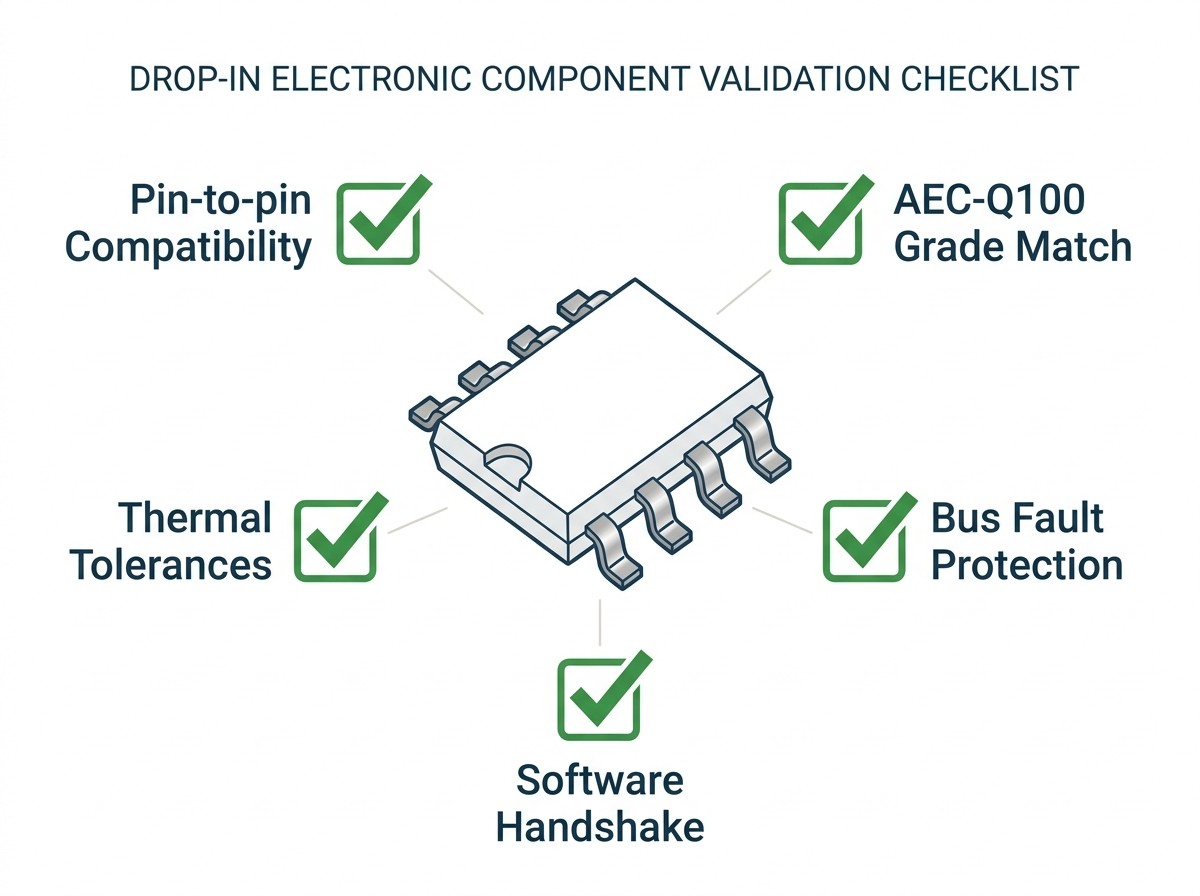
When evaluating an alternative transceiver, you must verify:
| Verification Step | What to Check | Why It Matters |
|---|---|---|
| Pin-to-pin compatibility | Package (SOIC-8, DFN, etc.) and pin mapping | Avoids PCB layout changes |
| Thermal tolerances | Operating temperature range (Grade 0: -40°C to +150°C) | ADAS modules near engine bay or brakes |
| AEC-Q100 grade match | Grade 0, 1, or 2 | Functional safety certification requirements |
| Bus fault protection | Short-circuit current limits | Prevents network failures in fault conditions |
| Software handshake | CAN protocol timing and wake-up behavior | Avoids arbitration errors in multi-node systems |
Pro Tip: When working with an independent distributor, request a Certificate of Conformance with specific reference to the AEC-Q100 or AEC-Q200 test report for the lot. Reputable distributors provide this documentation. If they cannot, the part carries counterfeit risk.
Closing Section
The 2026 ADAS and EV power semiconductor shortage is not a repeat of 2020—it is a structural deficit driven by AI's consumption of foundry capacity and EV architectures that triple per-vehicle demand. Procurement teams that treat this as a temporary disruption will face line-down situations. Teams that shift to proactive alternative sourcing, rigorous drop-in verification, and strategic qualification buffers will maintain production continuity.
Frequently Asked Questions
How long are the projected lead times for AEC-Q100 qualified ICs in 2026?
Average lead times reached 40 weeks in early 2026, with highly allocated discrete and analog components stretching to 48-52 weeks. Some specialized radar ASICs and power management ICs face 15-18 month lead times.
Which specific ADAS sensors are most affected by the 2026 shortage?
77GHz long-range radar sensor ASICs, LiDAR receiver ICs, and camera ISP (image signal processor) chips on 40nm-65nm nodes face the most severe allocation constraints. These mature-node components compete directly with AI infrastructure for foundry capacity.
How is the shift to multiphase drives impacting power semiconductor demand?
Multiphase (5-phase and 6-phase) traction drives require proportionally more power semiconductor modules per vehicle than traditional 3-phase drives. A 6-phase system effectively doubles IGBT or SiC MOSFET requirements, compounding supply chain strain.
What are the risks of using non-AEC-Q qualified parts in ADAS applications?
Non-AEC-Q components lack guaranteed reliability across automotive temperature ranges and may fail functional safety certification (ISO 26262). Using them voids warranty coverage and creates liability exposure if a sensor failure causes an accident.
How do I verify the authenticity of alternative-sourced automotive chips?
Request full traceability to the original manufacturer lot, AEC-Q qualification documentation, electrical test reports, and a Certificate of Conformance. Work with distributors who maintain ISO 9001 or AS9120 quality systems and can provide batch-level test data.
Avoid line-down situations and costly PCB redesigns. Check real-time availability, verify AEC-Q qualifications, and find reliable drop-in replacements for ADAS sensors, power modules, and CAN bus transceivers using UTMEL's part number search.
References
 UTMEL
UTMEL
We are the professional distributor of electronic components, providing a large variety of products to save you a lot of time, effort, and cost with our efficient self-customized service. careful order preparation fast delivery service
 The Key Role of Electronic Components in IoT DevicesUTMEL01 September 20236302
The article discusses the pivotal role of electronic components in Internet of Things (IoT) devices. IoT devices work by capturing real-world data using sensors, processing it through a microcontroller, and then sending it to the cloud for further analysis.
Read More Accelerometer Sensors Guide: Working Principle, Circuit Design, Specifications, and ApplicationsUTMEL25 June 20261128
A practical accelerometer sensor guide covering working principles, MEMS and piezoelectric types, datasheet specifications, circuit design, mounting, applications, and selection.
Read More 2026 ADAS Sensors: Supply Outlook and Alternative SourcingUTMEL18 July 20261269
Automotive cleanroom assembly integrating advanced driver assistance systems. The automotive industry faces a structural semiconductor deficit in 2026, driven not by pandemic-era demand shocks but by AI data centers absorbing global foundry capacity on legacy nodes (40nm-90nm) where 95% of automotive-grade components are manufactured. Video demonstrations of these systems show a "machine view" overlay with red crosshairs tracking pedestrian movement and sudden cut-ins before traditional collision thresholds are triggered.
Read More Magnetic Sensors for Position Detection: Hall Effect vs. AMR vs. TMR Engineering GuideUTMEL21 August 2026655
This guide compares Hall effect, AMR, and TMR magnetic sensors for position detection in motor control and robotics. It explains their physical principles, key performance metrics, and selection criteria. Hall effect suits low-cost commutation, AMR offers high-speed angle sensing, and TMR provides maximum precision and low power, with practical integration advice.
Read More Temperature Sensor Types Comparison: Thermocouple, RTD, and Semiconductor IC Selection GuideUTMEL17 August 2026570
This comprehensive selection guide compares thermocouples, platinum RTDs, and semiconductor ICs across measurement range, accuracy limits, and signal conditioning complexity. It covers fundamental operating physics, mathematical transfer functions, lead-wire compensation topologies, and power budgets. Engineers will find practical design checklists, benchtop multimeter diagnostic techniques, and an architectural decision workflow to optimize system performance and bill-of-materials cost.
Read More
Subscribe to Utmel !
![6HIC200-CF]() 6HIC200-CF
6HIC200-CFSCS
![EK60CH015]() EK60CH015
EK60CH015Menda
![CM502]() CM502
CM502Laird
![940/03]() 940/03
940/03WECO
![EBM7DS526]() EBM7DS526
EBM7DS526Menda
![EBM6CH250H]() EBM6CH250H
EBM6CH250HMenda
![ES75C004]() ES75C004
ES75C004Menda
![EBM6CS150]() EBM6CS150
EBM6CS150Menda
![EBM60TZ010B]() EBM60TZ010B
EBM60TZ010BMenda
![ES80MF003]() ES80MF003
ES80MF003Menda