Product
 Brand
Brand Articles
 Tools
Tools
MCU Power Management Availability Forecast 2026: Lead-Time Risks and Alternatives
Quick Answer: The 2026 Component Sourcing Landscape
The global semiconductor market in 2026 is experiencing a structural recalibration rather than a universal, pandemic-era shortage. This "selective crunch" means that while mainstream consumer electronics components have largely stabilized, specialized automotive, industrial, and edge-AI power management ICs (PMICs) face multi-year tightness.
For instance, high-current PMICs are under intense pressure because some industry estimates suggest AI servers draw roughly 10 to 15 times the power of traditional servers, pulling manufacturing capacity away from standard industrial power management components.
To navigate this landscape, electronics manufacturers must adopt a dual-pronged mitigation strategy:
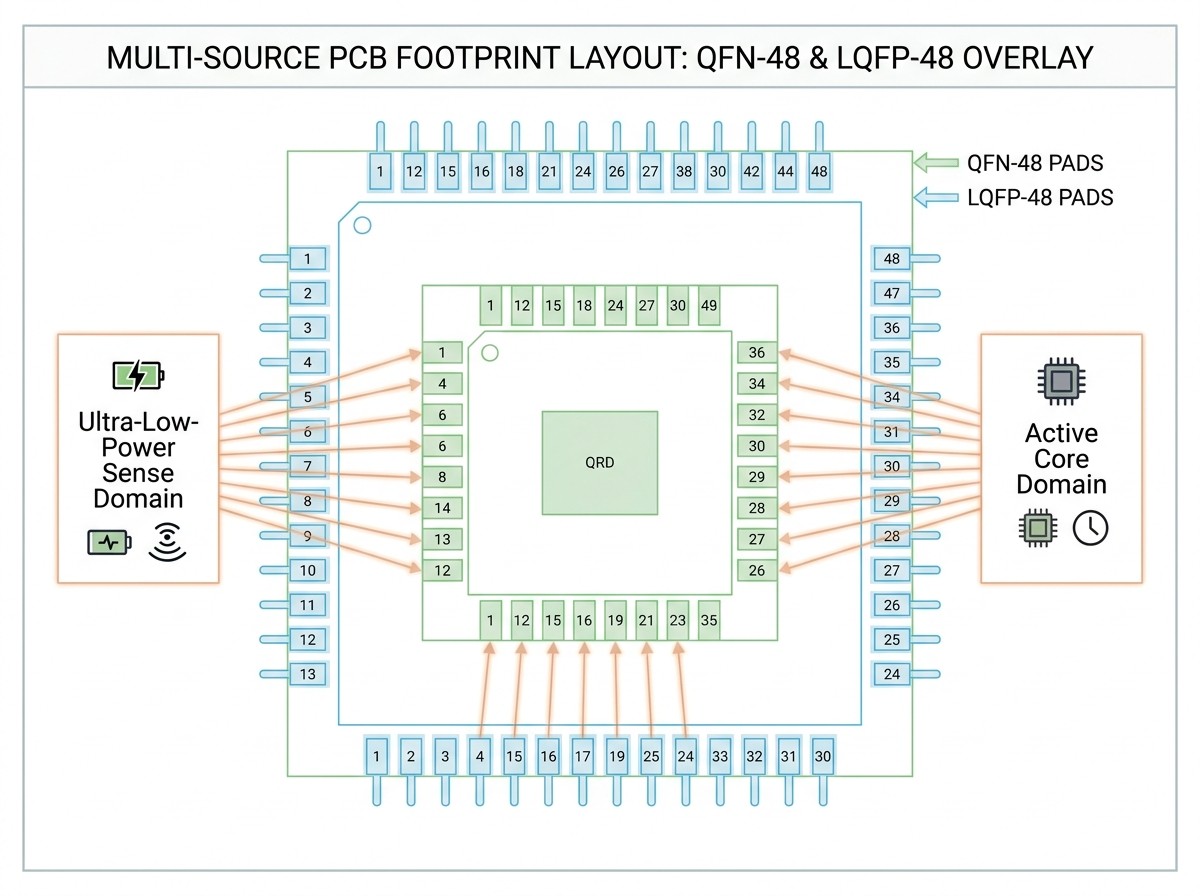
For Engineering Teams: Design for component agility. Implement multi-source PCB footprints and robust Hardware Abstraction Layers (HAL) to allow seamless component swapping without triggering expensive redesigns, effectively navigating power supply manufacturing delays.
For Procurement Teams: Transition from Just-In-Time (JIT) manufacturing to strategic buffering. Extend forecasting horizons to 3–9 months and build relationships with vetted independent distributors to secure spot-market inventory when franchised channels stall.
Lead Time Outlook by Component Category
The availability of microcontrollers and power management devices varies significantly by technology node and target application. Sourcing teams must monitor these distinct categories to prevent line-down situations.
MCU Power Management Lead Time 2026
High-current PMICs and advanced 32-bit MCUs are experiencing extended lead times. Industry reports indicate that the MCU power management lead time 2026 is stretching from 20 to 40+ weeks, with some specialized automotive and industrial families hitting up to 52 weeks.
IoT Chips Lead Time 2026 & Sensor Fusion Chips Lead Time 2026
Driven by rapid edge-AI adoption, demand for high-efficiency IoT chips and sensor fusion processors is surging. The IoT chips lead time 2026 and sensor fusion chips lead time 2026 are estimated to range between 18 and 30 weeks, depending on the foundry node and packaging complexity.
Industrial IoT Components Lead Time 2026
Ruggedized, high-reliability components face a tighter supply. The industrial IoT components lead time 2026 is estimated at 24 to 36 weeks due to strict qualification standards and limited mature-node foundry capacity.
8-Bit MCUs Lead Time 2026
In contrast, mature 8-bit architectures are stabilizing. The 8-bit MCUs lead time 2026 has returned to a manageable 9 to 10 weeks for many non-automotive families, while key chipmakers see 8-bit MCU lead times shrink to 2-4 weeks, making them a highly reliable fallback for basic control tasks.
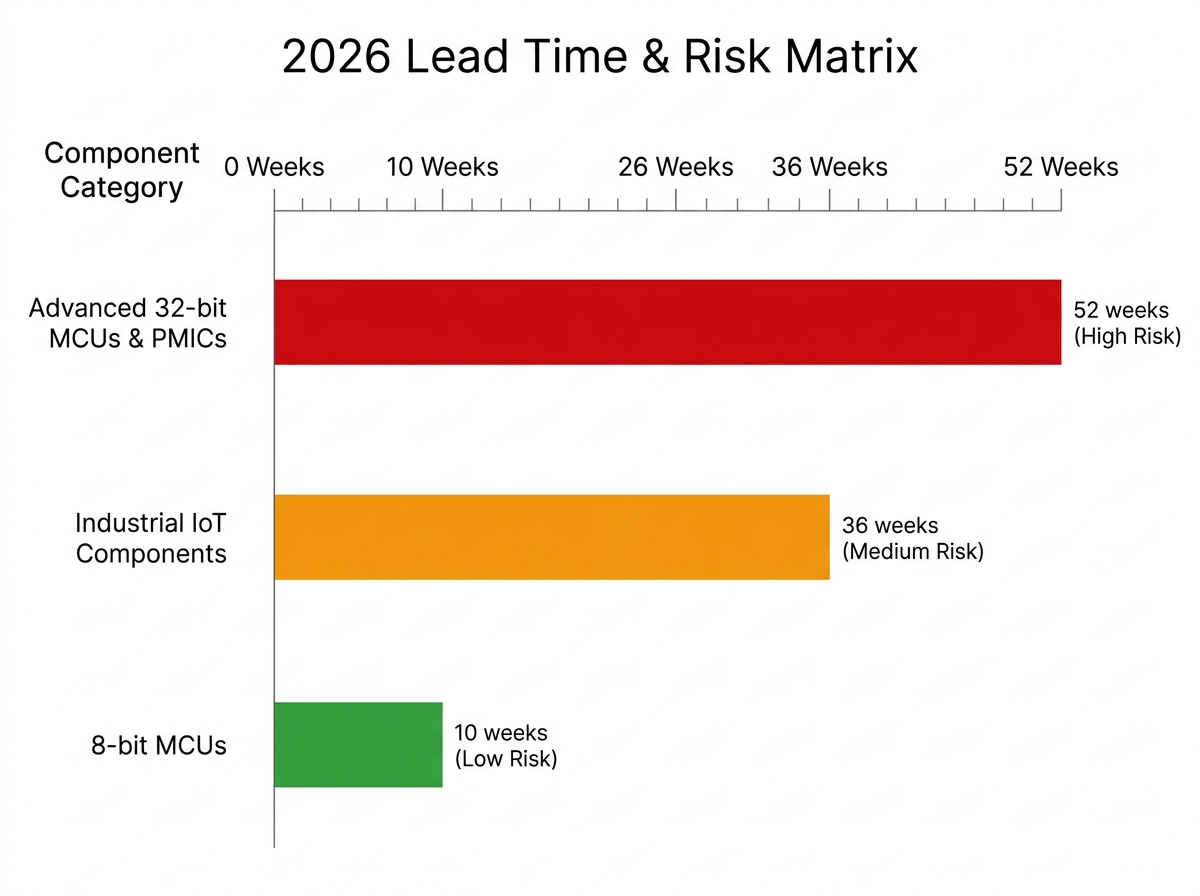
2026 Lead Time & Risk Matrix
| Component Category | Estimated Lead Time Range | Risk Level | Primary Market Driver |
|---|---|---|---|
| Advanced 32-bit MCUs & PMICs | 20 to 52 weeks | High | AI server power demands, automotive electrification |
| Industrial IoT Components | 24 to 36 weeks | Medium-High | High-reliability requirements, mature-node constraints |
| IoT & Sensor Fusion Chips | 18 to 30 weeks | Medium | Edge-AI adoption, smart sensor integration |
| 8-bit MCUs | 9 to 10 weeks | Low | Stabilized legacy production, mature foundry capacity |
Why Are MCU and PMIC Lead Times Stretching? (Correcting the Market Myth)
Many industry observers claim that "the chip shortage is completely over." This is a common misconception. The reality is a structural imbalance between advanced and mature foundry nodes.
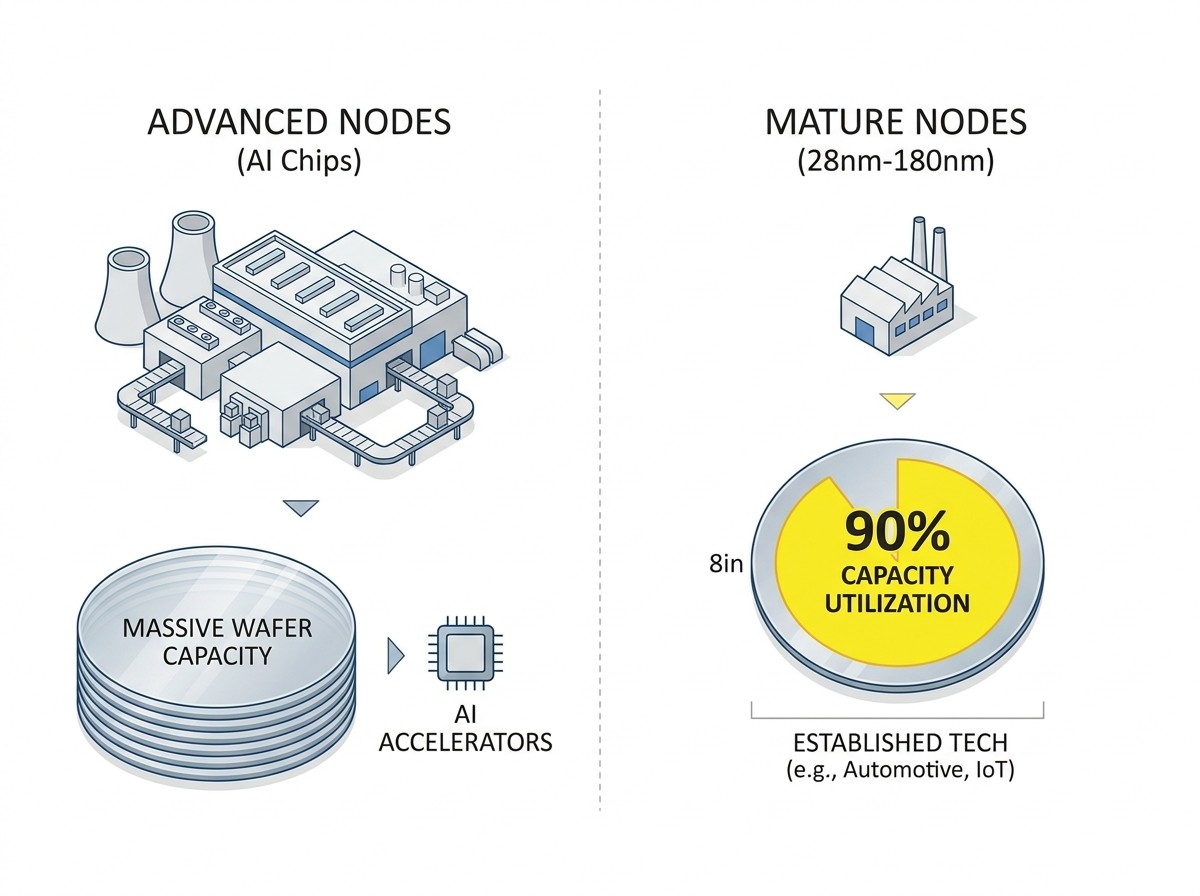
Industry analyses indicate that a large majority of modern vehicle and industrial chips rely on mature node technology (28nm to 180nm). However, major foundries are reallocating capital and capacity to high-margin, advanced-node AI chips. This has reportedly pushed the average utilization rate for older 8-inch wafers at top foundries to nearly 90% in 2026, leaving mature nodes starved for production capacity.
At the same time, the rapid integration of edge-AI and sensor fusion requires more complex power delivery networks, further straining the supply of PMICs. For a deeper dive into these macroeconomic shifts, see our Microcontroller (MCU) Market Analysis.
Top 7 Microcontrollers (MCUs) for Battery Life in 2026
Engineering Mitigation: Designing for Component Agility
Hardware and firmware must be designed to accommodate multiple component options from day one. If supply chain constraints force a microcontroller swap late in the product lifecycle, it is one of the most expensive hardware mistakes a company can make. It triggers a cascade of negative effects: a new PCB layout, a complete firmware rewrite, recertification, and months of production delays.
1. Multi-Source PCB Footprints and HAL
Engineers should design footprints that can accommodate multiple package types (e.g., both QFN and LGA packages) or different pinouts of similar-class MCUs. On the software side, writing firmware with a robust Hardware Abstraction Layer (HAL) isolates low-level hardware drivers from the application logic, allowing engineers to swap MCUs without rewriting the entire software stack.
2. The "Lowest Active Power" Trap
A common mistake is selecting an MCU based solely on the lowest active power consumption listed on the datasheet. Engineers must calculate sleep current, wake-up time (the power burned transitioning from sleep to active), minimum operating voltage, and peripheral power modes. Overlooking these factors can ruin battery life estimates and lock a design into a single, hard-to-source chip.
For instance, advanced low-power MCUs like the STM32U5 feature ultra-low-power modes such as "Stop 3" (drawing as little as 1.9µA to 4.3µA with full SRAM retention) and "Stop 0" (with a rapid wake-up time of ~100µs), while active run mode can be as low as 19.5 µA/MHz. Understanding these nuances is critical when evaluating potential alternatives. Learn more about this architecture in our guide on the STM32U5: The Most Complex Low-Power MCU.
3. Architectural Nuances & Application Boundaries
Swapping is rarely a 1:1 drop-in replacement. If a design relies on highly specific architectural features, finding a compatible alternative during a shortage is incredibly difficult:
The 0.8V "Zombie Battery" Hack: The Silicon Labs xG27 uses an integrated boost converter to run down to 0.8V, allowing a device to squeeze the very last drops of energy out of a single alkaline or "depleted" coin cell battery. If your design relies on this 0.8V bypass to eliminate external voltage regulators, swapping to a standard MCU that requires a minimum of 1.8V will require a complete PCB redesign.
FRAM vs. Flash: The TI MSP430 series uses FRAM (Ferroelectric RAM) instead of traditional Flash. Flash requires a lengthy, power-hungry erase cycle before writing new data, whereas FRAM writes almost instantly and uses drastically less energy. This makes it superior for frequent sensor data logging. However, the MSP430 is a 16-bit architecture. If your application requires 32-bit math operations, it faces a "16-bit math penalty"—requiring significantly more clock cycles to compute, staying active longer, and ultimately burning more battery than a 32-bit ARM Cortex would.
Transistor Leakage: Moving to smaller nodes, like the Nordic nRF54L (which transitioned from 55nm to 22nm), significantly reduces transistor leakage, extending deep sleep times in always-on IoT devices.
Subthreshold Operation: Ambiq’s Apollo5 uses proprietary SPOT (Subthreshold Power Optimized Technology) to operate transistors below their normal turn-on threshold, achieving extreme efficiency.
Dual-Power Domains: The NXP MCX L series features a dual-power domain that separates the real-time processing core from the ultra-low-power sense domain, allowing the sense domain to remain awake and polling sensors while the main core is completely powered down. It also uses Adaptive Dynamic Voltage Control (ADVC) to monitor thermal data and actual chip aging, dynamically selecting the absolute lowest safe core voltage across the entire lifecycle of the product.
Warning: Never assume a part is a "100% identical drop-in replacement." Always treat alternative parts as candidates and instruct engineering teams to validate electrical, thermal, and software parameters. Refer to our guide on Several steps to choose a microcontroller (MCU) for a structured selection methodology.
Procurement Mitigation: Securing the Supply Chain
Procurement teams must shift their focus from traditional Just-In-Time (JIT) manufacturing to strategic buffering.
1. Extending Forecasting Horizons
Sourcing teams should extend their forecasting horizons to 3–9 months. This gives suppliers and distributors adequate visibility to secure wafer allocation at foundries, reducing the risk of sudden line-down situations.
2. The Role of Independent Spot Markets
When franchised distributors quote 50+ week lead times, vetted independent distributors become critical. They provide access to global spot-market inventory, helping to bridge supply gaps. However, procurement teams must carefully manage counterfeit risks during a crunch by sourcing only from trusted partners with rigorous quality control and testing processes to secure spot-market inventory when franchised channels stall, aligning with the industry-wide power semiconductor sourcing strategies.
How UTMEL Helps Secure Your 2026 BOM
As a leading component distributor, UTMEL is uniquely positioned to help electronics manufacturers navigate the 2026 selective crunch. We offer a robust suite of supply chain solutions designed to keep your production lines running:
In-Stock Inventory: We maintain a broad inventory of MCUs, IoT modules, sensors, wireless modules, and power management devices.
Real-Time Lead-Time Checks: Our sourcing platform provides up-to-date lead-time data, allowing you to anticipate constraints before they impact your production.
Alternative Sourcing Assistance: Our engineering and sourcing teams help identify pin-to-pin compatible alternatives for constrained parts, ensuring you have viable options when your primary choices are unavailable.
Fast RFQ Quotes: We provide rapid quotes to help you secure spot-market inventory quickly.
Whether you are sourcing cutting-edge low-power processors or legacy architectures like the 8051 Microcontroller: History, Architecture, Applications, and Features, UTMEL's global sourcing network ensures supply chain continuity.
Final Datasheet & Sourcing Checklist
Before finalizing your 2026 bill of materials (BOM), ensure your engineering and procurement teams have completed the following steps:
Engineering Checklist
[ ] Validate Pin-to-Pin Compatibility: Ensure voltage thresholds, thermal limits, and pin configurations match across all alternative candidates.
[ ] Confirm Firmware HAL Compatibility: Verify that the software abstraction layer can accommodate alternative MCUs with minimal rewrite overhead.
[ ] Analyze Power Profiles: Evaluate sleep currents, wake-up times, and peripheral power modes rather than relying solely on active power specifications.
[ ] Assess Architectural Dependencies: Identify if the design relies on unique features like integrated boost converters (e.g., 0.8V bypass) or FRAM.
Procurement Checklist
[ ] Expand the Approved Vendor List (AVL): Include vetted independent distributors to access spot-market inventory.
[ ] Secure Buffer Stock: Build safety stock for high-risk, mature-node components (40-90nm) and specialized PMICs.
[ ] Extend Forecasting Horizons: Provide suppliers with 3–9 months of visibility to secure factory allocation.
[ ] Establish Quality Verification Protocols: Ensure all spot-market components undergo rigorous testing to mitigate counterfeit risks.
Frequently Asked Questions
What are the expected lead times for MCU power management devices in 2026?
In 2026, high-current PMICs and advanced 32-bit MCUs face extended lead times ranging from 20 to 40+ weeks, with specialized automotive and industrial families reaching up to 52 weeks due to demand from high-performance computing and electric vehicles.
Why are mature semiconductor nodes still experiencing tight supply in 2026?
Although the general chip shortage has stabilized, foundries have prioritized high-margin, advanced-node AI chips. This leaves mature nodes (28nm to 180nm) facing tight capacity, pushing older 8-inch wafer utilization rates near 90%.
How can hardware engineers design products to resist component shortages?
Engineers can implement multi-source PCB footprints that accommodate multiple package types and write firmware using a robust Hardware Abstraction Layer (HAL) to allow swapping microcontrollers without rewriting the application software.
What is the difference between active power and true low-power lifecycle optimization?
True low-power optimization requires evaluating parameters like sleep current, wake-up times, and peripheral power domains instead of relying solely on active datasheet numbers. For example, architectures like the STM32U5 provide specialized low-power sleep modes to retain memory efficiently.
Why are 8-bit microcontrollers highly available compared to 32-bit options?
Legacy 8-bit architectures rely on fully mature, stabilized foundry lines with less competition from advanced computing applications. Lead times for non-automotive 8-bit MCUs have stabilized down to 9 to 10 weeks, with some brands dropping even lower.
Sources and references used for this guide
Semiconductor Shortage 2026: A Guide for European OEMs
Source type: vendor article
Used for: Context on PMIC lead times extending beyond 50 weeks and uneven availability.
Caution: Distributor blog; use for market sentiment and estimates, not absolute factual guarantees.Power Supply Manufacturing Lead Times and delays 2026
Source type: official company documentation
Used for: Engineering mitigation strategies, modular design, and avoiding single-source dependency.
Caution: Manufacturer perspective; highly relevant for power supply strategies.Power Semiconductors Shortage Outlook 2026
Source type: official product page
Used for: Procurement mitigation, expanding approved vendor lists, and independent distributor value.
Caution: Own-brand source; use to align with UTMEL's business context.Microchip sees 8-bit MCU lead times shrink to 2-4 weeks
Source type: reputable professional source
Used for: Context on 8-bit MCU lead times stabilizing compared to advanced nodes.
Caution: Industry news; represents a specific point in time and specific manufacturer.
 UTMEL
UTMEL
We are the professional distributor of electronic components, providing a large variety of products to save you a lot of time, effort, and cost with our efficient self-customized service. careful order preparation fast delivery service
 Modeling Wide Band-Gap Semiconductors for Enhanced PerformanceRakesh Kumar, Ph.D.31 January 20243814
The article delves into the challenges faced by silicon-based power electronic devices and highlights the potential of wide band-gap semiconductors. It also emphasizes the importance of modeling power semiconductor devices and provides insights into various models. For electrical energy conversion to be dependable and effective, power electronics and semiconductor device technologies are essential.
Read More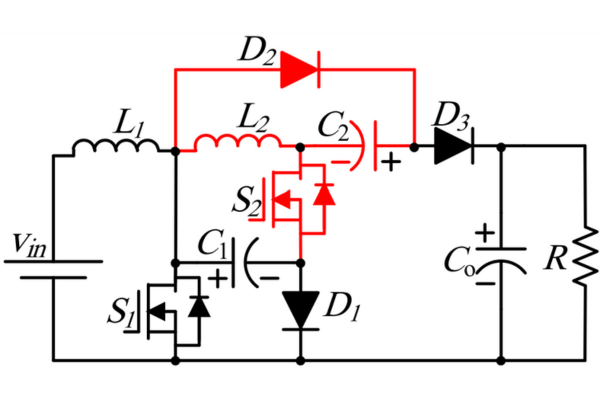 Optimizing Energy Management with Non-Isolated DC-DC ConvertersRakesh Kumar, Ph.D.04 February 20243463
The article classifies DC-DC converters and discusses the benefits and limitations of them. It proposes a modified DC-DC converter topology that combines the Cuk and Positive Output Super Lift Luo topologies to achieve a higher voltage gain with fewer components.
Read More ‘6G Networks’ - Pioneering the Next Era of Connectivity And InnovationRakesh Kumar, Ph.D.18 March 20243786
The article provides a comprehensive overview of the evolving landscape of mobile networks, the requirements that will shape the future of mobile communication, and the innovative technologies driving the transition to 6G.
Read More Review of IoT-Based Smart Home Security Systems- Part 1Rakesh Kumar, Ph.D.28 March 20244265
The article discusses the evolution of IoT-based smart home security systems, integrating advanced technologies like Raspberry Pi, PIR sensors, and voice recognition for enhanced user experience and efficiency.
Read More Understanding Photodiodes: Working Principles and Applications - Part 2Rakesh Kumar, Ph.D.24 May 20245493
The article provides a comprehensive overview of photodiodes, focusing on their operational principles, key factors affecting their efficiency, advantages, and disadvantages, and highlights their diverse applications.
Read More
Subscribe to Utmel !
![2-1190624-2]() 2-1190624-2
2-1190624-2TE Connectivity
![667353-000]() 667353-000
667353-000TE Connectivity
![650143-000]() 650143-000
650143-000TE Connectivity
![694681-000]() 694681-000
694681-000TE Connectivity
![2069577-4]() 2069577-4
2069577-4TE Connectivity
![2069250-3]() 2069250-3
2069250-3TE Connectivity
![2013595-4]() 2013595-4
2013595-4TE Connectivity
![665143-000]() 665143-000
665143-000TE Connectivity
![SHH-KTZ]() SHH-KTZ
SHH-KTZMenda
![EB41M1812]() EB41M1812
EB41M1812Menda