Product
 Brand
Brand Articles
 Tools
Tools
2026 Memory: Strategic Sourcing Tactics for DRAM & NAND Price Hikes
To mitigate the severe price hikes of the 2026 memory super-cycle, B2B procurement managers should transition from Just-In-Time (JIT) inventory models to proactive sourcing strategies. Key tactics include establishing rolling 3-to-6-month safety stocks, decoupling memory module procurement from bare-metal server purchases to avoid OEM markups, certifying alternative memory modules across multiple manufacturers, and securing long-term supply agreements (LTAs).
This structural shortage is primarily driven by the "3:1 trade-off" bottleneck, where chipmakers are reallocating raw wafer capacity to high-margin High Bandwidth Memory (HBM) for AI data centers, severely squeezing the supply of standard DRAM and NAND Flash.
The global semiconductor landscape has shifted from a consumer-driven boom-and-bust cycle to an AI-led structural scarcity. For sourcing managers and B2B electronics buyers, navigating this environment requires a deep understanding of the underlying manufacturing bottlenecks and a willingness to rewrite traditional procurement playbooks. To understand the full scale of this market shift, buyers can explore our detailed guide on navigating the 500% surge in DRAM and NAND Flash prices.
The Structural Shift: Why 2026 is a Memory "Super-Cycle"
Many procurement managers mistakenly assume that the current price hikes are a temporary cyclical fluctuation that will resolve itself by the end of the fiscal year. However, market intelligence indicates that the 2026 memory shortage is a fundamental, structural "super-cycle" driven by the explosive growth of generative AI infrastructure.
Major chipmakers are aggressively reallocating their manufacturing capacity to satisfy the insatiable demand of hyperscale data centers. For instance, SK Hynix officially forecasts that demand for its HBM3E and HBM4 products will fuel an AI memory supercycle, with data centers projected to consume over 70% of all high-end memory output in 2026.
Because leading-edge fabrication facilities (fabs) have finite cleanroom space and wafer processing capabilities, this massive pivot to AI-centric silicon has directly cannibalized the production lines of conventional memory. Standard DDR4, DDR5, and enterprise SSDs are no longer the primary focus of major fabs, leading to severe allocation cuts for traditional enterprise and industrial buyers.
The "3:1 Trade-Off" Bottleneck
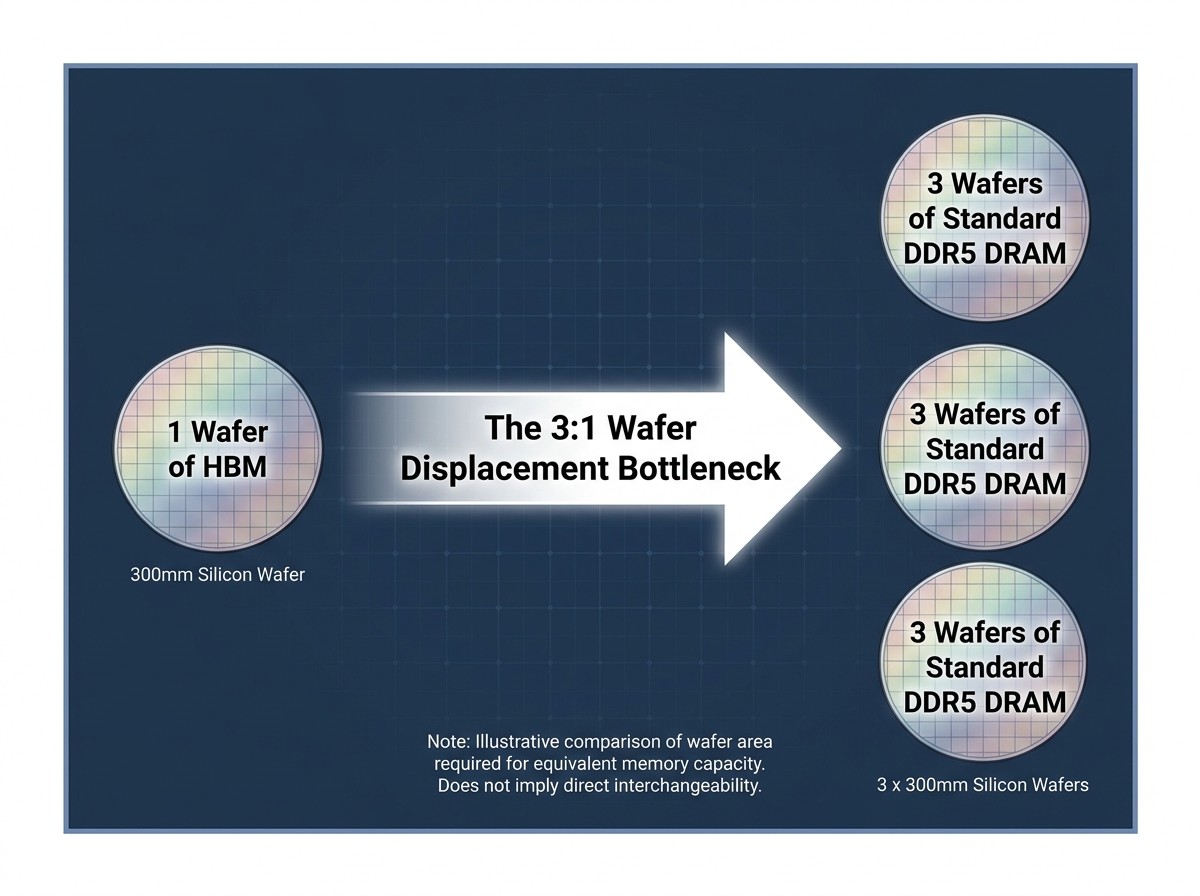
At the heart of this capacity squeeze is a physical manufacturing constraint known as the 3:1 trade-off.
[ 1 Wafer of High Bandwidth Memory (HBM) ]
│
▼ (Displaces)
[ 3 Wafers of Standard DDR5 DRAM ]
According to industry analysis, producing one gigabyte of High Bandwidth Memory (HBM) consumes roughly three times the raw wafer capacity of producing an equivalent gigabyte of standard DDR5 DRAM. This bottleneck is caused by several technical factors:
Larger Die Sizes: HBM dies are physically larger than standard DRAM dies, meaning fewer chips can be harvested from a single 300mm silicon wafer.
Complex Packaging: HBM requires advanced Through-Silicon Via (TSV) packaging, where multiple DRAM dies are stacked vertically and connected. This process has inherently lower manufacturing yields compared to single-die standard DRAM.
Increased Testing Requirements: The complexity of stacked silicon requires extensive testing phases, which slows down overall fab throughput.
Because of this 3:1 ratio, every wafer dedicated to HBM production directly removes three wafers of standard DRAM from the global supply chain. This physical reality explains why standard DDR4/DDR5 and SSD allocations are being squeezed so aggressively, even as overall silicon wafer production remains high.
Price Forecasts: What to Expect for DRAM and NAND
Budget forecasting for the remainder of 2026 requires preparing for sustained, multi-quarter price increases. According to industry intelligence, the supply-demand imbalance is projected to drive contract prices to historic highs.
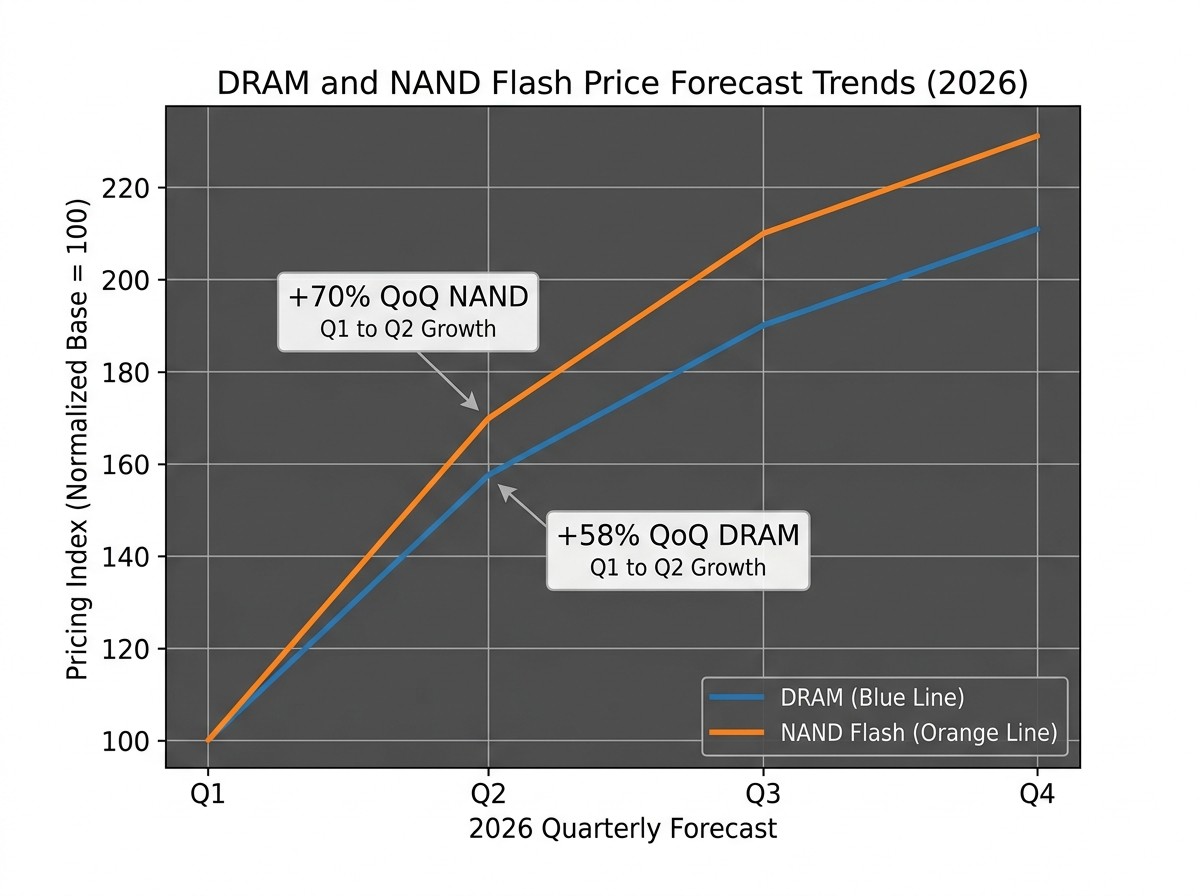
DRAM Contract Prices: TrendForce projects conventional DRAM contract prices to rise by 58–63% QoQ in Q2 2026. This trend is expected to persist as standard DDR5 supply remains highly constrained.
NAND Flash Contract Prices: NAND Flash contract prices are projected to rise by 70–75% QoQ in Q2 2026, driven by enterprise SSD demand and limited raw NAND wafer allocations.
Long-Term Market Valuation: Highlighting the scale of this super-cycle, Yole Group forecasts the overall DRAM market to reach approximately $400 billion by 2027, driven primarily by next-gen DRAM, HBM, and 3D DRAM architectures.
For a broader view of how these memory trends fit into the wider semiconductor landscape, refer to our comprehensive analysis of 2026 semiconductor and electronic components price trends.
Procurement Decision Framework: 4 Strategic Sourcing Tactics to Protect Your BOM
To shield your production lines from severe allocation cuts and price volatility, procurement teams must adopt a structured decision framework. The table below maps your specific bill-of-materials (BOM) risk level to the most effective sourcing tactic.
| BOM Risk Level | Application Boundary | Recommended Sourcing Tactic | Primary Benefit |
|---|---|---|---|
| High Risk (Critical Production) | Enterprise Servers, Industrial PCs, Edge AI | Decouple Memory from Compute & Lock in LTAs | Bypasses OEM markups; guarantees physical allocation. |
| Medium Risk (Standard Builds) | Commercial Electronics, Networking Gear | Certify Alternative Modules & Hybrid Storage | Lowers BOM cost volatility; bypasses single-source bottlenecks. |
| Low-to-Medium Risk (Legacy) | Legacy Industrial, Embedded Systems | Establish Rolling Safety Stocks | Shields against sudden spot market spikes and lead-time extensions. |
1. Establish Rolling Safety Stocks
The legacy Just-In-Time (JIT) inventory model, which relies on predictable lead times and stable pricing, is highly vulnerable during a memory super-cycle. When lead times stretch from weeks to months, a single delayed shipment can halt an entire assembly line.
Procurement managers should transition to a rolling safety stock model, maintaining a 3-to-6-month buffer of critical memory components based on rolling demand forecasts. While this increases short-term holding costs, it provides a vital buffer against sudden spot market spikes and allocation cuts. When calculating safety stocks, prioritize high-density modules and components with single-source dependencies.
2. Decouple Memory Procurement from Compute
One of the most effective cost-saving tactics for enterprise IT and data center buyers is to decouple memory purchases from bare-metal server procurement.
Historically, memory has comprised a significant portion of a server's total bill-of-materials (BOM) cost—typically around 20-30%. However, with 64GB RDIMM prices surging dramatically in early 2026, major server OEMs are passing on 15-25% total server cost increases to buyers.
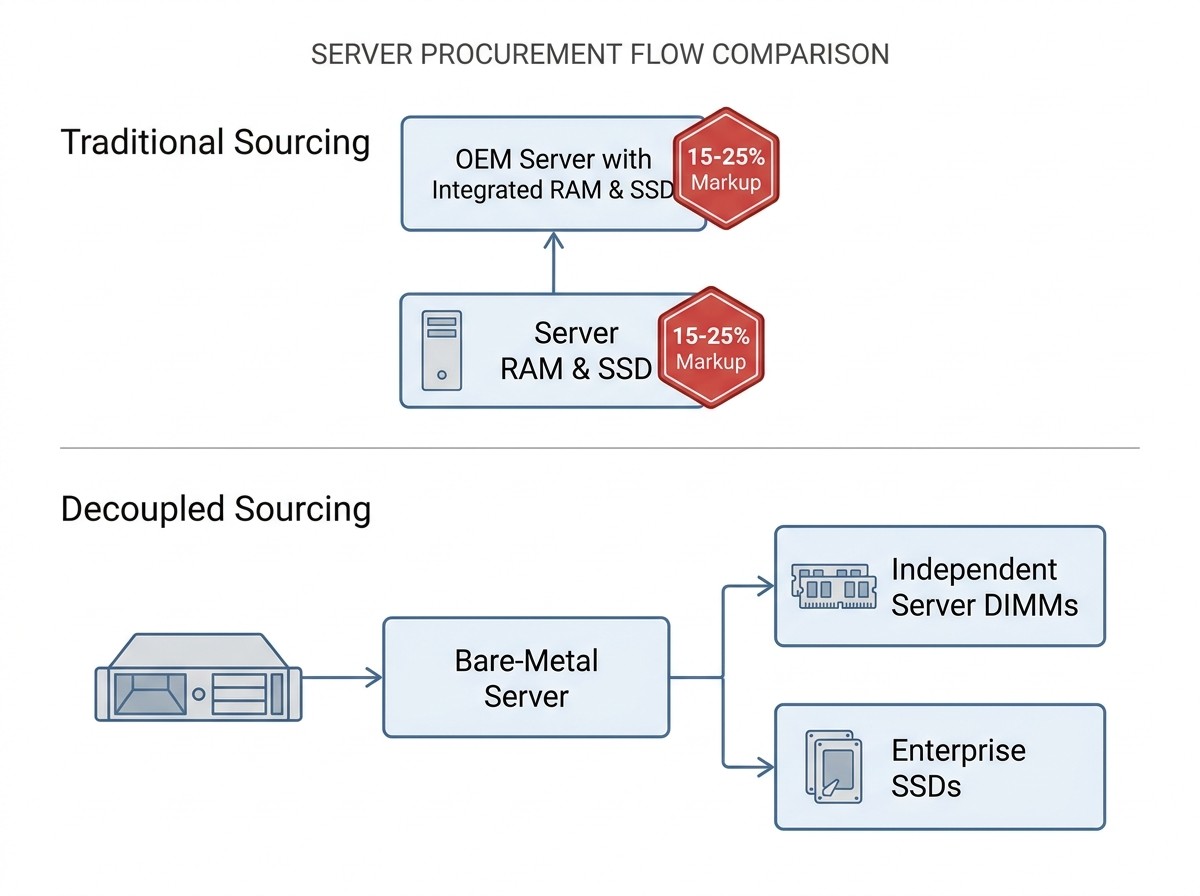
[ Traditional OEM Server Purchase ] ──► Includes 15-25% OEM Markup on Memory
[ Decoupled Sourcing Strategy ] ──► Buy Bare-Metal Server (No RAM/Storage)
──► Source Server DIMMs & SSDs Independently
By purchasing bare-metal servers (servers without pre-installed RAM or storage) and sourcing independent Server Memory Modules (DIMMs) and Enterprise SSDs separately, procurement teams can bypass massive OEM markups. This strategy allows buyers to negotiate directly with independent distributors and leverage competitive market pricing.
3. Certify Alternative Modules & Hybrid Architectures
Relying on a single memory manufacturer or a single part number is a high-risk strategy during a global shortage. Procurement teams must work closely with engineering departments to qualify and certify alternative memory modules and flexible architectures.
Qualifying Alternative Modules: Ensure that alternative parts from different manufacturers (e.g., Micron, Samsung, SK Hynix equivalents) are pre-approved on your Approved Vendor List (AVL). Compare key specifications such as density, speed (MHz), voltage, and latency to ensure drop-in compatibility.
Hybrid Storage Architectures: In storage applications, engineers can design hybrid architectures that mix high-speed, high-cost NAND Flash (for critical caching and active data) with legacy, lower-cost flash or alternative storage tiers. This reduces the overall volume of high-density NAND required, lowering the total BOM cost.
4. Lock in Long-Term Supply Agreements
For highly critical production pipelines, relying solely on the spot market is unsustainable. Sourcing managers should seek to lock in Long-Term Agreements (LTAs) with trusted distribution partners.
LTAs provide mutual benefits: they give manufacturers and distributors predictable demand forecasts, and in return, they guarantee the buyer a set physical allocation of components at a negotiated price ceiling. When entering LTAs during a super-cycle, ensure the contract includes clear clauses regarding allocation guarantees, lead-time commitments, and mechanisms for price adjustments if market conditions shift.
Shielding Your Supply Chain with UTMEL Electronics
During a severe market crunch, traditional franchise distribution channels may restrict allocations to their largest tier-1 customers, potentially leaving mid-market OEMs and contract manufacturers facing significant supply disruptions. This is where partnering with an independent, global distributor becomes a strategic necessity.
UTMEL Electronics serves as a reliable partner to shield your supply chain from BOM cost volatility and allocation cuts. By leveraging a verified global distributor network, UTMEL provides access to hard-to-find inventory and secures reliable allocations for critical memory components.
Through UTMEL's extensive sourcing network, buyers can secure:
DRAM Chips & Memory ICs to maintain active production lines.
High-density NAND Flash and Enterprise SSDs to support storage infrastructure.
Server Memory Modules (DIMMs) to execute decoupled compute-sourcing strategies.
By maintaining strict quality control and counterfeit prevention standards, UTMEL ensures that alternative and hard-to-find memory components meet exact manufacturer specifications, protecting both your budget and your product reliability.
Final Checklist for Procurement Managers
To prepare your organization for the ongoing challenges of the 2026 memory super-cycle, execute the following immediate next steps:
[ ] Audit Current Inventory: Calculate your exact run-rates and identify which products rely on highly constrained DDR4, DDR5, or NAND components.
[ ] Identify Single-Source Risks: Flag any memory ICs or modules that do not have pre-approved alternative manufacturers on the AVL.
[ ] Initiate Engineering Reviews: Provide engineering teams with datasheets for alternative memory modules and initiate the qualification process.
[ ] Evaluate Server Contracts: Determine if upcoming server deployments can be purchased as bare-metal units to allow for independent memory sourcing.
[ ] Secure Q3/Q4 Allocations: Contact independent distributors like UTMEL Electronics to secure allocation blocks and establish rolling safety stocks.
For a deeper dive into short-term stocking strategies, consult our in-depth analysis of the Q1 2026 memory chip market stocking guide.
Sources and references used for this guide
AI Server Demand to Drive Memory Contract Price Increases
Source type: industry institution
Used for: Projections on DRAM and NAND contract price increases.
Caution: Forecasts are subject to market changes; do not state as guaranteed future prices.2026 Market Outlook: SK hynix's HBM to Fuel AI Memory Supercycle
Source type: official company documentation
Used for: Confirmation of the HBM-led memory supercycle and capacity focus.
Caution: Vendor source; focus on macro market statements rather than competitive positioning.Global Memory Shortage Crisis: Market Analysis
Source type: industry institution
Used for: Impact of memory shortage on broader PC and smartphone markets.
Caution: None.Next-Gen DRAM 2026 – Focus on HBM and 3D DRAM
Source type: research source
Used for: Macroeconomic context of the DRAM market growth driven by AI.
Caution: None.
 UTMEL
UTMEL
We are the professional distributor of electronic components, providing a large variety of products to save you a lot of time, effort, and cost with our efficient self-customized service. careful order preparation fast delivery service
 Power Semiconductor Procurement After the Nexperia Shake-Up—NXP for Stability, ON for Technology, or Nexperia for Value?UTMEL04 November 20254880
The recent supply chain turmoil surrounding Netherlands-based Nexperia has sent shockwaves through the global semiconductor industry, forcing procurement professionals to re-evaluate their sourcing strategies.
Read More AI Computing Power Gap: How Token Consumption is Reshaping Server Component SourcingUTMEL23 June 2026955
As global token consumption drives the transition to high-density 100kW+ AI data centers, power delivery networks require advanced Wide-Bandgap semiconductors (SiC/GaN) and high-capacitance MLCCs. This shift has triggered a component procurement crisis with lead times exceeding 24 weeks. To bypass shortages, hardware buyers must abandon just-in-time manufacturing and leverage independent global distributor networks to secure critical power and passive components.
Read More The BSPDN Revolution: Overcoming IR Drop in Sub-2nm GAAFET Nodes with Backside Power DeliveryUTMEL25 June 2026933
As semiconductor manufacturing enters the sub-2nm era, Backside Power Delivery Networks (BSPDN) are replacing traditional front-side routing to overcome critical IR drop bottlenecks. By separating power and signal delivery, chipmakers like Intel and TSMC drastically improve performance and density in GAAFET designs. However, this radical shift introduces manufacturing complexities, thermal challenges, and demands advanced packaging and power management solutions.
Read More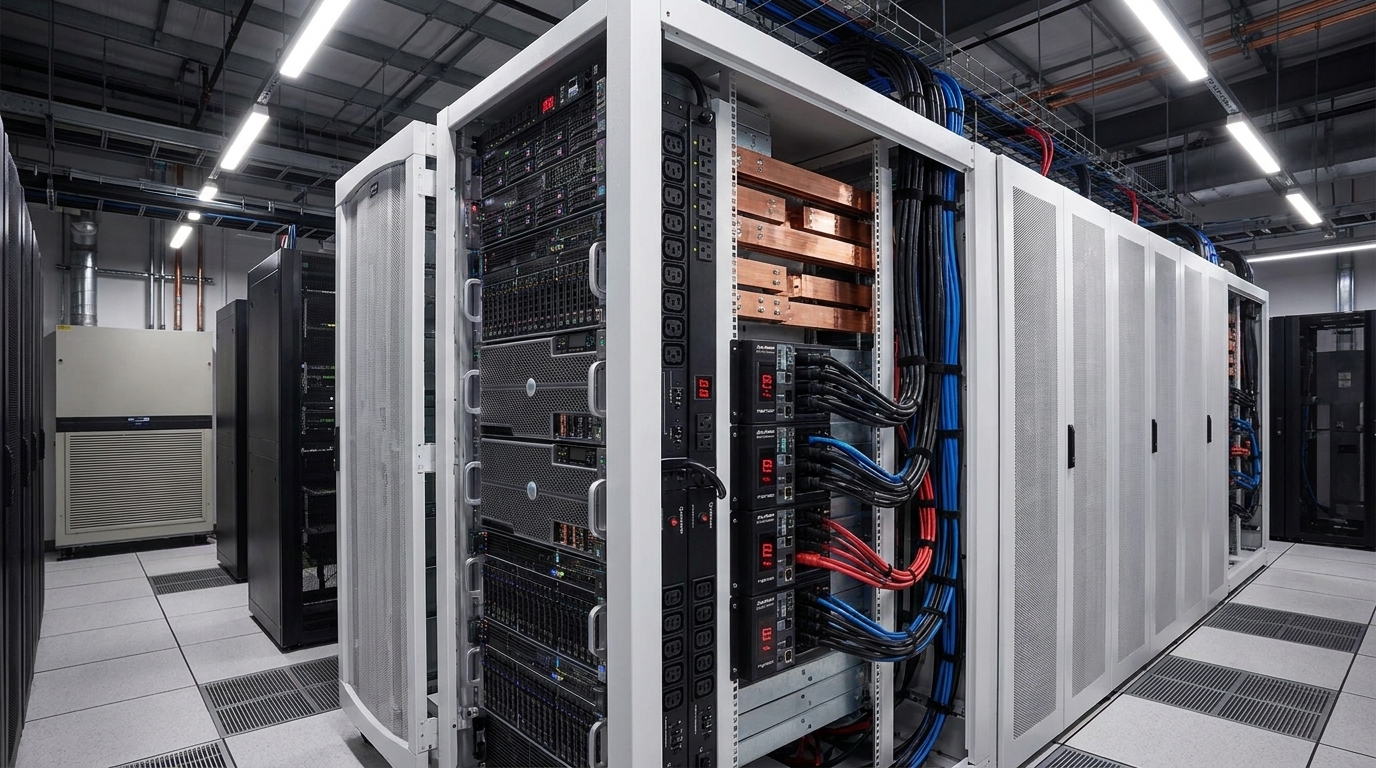 Power Management ICs Trends 2026: AI Demand, Supply Risks, and Sourcing StrategiesUTMEL06 July 20261432
As AI server racks surpass 100kW by 2026, data centers are shifting toward wide-bandgap semiconductors like SiC and GaN. However, this demand has triggered a critical shortage of mature-node Power Management ICs (PMICs). To prevent production halts, sourcing teams must abandon 'just-in-time' models, implement proactive 'just-in-case' strategies, and rapidly qualify pin-to-pin alternative components to secure their supply chains.
Read More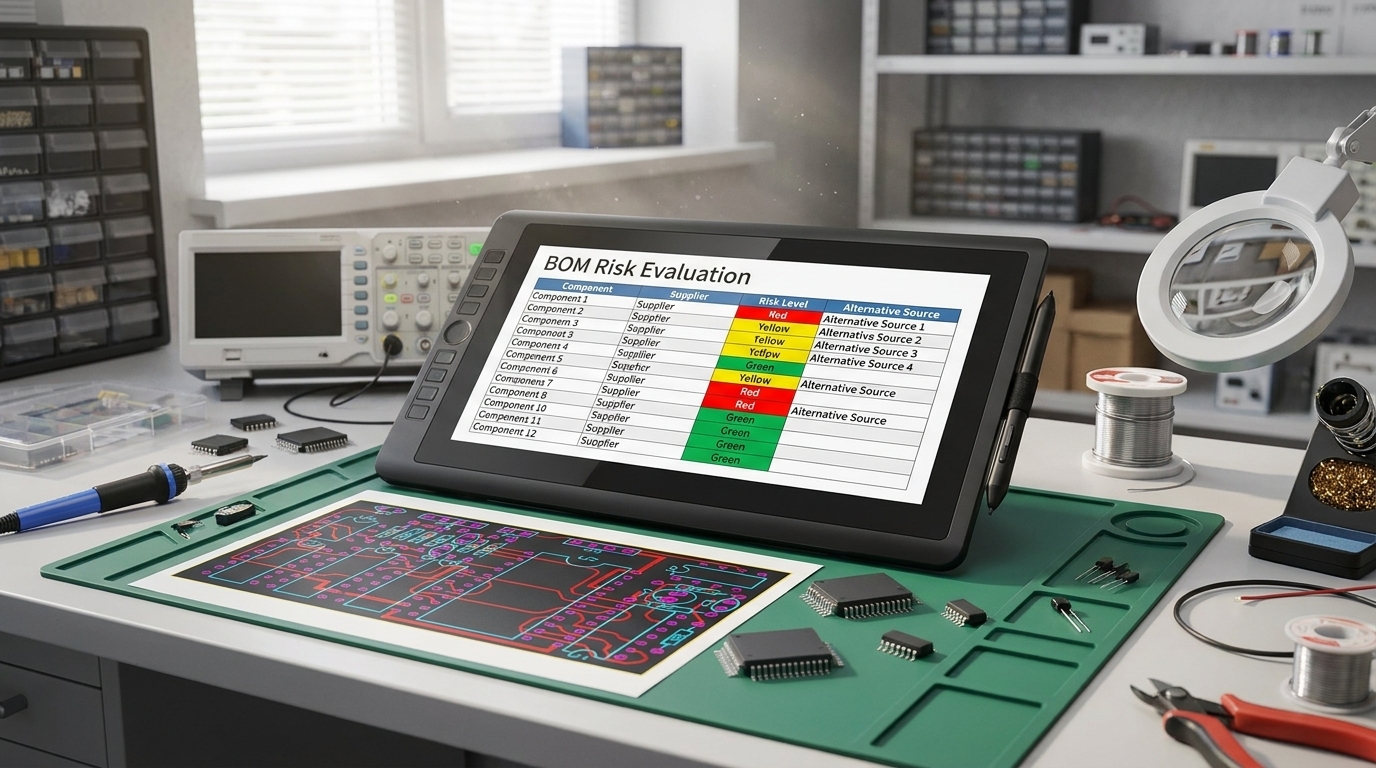 onsemi Synaptics Acquisition Impact: BOM Risk Checklist and Second-Source Strategy for Edge AI DesignsUTMEL27 July 2026345
The onsemi acquisition of Synaptics provides hardware program managers a 12-to-18-month window before potential product cancellations occur in mid-2027. This guide outlines how to audit BOM exposure across overlap and non-core product lines, calculate Last-Time-Buy volumes including hidden storage costs, establish proactive second-sourcing triggers, and implement supply chain monitoring to prevent line-down events.
Read More
Subscribe to Utmel !
![02982028LXFC-F100]() 02982028LXFC-F100
02982028LXFC-F100Littelfuse Inc.
![BLUENRG-232]() BLUENRG-232
BLUENRG-232STMicroelectronics
![BLM18PG221SN1D]() BLM18PG221SN1D
BLM18PG221SN1DMurata Electronics
![BLM18AG121SN1D]() BLM18AG121SN1D
BLM18AG121SN1DMurata Electronics
![BLM21AG102SN1D]() BLM21AG102SN1D
BLM21AG102SN1DMurata Electronics
![BLM18SG221TN1D]() BLM18SG221TN1D
BLM18SG221TN1DMurata Electronics
![FOD3120SD]() FOD3120SD
FOD3120SDON Semiconductor
![BLM18SG331TN1D]() BLM18SG331TN1D
BLM18SG331TN1DMurata Electronics
![FL7760AM6X]() FL7760AM6X
FL7760AM6XON Semiconductor
![BLM18KG601SN1D]() BLM18KG601SN1D
BLM18KG601SN1DMurata Electronics