Product
 Brand
Brand Articles
 Tools
Tools
The 2026 Memory Super-Cycle: Navigating the 500% Surge in DRAM and NAND Flash Prices
Quick answer
The 2026 memory upcycle is real, but the phrase "500% surge in DRAM and NAND prices" is too broad. A Korean export-unit-value statistic, a contract-price forecast, and a retail SSD price are different measurements and should not be combined into one headline. The strongest verified pressure is in DRAM, HBM, enterprise SSDs, and selected mature memory products. Pricing still varies by product, customer agreement, quantity, qualification, and delivery date.
For buyers, the practical response is to separate market signals from purchasing evidence. Use industry forecasts to identify risk, then make decisions from current quotations for the exact manufacturer part number, package, grade, quantity, lead time, and source. Do not reduce memory capacity or approve an alternate device until engineering has validated the system impact.
Updated: August 17, 2026. Forecasts and supply conditions can change. Current manufacturer notices and dated quotations should control active purchasing decisions.
2026 memory market snapshot
AI infrastructure remains the main demand engine. TrendForce estimated that combined capital expenditure by nine large cloud service providers would exceed $886.7 billion in 2026, up about 90% year over year, and raised its forecast for 2026 AI server shipments to nearly 31% growth. That investment supports demand for HBM, server DRAM, enterprise SSDs, and the broader memory hierarchy used around accelerators and CPUs.
Supply is not expanding at the same speed. In its fiscal third-quarter 2026 prepared remarks, Micron said DRAM and NAND industry demand continued to exceed supply and described long construction cycles, process complexity, limited cleanroom space, and the increasing HBM trade ratio as structural constraints. Micron also said it had signed 16 strategic customer agreements covering customers in data center, consumer, automotive, and industrial markets.
These signals support a tight-memory outlook, but they do not prove that every DRAM, NAND, NOR, eMMC, UFS, or SSD product has the same shortage or price increase. Each segment has a different capacity pool, customer base, controller requirement, qualification cycle, and inventory position.
Why AI changes memory allocation
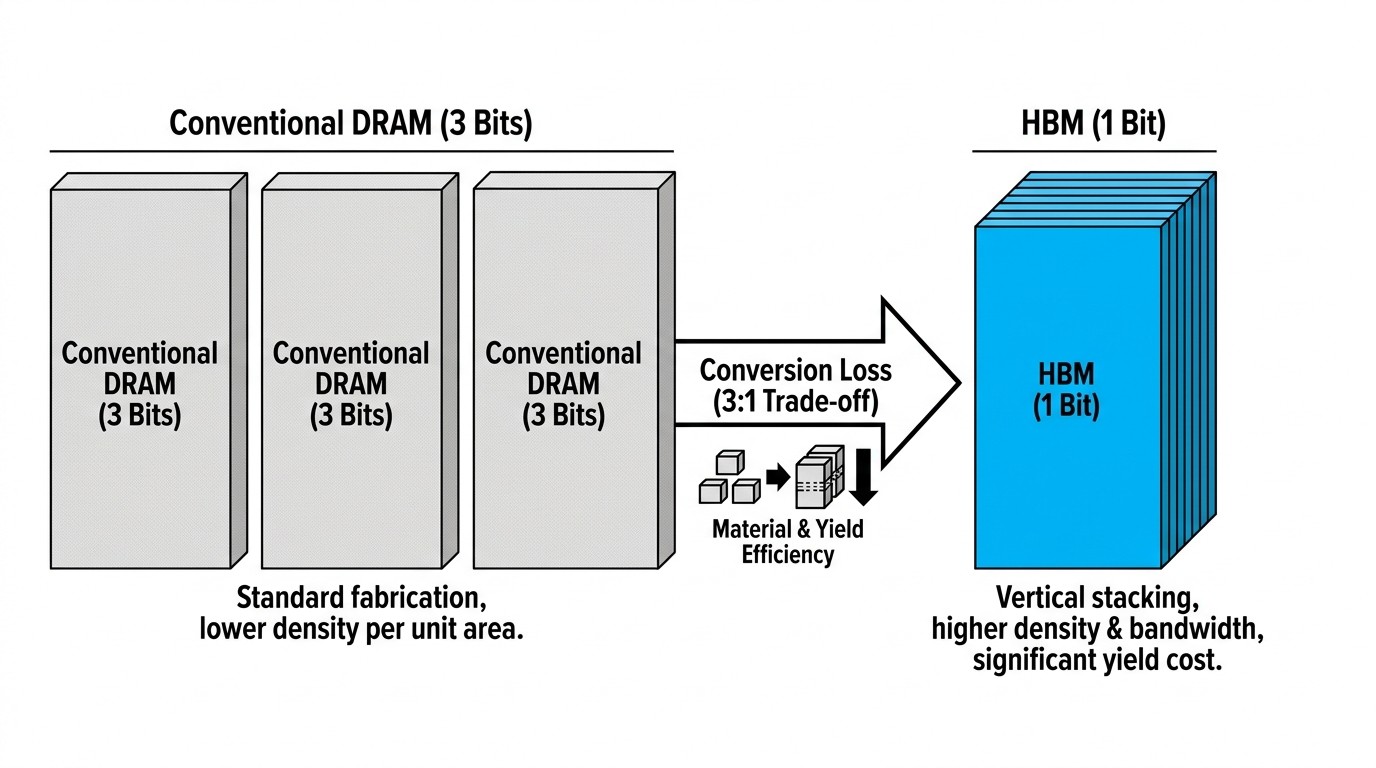
AI systems need both compute and a high-performance memory subsystem. HBM is built from stacked DRAM dies and requires advanced packaging, testing, and additional wafer input compared with conventional DRAM. As suppliers allocate more resources to HBM and high-density server products, less capacity may be available for other DRAM products.
The often-cited "3:1 trade-off" is a useful illustration of this pressure, but it should not be treated as a universal conversion factor. The trade ratio varies with HBM generation, die size, stack height, process node, yield, and packaging flow. The defensible conclusion is that HBM consumes more manufacturing resources per delivered bit than conventional DRAM, not that every HBM bit always removes exactly three standard DRAM bits.
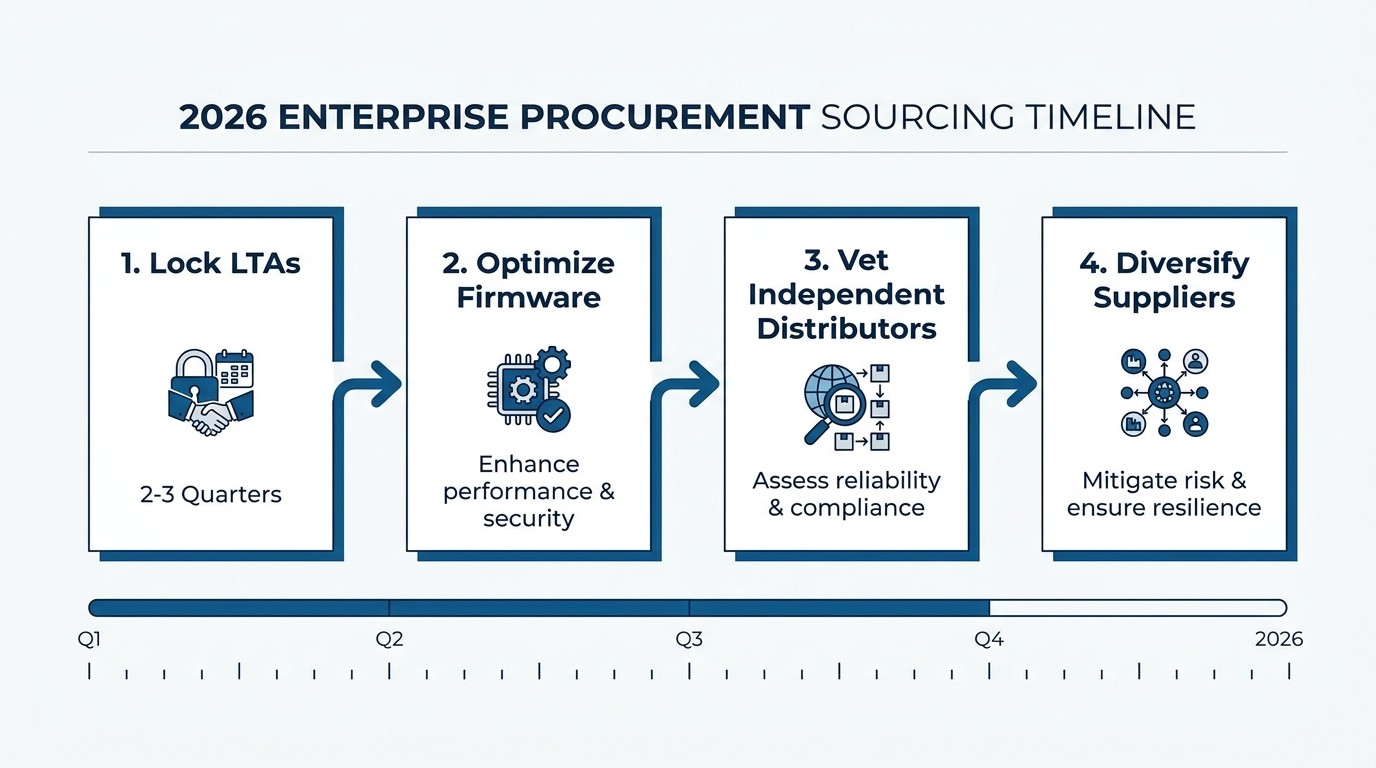
Capacity allocation is also shaped by commercial agreements. TrendForce reported in July that multi-year long-term agreements were limiting price increases for some cloud customers, while supply sold outside those agreements remained more exposed to market pricing. Micron's prepared remarks similarly described multi-year agreements with volume commitments and, in some cases, price floors or ceilings. This means two buyers can face different availability and pricing for similar memory products.
DRAM and NAND price trajectory: what the forecasts actually say
First quarter 2026
On February 2, TrendForce raised its first-quarter forecast for conventional DRAM contract prices to a 90% to 95% quarter-over-quarter increase and its NAND Flash forecast to 55% to 60%. The same release identified especially strong pressure in PC DRAM, server DRAM, mobile DRAM, and enterprise SSDs.
Second quarter 2026
On March 31, TrendForce forecast another 58% to 63% quarter-over-quarter increase for conventional DRAM contract prices and 70% to 75% for NAND Flash. The research firm attributed the pressure to server and AI demand, capacity allocation, limited near-term supply growth, and customers using long-term agreements to secure supply.
Third quarter 2026
By July, the rate of increase was forecast to slow. TrendForce projected conventional DRAM contract prices to rise 13% to 18% quarter over quarter in the third quarter and NAND Flash contract prices to rise 10% to 15%. It cited weaker consumer demand, high comparison bases, and customers reaching affordability limits, even as supply remained tight.
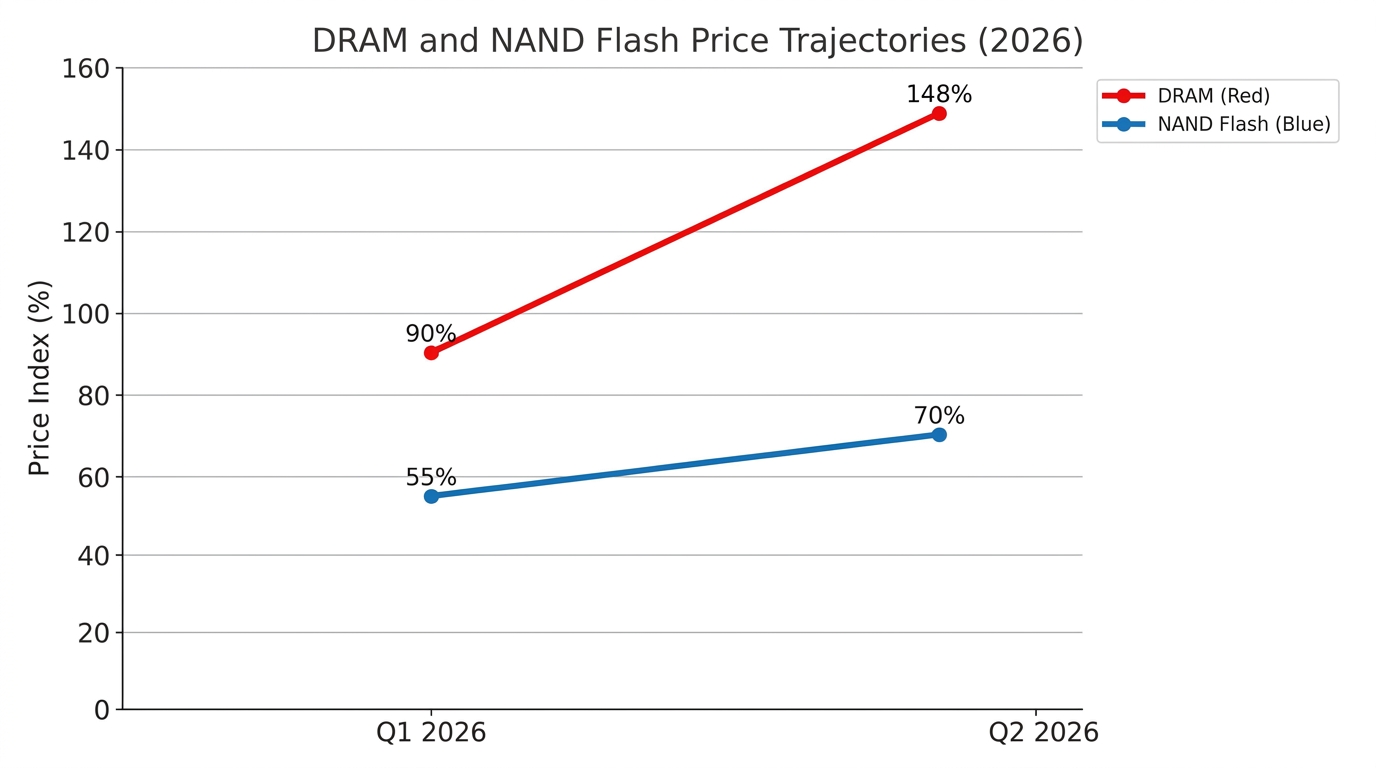
These percentages describe broad contract-price forecasts for specified product groups and quarters. They are not a price index for every memory component. They also should not be multiplied mechanically and applied to an individual bill of materials. A contract price, spot-market quote, export unit value, and retail product price measure different transactions.
For that reason, the article title should not promise a universal 500% increase. The earlier article cited a change in Korean export value per kilogram, which can be affected by product mix as well as price. That measure does not show that DRAM and NAND buyers universally paid five times more for comparable products.
Outlook by memory segment
HBM and server DRAM
HBM and server DRAM remain closely tied to AI accelerator and general-purpose server deployments. TrendForce forecast server DRAM contract prices to rise 13% to 18% quarter over quarter in the third quarter, while noting that long-term agreements cap increases for some customers. Buyers without committed supply may face more exposure than customers covered by multi-year agreements.
Server-memory planning should include CPU availability, module capacity, platform qualification, and the delivery schedule. A lower-capacity RDIMM may reduce immediate cost, but it can also change server count, software licensing, power consumption, and workload performance. Capacity changes require system-level analysis.
PC and mobile DRAM
PC and smartphone demand weakened as higher component costs reached end customers. TrendForce expected PC and mobile memory prices to continue rising in the third quarter, but at a slower pace because device brands and consumers were becoming less willing to absorb further increases.
This is a good example of market divergence. Weak device shipments do not automatically create cheap memory when suppliers are reducing the capacity allocated to consumer products. At the same time, weaker demand can limit how far prices rise. Buyers should track both supplier allocation and end-market inventory.
Enterprise SSD and NAND Flash
Enterprise SSD demand remains supported by AI inference, data centers, and high-capacity storage. However, NAND is not one market. Enterprise SSDs, client SSDs, raw NAND wafers, mobile managed NAND, and removable storage can show different conditions. TrendForce's third-quarter outlook described stronger support for enterprise SSD pricing and more resistance in client and consumer products.
For NAND-based products, verify capacity, interface, controller, firmware, endurance, write workload, error correction, power-loss protection, package, temperature range, and qualification status. The Utmel guide to NAND Flash provides background on the technology and its applications.
NOR Flash and SLC NAND
Mature memory can be constrained even when it is not used directly in AI accelerators. In June, TrendForce estimated that average NOR Flash contract prices had increased 100% to 120% during the first half of 2026 and SLC NAND prices had increased 130% to 150%. It linked the pressure to suppliers prioritizing higher-value products, limited mature-node expansion, and demand from automotive, industrial, networking, and edge applications.
Those figures are segment estimates, not a guarantee for every density or manufacturer. TrendForce also expected lower-density NOR Flash to benefit from additional Chinese capacity, which could stabilize some products. Procurement teams should therefore monitor the exact density, interface, package, grade, lifecycle, and approved vendor list instead of assuming every mature-memory part follows the same curve.
eMMC and UFS
The earlier claim that automotive eMMC and UFS prices had universally quadrupled with 52-week lead times was not supported by a direct source. TrendForce's third-quarter analysis instead said eMMC and UFS availability had become relatively more abundant as smartphone procurement weakened, with more modest price increases expected.
Automotive and industrial managed memory can still have long qualification cycles and part-specific constraints. Confirm the exact automotive grade, temperature range, endurance profile, package, controller and firmware compatibility, change-notification policy, and traceability requirements.
When could memory supply ease?
There is no single end date for the memory shortage. TrendForce's July 30 outlook expects DRAM and NAND to diverge in 2027. DRAM supply is expected to remain tight because HBM allocation and server demand continue to absorb capacity, while meaningful new output takes time to ramp. Its August 4 update also projected DRAM tightness through 2027.
NAND Flash may move toward a looser supply environment in the second half of 2027 as process migrations and new capacity increase bit output while consumer demand remains weak. TrendForce estimated a 4% to 5% NAND supply deficit for 2026 but expected the balance to turn positive in the second half of 2027.
These are forecasts, not fixed deadlines. Faster AI demand, delayed fab ramps, yield problems, export controls, or stronger consumer recovery could prolong tightness. Faster process migration or weaker demand could ease it earlier. Buyers should update forecasts regularly rather than treating 2027 or 2028 as a guaranteed recovery date.
A practical procurement and engineering plan
1. Identify the exact commercial item
Record the manufacturer, full part number, density, organization, interface, speed grade, voltage, package, temperature grade, lifecycle status, and approved firmware or controller combination. A broad label such as "DDR5" or "NAND" is not enough to compare quotations.
2. Separate forecast data from quotation data
For every quote, record the date, currency, quantity break, minimum order quantity, cancellation terms, stock quantity, lead time, delivery schedule, source, lot and date code, country of origin, and quote validity. Market percentages explain context; a dated quotation establishes the purchasing condition.
3. Match supply commitments to validated demand
Long-term agreements can improve supply visibility, but they may include volume commitments, deposits, price floors, ceilings, or take-or-pay terms. Model base, upside, and downside demand before committing. Avoid speculative inventory that lacks a consumption plan, storage controls, lifecycle review, and quality strategy.
4. Treat capacity reduction as an engineering change
Reducing DRAM, NAND, or managed-memory capacity may affect performance, endurance, boot behavior, update strategy, data retention, error handling, and product life. Validate the full workload and worst-case operating conditions before changing the production configuration.
5. Qualify alternatives instead of assuming equivalence
Similar density and package do not prove that two memory products are drop-in replacements. Verify pinout, command set, timing, voltage, package dimensions, controller support, firmware, endurance, ECC behavior, temperature range, qualification, lifecycle, and change-control requirements. Complete board-level and system-level testing before release.
6. Apply source and authenticity controls
When authorized supply is unavailable, an independent source requires stronger controls, not fewer. Define traceability documents, packaging and label inspection, electrical testing, sample plans, counterfeit-risk procedures, return terms, and storage requirements. Utmel's memory IC and integrated circuit catalog can support part discovery and quotation requests, but engineering and quality approval remain application-specific.
Frequently asked questions
Are DRAM and NAND prices really up 500% in 2026?
No single verified measure supports that statement for the entire DRAM and NAND markets. Some 2026 contract-price forecasts were exceptionally high, and a Korean export-unit-value statistic reportedly approached a 500% year-over-year change. Those measures are not interchangeable and do not establish a universal fivefold increase for comparable products.
Why does HBM demand affect conventional DRAM?
HBM uses DRAM wafers plus complex stacking, testing, and advanced packaging. It requires more manufacturing resources per delivered bit than conventional DRAM. When suppliers prioritize HBM and server products, available capacity for other DRAM segments can tighten.
Will all memory prices keep rising at the same rate?
No. TrendForce's third-quarter forecast showed continued increases but a much slower pace than in the first half. Server DRAM, PC DRAM, mobile DRAM, enterprise SSDs, client SSDs, NOR Flash, SLC NAND, eMMC, and UFS can diverge substantially.
Should buyers sign long-term agreements immediately?
Only after validating demand, commercial terms, cash requirements, lifecycle risk, and the engineering roadmap. LTAs can improve allocation and price visibility, but binding volume commitments can create excess-inventory risk if product demand changes.
Can a lower-capacity memory device reduce BOM cost safely?
Sometimes, but it is an engineering decision. Validate performance, endurance, update requirements, boot behavior, error handling, data retention, and worst-case workloads before reducing capacity.
When will memory supply normalize?
Current forecasts differ by segment. TrendForce expects DRAM to remain tight through 2027, while NAND Flash may become more balanced in the second half of 2027. These are forward-looking estimates and should be refreshed as capacity, demand, and customer agreements change.
Sources
AI Server Shipments Forecast Raised to Nearly 31% YoY in 2026 - TrendForce, August 3, 2026.
Memory Price Outlook for 1Q26 Sharply Upgraded - TrendForce, February 2, 2026.
AI Server Demand to Drive Memory Contract Price Increases in 2Q26 - TrendForce, March 31, 2026.
AI Server Demand Continues to Support Memory Prices in 3Q26 - TrendForce, July 3, 2026.
Long-Term Agreements Cap Price Increases for Server DRAM - TrendForce, July 9, 2026.
Structural Shortages for NOR Flash and SLC NAND - TrendForce, June 16, 2026.
Diverging DRAM and NAND Flash Outlook in 2027 - TrendForce, July 30, 2026.
DRAM Supply to Remain Tight in 2027 - TrendForce, August 4, 2026.
Fiscal Q3 2026 Earnings Call Prepared Remarks - Micron Technology, June 24, 2026.
 UTMEL
UTMEL
We are the professional distributor of electronic components, providing a large variety of products to save you a lot of time, effort, and cost with our efficient self-customized service. careful order preparation fast delivery service
 Power Semiconductor Procurement After the Nexperia Shake-Up—NXP for Stability, ON for Technology, or Nexperia for Value?UTMEL04 November 20254820
The recent supply chain turmoil surrounding Netherlands-based Nexperia has sent shockwaves through the global semiconductor industry, forcing procurement professionals to re-evaluate their sourcing strategies.
Read More AI Computing Power Gap: How Token Consumption is Reshaping Server Component SourcingUTMEL23 June 2026896
As global token consumption drives the transition to high-density 100kW+ AI data centers, power delivery networks require advanced Wide-Bandgap semiconductors (SiC/GaN) and high-capacitance MLCCs. This shift has triggered a component procurement crisis with lead times exceeding 24 weeks. To bypass shortages, hardware buyers must abandon just-in-time manufacturing and leverage independent global distributor networks to secure critical power and passive components.
Read More The BSPDN Revolution: Overcoming IR Drop in Sub-2nm GAAFET Nodes with Backside Power DeliveryUTMEL25 June 2026803
As semiconductor manufacturing enters the sub-2nm era, Backside Power Delivery Networks (BSPDN) are replacing traditional front-side routing to overcome critical IR drop bottlenecks. By separating power and signal delivery, chipmakers like Intel and TSMC drastically improve performance and density in GAAFET designs. However, this radical shift introduces manufacturing complexities, thermal challenges, and demands advanced packaging and power management solutions.
Read More Power Management ICs Trends 2026: AI Demand, Supply Risks, and Sourcing StrategiesUTMEL06 July 20261277
As AI server racks surpass 100kW by 2026, data centers are shifting toward wide-bandgap semiconductors like SiC and GaN. However, this demand has triggered a critical shortage of mature-node Power Management ICs (PMICs). To prevent production halts, sourcing teams must abandon 'just-in-time' models, implement proactive 'just-in-case' strategies, and rapidly qualify pin-to-pin alternative components to secure their supply chains.
Read More onsemi Synaptics Acquisition Impact: BOM Risk Checklist and Second-Source Strategy for Edge AI DesignsUTMEL27 July 2026294
The onsemi acquisition of Synaptics provides hardware program managers a 12-to-18-month window before potential product cancellations occur in mid-2027. This guide outlines how to audit BOM exposure across overlap and non-core product lines, calculate Last-Time-Buy volumes including hidden storage costs, establish proactive second-sourcing triggers, and implement supply chain monitoring to prevent line-down events.
Read More
Subscribe to Utmel !
![H050X044H1T]() H050X044H1T
H050X044H1TPanduit Corp
![110060947]() 110060947
110060947Seeed Technology Co., Ltd
![1.69508.8100000]() 1.69508.8100000
1.69508.8100000RAFI USA
![SLI-343P8G3F]() SLI-343P8G3F
SLI-343P8G3FROHM Semiconductor
![1203410303]() 1203410303
1203410303Molex
![SGNE06C080MT150N25]() SGNE06C080MT150N25
SGNE06C080MT150N25TDK Corporation
![1-22279-6]() 1-22279-6
1-22279-6TE Application Tooling
![H100X044H1T-2]() H100X044H1T-2
H100X044H1T-2Panduit Corp
![SLI-343P8C3F]() SLI-343P8C3F
SLI-343P8C3FROHM Semiconductor
![83500000005]() 83500000005
83500000005Littelfuse Inc.