

 Product
 Brand
Brand Articles
 Tools
Tools
What JEDEC JEP203 and JEP204 Actually Change for SiC Qualification Engineers and Component Buyers
1. The Problem These Documents Actually Solve
Some context on where these documents come from. JEDEC's JC-70 committee for Wide Bandgap Power Electronic Conversion Semiconductors was formed in October 2017 with roughly 22 member companies. It now has more than 70, spanning GaN and SiC device makers, the companies that use those devices, test and measurement suppliers, universities and national laboratories[3]. JEP203 and JEP204 were developed by its JC-70.2 Silicon Carbide Subcommittee[1], which is organised into task groups covering reliability and qualification procedures, datasheet elements and parameters, and test and characterization methods. Both new documents come out of the reliability and qualification track. Datasheet parameter harmonisation is a separate, ongoing workstream — worth knowing, because it means these two publications do not by themselves standardise what appears on a datasheet.
Here is the practical problem they address. Two SiC MOSFET vendors could both publish a short-circuit withstand time and mean materially different things by it. Bus voltage, gate drive voltage, starting junction temperature, stray inductance in the test fixture, the definition of failure, and the criteria for ending the measurement were all effectively vendor-defined.
The result was predictable. A withstand time from one supplier was not directly comparable to the same figure from another, and every design team ran its own evaluation under its own worst-case conditions anyway. The datasheet number served marketing better than it served engineering.
JEP204 addresses a related version of the same problem on the reliability side. Ask three SiC suppliers what reliability testing they have run and you would get back three lists whose test names, conditions and read points varied by vendor, by target application, and sometimes by whoever wrote the report. There was no shared menu to point at and say: run these, this way, and report results in this format.
That mattered more each year as the SiC supply chain broadened beyond a handful of vertically integrated makers. Without a common qualification vocabulary, every new supplier onboarding required a custom evaluation framework built from scratch.
2. JEP203 in Practice: Short-Circuit Evaluation That Means Something
JEP203 is titled Guideline for Short Circuit Evaluation in Power Conversion Transistors. According to JEDEC, it provides guidance for evaluating the short-circuit capability of power MOSFETs, with the aim of improving protection design, testing consistency and system robustness in applications such as electric vehicles, industrial drives and energy infrastructure[1].
Why SiC Short-Circuit Testing Is Harder Than Silicon
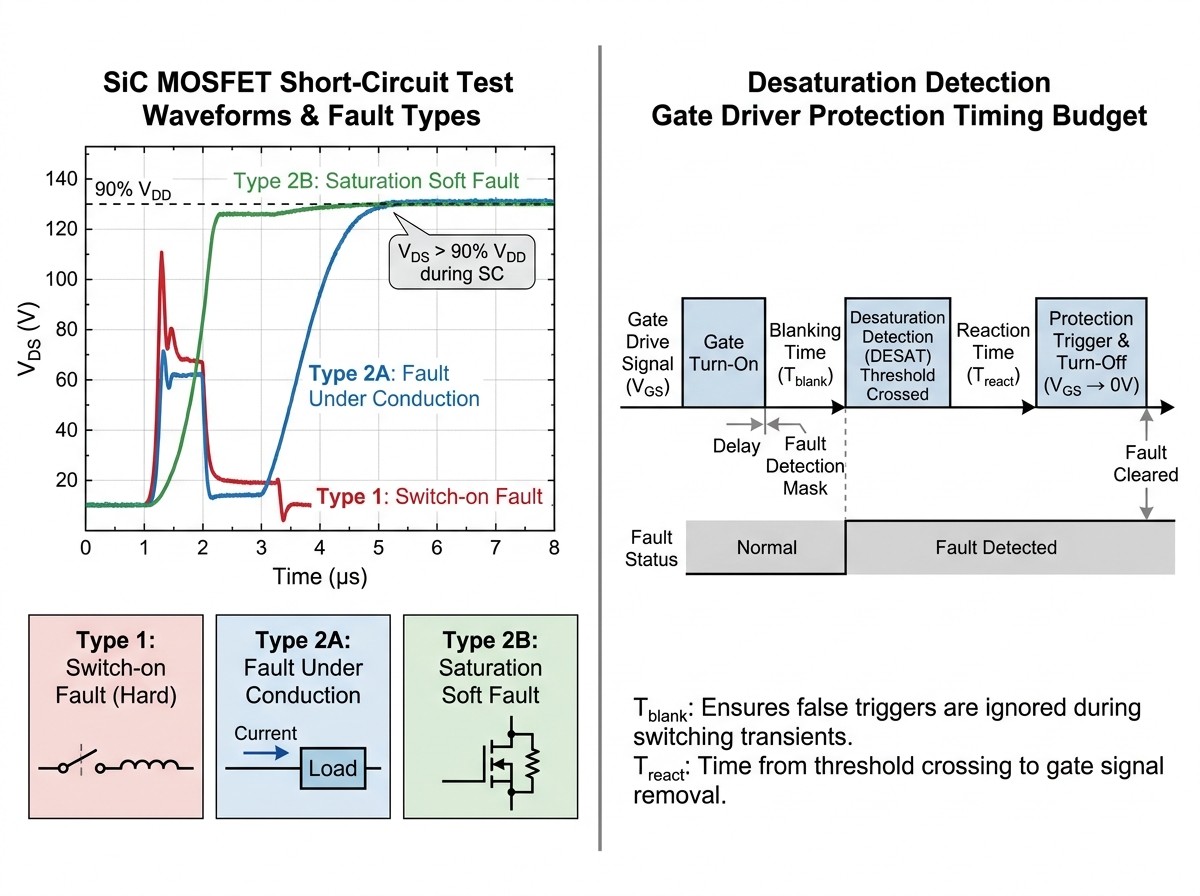
A SiC MOSFET under short-circuit conditions concentrates extreme stress in a very small volume. Compared with a silicon IGBT of equivalent current rating, the SiC die is smaller — often substantially — so current density during a short circuit is far higher. The device heats faster, thermal runaway arrives sooner, and the window between conducting normally and being destroyed is typically measured in single-digit microseconds rather than the roughly ten microseconds a comparable silicon IGBT might tolerate.
That leaves no margin for slow gate driver response. The protection circuit, usually desaturation detection on the gate driver, has to detect the fault, initiate turn-off and complete the transition before the device fails. Which means the design engineer needs to know the real short-circuit withstand capability under conditions that resemble their own inverter's bus voltage, gate drive voltage and worst-case starting junction temperature — not under whatever conditions happened to produce the most flattering number.
What a Shared Evaluation Basis Changes for Protection Design
JEP203 does not set a minimum withstand time that devices must meet. It is a guideline for how the evaluation is performed and reported. Three things follow from that for a design engineer:
First, cross-vendor comparison becomes possible. When two suppliers both reference JEP203 in their short-circuit data, the numbers can be compared on a like-for-like basis. Before June 2026 a sourcing engineer evaluating cross-brand alternates — for instance when a qualified part goes on allocation and the design needs a functionally equivalent replacement — had no reliable way to know whether an alternate's short-circuit rating was genuinely better, genuinely worse, or simply measured differently. Requesting JEP203-referenced data closes that gap, and makes multi-source strategies viable in applications where short-circuit robustness is a hard requirement.
Second, protection timing can be sized against a known test condition. If the engineer knows the bus voltage, gate voltage and starting junction temperature behind a withstand figure, they can set the desaturation detection threshold and blanking time with a defensible margin instead of an assumption. Without that, the margin is speculation dressed up as a specification.
Third, the withstand time can be treated as a budget. The total interval from fault onset to safe turn-off includes detection delay, gate driver propagation delay, the turn-off transition itself, and any overshoot clamping. A defined device capability lets each portion of that budget be allocated against something real.
One caveat worth stating plainly, because the rest of this article depends on it: JEP203 is a guideline, not a regulation. No supplier is obliged to reference it, and many datasheets will not mention it for some time. That is precisely why the burden sits with the buyer to ask. Which brings us to Section 4.
3. JEP204 in Practice: A Catalog, Not a Qualification Mandate
JEP204 is titled Catalog of Stress Procedures for Silicon Carbide Devices for Power Electronic Conversion. JEDEC describes it as a comprehensive reference covering reliability, environmental and ruggedness stress procedures for SiC power devices, giving qualification engineers and device manufacturers a common framework for evaluating long-term reliability and performance[1].
What "Catalog" Means Operationally
The word catalog is doing real work here. JEP204 is not a standard in the sense that AEC-Q101 is a standard. It is a reference of well-defined stress procedures that the industry agrees are relevant, from which a qualification engineer can draw when building a test plan.
The practical benefit is shared vocabulary. Instead of specifying a test "per our internal procedure," an engineer can reference a JEP204 entry and expect that any competent lab or supplier will interpret it the same way. That reduces ambiguity in supplier qualification documentation and makes test reports from different device makers meaningfully comparable.

The SiC-Specific Mechanisms a Qualification Plan Has to Cover
Independent of any particular document, these are the degradation modes that distinguish a SiC qualification plan from a silicon one, and the areas where vendor practice has historically been least consistent. Use them as the checklist when reviewing what a supplier actually tested:
Gate threshold instability. Threshold voltage drift under gate bias and under high-frequency switching stress, which behaves differently in SiC than in silicon because of the gate oxide interface.
Bipolar degradation. Stacking fault expansion driven by body diode conduction, a failure mode with no silicon MOSFET equivalent.
Humidity under bias. High-voltage humidity testing, particularly where switching is applied during exposure rather than static bias, which better represents field conditions.
Ruggedness. Avalanche capability, surge current, and short-circuit withstand.
Package and module reliability. Wire bond fatigue, die-attach integrity, and thermal and power cycling at module level.
Whether a given supplier's qualification covers each of these, and how, is exactly what Section 4 is designed to surface.
Relationship to AEC-Q101
This is the question that causes the most confusion, so it is worth stating directly: JEP204 does not replace AEC-Q101.
AEC-Q101 is a qualification standard from the Automotive Electronics Council. It defines mandatory stress tests, sample sizes, acceptance criteria and lot requirements for discrete semiconductors intended for automotive use. A supplier qualifies a device to AEC-Q101 by completing the prescribed flow and meeting the acceptance criteria.
JEP204 is a JEDEC guideline. It does not mandate tests, define sample sizes or set pass/fail limits. It offers a catalog of defined stress procedures that qualification engineers can draw from when designing a plan.
In practice the two layer together. Automotive programs will still qualify to AEC-Q101. JEP204 supplies SiC-specific procedures for the mechanisms listed above, which a general-purpose discrete semiconductor standard was never written to address. For non-automotive applications — industrial drives, solar inverters, data center power — where AEC-Q101 qualification may not be contractually required, JEP204 gives engineers a defensible public reference to build a SiC qualification plan around instead of defaulting to a vendor's internal standard.
4. What to Ask Suppliers for Now
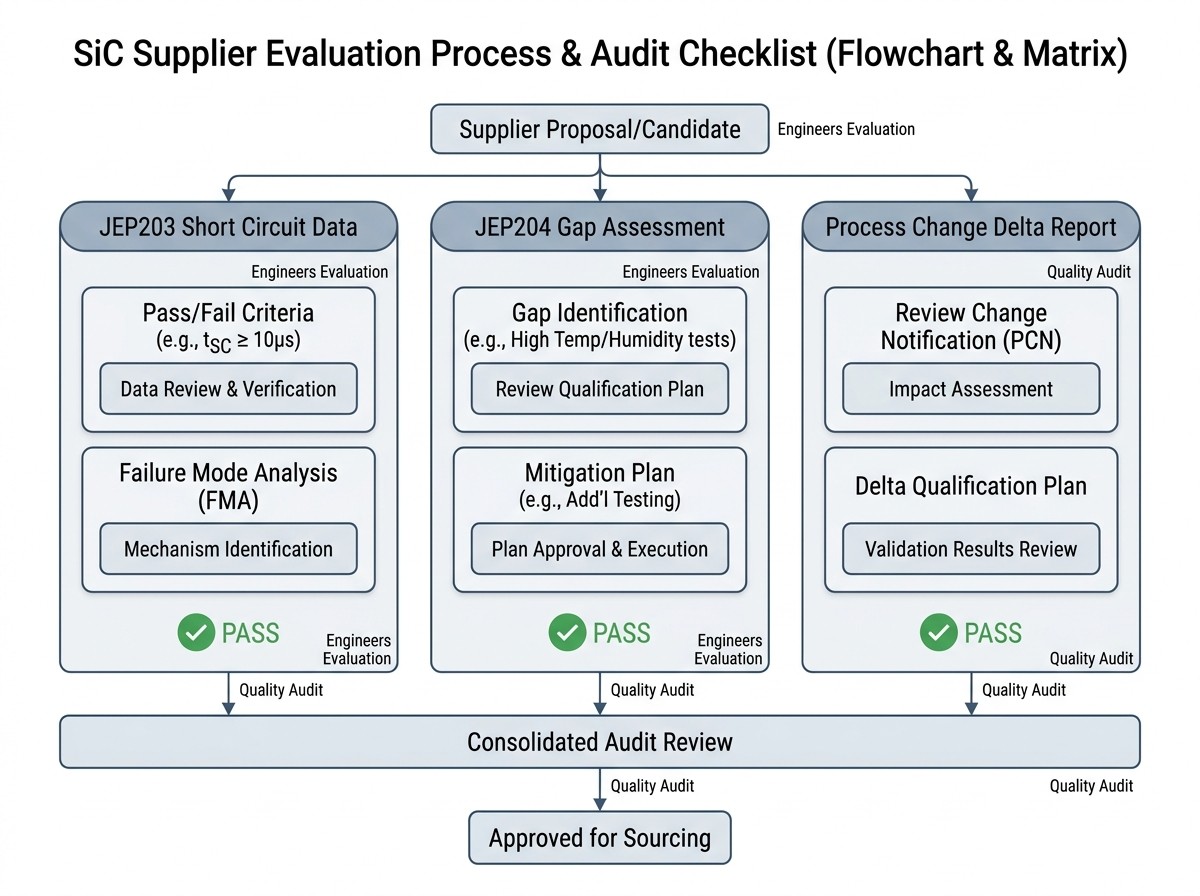
The following is written to be copied into an email or supplier questionnaire. For each item, the table shows what a credible answer looks like alongside what an evasive one looks like.
| Question to Ask | What a Good Answer Looks Like | What an Evasive Answer Looks Like |
|---|---|---|
| Is the short-circuit withstand time in your datasheet or qualification report generated per JEP203? | "Yes. Tested per JEP203 at [bus voltage], [gate voltage], starting Tj = [value]. Full test conditions and failure criteria are listed in the report appendix." | "Our short-circuit performance is industry-leading." Or: "We follow internal standards that exceed JEDEC requirements," without stating the conditions. |
| Which JEP204 stress procedures have been run on this device, and under what conditions? | A table listing specific procedure references, sample sizes per test, read points, and results summaries. | "Full reliability testing has been completed." Or: "We test to AEC-Q101," offered as though it answers the question. It does not — AEC-Q101 was not written around SiC-specific mechanisms. |
| If the qualification predates JEP204, has a gap assessment been performed? | "Yes. We reviewed our earlier qualification against JEP204 and identified procedures not previously run: [list]. Those are scheduled, and preliminary data will be available under NDA in [month]." | "Our qualification is comprehensive and we see no need to update it." A gap assessment is not a requalification; declining to run one is itself a signal. |
| How do you handle qualification when a die revision or process change occurs? | "We have a documented change notification process. For die revisions affecting active area, gate oxide or termination, we re-run the applicable procedure set. Customers under NDA receive a delta report showing which tests were repeated and results versus the prior revision." | "Minor process changes do not affect reliability," with no defined delta list or change-triggered requalification criteria. |
| What documentation is available under NDA versus openly? | "Datasheets state short-circuit test conditions publicly. Full qualification reports, including sample sizes, read points, cycling data and failure analysis summaries, are available under NDA. A qualification summary can be shared with your sourcing team without an NDA." | "We provide reliability data on request," without specifying what data, at what level of detail, or under what terms. |
For engineers evaluating cross-brand alternates — whether because a qualified part is on allocation, a second source is needed for supply assurance, or a design refresh is underway — asking these five questions consistently across suppliers is the single most effective step toward making JEP203 and JEP204 operational in a qualification workflow.
5. What to Do If Your Existing Qualification Predates June 2026
No one needs to requalify a shipping product because a JEDEC guideline was published. That is not how guidelines work, and no sensible quality organisation would demand it.
The workable position is to treat JEP203 and JEP204 as the baseline for anything new.
For new designs starting now: write both into the component specification. Require short-circuit data per JEP203 conditions. Use JEP204 as the reference catalog when defining the reliability qualification plan. This costs nothing extra and makes all incoming supplier data comparable from day one.
For devices already qualified and in production: schedule a gap assessment at the next design refresh, vendor review or AVL audit. Ask the questions in Section 4. If a supplier already holds data that maps to JEP204 procedures, get it. If they do not, ask when they plan to generate it. Use the answers to inform the next program, not to disrupt a stable line.
For onboarding a new supplier into an existing AVL: use both documents as specification language in the supplier quality agreement. "Short-circuit evaluation shall be per JEP203. Reliability qualification shall reference JEP204 procedures as applicable" replaces vague wording like "supplier shall demonstrate adequate reliability" with something both parties can look up.
For supply agreements and alternates: when a qualified part goes on allocation and the design team needs a cross-brand alternate, JEP203 conditions and JEP204 references become the basis for an apples-to-apples comparison. If both the incumbent and the alternate reference the same guidelines, the sourcing decision becomes technical rather than speculative. This is the scenario where having multi-brand inventory with datasheet access and qualification document support in one place materially shortens the time to identify and onboard a viable alternate.
6. The Wider JEDEC Wide Bandgap Document Set
JEP203 and JEP204 do not sit alone. If you work across SiC and GaN, it is worth knowing which documents already exist so you neither mistake older publications for new releases nor assume coverage is missing where it is not.
On the SiC side, JEDEC also publishes JEP194, Guideline for Gate Oxide Reliability and Robustness Evaluation Procedures for Silicon Carbide Power MOSFETs, covering gate reliability and lifetime testing for SiC devices with a gate oxide or gate dielectric[4]. Given that gate threshold instability is one of the mechanisms that most distinguishes SiC from silicon, JEP194 belongs in any SiC qualification discussion alongside the two new documents.
On the GaN side, the guidelines are older and well established:
JEP173 (2019): dynamic on-resistance test method guidelines for GaN HEMT based power conversion devices, addressing the current-collapse measurement problem specific to GaN.
JEP180 (2020): guideline for switching reliability evaluation procedures for GaN power conversion devices, covering switching accelerated life and dynamic high-temperature operating-life testing.
JEP182 (2021): test method for continuous-switching evaluation of GaN power conversion devices, defining test circuits used alongside JEP180[5].
JEP198 (2024): framework for evaluating time-dependent breakdown reliability of GaN power transistors under off-state bias, including high-temperature reverse bias stress and application-specific stress testing.
These GaN documents have been referenced in supplier datasheets and qualification reports for years. If a GaN supplier is not citing JEP173 for dynamic RDS(on) data or JEP180 for switching reliability, that is a gap worth flagging in the same way you would flag missing JEP203 data for SiC.
7. Reference Summary Table
| Document | What It Covers | Who It Is For | Published | Where to Get It |
|---|---|---|---|---|
| JEP203 | Guideline for short circuit evaluation in power conversion transistors | Design engineers specifying protection circuits; qualification engineers validating short-circuit robustness; sourcing engineers comparing SiC MOSFETs | June 3, 2026 | JEDEC website, free download after registration |
| JEP204 | Catalog of stress procedures for SiC devices, spanning reliability, environmental and ruggedness testing | Qualification and reliability engineers building SiC test plans; supplier quality engineers reviewing vendor data | June 3, 2026 | JEDEC website, free download after registration |
| JEP194 | Gate oxide reliability and robustness evaluation procedures for SiC power MOSFETs | SiC qualification engineers assessing gate reliability and lifetime | See JEDEC document page | JEDEC website, free download after registration |
| AEC-Q101 (for comparison) | Automotive discrete semiconductor qualification standard with mandatory tests, sample sizes and acceptance criteria | Automotive Tier 1 and OEM qualification teams; suppliers targeting automotive | Check current revision | Automotive Electronics Council website |
| JEP173 | Dynamic RDS(on) test methods for GaN HEMTs | GaN device and application engineers | 2019 | JEDEC |
| JEP180 | Switching reliability evaluation procedures for GaN | GaN qualification engineers | 2020 | JEDEC |
| JEP182 | Continuous-switching test methods for GaN | GaN reliability engineers | 2021 | JEDEC |
| JEP198 | Time-dependent breakdown and reverse-bias reliability for GaN | GaN device and qualification engineers | 2024 | JEDEC |
8. What to Ignore
Disregard claims that JEP203 or JEP204 replace AEC-Q101, or that either sets pass/fail thresholds. Neither document defines acceptance limits; both standardise methods and reporting. Also disregard any supplier who claims coverage without mapping it to specific document references — "JEDEC compliant" on its own means nothing checkable.
Frequently Asked Questions
Q: Do JEP203 and JEP204 apply to silicon MOSFETs and IGBTs?
The two differ here. JEP204 is titled for silicon carbide devices and is scoped to SiC. JEP203 is titled for power conversion transistors generally, and JEDEC describes it as guidance for evaluating the short-circuit capability of power MOSFETs without restricting it to a single material system — although it was developed by the SiC subcommittee and its motivation is SiC. If the distinction matters for your program, read the scope statement in the document itself rather than relying on which committee produced it.
Q: If my supplier says they are "JEDEC qualified," does that mean they follow JEP203 and JEP204?
Not necessarily. "JEDEC qualified" is not a defined term. Ask which specific publications their qualification data follows. A supplier who cannot cite documents by number may still be using internal standards that do not align with the industry-agreed methods.
Q: Does JEP204 mandate sample sizes and pass/fail criteria?
No. It is a catalog of stress procedures. Sample sizes and acceptance criteria remain application-defined, typically driven by customer requirements, AEC-Q101 where automotive, or internal reliability policy.
Q: Can I download JEP203 and JEP204 for free?
Yes. Both are available at no cost from the JEDEC website after creating a free account[1].
Q: Our design is industrial, not automotive. Is JEP204 still relevant?
Yes. AEC-Q101 is an automotive qualification standard. JEP204 is a cross-industry reference catalog. For industrial drives, solar inverters and data center power supplies where AEC-Q101 qualification is not contractually required, JEP204 provides a public reference for building a SiC-specific qualification plan.
Q: How does this help when I need to find an alternate part quickly?
When a qualified SiC MOSFET goes on allocation, JEP203 test conditions and JEP204 stress references give you a filter. Ask alternate suppliers whether their short-circuit data was generated per JEP203 and which JEP204 procedures their qualification report references. If yes, you have a basis for comparison. If no, you know you are comparing data generated under different conditions and the alternate needs deeper evaluation before it enters the AVL.
References
JEDEC® Releases New SiC Guidelines to Improve Reliability and Evaluation in Power Electronics — JEDEC Solid State Technology Association, June 3, 2026
JEDEC Publishes New SiC Evaluation and Reliability Guidelines — Power Electronics News
JC-70 Wide Bandgap Power Electronic Conversion Semiconductors — JEDEC committee page
JEP182: Test Method for Continuous-Switching Evaluation of Gallium Nitride Power Conversion Devices — JEDEC
 UTMEL
UTMEL
We are the professional distributor of electronic components, providing a large variety of products to save you a lot of time, effort, and cost with our efficient self-customized service. careful order preparation fast delivery service
 Improving the Energy Conversion Efficiency of Triboelectric NanogeneratorsSaumitra Jagdale19 November 20243210
There is a huge growth in demand for self-sustaining electronic devices, as the traditional power-generating devices fail in remote and harsh environments due to the periodic requirement of battery changes. Also, these devices are frequency specific; some work only in high frequency and some in low frequency. Triboelectric nanogenerators (TENGs) provide a promising solution by efficiently converting mechanical energy into electricity as they are versatile, compact, and cheap, making them a popular choice.
Read More Methodologies for Increasing Efficiency of Fuel Stack Technology for Energy GenerationSaumitra Jagdale19 November 20243066
Presently, power companies are moving towards renewable energy systems. Conventional energy sources are more expensive because they require a vast network to be maintained and huge human resources. Also, they harm the environment by releasing several harmful gases. As the industry’s focus shifts toward renewable energy sources, energy systems powered by Proton Exchange Membrane Fuel Stacks (PEMFS) are gaining traction.
Read More VSC Light Meaning, Causes, and Step-by-Step DiagnosticsUTMEL19 May 20262619
A VSC (Vehicle Stability Control) light indicates the system is disabled, often as a fail-safe triggered by unrelated engine faults like a loose gas cap. While the stability system prevents lateral skidding, it shuts down when sensor data is unreliable. Proper diagnosis requires an ABS-capable OBD2 scanner. Resolving the root engine code, checking wheel speed sensors, or performing a zero-point calibration usually restores system function.
Read More What JEDEC JEP203 and JEP204 Actually Change for SiC Qualification Engineers and Component BuyersUTMEL29 July 2026388
Summary: When JEDEC published JEP203 and JEP204 on June 3, 2026[1], most coverage treated them as an announcement. They are better understood as the first shared language the silicon carbide industry has had for two problems that have quietly consumed engineering hours since the first commercial SiC MOSFETs shipped: short-circuit evaluation that produces numbers you can compare across suppliers, and a consolidated reference of stress procedures so qualification engineers stop reinventing test plans from scratch. This article explains what changes on Monday morning and what to ask suppliers for now.
Read More 2nm vs 3nm Chips: What the Latest Process Nodes Mean for PerformanceUTMEL19 August 2026966
The shift from 3nm to 2nm process nodes marks a fundamental change in transistor architecture, moving from FinFET to Gate-All-Around (GAA) nanosheets. This transition delivers meaningful improvements in performance, power, and density, but also introduces new challenges like SRAM scaling limits, thermal density, and backside power delivery. The article compares TSMC, Samsung, and Intel approaches, offering a practical decision framework for engineering teams.
Read More
Subscribe to Utmel !
![1212114]() 1212114
1212114Phoenix Contact
![61030000179]() 61030000179
61030000179HARTING
![9018480000]() 9018480000
9018480000Weidmüller
![1212389]() 1212389
1212389Phoenix Contact
![LF-TC-01]() LF-TC-01
LF-TC-01Hirose Electric Co Ltd
![5021]() 5021
5021Keystone Electronics
![11008-B]() 11008-B
11008-BKeystone Electronics
![TP920]() TP920
TP920Fluke Electronics
![0638882100]() 0638882100
0638882100Molex
![47-20004]() 47-20004
47-20004Amphenol RF


