Product
 Brand
Brand Articles
 Tools
Tools
Guide to Manufacturer Part Number Suffixes: How to Decode IC Ordering Codes and Prevent Procurement Errors
This technical guide provides electronic procurement specialists, bill of materials (BOM) engineers, and hardware designers with a systematic framework for interpreting and verifying integrated circuit (IC) Manufacturer Part Number (MPN) suffixes. In electronic component sourcing, a base part number defines only functional silicon architecture, whereas the complete Orderable Part Number (OPN)—governed by its trailing suffix characters—dictates package footprint geometry, pin pitch, operating temperature ratings, carrier packaging media, lead-free environmental compliance, and silicon mask revisions. Suffix definitions are strictly proprietary to each semiconductor manufacturer and must never be cross-applied between vendors.
Applying schematic-level base part numbers to procurement orders introduces severe operational risks: automated surface-mount technology (SMT) feeder line stoppages from non-tape packaging, footprint mismatches during PCB assembly, and catastrophic field failures caused by commercial-grade silicon deployed in sub-zero industrial environments. Consequently, achieving zero-defect component sourcing requires cross-referencing every alphanumeric character against primary manufacturer datasheet addenda before releasing purchase orders.
Base Part Numbers vs. Orderable Part Numbers (OPNs)
A semiconductor part number is not a single static string; it is a layered alphanumeric hierarchy divided into functional family identifiers and orderable factory codes.
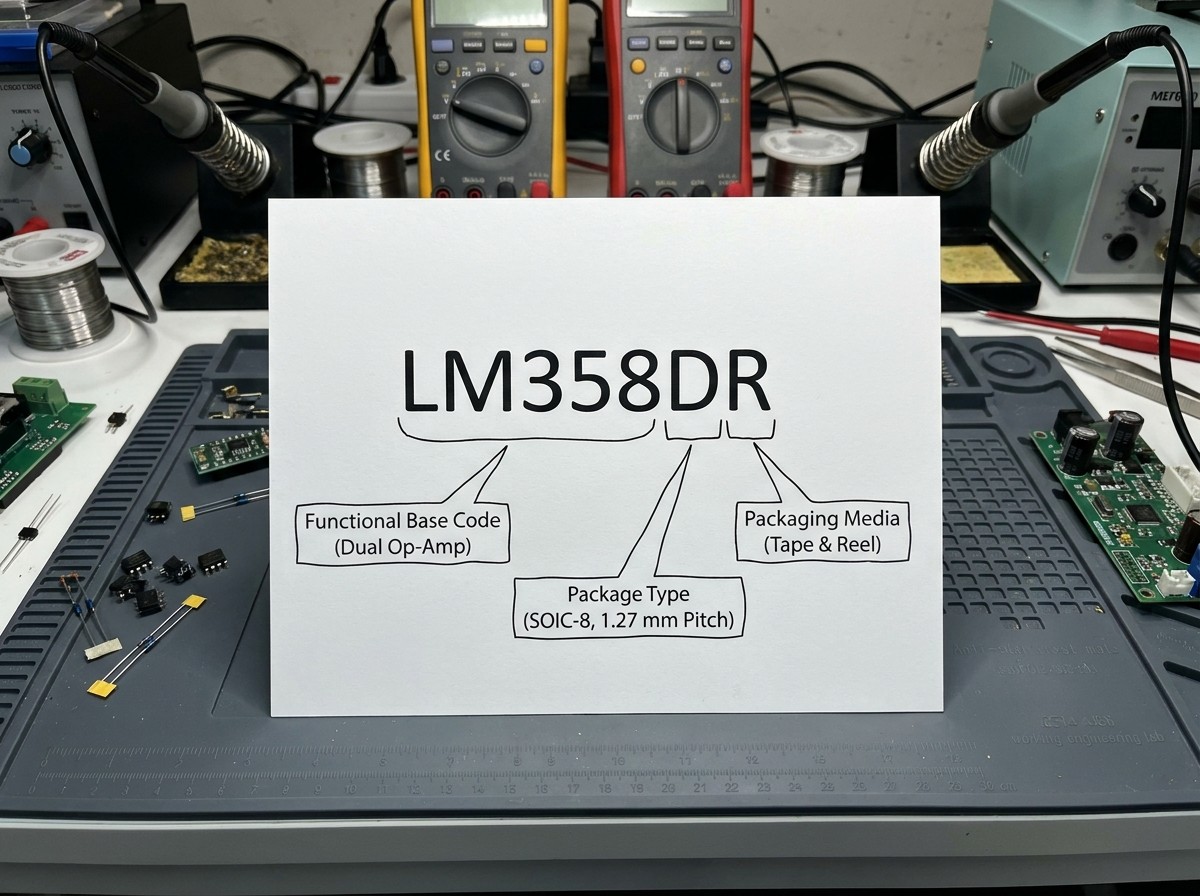
Functional Family Codes vs. Factory-Orderable SKUs
The Base Part Number (often referred to as the parent number or generic series) defines the core electronic functionality and internal schematic topology of an IC. Examples include STM32F407 (an ARM Cortex-M4 microcontroller family), MAX485 (an RS-485 transceiver), and TPS62130 (a step-down DC-DC converter). Hardware design engineers frequently place these truncated base numbers on schematic symbols during the initial circuit design phase.
Conversely, an Orderable Part Number (OPN), or full Manufacturer Part Number (MPN), represents the exact Stock Keeping Unit (SKU) manufactured, packed, and inventoried at the semiconductor fabrication facility. The OPN appends specific prefixes and trailing alphanumeric suffixes to the base code to capture all mechanical, thermal, environmental, and packaging variations.
| Base Part Number (Functional) | Orderable Part Number (Factory) |
|---|---|
| LM358 | LM358DR |
| STM32F407 | STM32F407VGT6TR |
| MAX485 | MAX485ESA+T |
| PIC16F877A | PIC16F877A-I/PT |
The Operational Risk of Purchasing with Base Numbers
Submitting an incomplete or truncated base part number on a purchase order (PO) disrupts automated enterprise resource planning (ERP) workflows and distributor application programming interfaces (APIs). When a base number is queried without suffix qualifiers, three failure modes routinely occur:
Automated Rejection: Distributor purchasing portals reject the line item because the base string maps to dozens of distinct orderable SKUs without a defined default.
Arbitrary Fulfillment: If a vendor system attempts fuzzy matching, it may fulfill an arbitrary in-stock variant—such as shipping a broad 1.27 mm pitch Small Outline IC (SOIC) when the PCB layout requires an ultra-dense 0.65 mm pitch Thin Shrink Small Outline Package (TSSOP).
Packaging Incompatibility: Bare base numbers often default to sample packaging (such as individual cut tape strips, static tubes, or waffle trays) rather than high-volume embossed carrier tape, halting automated high-speed SMT assembly lines.
Managing Internal Part Numbers (IPNs) vs. Vendor MPNs in BOM Scrubbing
Component engineering teams maintain Internal Part Numbers (IPNs) within their Product Lifecycle Management (PLM) databases to track company-specific inventory across multiple approved manufacturer parts (AML).
A critical architectural mistake in PLM design is "overloading" the IPN string with intelligent attributes (such as embedding temperature grades or packaging codes into custom sub-strings). As component engineering experts emphasize, part numbers should maintain non-significant sequential numbering, while parametric classification data—such as package pitch, thermal tolerance, Moisture Sensitivity Level (MSL), and lead finish—must reside in discrete database attribute fields. Overloaded part strings create severe maintenance debt when vendors alter internal suffix nomenclatures.
The 5 Critical Manufacturing Dimensions Encoded in Suffixes
A single trailing character in an MPN dictates five vital physical, thermal, and regulatory variables.
| Dimension | Manufacturing & Engineering Scope |
|---|---|
| 1. Geometry | Package architecture, pin count, terminal pitch, exposed thermal pad size |
| 2. Thermal Rating | Commercial, Industrial, Automotive (AEC-Q100 standards[4]), Military screening |
| 3. SMT Packaging | Embossed Tape & Reel, Mini-Reel, Rigid Tube/Stick, Waffle Tray, Cut Tape |
| 4. Plating / Eco | RoHS Lead-Free (Pb-Free), Halogen-Free mold compounds, Leaded (SnPb) finish |
| 5. Silicon Mask | Hardware errata steppings, factory pre-programmed firmware / secure bootloaders |
Package Geometry, Pin Count, and Lead Pitch Variants
Identical silicon dies are regularly packaged in multiple mechanical outlines to accommodate distinct board-density constraints. Suffix characters specify:
Package Architecture: Distinguishing between Dual In-Line (DIP), Small Outline (SOIC/SOP), Thin Shrink Small Outline (TSSOP), Quad Flat No-Lead (QFN), and Wafer-Level Chip Scale Packaging (WLCSP).
Terminal Pitch: Differentiating standard SOIC (1.27 mm pin pitch) from TSSOP (0.65 mm pin pitch) or fine-pitch BGA (0.8 mm vs. 0.5 mm ball pitch).
Thermal Enhancements: Specifying whether a package includes an exposed bottom thermal ground pad (such as a PowerPAD or exposed die attach paddle) that alters PCB footprint land pattern requirements.
Operating Temperature Range and Automotive Qualification
Operating temperature suffixes establish the certified environmental boundary within which the semiconductor fabricator guarantees electrical datasheet parameters.
Commercial Grade: Typically rated for 0°C to +70°C (often designated by a
Csuffix or standard baseline indicator).Industrial Grade: Rated for -40°C to +85°C or -40°C to +105°C (frequently designated by
I,E, or6).Extended / High-Temperature Grade: Rated for -40°C to +125°C or +150°C (often designated by
E,H, or3).Military / Aerospace Grade: Fully screened for -55°C to +125°C (often marked with
M,EP, or/883military spec compliance).
According to the Automotive Electronics Council AEC-Q100 Rev-J standard specification, automotive qualification requires rigorous failure mechanism stress testing categorized into four standardized ambient temperature operating grades:
AEC-Q100 Grade 0: -40°C to +150°C (extreme powertrain/under-hood environments).
AEC-Q100 Grade 1: -40°C to +125°C (general under-hood and high-stress ambient compartments).
AEC-Q100 Grade 2: -40°C to +105°C (hot cabin and passenger compartment locations).
AEC-Q100 Grade 3: -40°C to +85°C (standard passenger compartment electronics).
Automotive suffixes (such as -Q1, -VAO, or /V) signify not only compliance with these temperature boundaries, but also zero-defect manufacturing mandates, extended Production Part Approval Process (PPAP) documentation, and controlled fabrication site sourcing.
Packaging Media and SMT Feeder Compatibility
The final suffix characters routinely define the physical carrier media used to transport components to automated pick-and-place equipment in accordance with Tape and Reel Packaging Specifications[5] (EIA-481 standard).
Embossed Tape & Reel: Standard carrier tape wound onto 7-inch (small reel) or 13-inch (production reel) plastic hubs.
Tubes / Sticks: Rigid polyvinyl chloride (PVC) extruded slide magazines used primarily for manual assembly or specialized vibration feeders.
Matrix Trays / Waffle Packs: Molded carbon-filled matrix trays engineered for large high-pin-count components (e.g., QFP, BGA) that cannot fit within conventional carrier tape pockets.
Cut Tape / Loose Bulk: Strips of tape sliced from a larger reel without leading or trailing leader tape. This format is common for engineering prototypes but incompatible with high-speed automated feeders.
Environmental Plating and Material Compliance
Regulatory directives—including EU RoHS (Restriction of Hazardous Substances) and REACH—mandate strict accounting of terminal lead finishes and molding compound chemistry:
Lead-Free (Pb-Free) Status: Designators such as
NOPB(National Semiconductor legacy),G4/E4(TI Green),+(Maxim lead-free), or#PBF(Linear Technology Lead-Free) guarantee Matte Tin ( 100% Sn ) or Nickel-Palladium-Gold ( NiPdAu ) lead finishes, maintaining lead concentrations below 1,000 ppm ($0.1\%$).Halogen-Free / Green Mold Compounds: Indicates that flame retardants in the epoxy encapsulation do not contain hazardous brominated or chlorinated compounds.
Legacy Leaded Solder ($SnPb$): Older components lacking environmental suffixes may utilize 63/37 SnPb lead finishes, which are strictly prohibited in commercial hardware destined for RoHS-regulated markets.
Silicon Steppings, Mask Revisions, and Pre-Programmed Firmware
Microcontrollers, complex system-on-chips (SoCs), and programmable power management ICs (PMICs) use trailing suffix characters to track factory hardware modifications:
Silicon Revision / Errata Steppings: Distinguishes between early prototype silicon masks containing known hardware errata and mature production steppings where silicon bugs have been resolved at the lithography level.
Factory Pre-Flashed Bootloaders / Firmware: For microcontrollers, trailing codes differentiate blank, unprogrammed flash devices from factory pre-programmed chips configured with unique device IDs, secure cryptographic bootloaders, or custom firmware images.
Vendor-Specific Decoder Rules: The Danger of Cross-Brand Assumptions
A suffix letter defined by one semiconductor fabricator cannot be applied to another vendor. Suffix systems are entirely proprietary.
Texas Instruments (TI): Reel Quantities, Package Codes, and Automotive Indicators
Texas Instruments embeds package designators, tape packaging quantities, and reliability screening within structured alphanumeric blocks according to guidelines on interpreting TI Logic part numbers[1].
Large Reel vs. Small Reel Indicators: In TI's SOT-23 (
DBVdrawing) and SC-70 (DCKdrawing) lines, the trailing letter determines production reel volume:DBVRdesignates an embossed carrier tape on a large production reel containing 3,000 units.DBVTdesignates the identical physical IC packaged in a mini-reel containing 250 units.Microcontroller Encoding (
MSP430/MSPM0): In architectures such as the MSPM0 mixed-signal microcontrollers[3] and MSP430 (e.g.,MSP430F5438AIPMT):Idesignates the industrial operating temperature (-40°C to +85°C).PMdesignates the 64-pin LQFP mechanical package.Tspecifies small tape and reel packaging (omitting the trailingTindicates standard plastic tray packaging).Legacy Eco-Codes and Automotive:
NOPB: "No Lead" indicator originating from legacy National Semiconductor components (e.g.,LM317EN/NOPB).G4/E4: Denotes TI Green mold compound and RoHS-compliant terminal plating (e.g.,SN74HC04DRG4).-Q1: Designates AEC-Q100 automotive qualification with full PPAP documentation (e.g.,TPS62130AQRGTRQ1).
Analog Devices, Linear Technology, and Maxim Integrated Portfolio
The Analog Devices (ADI) product portfolio integrates three distinct historical naming conventions: legacy ADI, legacy Linear Technology, and legacy Maxim Integrated.
Analog Devices Classic: In
AD712TRZ-EP-R7:Tdenotes the extended military temperature screening range (-55°C to +125°C).Rspecifies a standard narrow-body SOIC package.Zguarantees RoHS compliance (pure Matte Tin finish).EPdesignates Enhanced Product qualification (controlled aerospace baseline).-R7or-RL7specifies a 7-inch Tape and Reel (approximately 1,000 units), whereas-RLindicates a 13-inch production reel (2,500 units).Linear Technology Classic: In
LTC2054IS5#TRMPBF:Idenotes the industrial temperature grade (-40°C to +85°C).S5designates a 5-lead Thin Small Outline Transistor package (TSOT-23).#TRdenotes standard Tape & Reel.Mspecifies a mini-reel volume of 500 units (compared to standard reels of 2,500 units).PBFconfirms Lead-Free ( 100% Pb -Free) construction.Maxim Integrated Classic: In
MAX485ESA+T:Erepresents the industrial temperature rating (-40°C to +85°C).Sdenotes an 8-pin Narrow SOIC (150-mil package width).Aspecifies the 8-pin pinout configuration code.+confirms full RoHS/Lead-Free compliance (replaces legacy leaded packages).Tdesignates standard Tape & Reel carrier packaging.
STMicroelectronics: Positional Alphanumeric Matrix
STMicroelectronics employs a rigid positional decoding matrix where each character index within the OPN string strictly governs a predefined manufacturing parameter, as outlined in datasheets for the STM32F103 performance line[6].
STM32 Microcontroller Breakdown: In
STM32F407VGT6TR:Position 1 (
STM32F407): Sub-family architecture (High-Performance ARM Cortex-M4).Position 2 (
V): Pin count indicator (V= 100 pins,Z= 144 pins,I= 176 pins,R= 64 pins,C= 48 pins).Position 3 (
G): Embedded Flash memory capacity (G= 1024 Kbytes,E= 512 Kbytes,C= 256 Kbytes).Position 4 (
T): Package geometry type (T= Low-Profile Quad Flat Package / LQFP,H= TFBGA,U= VFQFPN,Y= WLCSP).Position 5 (
6): Certified operating temperature band (6= -40°C to +85°C ,7= -40°C to +105°C ,3= -40°C to +125°C ).Position 6 (
TR): Tape and Reel packaging (omission ofTRdefaults to rigid matrix shipping trays).Analog and Standard Logic: In
LM358DTversusLM358PT:Ddesignates standard SO-8 packaging, andTspecifies Tape & Reel.Pdesignates TSSOP-8 packaging, andTspecifies Tape & Reel.
Microchip Technology: Product Identification System (PIS)
Microchip Technology structures component identification via its standardized Product Identification System (PIS), documented in components like the TC4426A/TC4427A/TC4428A driver family[7].
Microcontroller and Analog Naming Rules: In
TC4426AEOA713:Erepresents Extended/Industrial temperature rating (-40°C to +85°C).OAindicates the plastic 8-lead SOIC (150 mil body) package.713is a specific numeric suffix designating Tape & Reel packaging. This numeric identifier does not appear on the physical IC package marking.Microcontroller Suffix Format: In
PIC16F877A-I/PT:Idenotes the Industrial temperature range (-40°C to +85°C).PTindicates a 44-lead Thin Quad Flat Pack (TQFP).The omission of a trailing
/713orTdenotes fulfillment in rigid plastic IC tubes or shipping trays.Automotive Suffix Identifier: Appending the suffix
-VAOdesignates complete AEC-Q100 qualification with specialized baseline processing (e.g.,PIC18F46K22T-E/PTVAO).
The Cross-Brand Suffix False Friends Matrix
The following matrix highlights how identical alphanumeric suffix codes represent fundamentally different manufacturing parameters across major semiconductor vendors.
| Suffix Character | Texas Instruments | STMicroelectronics | Analog Devices / Maxim Integrated | Microchip Technology |
|---|---|---|---|---|
| T | Small Reel Packaging (250 / 500 units) | LQFP Package Type (e.g., STM32F407VGT6) | Tape & Reel Carrier Packaging (General) | Tape & Reel (or High-Temp Pinout Variant) |
| R | Large Reel Packaging (3,000 / 4,000 units) | 64-Pin Count Code (e.g., STM32F407RGT6) | SOIC Package Code (Legacy ADI Naming) | Extended Memory or Reverse Pinout Design |
| 6 | Voltage / Logic Sub-Family Identifier | Industrial Temp Band (-40°C to +85°C) | Internal Die / Speed Sort Rating | Internal Feature / Silicon Stepping Code |
| P / PBF | PDIP Package Code (e.g., NE555P) | TSSOP Package Code (e.g., LM358PT) | Lead-Free Plating Indicator (#PBF) | PDIP Package Code (e.g., PIC16F877A-I/P) |
| Z | High-Impedance State or Custom Feature | Internal Mask / Revision Code | RoHS-Compliant Lead-Free Indicator (ADI) | Custom Firmware / Mask Option Code |
Physical SMT Assembly and Field Reliability Failure Modes
Omitting or misinterpreting suffix codes causes severe failures on the factory floor and in deployed products.
Automated Feeder Failures: Cut Tape, Loose Bulk, and Tape Pitch Errors
High-speed SMT placement systems pick components at rates exceeding 20,000 to 50,000 parts per hour. These machines require continuous reels compliant with EIA-481 standards.
Cut Tape Disruptions: When buyers purchase truncated part numbers without tape-and-reel suffixes, distributors often supply "Cut Tape"—short strips of carrier tape cut from a larger spool. Cut tape cannot be loaded into automated smart feeders because it lacks the necessary leading and trailing film (leader/trailer) required to thread through the tape-peeling mechanism. Assembly facilities must stop production lines to manually splice extension tapes or charge high third-party re-reeling fees.
Minimum Order Quantity (MOQ) Risks: Confusing TI's
DBVR(3,000 pcs) withDBVT(250 pcs) causes buyers building prototype runs of 50 boards to over-procure inventory by thousands of dollars, or conversely, causes production runs to run out of components prematurely.
Cold-Start Boot Failures from Temperature Downgrades
Deploying commercial-grade components in industrial or automotive environments frequently causes catastrophic system crashes when ambient temperatures drop below freezing ( 0°C).
Users on community engineering forums regularly report field failures where outdoor microcontrollers fail to boot during winter conditions. The failure mechanism is rarely total silicon destruction; rather, commercial-grade silicon exhibits:
Internal Oscillator Drift: On-chip phase-locked loops (PLLs) and RC oscillators drift out of timing specification, preventing microcontrollers from establishing stable USB, CAN, or UART communications.
Bandgap Reference Shift: Internal voltage reference circuitry drifts, triggering false internal Brown-Out Resets (BOR) or corrupting Analog-to-Digital Converter (ADC) voltage readings.
Propagation Delay Extension: Setup and hold times inside logic gates violate timing margins, locking up memory buses during cold initialization.
Moisture Sensitivity Level (MSL) Violations and Reflow Delamination
Semiconductor plastic molding compounds absorb atmospheric moisture. In accordance with IPC/JEDEC J-STD-020 and J-STD-033:
Sealed Reel Packaging: ICs shipped in authentic Tape & Reel formats are sealed within Moisture Barrier Bags (MBB) containing desiccant packs and a Humidity Indicator Card (HIC), preserving the device's floor life rating (e.g., MSL 3 = 168 hours out-of-bag floor life).
Unsealed Tube and Bulk Handling: Components delivered in loose tubes or broken packaging from unauthorized channels are exposed to ambient humidity. When subjected to high-temperature lead-free convection reflow soldering ( 245°C to 260°C peak profile), trapped moisture rapidly vaporizes into high-pressure steam. This causes internal package cracking, die-attach delamination, and microscopic bonding wire fractures—a structural failure mode known as package popcorning.
Top-Side Marking Codes vs. Full Orderable MPNs in Incoming QA
A major source of confusion in incoming quality assurance (IQA) occurs when warehouse inspectors reject authentic shipments because the laser markings etched onto physical chips do not match the long MPN on the purchase order.
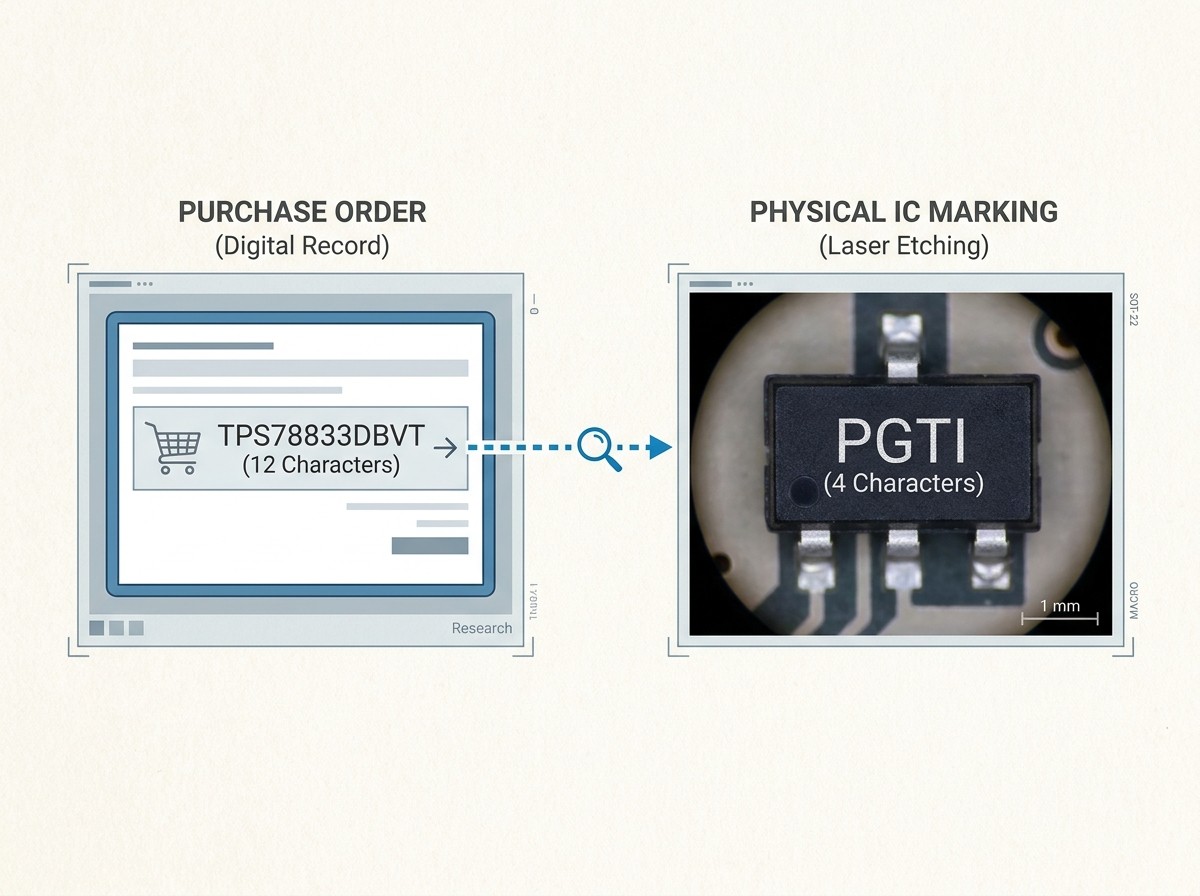
Why Miniature IC Packages Cannot Fit the Full MPN
Ultra-small IC packages—such as SOT-23 ( 2.9 × 1.6 mm), SC-70 ( 2.0 × 1.25 mm), DFN ( 2.0 × 2.0 mm), and WLCSP—have physical surface areas under 3 × 3 mm2. These packages cannot accommodate standard 14- to 18-character MPNs using legible laser marking fonts.
Consequently, semiconductor fabricators encode miniature packages using truncated 2- to 5-character top-side marking shorthand codes.
In Texas Instruments components, the 12-character low-dropout regulator
TPS78833DBVTis laser-marked solely with the 4-character shorthand codePGTI.The adjustable regulator
TPS76201DBVTis marked with the shorthand codePFUI.
Incoming QA inspectors who are unaware of package marking conversions frequently flag genuine components as counterfeit or mis-shipped, creating false inventory holds and delaying assembly schedules.
Resolving Top-Mark Discrepancies During Incoming Inspection
To reconcile physical top markings against purchase orders, IQA personnel must follow a standardized verification protocol:
Datasheet Addendum Lookup: Navigate to Section 8 or 9 ("Device Marking Information", "Packaging Information", or "Package Option Addendum") of the official manufacturer datasheet to locate the Top Mark Cross-Reference table.
Manufacturer Web Portals: Utilize official web-based marking tools (such as the Texas Instruments Packaging Part Marking Lookup[2] engine or Microchip Device Marking Database) to enter the 3- to 5-character physical stamp and retrieve the corresponding orderable MPN.
Reel Label Reconciliation: Verify that the barcoded reel label and moisture barrier bag exterior clearly state the complete 16-character factory MPN, matching the invoice and purchase order.
Standard Operating Procedure: The 3-Step MPN Verification Workflow
To eliminate procurement errors, BOM scrubbers and procurement teams must implement a structured three-step verification workflow prior to issuing purchase orders.
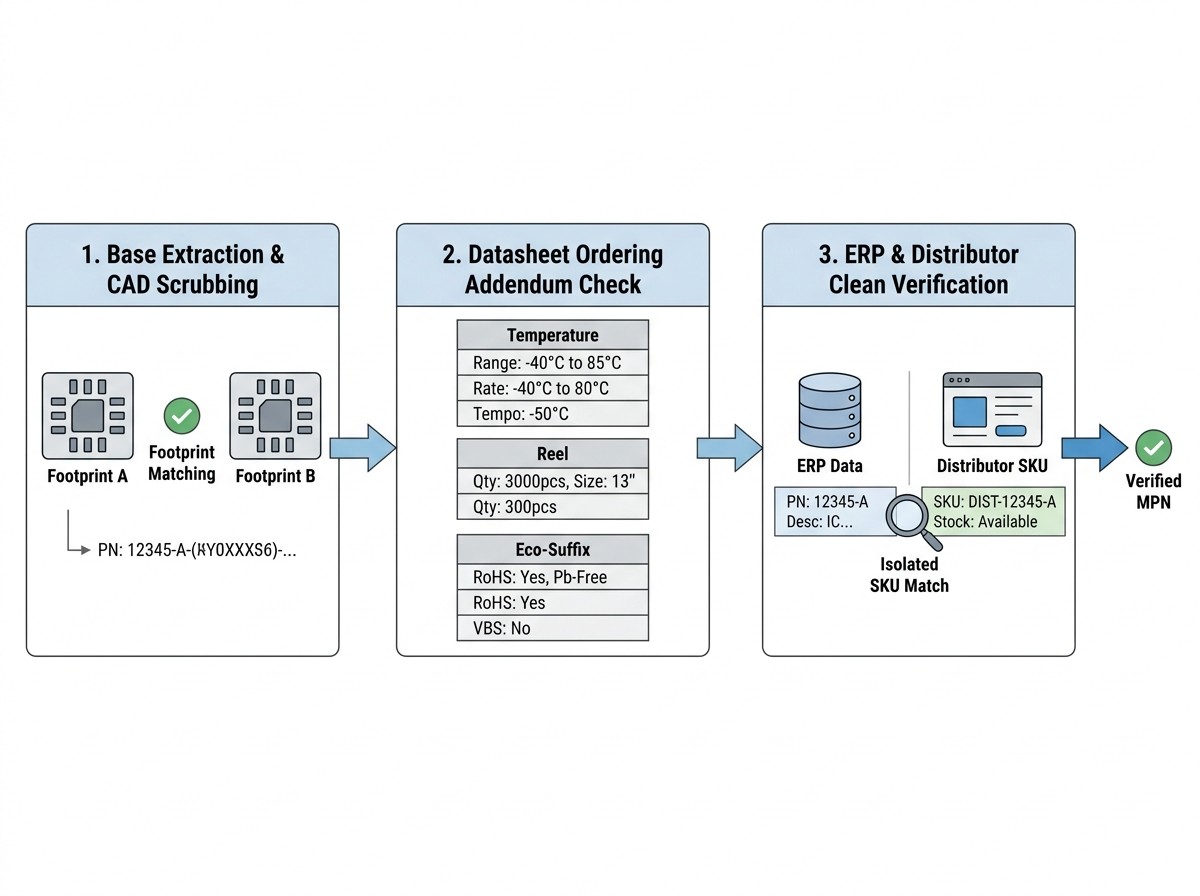
Step 1: Base Model Extraction and Parameter Scrubbing
Extract the schematic designator and base functional part number from the CAD design tool.
Cross-check the requested electronic attributes against the physical PCB layout:
Verify package geometry and pad pitch (e.g., ensuring an 8-pin layout is designed for SOIC-8 at 1.27 mm pitch, not MSOP-8 at 0.65 mm pitch).
Confirm that the circuit operating environment matches the required operating temperature band (Commercial, Industrial, or Automotive AEC-Q100).
Step 2: Datasheet Ordering Addendum Cross-Check
Download the latest official datasheet directly from the semiconductor manufacturer's website.
Navigate past the electrical tables directly to the concluding pages: the "Ordering Information Scheme" or "Package Option Addendum".
Assemble the full MPN character-by-character by selecting the exact columns corresponding to:
Package Type Code
Temperature Range Code
Carrier Packaging Format (Tape & Reel vs. Tube/Tray)
Lead Finish / RoHS Green Indicator
Automotive Qualification Suffix (
-Q1,-VAO,/V)
Step 3: Distributor Quotation and ERP Field Validation
Cross-reference the assembled factory MPN against authorized distributor quotations and ERP catalog entries.
Isolate Distributor Internal SKUs: Ensure distributor-specific inventory tags are strictly segregated from the factory MPN:
Digi-Key appends internal suffixes (e.g.,
-ND,1-ND,-6-ND,-2-NDfor reel variations).Mouser and Arrow append proprietary cart/reel indicators.
The purchase order sent to manufacturing must display the clean manufacturer MPN, keeping distributor internal SKUs stored in separate internal fields.
Preventing Digital Ingestion Errors in Spreadsheets and ERPs
During bill of materials processing, subtle digital formatting glitches can corrupt part number strings without triggering software errors.
Part Numbers: Best Practices and mistakes to avoid
The Leading Zero Truncation Glitch: In visual stress demonstrations of BOM ingestion, exporting part catalogs to CSV files and importing them into spreadsheet tools (such as Microsoft Excel) causes the software to automatically convert leading-zero strings into numeric values. An internal SKU or part number string like
000103is silently stripped of its leading zeros, turning into103. As experts point out: "If you are using an older version of Excel, this will happen and you probably wouldn't notice: the leading zeros are removed... Numbers have less ambiguity than letters like 'I's or zeros with 'O's." To prevent this silent corruption, procurement systems must enforce explicit string formatting across all tabular databases.Hyperlink Underscore Concealment: In visual tests of web-based BOM interfaces, item numbers containing underscore delimiters (such as
108_4356) hyperlinked to drawings or datasheets visually obscure the underscore. The standard blue underline of the hyperlink merges directly into the underscore glyph, causing data entry operators to misread the character as a blank space and generate invalid transcription queries.Acoustic and Phonetic Ambiguity in Supply Chains: Complex alphanumeric part numbers generate phonetic ambiguity when communicated over the phone or across offshore manufacturing teams with varying accents (e.g., confusing "B" and "D", "P" and "T", "M" and "N", or "0" and "O"). Purely numeric internal SKU sequences paired with discrete attribute columns substantially decrease typing errors and eliminate cross-language pronunciation discrepancies.
Pre-Procurement MPN Suffix Verification Checklist
The following operational checklist acts as a mandatory pre-flight gate before releasing component purchase orders.
| # | Verification Gate | Inspection Criteria | Verification Status |
|---|---|---|---|
| 1 | Footprint Match | Package code and terminal pitch match physical PCB CAD footprint layout. | [ ] PASS / [ ] FAIL |
| 2 | Thermal Rating Check | Temperature suffix covers maximum operating environment requirements. | [ ] PASS / [ ] FAIL |
| 3 | Automotive Check | AEC-Q100 suffix (-Q1, -VAO, /V) is verified if deploying in vehicles. | [ ] PASS / [ ] N/A |
| 4 | Packaging Carrier | Suffix specifies Tape & Reel (TR/R/T/713) for automated SMT line feeders. | [ ] PASS / [ ] FAIL |
| 5 | RoHS / Green Status | Lead finish indicator confirms Pb-Free compliance (+, #PBF, G4, NOPB, Z). | [ ] PASS / [ ] FAIL |
| 6 | Datasheet Addendum Table Verification | Full OPN string matches an active SKU in manufacturer ordering table. | [ ] PASS / [ ] FAIL |
| 7 | Distributor SKU Split | Distributor tags (-ND, Mouser codes) are removed from true factory MPN. | [ ] PASS / [ ] FAIL |
| 8 | Spreadsheet Data Gate | Leading zeros and underscore strings are verified as preserved text. | [ ] PASS / [ ] FAIL |
Strategic Summary and Best Practices
Achieving high-reliability electronic sourcing requires treating the Manufacturer Part Number as an indivisible string where every trailing character defines a critical manufacturing parameter. Base part numbers serve solely as engineering functional designators; only full Orderable Part Numbers govern physical PCB pad matching, automated SMT line throughput, environmental regulatory compliance, and thermal reliability.
Procurement teams, BOM scrubbers, and hardware engineers must eliminate generic suffix rules of thumb, enforce three-step ordering addendum cross-checks, and separate distributor SKUs from factory MPNs across all ERP and PLM databases.
Frequently Asked Questions (FAQ)
Why did our distributor deliver cut tape instead of a production reel when the part number suffix was omitted?
When a purchase order specifies a base part number without a trailing reel suffix (such as omitting R, TR, or 713), distributor ERP systems default to open-stock inventory. Distributors routinely slice small quantities from larger master spools to fulfill exact line-item quantities without charging reel packaging premiums. To ensure components arrive on continuous reels ready for automated SMT feeders, procurement orders must explicitly include the manufacturer's tape-and-reel suffix.
Is it safe to substitute an industrial-grade suffix for a commercial-grade suffix if the price is identical?
Yes, in nearly all electronic hardware designs, substituting an industrial-grade component (e.g., rated -40°Cto +85°C) for a commercial-grade part (rated 0°Cto +70°C) is fully upward-compatible. The physical pinout, silicon functionality, and electrical parameters will match or exceed commercial specifications. However, downgrading an industrial requirement to a commercial part is dangerous and frequently causes sub-zero operational failures.
What is the difference between an authorized distributor SKU and a manufacturer part number suffix?
A Manufacturer Part Number (MPN) is the globally standardized orderable SKU defined by the chipmaker (e.g., LM358DR from Texas Instruments). An authorized distributor SKU is an internal inventory tracking string appended by distributors (such as Digi-Key's 296-1014-1-ND or Mouser's 595-LM358DR). Distributor SKUs often indicate packaging variants (like cut tape vs. custom reel), but they must never be placed in the primary MPN field sent to contract manufacturers.
What should I do if a legacy datasheet lists obsolete suffixes like NOPB or G4?
Suffixes like NOPB (No Lead) and G4/E4 (Green/RoHS) were introduced during the global transition to RoHS compliance in the mid-2000s. Today, many semiconductor fabricators have transitioned their entire product lines to lead-free standards by default, rendering some legacy eco-suffixes obsolete or standardizing them into baseline part numbers. When encountering these codes on legacy schematics, check the manufacturer's product lifecycle status and current ordering addendum to confirm active orderable part codes.
How can I confirm that an ordered part is pre-programmed versus blank silicon?
Check the manufacturer's Ordering Information Scheme for specialized firmware suffix extensions. For example, microcontrollers and programmable PMICs will append custom alphanumeric sequences, customer configuration codes, or mask ROM identifiers (e.g., /XXX or specialized 3-digit identifiers) to designate factory pre-flashed silicon. Standard catalog MPNs lacking these custom firmware suffixes are fulfilled as blank silicon that requires programming during the PCB assembly process.
References
Interpreting TI Logic part numbers — Texas Instruments
Packaging Part Marking Lookup and Packaging Terminology — Texas Instruments
MSPM0H321x Mixed-Signal Microcontrollers Datasheet — Texas Instruments
High Reliability Part Numbering System — Texas Instruments
Tape and Reel Packaging Specifications — Analog Devices
Datasheet - STM32F103x8 STM32F103xB Medium-Density Performance Line — STMicroelectronics
TC4426A/TC4427A/TC4428A 1.5A Dual High-Speed Power MOSFET Drivers — Microchip Technology
 UTMEL
UTMEL
We are the professional distributor of electronic components, providing a large variety of products to save you a lot of time, effort, and cost with our efficient self-customized service. careful order preparation fast delivery service
 Modeling Wide Band-Gap Semiconductors for Enhanced PerformanceRakesh Kumar, Ph.D.31 January 20243877
The article delves into the challenges faced by silicon-based power electronic devices and highlights the potential of wide band-gap semiconductors. It also emphasizes the importance of modeling power semiconductor devices and provides insights into various models. For electrical energy conversion to be dependable and effective, power electronics and semiconductor device technologies are essential.
Read More Optimizing Energy Management with Non-Isolated DC-DC ConvertersRakesh Kumar, Ph.D.04 February 20243505
The article classifies DC-DC converters and discusses the benefits and limitations of them. It proposes a modified DC-DC converter topology that combines the Cuk and Positive Output Super Lift Luo topologies to achieve a higher voltage gain with fewer components.
Read More ‘6G Networks’ - Pioneering the Next Era of Connectivity And InnovationRakesh Kumar, Ph.D.18 March 20243839
The article provides a comprehensive overview of the evolving landscape of mobile networks, the requirements that will shape the future of mobile communication, and the innovative technologies driving the transition to 6G.
Read More Review of IoT-Based Smart Home Security Systems- Part 1Rakesh Kumar, Ph.D.28 March 20244314
The article discusses the evolution of IoT-based smart home security systems, integrating advanced technologies like Raspberry Pi, PIR sensors, and voice recognition for enhanced user experience and efficiency.
Read More Understanding Photodiodes: Working Principles and Applications - Part 2Rakesh Kumar, Ph.D.24 May 20245578
The article provides a comprehensive overview of photodiodes, focusing on their operational principles, key factors affecting their efficiency, advantages, and disadvantages, and highlights their diverse applications.
Read More
Subscribe to Utmel !
![REM16]() REM16
REM16Chip Quik
![SMD2SWLT.047 8OZ]() SMD2SWLT.047 8OZ
SMD2SWLT.047 8OZChip Quik
![LTHX]() LTHX
LTHXApex Tool Group
![2022-106/000-012]() 2022-106/000-012
2022-106/000-012WAGO
![72-029]() 72-029
72-029NTE ELECT
![KT5002]() KT5002
KT5002IFM Electronic
![KT5112]() KT5112
KT5112IFM Electronic
![KT5309]() KT5309
KT5309IFM Electronic
![S-D-10AS]() S-D-10AS
S-D-10ASMenda
![FLDNYDX1-250]() FLDNYDX1-250
FLDNYDX1-250Multicomp