Product
 Brand
Brand Articles
 Tools
Tools
The BSPDN Revolution: Overcoming IR Drop in Sub-2nm GAAFET Nodes with Backside Power Delivery
As semiconductor manufacturing enters the Angstrom era, the traditional architecture of routing both power and signal lines on the front side of a silicon wafer has hit a hard physical wall. For decades, Moore’s Law was sustained by shrinking transistors, but at the 2nm node and below, the interconnects themselves have become the primary bottleneck. Enter the Backside Power Delivery Network (BSPDN)—a radical mechanical restructuring of the chip that physically decouples power and signal routing. By relocating the power delivery network to the newly exposed back surface of a thinned silicon wafer, BSPDN drastically reduces dynamic voltage degradation (IR drop), frees up critical front-side routing resources, and unlocks the full performance potential of Gate-All-Around (GAAFET) transistors.
The Physical Limits of Front-Side Power Routing
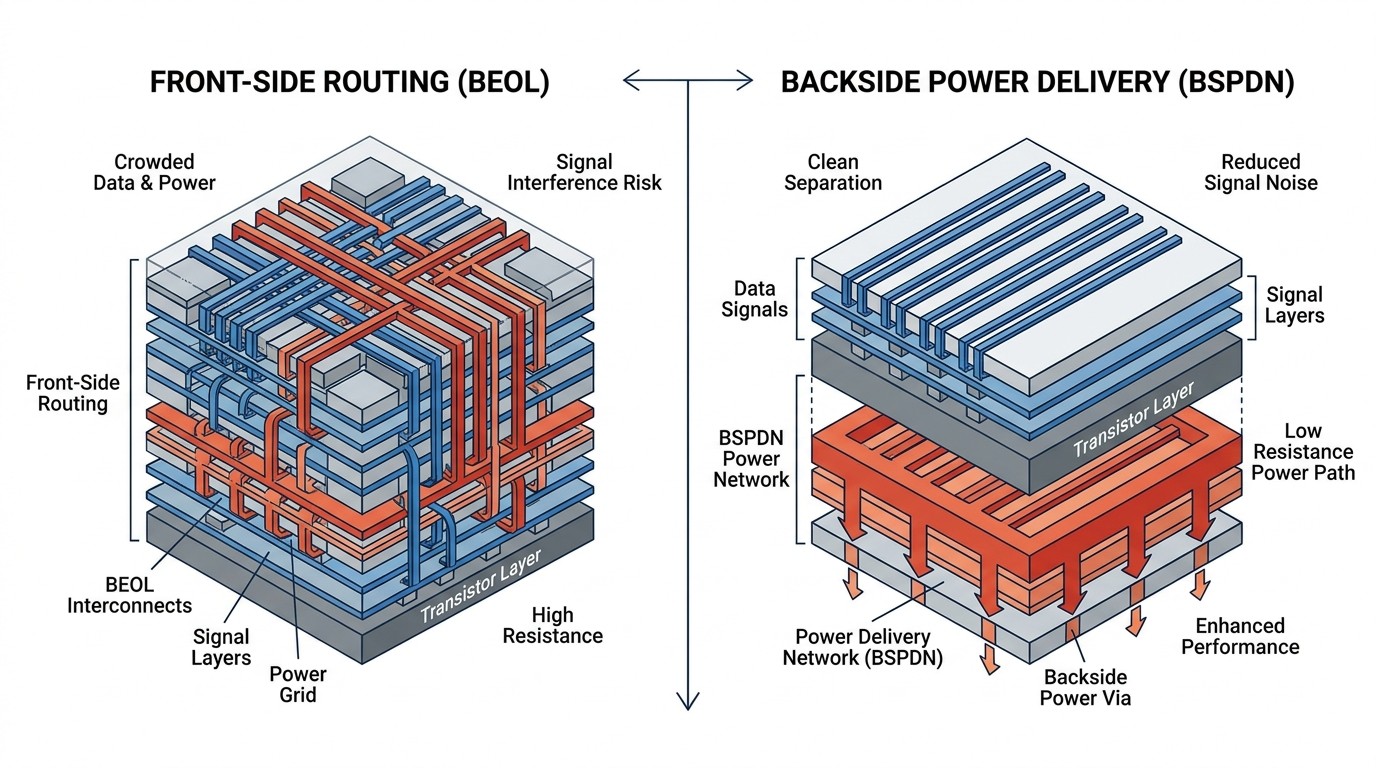
In a conventional integrated circuit, transistors are fabricated on the silicon substrate, and a complex web of wiring—the Back End of Line (BEOL) stack—is built on top of them. This front-side stack must handle both data signals and power delivery.
As transistor density increases, these two networks are forced to compete for highly constrained spatial resources. Power routing typically consumes over 20% of the available front-side metal layers. More critically, delivering power from the top of the chip down to the transistors requires electrons to travel through 15 to 20 layers of increasingly narrow interconnects and vias.
This long, tortuous path creates severe electrical resistance. The result is "IR drop" (voltage droop), where the voltage supplied to the transistor degrades significantly before it even reaches the device. In high-performance AI chips and data center processors, this dynamic IR drop compromises switching speeds, generates excess heat, and prevents the transistors from operating at their theoretical limits.
The Mechanical Architecture of BSPDN
BSPDN solves the congestion and resistance problems through a process of physical decoupling. Visualizing the manufacturing workflow reveals a highly complex, multi-step physical intervention that fundamentally alters how a chip is built.
Front-Side Fabrication and Carrier Bonding: First, the front-side transistors (such as RibbonFET or Nanosheet GAAFETs) and the signal interconnects are fabricated. Because the subsequent steps require aggressive physical manipulation, the front side of the wafer is bonded to a rigid glass or silicon carrier wafer using hybrid bonding techniques.
Extreme Wafer Thinning: As observed in process demonstrations, the bulk silicon substrate is flipped and mechanically and chemically thinned down to just a few hundred nanometers. Maintaining wafer strength during this aggressive thinning is a primary yield hurdle; any structural compromise can destroy the delicate front-side circuitry.
Nano-Through-Silicon-Vias (nTSVs): To connect the new backside power network to the front-side standard cells, manufacturers etch nTSVs. Unlike traditional TSVs used in advanced packaging (which are typically around 10μm in diameter), nTSVs are roughly 100nm in diameter.
Buried Power Rails (BPR): The nTSVs connect to Buried Power Rails—conductive tracks embedded deep within the silicon, directly beneath the standard cells. This allows power to be delivered vertically, bypassing the entire front-side BEOL stack.
By separating the networks, BSPDN can reduce dynamic IR drop by up to 7x, while allowing the front-side metal layers to be optimized entirely for high-density signal integrity.
📺 What Is Backside Power Delivery in Semiconductor Device Manufacturing?
Foundry Showdown: Intel PowerVia vs. TSMC Super Power Rail
The race to commercialize BSPDN is currently led by Intel and TSMC, both of which are pairing backside power with their respective GAAFET architectures for nodes entering mass production between 2024 and 2026.
Implementation Comparison Matrix
| Feature / Metric | Intel 18A (PowerVia) | TSMC A16 (Super Power Rail) |
|---|---|---|
| Transistor Architecture | RibbonFET (GAA) | Nanosheet (GAA) |
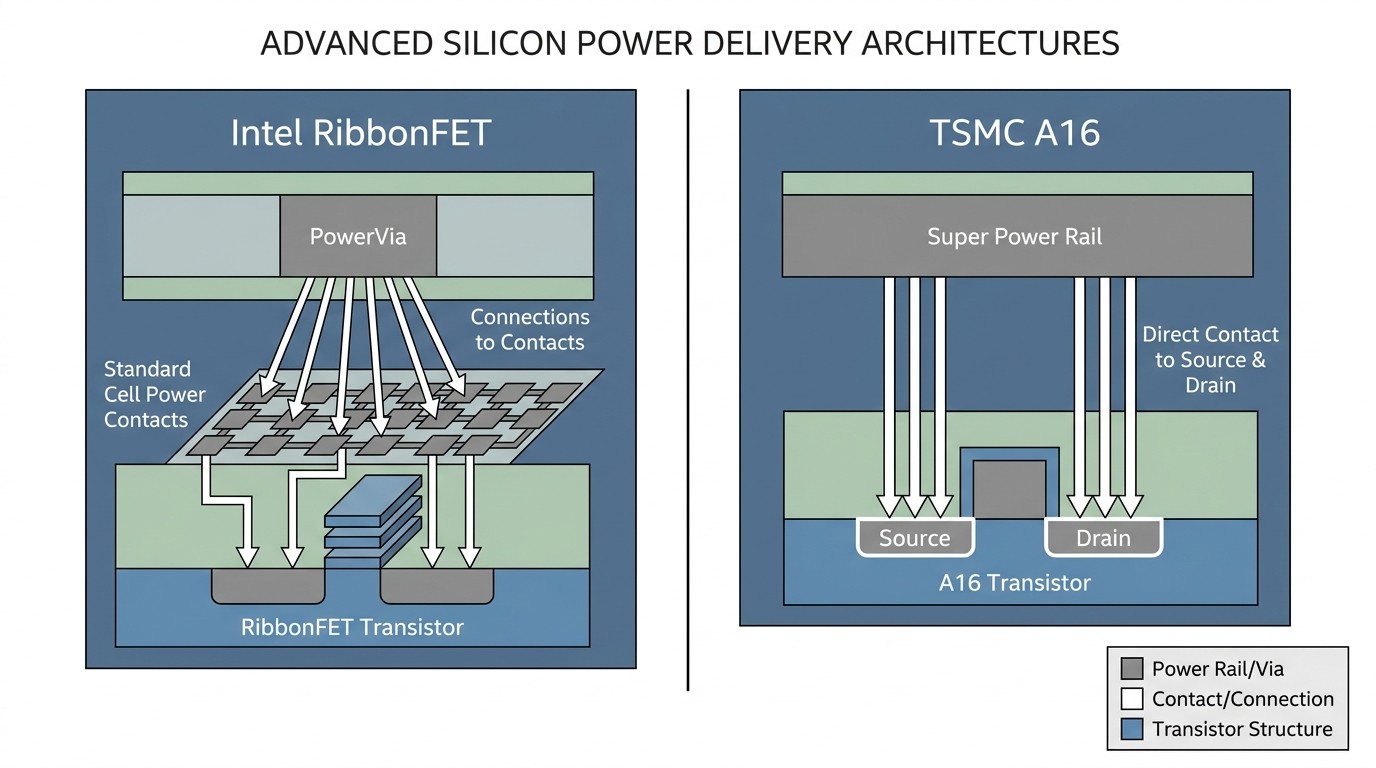
| Power Connection Method | nTSVs to standard cell power contacts | Direct contact to transistor source and drain |
| Performance Gain | ~6% frequency boost; 30% lower platform voltage | 8–10% speed boost (at same voltage) |
| Efficiency / Power Cut | Significant reduction in resistance loss | Up to 20% power reduction (at same speed) |
| Density Improvement | 5–10% higher standard cell utilization | ~10% increase in logic and SRAM density |
| Target Production | Ramping up (2024/2025) | Late 2026 |
While Intel's PowerVia connects the backside network to the standard cell level, TSMC’s Super Power Rail (SPR) takes a more complex manufacturing route by connecting the power directly to the source and drain of the transistor. TSMC's approach is highly complex to manufacture but yields exceptional performance and density metrics for hyperscaler data center applications.
Thermal and Manufacturing Challenges in the "Silicon Sandwich"
While BSPDN solves the electrical routing crisis, it introduces a severe thermal management problem.
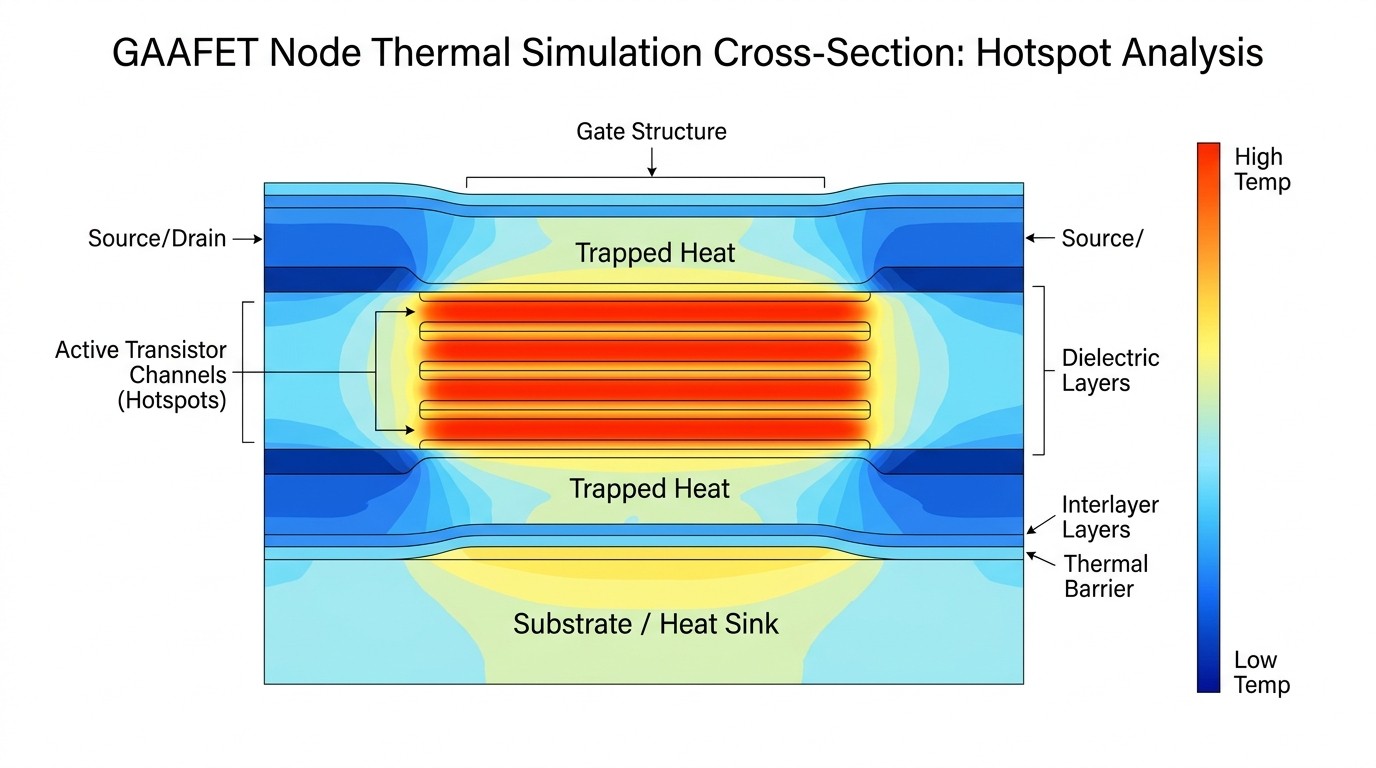
In a traditional chip, the bulk silicon substrate acts as a highly effective heat spreader, drawing thermal energy away from the active transistors. In a BSPDN architecture, that bulk silicon is almost entirely ground away. The transistors are now trapped in a "silicon sandwich"—sandwiched between the dense signal routing layers on the front and the thick power delivery metals on the back.
Because both sides of the transistor are now covered by insulating dielectric materials and metal layers, heat dissipation is severely compromised. Industry simulations indicate that this architecture can raise local hotspot temperatures by up to 14°C. Furthermore, manufacturing the nTSVs requires uniform copper coating inside nanoscale holes, demanding next-generation inspection equipment and flawless overlay control to align the backside metals with the microscopic front-side transistors.
Sourcing for the Angstrom Era: PMICs and Advanced Packaging
The physical realities of BSPDN mean that chip-level innovations cannot exist in a vacuum. Feeding a highly efficient, low-resistance backside power network requires board-level and package-level power management capable of handling new thermal profiles and delivering ultra-precise voltages.
Hardware designers and procurement teams must rethink their Bill of Materials (BOM) for sub-2nm designs. The transition to BSPDN necessitates advanced introduction to IC packaging techniques, including specialized substrates that can interface with backside power contacts while managing the increased thermal density. Furthermore, achieving the 20% system-level power reductions promised by foundries requires pairing BSPDN chips with high-voltage direct current (HVDC) systems and next-generation wide-bandgap semiconductors, a trend explored in the evolution of SiC and GaN in 2026.
For engineering teams conducting R&D and pilot testing on these next-generation architectures, sourcing the right components is critical. UTMEL Electronics provides robust global sourcing of high-reliability Power Management ICs (PMICs), advanced packaging substrate materials, and high-speed TSV-compatible components. By partnering with a specialized distributor, process integration specialists can secure the critical integrated circuits and silicon wafer elements required to validate sub-2nm designs and overcome the thermal and electrical challenges of the Angstrom era.
What to Ignore in BSPDN Hype
As BSPDN dominates semiconductor roadmaps, procurement and design teams should filter out low-quality industry noise:
Ignore claims that BSPDN is just a design software update: Some marketing materials frame BSPDN as an EDA (Electronic Design Automation) routing feature. It is not. It is a massive, physical manufacturing overhaul requiring wafer thinning, carrier bonding, and dual-sided lithography.
Ignore outdated TSMC node rumors: Early industry speculation suggested TSMC would introduce backside power on the N2P node. Official roadmaps have since confirmed that TSMC reserved Super Power Rail for the A16 (1.6nm) node to ensure mature integration with their GAAFET architecture.
Ignore power-saving claims that omit thermal costs: Articles claiming a flat "20% power reduction" without mentioning the required investments in advanced liquid cooling or specialized PMICs are painting an incomplete picture. The electrical efficiency gains are real, but they must offset the thermal penalties of the "silicon sandwich."
Frequently Asked Questions (FAQs)
What is the difference between traditional TSVs and nTSVs?
Traditional Through-Silicon Vias (TSVs) are used in 2.5D and 3D advanced packaging (like connecting HBM memory to an interposer) and are typically around 10 micrometers (μm) in diameter. Nano-TSVs (nTSVs) used in BSPDN are roughly 100 times smaller—about 100 nanometers (nm) in diameter—allowing them to connect directly to individual standard cells or transistors.
How does BSPDN reduce dynamic IR drop?
In traditional designs, power must travel through 15 to 20 layers of narrow front-side wiring, creating high electrical resistance. BSPDN delivers power vertically from the back of the wafer directly to the transistors via wide, low-resistance metal rails and nTSVs, shortening the current path and reducing IR drop by up to 7x.
Why is a carrier wafer required for BSPDN manufacturing?
To expose the backside of the transistors, the bulk silicon substrate must be mechanically and chemically thinned down to a few hundred nanometers. At this thickness, the wafer loses its structural rigidity. A glass or silicon carrier wafer is bonded to the front side to provide the mechanical support necessary to survive the backside lithography and metallization processes.
Does BSPDN increase chip operating temperatures?
Yes, it can. By grinding away the bulk silicon (which naturally acts as a heat spreader) and sandwiching the transistors between front-side signal metals and back-side power metals, heat becomes trapped. This "silicon sandwich" effect can increase local transistor temperatures by up to 14°C, requiring advanced packaging and cooling solutions.
How does BSPDN interact with GAAFET transistors?
BSPDN and GAAFETs (like Intel's RibbonFET or TSMC's Nanosheet) are highly synergistic. GAAFETs provide superior 3D control over the transistor channel, allowing for higher drive currents. However, to utilize that current, the transistor needs clean, low-resistance power delivery. BSPDN provides the uncompromised power network required to maximize the performance of GAA architectures.
References
 UTMEL
UTMEL
We are the professional distributor of electronic components, providing a large variety of products to save you a lot of time, effort, and cost with our efficient self-customized service. careful order preparation fast delivery service
 Power Semiconductor Procurement After the Nexperia Shake-Up—NXP for Stability, ON for Technology, or Nexperia for Value?UTMEL04 November 20254857
The recent supply chain turmoil surrounding Netherlands-based Nexperia has sent shockwaves through the global semiconductor industry, forcing procurement professionals to re-evaluate their sourcing strategies.
Read More AI Computing Power Gap: How Token Consumption is Reshaping Server Component SourcingUTMEL23 June 2026936
As global token consumption drives the transition to high-density 100kW+ AI data centers, power delivery networks require advanced Wide-Bandgap semiconductors (SiC/GaN) and high-capacitance MLCCs. This shift has triggered a component procurement crisis with lead times exceeding 24 weeks. To bypass shortages, hardware buyers must abandon just-in-time manufacturing and leverage independent global distributor networks to secure critical power and passive components.
Read More The BSPDN Revolution: Overcoming IR Drop in Sub-2nm GAAFET Nodes with Backside Power DeliveryUTMEL25 June 2026895
As semiconductor manufacturing enters the sub-2nm era, Backside Power Delivery Networks (BSPDN) are replacing traditional front-side routing to overcome critical IR drop bottlenecks. By separating power and signal delivery, chipmakers like Intel and TSMC drastically improve performance and density in GAAFET designs. However, this radical shift introduces manufacturing complexities, thermal challenges, and demands advanced packaging and power management solutions.
Read More Power Management ICs Trends 2026: AI Demand, Supply Risks, and Sourcing StrategiesUTMEL06 July 20261401
As AI server racks surpass 100kW by 2026, data centers are shifting toward wide-bandgap semiconductors like SiC and GaN. However, this demand has triggered a critical shortage of mature-node Power Management ICs (PMICs). To prevent production halts, sourcing teams must abandon 'just-in-time' models, implement proactive 'just-in-case' strategies, and rapidly qualify pin-to-pin alternative components to secure their supply chains.
Read More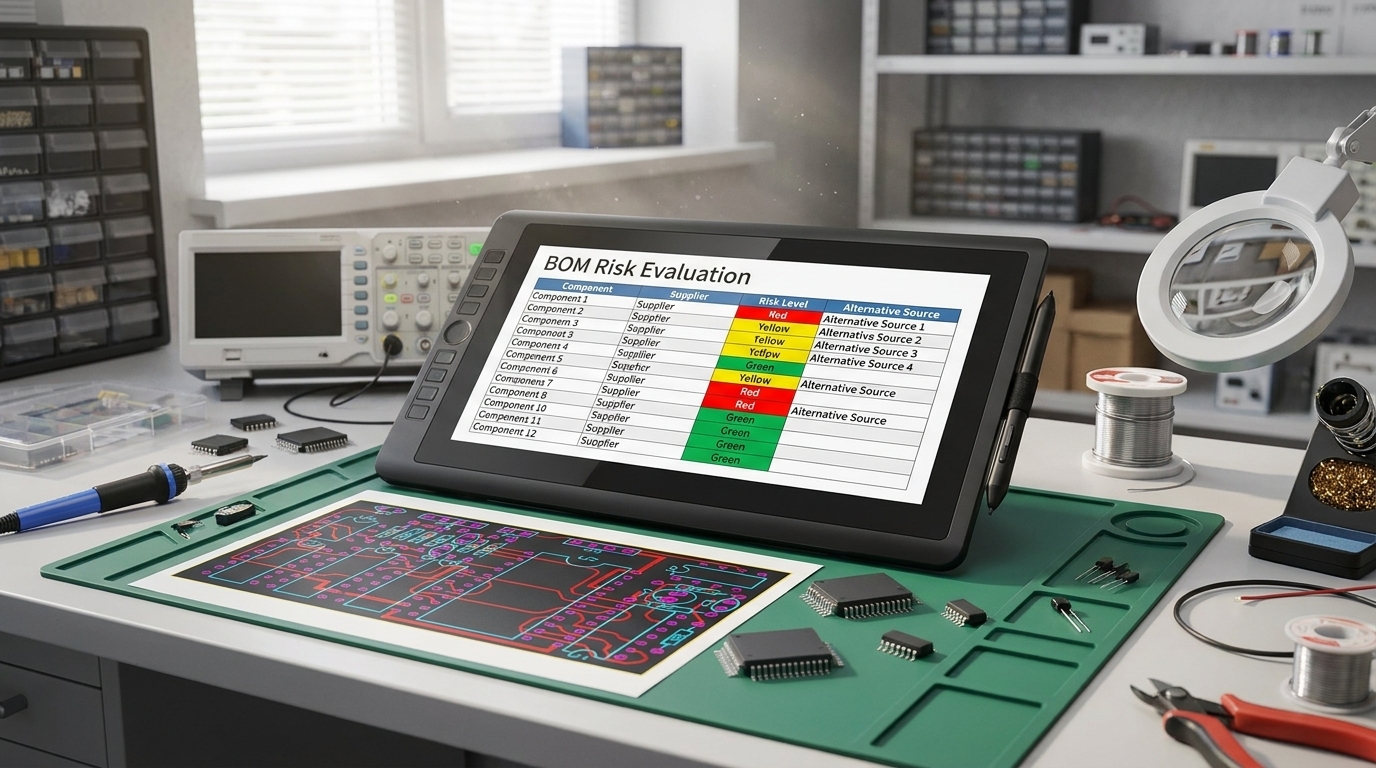 onsemi Synaptics Acquisition Impact: BOM Risk Checklist and Second-Source Strategy for Edge AI DesignsUTMEL27 July 2026330
The onsemi acquisition of Synaptics provides hardware program managers a 12-to-18-month window before potential product cancellations occur in mid-2027. This guide outlines how to audit BOM exposure across overlap and non-core product lines, calculate Last-Time-Buy volumes including hidden storage costs, establish proactive second-sourcing triggers, and implement supply chain monitoring to prevent line-down events.
Read More
Subscribe to Utmel !
![BLM18PG121SN1D]() BLM18PG121SN1D
BLM18PG121SN1DMurata Electronics
![TP3420AV309]() TP3420AV309
TP3420AV309Texas Instruments
![19-217/R6C-AL1M2VY/3T]() 19-217/R6C-AL1M2VY/3T
19-217/R6C-AL1M2VY/3TEverlight Electronics Co Ltd
![MPZ2012S102AT000]() MPZ2012S102AT000
MPZ2012S102AT000TDK Corporation
![SE2537L-R]() SE2537L-R
SE2537L-RSkyworks Solutions Inc.
![SKY81294-14-001]() SKY81294-14-001
SKY81294-14-001Skyworks Solutions Inc.
![HMC588LC4BTR]() HMC588LC4BTR
HMC588LC4BTRAnalog Devices Inc.
![80HCPS1432CRM]() 80HCPS1432CRM
80HCPS1432CRMRenesas Electronics America Inc.
![DS21Q48N]() DS21Q48N
DS21Q48NMaxim Integrated
![ALT6702RM45Q7]() ALT6702RM45Q7
ALT6702RM45Q7Skyworks Solutions Inc.