Product
 Brand
Brand Articles
 Tools
Tools
Decoding AEC-Q100: A Sourcing Guide to Automotive Grade Semiconductor Qualification and Temperature Ratings
Sourcing a microcontroller or memory IC for a vehicle is not a “pick-from-the-shelf” exercise. A single component failure in an electronic control unit can trigger a recall affecting hundreds of thousands of cars. Yet many buyers and design engineers face a recurring puzzle: two chips share the same base part number, but one is marked “automotive grade” and costs several times more. What exactly does that premium buy, and how can you verify it before you commit?
Quick Answer
An automotive grade semiconductor is an integrated circuit (IC) that has passed the failure‑mechanism‑based stress tests defined by the Automotive Electronics Council[1] (AEC‑Q100). Qualification confirms that the device—not a whole product family—can withstand extreme temperature swings, high humidity, and electrical noise well enough to deliver field reliability across the full automotive lifecycle. Compliance is generally understood to be self‑declared by the manufacturer and documented through a Production Part Approval Process (PPAP) package, rather than validated by a central certification body. Before you buy, always verify the exact orderable part number suffix, the datasheet’s temperature grade, and the availability of qualification summaries. This guide shows you how.
If you are already familiar with the broad landscape of high‑reliability silicon, explore Utmel’s Integrated Circuits (ICs) category to understand what’s currently available across multiple families.
What Does “Automotive Grade” Actually Mean?
The phrase “automotive grade” is often used loosely, but inside the supply chain it carries a hard technical meaning that separates AEC‑Q100 qualified ICs from commercial or industrial parts.
Zero‑defects objective (not a marketing slogan)
While consumer electronics may tolerate failure rates in the range of a few hundred parts per million (ppm)—for example, around 300 ppm for a smartphone—the automotive industry targets failure rates measured in parts per billion (ppb) or less than 1 ppm. Even a 1 ppm defect rate in a component that appears in hundreds of thousands of vehicles translates into thousands of field failures. The AEC‑Q004 “Zero Defects” framework guides suppliers toward this statistical reality, as detailed in the Monolithic Power webinar on AEC-Q100 fundamentals[2], and top‑tier manufacturers back it with per‑lot screening methods such as Part Average Testing (PAT) and Short Term Reliability Monitoring (STRM) that operate well beyond the standard AEC‑Q100 qualification requirements.AEC‑Q100 is for ICs only—know the family tree
The Automotive Electronics Council maintains a suite of standards, and mixing them up leads to incorrect sourcing decisions:When a supplier claims a part is “automotive,” check that the claim maps to the correct AEC‑Qxx family. A wire‑wound resistor passing AEC‑Q200 has nothing to do with AEC‑Q100 and cannot be cross‑referenced as equivalent to an automotive‑grade IC.
AEC‑Q100 – Failure‑mechanism‑based stress test qualification for packaged integrated circuits (MCUs, memory, analog ICs, etc.).
AEC‑Q101 – Discrete semiconductors (MOSFETs, diodes, IGBTs).
AEC‑Q200 – Passive components (resistors, capacitors, inductors).
The AEC‑Q100 Temperature Grades Explained
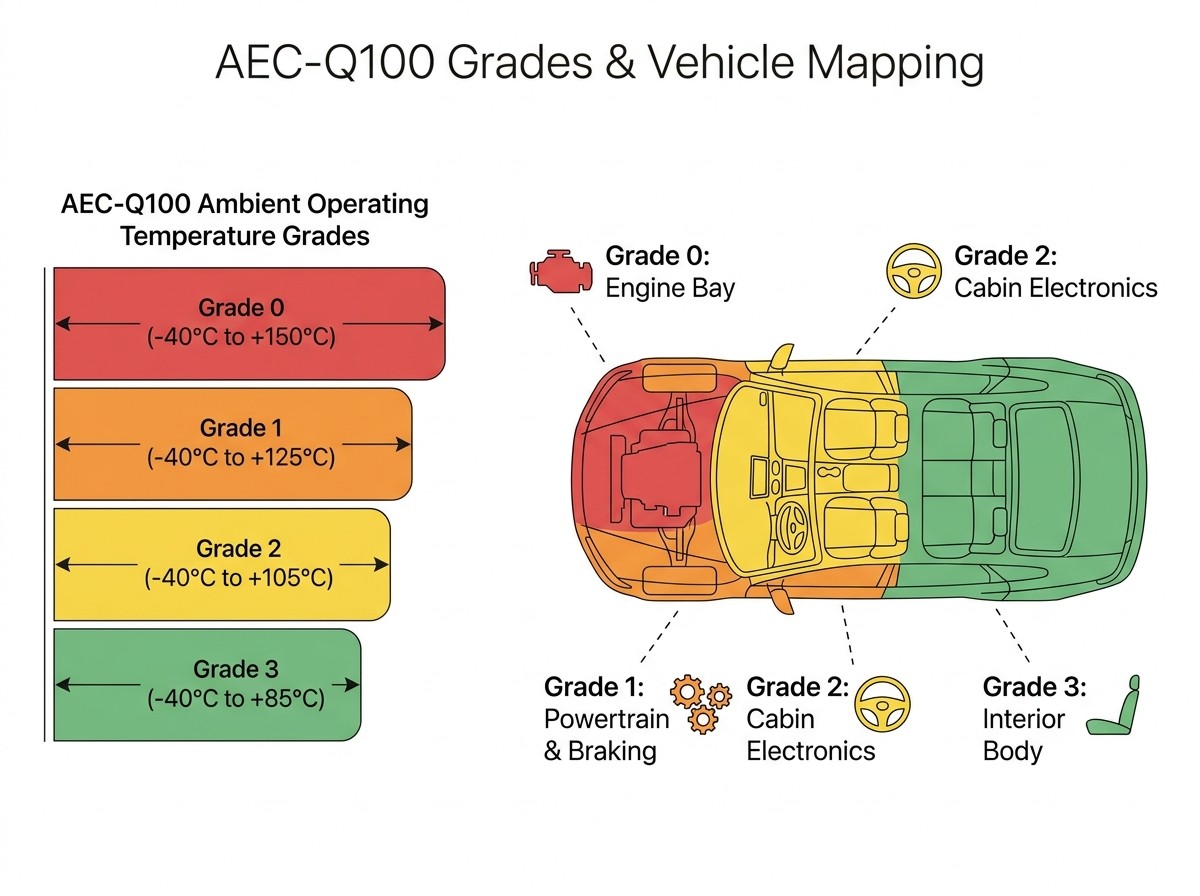
A vehicle presents multiple thermal zones, from the searing heat of an engine bay to the gentle warmth of a dashboard infotainment unit. AEC‑Q100 translates these environments into defined ambient operating temperature grades. The grade a chip carries is not an afterthought—it determines where the chip can legally be used in an OEM’s bill of materials.
| Temperature Grade | Ambient Operating Temperature Range | Typical Vehicle Location / Use Case |
|---|---|---|
| Grade 0 | –40 °C to +150 °C | Extreme under‑hood (turbocharger, exhaust control, cylinder deactivation), transmission‑mounted electronics. |
| Grade 1 | –40 °C to +125 °C | Powertrain, engine control unit (ECU), brake system electronics, chassis sensors. |
| Grade 2 | –40 °C to +105 °C | Passenger cabin (infotainment, cluster gateway, HVAC control), mirror‑mounted modules. |
| Grade 3 | –40 °C to +85 °C | Interior convenience (window lift, seat control), some body electronics. |
| Grade 4 | 0 °C to +70 °C | Non‑critical, specialized applications; rarely used in core vehicle functions. |
(Sources: AEC‑Q100 Rev‑J specification document; Monolithic Power webinar; Infineon community knowledge base[3].)
A Grade 3 chip rated for –40 °C to +85 °C will not survive long in an engine bay that regularly sees junction temperatures above 125 °C, even if the base die appears identical to a Grade 1 version. The qualification data is grade‑specific; using a lower‑grade device in a high‑stress zone voids compliance and exposes the system to early wear‑out failures.
Core Stress Tests: How Chips Earn Their Rating
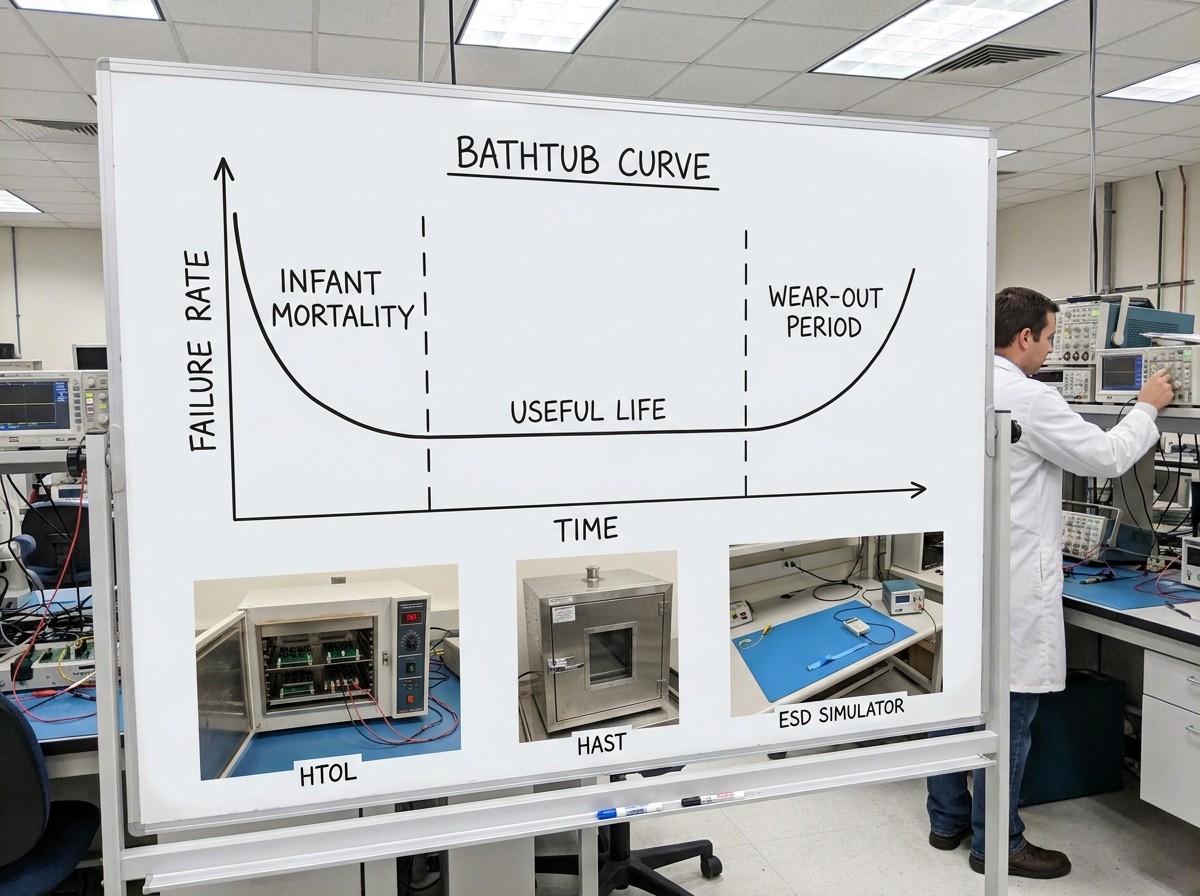
AEC‑Q100 qualification is not a single “test” but a battery of stress groups designed to replicate the real‑world failure mechanisms that occur over a vehicle’s 10‑ to 15‑year service life. Collectively, these tests address the classic reliability “bathtub curve”—eliminating early infant mortality on the left side and delaying wear‑out on the right.
Webinar: Automotive AEC-Q100 Early Version
Key stress tests (categories, not universal thresholds):
High Temperature Operating Life (HTOL) – Subjects the IC to extended operation at or near its maximum rated junction temperature to accelerate thermal- and voltage‑driven failure mechanisms. HTOL targets the long‑term wear‑out tail of the bathtub curve.
Highly Accelerated Stress Test (HAST) – Exposes the device to elevated humidity, temperature, and sometimes electrical bias to accelerate moisture‑related failure mechanisms, as described in the AEC‑Q100 framework.
Electrostatic Discharge (ESD) – Human Body Model (HBM) and Charged Device Model (CDM) – Governed by AEC‑Q100‑002 (HBM) and AEC‑Q100‑011 (CDM). These tests confirm the device can survive electrostatic events that occur during assembly, handling, or in‑vehicle maintenance.
Temperature Cycling – Repeatedly swings the device between extreme hot and cold conditions to stress interconnects, wire bonds, and package materials.
While many industry discussions quote “1,000 hours of HTOL” or a specific ESD threshold, the actual duration and voltage levels depend on the device’s temperature grade and the detailed JEDEC/AEC test conditions. When reviewing supplier data, ask for the test method and the grade‑specific acceptance criteria, not a single universal number.
The Myth of the “AEC Certificate”: Understanding Self‑Declaration
Perhaps the most painful sourcing friction occurs when a buyer demands an “AEC‑Q100 certificate” and the supplier cannot provide one—because no such certificate exists.
How compliance actually works
There is no government agency or central AEC board that audits facilities and issues an AEC‑Q100 certificate. Instead, compliance is supplier‑declared. A semiconductor manufacturer conducts the full stress‑test program internally (or via an accredited independent laboratory) and, once all requirements are met, documents the qualification through:
A Production Part Approval Process (PPAP) package, typically including a Part Submission Warrant, material declarations, and reliability test data.
A supplier‑provided qualification summary that documents the design, construction, and qualification results.
Public datasheet statements such as “AEC‑Q100 Qualified, Grade 1.”
The process is analogous to ISO 9001: the manufacturer self‑attests conformity and provides evidence to the customer. For an OEM or Tier‑1 project, the buyer’s quality team audits the PPAP evidence, not a standalone “AEC certificate.”
Why this matters for sourcing
If you are comparing two suppliers and both claim AEC‑Q100 compliance, do not accept the claim at face value. Always request the PPAP documentation or the Automotive New Product Qualification Summary. A reputable supplier will have those documents ready for review under a non‑disclosure agreement.
How to Verify AEC‑Q100 Status Before Sourcing
Engineers and supply chain managers need a repeatable, evidence‑based process. Use this checklist to avoid the common trap of ordering a commercial part that happens to share the same base part number as an automotive device.
Verification Checklist
Check the Ordering Part Number (OPN) suffix
Automotive variants usually carry a specific suffix or prefix that distinguishes them from commercial versions. As highlighted in TI E2E automotive forum discussions[4], Texas Instruments uses a “‑Q1” designation for its automotive‑qualified ICs, while other manufacturers use “‑A,” “A,” or similar. A quick supplier‑specific guide is essential—ask your distributor for a suffix decoder.Review the official datasheet
The datasheet must explicitly state “AEC‑Q100 Qualified” and list the temperature grade (e.g., “Grade 1: –40 °C to +125 °C”). If the grade is missing or the language is ambiguous (e.g., “suitable for automotive applications”), treat it as commercial.Request qualification documentation beyond the marketing leaflet
Ask for the PPAP or Automotive New Product Qualification Summary.
Confirm that the qualification is part‑number specific. A part that passes qualification under one die revision or wafer fab does not automatically qualify a derivative; any process change triggers re‑qualification.
If you are designing into safety‑critical systems such as ADAS, remember that the supply outlook can change rapidly. Read our guide on 2026 ADAS Sensors Supply Outlook and Alternative Sourcing to understand how sourcing strategies must adapt.
Validate traceability and fixed‑BOM policy
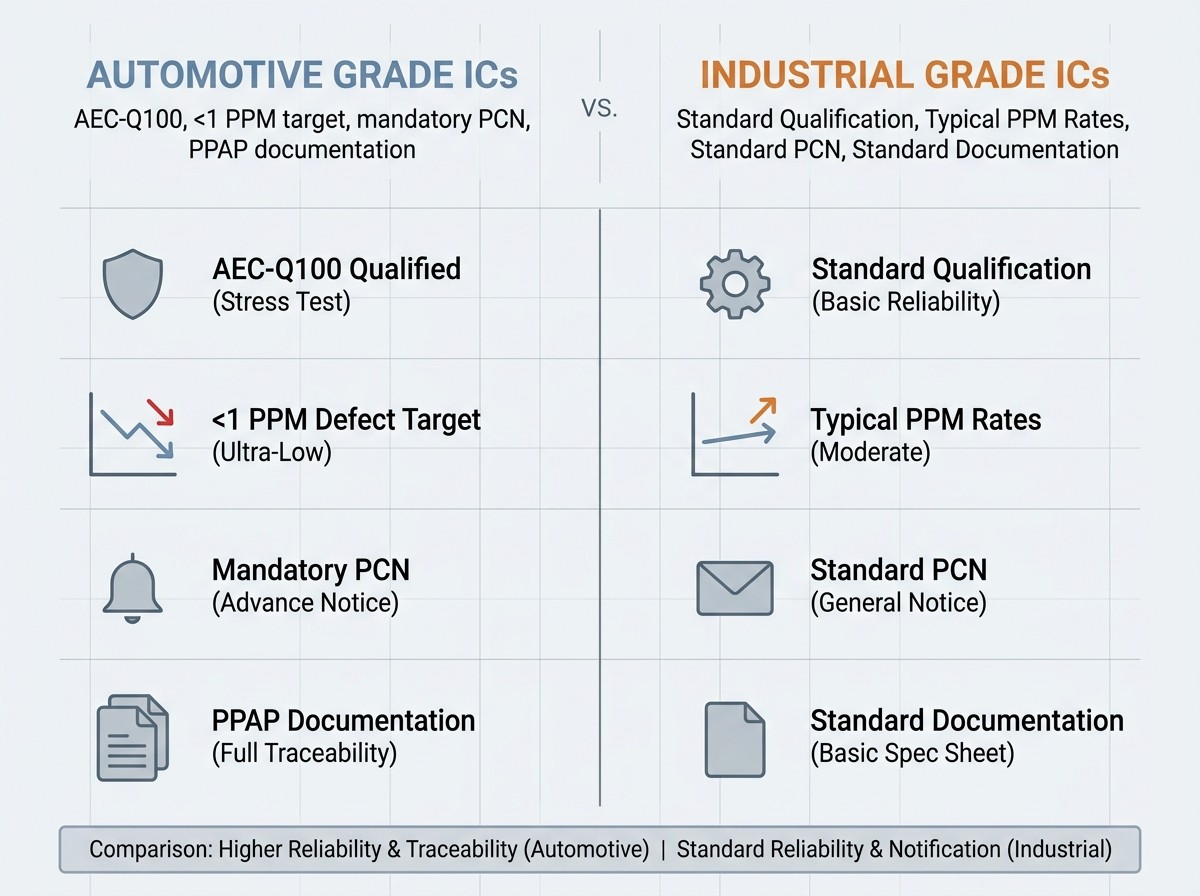
True automotive sourcing requires a Product Change Notification (PCN) agreement. If a manufacturer changes the wafer fabrication site, mold compound, or bond wire material, the automotive customer must be notified and the part re‑qualified. Industrial or commercial flows rarely enforce this with the same rigor.
Automotive vs. Industrial Grade: Where to Draw the Line
When lead times stretch and automotive‑grade ICs are on allocation, the temptation to substitute an industrial‑grade device becomes strong. The physical die may appear identical, but the sourcing risks are fundamentally different.
Hidden Risks That Can Wreck a Production Build
| Criterion | Automotive (AEC‑Q100 Qualified) | Industrial / Commercial |
|---|---|---|
| Failure rate expectation | <1 ppm, driven by PPAP and per‑lot screening (PAT, STRM) | Usually specified in percent or tens of ppm, without automotive‑specific outlier removal |
| Temperature qualification | Specific grade guaranteed by test program | May operate across a wider spec, but without the automotive‑specific stress‑test evidence |
| Change control | PCN mandatory; any change requires re‑qualification and PPAP update | PCN may be voluntary or limited; material and process changes often unannounced |
| Documentation | PPAP, qualification summary, traceability lot history available | Typical certificate of conformance only; no PPAP |
| Application risk | Designed to survive 10–15 year mission profiles with zero‑defect mindset | Designed for shorter commercial cycles (2–5 years) with acceptable failure rates |
A single 1‑ppm industrial chip that fails in a body‑control module can generate thousands of warranty claims. When the failure is traced back to a missing PPAP, the liability sits squarely with the sourcing decision. Before you substitute, ask your quality team: If this part fails in the field, can I demonstrate to the OEM that the due diligence was identical to that for an automotive‑qualified alternative?
For a detailed verification workflow specifically for memory components, see Automotive vs. Industrial Memory: How to Verify Grade Codes Before Sourcing. For a deeper look at how programmable logic is handled in high‑reliability zones, read FPGAs in Electric Cars: The Complete Guide to Powertrain, ADAS, and BMS.
Frequently Asked Questions
Does AEC‑Q100 qualification apply to the whole product family?
No. Qualification is tied to the exact part number, fabrication process, and package. If the manufacturer changes even the mold compound, that variant must be re‑qualified and the PPAP updated. Always assume that a similar part in the same data sheet is not qualified until you verify it explicitly.
Can I use an AEC‑Q100 Grade 3 chip in an engine control unit?
No. Under‑hood and transmission environments demand Grade 1 or Grade 0 because ambient temperatures routinely exceed 105 °C, and junction temperatures can climb much higher. Using a Grade 3 part in such a zone is a direct specification violation and will lead to early‑life failures.
Is there any official AEC certificate I can ask for?
No. The AEC does not issue certificates. What you should request is the PPAP package, which serves as the formal evidence of compliance. A supplier that insists an “AEC certificate” is unnecessary is correct; one that cannot provide a PPAP when you ask for it, however, should raise a red flag.
Sources and references used for this guide
AEC Documents
Source type: standards body
Used for: Existence of AEC-Q100 standard and test categories.
Caution: Do not cite specific test hours as universal.Fundamentals of AEC-Q100: What “Automotive Qualified” Means
Source type: official company documentation
Used for: Temperature grades 0-4 and general failure rate context.
Caution: Vendor source; use for technical definitions, not ranking.What is AEC-Q100 and it's Specifications?
Source type: community discussion
Used for: Corroborating temperature grade ranges.
Caution: Community forum; use as background support.GRADE 0 vs GRADE 1 rating - Automotive Forum
Source type: community discussion
Used for: Practical sourcing context regarding part number suffixes.
Caution: Community forum; use as background support.
 UTMEL
UTMEL
We are the professional distributor of electronic components, providing a large variety of products to save you a lot of time, effort, and cost with our efficient self-customized service. careful order preparation fast delivery service
 Modeling Wide Band-Gap Semiconductors for Enhanced PerformanceRakesh Kumar, Ph.D.31 January 20243797
The article delves into the challenges faced by silicon-based power electronic devices and highlights the potential of wide band-gap semiconductors. It also emphasizes the importance of modeling power semiconductor devices and provides insights into various models. For electrical energy conversion to be dependable and effective, power electronics and semiconductor device technologies are essential.
Read More Optimizing Energy Management with Non-Isolated DC-DC ConvertersRakesh Kumar, Ph.D.04 February 20243445
The article classifies DC-DC converters and discusses the benefits and limitations of them. It proposes a modified DC-DC converter topology that combines the Cuk and Positive Output Super Lift Luo topologies to achieve a higher voltage gain with fewer components.
Read More ‘6G Networks’ - Pioneering the Next Era of Connectivity And InnovationRakesh Kumar, Ph.D.18 March 20243767
The article provides a comprehensive overview of the evolving landscape of mobile networks, the requirements that will shape the future of mobile communication, and the innovative technologies driving the transition to 6G.
Read More Review of IoT-Based Smart Home Security Systems- Part 1Rakesh Kumar, Ph.D.28 March 20244245
The article discusses the evolution of IoT-based smart home security systems, integrating advanced technologies like Raspberry Pi, PIR sensors, and voice recognition for enhanced user experience and efficiency.
Read More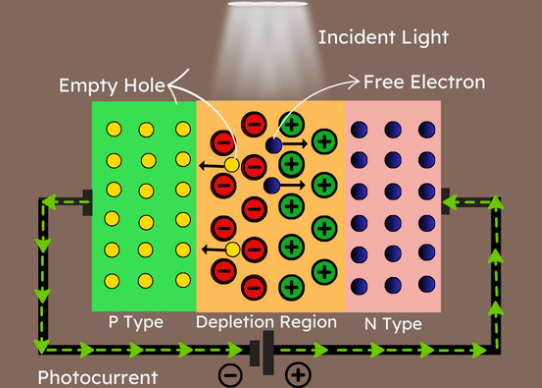 Understanding Photodiodes: Working Principles and Applications - Part 2Rakesh Kumar, Ph.D.24 May 20245464
The article provides a comprehensive overview of photodiodes, focusing on their operational principles, key factors affecting their efficiency, advantages, and disadvantages, and highlights their diverse applications.
Read More
Subscribe to Utmel !
![CUSA-R80-15-2500-TH]() CUSA-R80-15-2500-TH
CUSA-R80-15-2500-THCUI Devices
![LM71EDBVRQ1]() LM71EDBVRQ1
LM71EDBVRQ1Texas Instruments
![SEN0437]() SEN0437
SEN0437DFRobot
![SM72480SDE-105/NOPB]() SM72480SDE-105/NOPB
SM72480SDE-105/NOPBNational Semiconductor
![FL 88]() FL 88
FL 88EDSYN
![VM18CAQ]() VM18CAQ
VM18CAQSchneider
![1930]() 1930
1930Adafruit
![TOL-10242]() TOL-10242
TOL-10242SparkFun
![TOL-08775]() TOL-08775
TOL-08775SparkFun
![TOL-09327]() TOL-09327
TOL-09327SparkFun