Product
 Brand
Brand Articles
 Tools
Tools
Memory ICs: Types, Applications & Selection (2025)
Introduction to Memory ICs
Memory Integrated Circuits (ICs) are semiconductor devices designed to store digital data in electronic systems. They form the backbone of nearly all modern digital devices, from smartphones and laptops to industrial equipment and automotive systems.
These specialized ICs serve as the workhorses of data storage and retrieval, enabling everything from temporary data processing to long-term information storage. Unlike processing components, memory ICs are optimized for rapid access, reliable data retention, and efficient space utilization.
"Memory ICs are the unsung heroes of the digital revolution, holding our data, enabling our applications, and making possible the computing experiences we take for granted every day."
For engineers, designers, and technology enthusiasts, understanding memory ICs is crucial. These components often represent critical decision points in system design, affecting performance, power consumption, reliability, and cost.
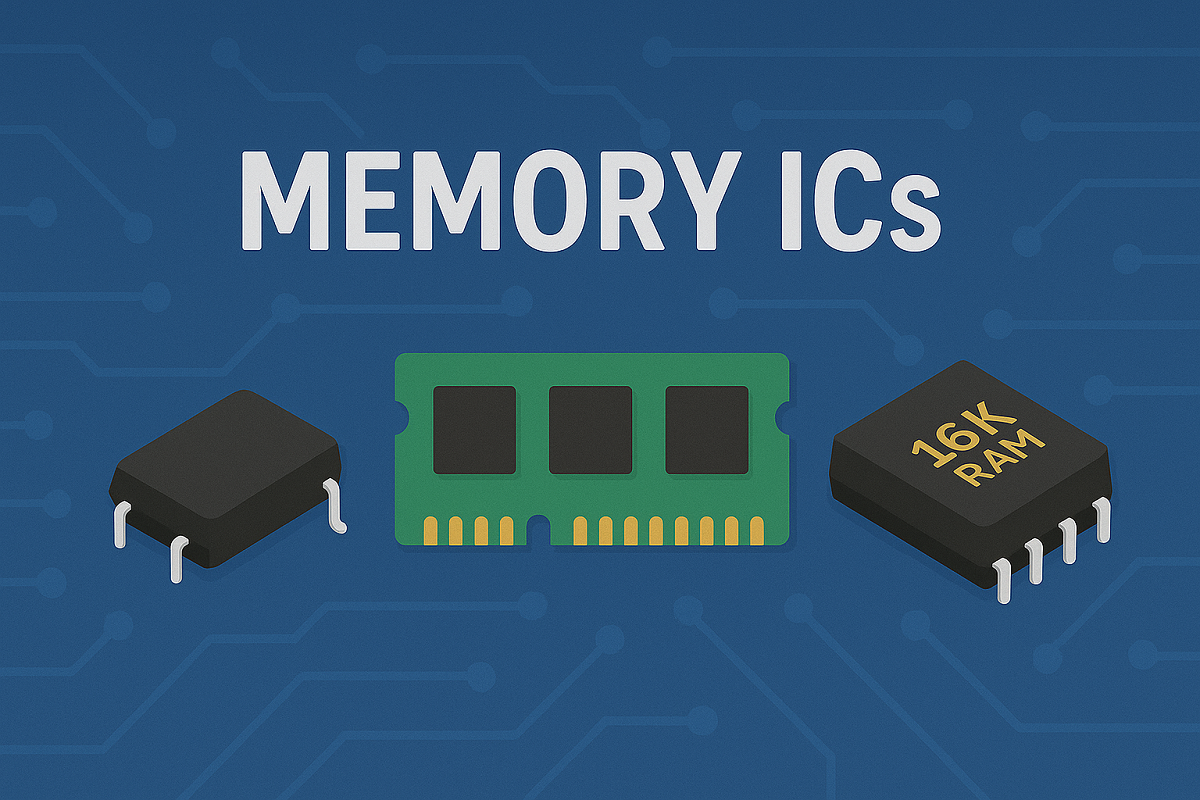
 Common memory IC packages used in modern electronics
Why Memory ICs Matter
Memory ICs play several critical roles in electronics design:
Performance Enablement: Sufficient and well-designed memory architecture can significantly enhance system performance.
Power Optimization: Different memory technologies offer various trade-offs between performance and power consumption.
Cost Management: Memory often represents a substantial portion of the bill of materials in many systems.
Reliability Assurance: Properly selected memory ensures data integrity and system stability.
Have you considered how memory architecture decisions impact your product's performance and user experience?
Memory IC Types: Understanding the Core Technologies
Dynamic Random-Access Memory (DRAM)
DRAM stands as the workhorse of main memory in computing systems. This volatile memory technology stores each bit of data in a separate capacitor within an integrated circuit. The term "dynamic" refers to its need for regular refreshing to maintain stored data.
Key Characteristics of DRAM:
High Density: Offers excellent storage capacity per unit area
Refresh Requirement: Needs periodic refresh cycles to maintain data
Moderate Access Speed: Typically ranges from 10-100ns access time
Lower Cost per Bit: More economical than SRAM for large memory requirements
Higher Power Consumption: Due to refresh operations
DRAM has evolved through multiple generations, including SDR, DDR, DDR2, DDR3, DDR4, and now DDR5, each offering improved performance, reduced power consumption, and enhanced features.
A specialized variant, LPDDR (Low-Power DDR), has been developed specifically for mobile and embedded applications where power efficiency is paramount.

DRAM cell structure showing capacitor-based storage
Static Random-Access Memory (SRAM)
SRAM represents the premium tier of volatile memory, storing data bits using six transistors that form a bistable flip-flop circuit. Unlike DRAM, it doesn't require refreshing to maintain data, making it "static" in operation.
Key Characteristics of SRAM:
Ultra-Fast Access: Typically 1-10ns access times
No Refresh Needed: Data remains stable without refreshing
Higher Power Consumption When Active: Due to more transistors per bit
Lower Standby Power: Can be very efficient in sleep states
Lower Density: Requires more silicon area per bit than DRAM
Higher Cost per Bit: Premium pricing due to larger die size
SRAM is commonly used in processor caches (L1, L2, L3), high-speed buffers, registers, and applications requiring the fastest possible memory access with minimal latency.
The technology offers several variants including asynchronous SRAM, synchronous SRAM, and ZBT (Zero Bus Turnaround) SRAM for specialized applications.

Circuit structures of DRAM, SRAM, and Flash memory cells
Flash Memory
Flash memory has revolutionized non-volatile storage, offering persistent data retention without power. It uses floating-gate transistors to store electrical charges that represent binary data, making it ideal for long-term storage applications.
Key Characteristics of Flash Memory:
Non-Volatile Storage: Retains data without power
Block-Based Access: Data is read/written in blocks
Limited Write Cycles: 10,000-100,000 program/erase cycles per block
Moderate to Slow Write Speeds: Slower writes compared to reads
Good Read Performance: Fast random read access
High Density: Excellent storage capacity per unit area
Flash memory comes in two primary architectures:
NOR Flash: Offers random access capabilities, faster read performance, and is used for code storage and execution (XIP - Execute In Place)
NAND Flash: Provides higher density, lower cost per bit, and is used for mass storage in SSDs, memory cards, and USB drives
Flash memory technologies continue to evolve with 3D NAND, QLC (Quad-Level Cell), and other innovations pushing storage densities to unprecedented levels.
For a deeper understanding of certain flash memory variants, explore this article on EPROM and EEPROM technologies.

Comparison of memory technologies for embedded systems
Emerging Memory Technologies
Beyond the established technologies, several emerging memory types are gaining traction:
Magnetoresistive RAM (MRAM): Non-volatile memory using magnetic elements
Phase-Change Memory (PCM): Uses the unique behavior of chalcogenide glass
Ferroelectric RAM (FRAM): Combines non-volatility with DRAM-like performance
Resistive RAM (ReRAM): Changes resistance to store data
These technologies aim to bridge the performance gap between traditional DRAM and Flash memory, potentially offering "universal memory" solutions that combine the best attributes of both.
Comparative Analysis: Choosing the Right Memory Technology
When selecting memory ICs for a specific application, understanding the trade-offs between different technologies is crucial. The following table provides a comparative overview of the main memory types:
| Characteristic | SRAM | DRAM | NOR Flash | NAND Flash |
|---|---|---|---|---|
| Volatility | Volatile | Volatile | Non-volatile | Non-volatile |
| Density | Low | High | Medium | Very High |
| Read Speed | Fastest (1-10ns) | Fast (10-100ns) | Medium (50-100ns) | Slow (25-50μs) |
| Write Speed | Fastest (1-10ns) | Fast (10-100ns) | Slow (5-10μs) | Very Slow (200-500μs) |
| Endurance | Unlimited | Unlimited | 10⁴-10⁵ cycles | 10³-10⁵ cycles |
| Active Power | Medium-High | Medium | Low | Low |
| Standby Power | Low | Medium (refresh) | Very Low | Very Low |
| Cost per Bit | Highest | Medium | Medium-High | Lowest |
| Best Use Case | Cache, high-speed buffers | Main memory | Boot code, firmware | Mass storage, SSDs |
Performance vs. Power vs. Cost Triangle
Memory selection often involves navigating the "triangle" of competing priorities:
Performance-Optimized Systems: Typically employ SRAM for critical paths, DRAM for main memory, and high-performance flash for storage
Power-Optimized Systems: Favor LPDDR memory, carefully sized caches, and power-efficient flash variants
Cost-Optimized Systems: Use minimal SRAM, commodity DRAM, and cost-effective NAND flash storage
What is the most critical memory performance metric for your specific application? Access time? Bandwidth? Retention? Power consumption?
Applications Across Industries
Memory ICs are essential components across virtually all electronic systems and industries. Their specific applications vary based on performance requirements, power constraints, and reliability needs.
Consumer Electronics
Smartphones: LPDDR for main memory, NAND flash for storage, small SRAM caches
Tablets & Laptops: DDR4/DDR5 DRAM, SSD storage using 3D NAND
Smart TVs: DDR memory for UI, NAND for OS storage
Gaming Consoles: High-bandwidth GDDR memory for graphics, large DRAM pools
Memory requirements in consumer devices continue to grow, with flagship smartphones now featuring 12-16GB of RAM and 256GB-1TB of storage.
Automotive Electronics
ADAS Systems: High-reliability DRAM and flash for sensor processing
Infotainment: DDR memory for UI, NAND for maps and media
ECUs: Automotive-grade flash for firmware, SRAM for runtime operations
Diagnostic Systems: EEPROM for storing fault codes and parameters
Automotive applications demand extended temperature ranges (-40°C to +125°C) and rigorous qualification standards like AEC-Q100.
Industrial & IoT
Industrial Controllers: Non-volatile memory for configuration and programs
Smart Sensors: Low-power flash and small SRAM buffers
Gateway Devices: DDR memory, eMMC or NAND storage
HMI Systems: DRAM for interface, flash for application storage
Industrial memory often prioritizes longevity, with 10+ year support commitments and enhanced reliability features.
Data Centers & AI
Servers: High-capacity DDR4/DDR5 DIMMs, often with ECC
Storage Arrays: Enterprise-grade SSDs with 3D NAND
AI Accelerators: HBM (High Bandwidth Memory) for massive parallel processing
Network Equipment: RLDRAM or specialized low-latency memory
Data center applications are driving demand for higher density, higher reliability, and increasingly specialized memory solutions.
Memory Hierarchies in Modern Systems
Most sophisticated electronic systems employ a hierarchy of memory technologies to balance performance, power, and cost:
Level 1: Registers and L1 cache (SRAM) - Smallest, fastest, most expensive
Level 2: L2/L3 cache (SRAM) - Larger, still very fast
Level 3: Main memory (DRAM) - Large capacity, moderate speed
Level 4: Solid State Storage (NAND Flash) - Very large capacity, non-volatile
Level 5: Hard Drives or Network Storage - Highest capacity, slowest access
Each level in this hierarchy serves as a cache for the level below it, with increasingly larger sizes but slower access times as you move down the hierarchy.
For more details on specific memory configurations in computing systems, see this resource on DIMM modules and DDR technologies.
How might your application benefit from a carefully designed memory hierarchy rather than a single memory solution?
Market Trends & Future Outlook
The memory IC market represents one of the largest segments within the semiconductor industry, with significant cyclical patterns and rapid technological evolution. Understanding current trends can help guide purchasing and design decisions.
Current Market Landscape (2025)
The memory market is dominated by a handful of major manufacturers:
DRAM Market: Samsung leads with approximately 41% market share, followed by SK Hynix (34%) and Micron (22%)
NAND Flash Market: More diverse with Samsung, Kioxia, Western Digital, SK Hynix, and Micron as key players
Specialty Memory: Includes manufacturers like Cypress (Infineon), Microchip, ISSI, and others focusing on niche memory products
Key Market Drivers
AI and Machine Learning: Driving demand for high-bandwidth memory solutions
5G Infrastructure: Requiring more memory in network equipment and edge devices
Automotive Electronics: Growing memory content in vehicles for ADAS, infotainment, and electrification
IoT Proliferation: Billions of connected devices each requiring memory components
Data Center Expansion: Cloud computing and hyperscale facilities driving server memory demand
Market Growth Projections
13.5%
Projected CAGR for global memory IC market (2025-2030)
$168B
Estimated total memory market size in 2025
78.9%
Year-over-year growth in memory products (2024)
7.6%
CAGR for Memory IC Market over the next 5 years
Technological Trends
DRAM Evolution
DDR5 adoption accelerating
HBM3E for AI applications
LPDDR5X for mobile devices
Compute-in-memory architectures
Flash Advancements
176+ layer 3D NAND structures
PLC (Penta-Level Cell) development
Zone Namespaces for SSDs
Computational storage
Emerging Technologies
STT-MRAM commercial deployment
Phase-Change Memory integration
FRAM for IoT applications
DNA-based storage research
Supply Chain Considerations
The memory market is known for its cyclical nature, with periods of oversupply and shortages. Current supply chain insights include:
Production Capacity: Major manufacturers are cautiously expanding capacity after recent market corrections
Regional Diversification: Growing memory production in China alongside traditional centers in Korea, Japan, Taiwan, and the US
Trade Tensions: Geopolitical factors continue to influence supply chains and technology transfer
Long-Term Availability: Critical for industrial and automotive applications with 10-15 year product lifecycles
"The memory market in 2025 is characterized by strong growth driven by AI applications, but with increasing technological complexity and emerging alternatives to traditional DRAM and NAND technologies."
Understanding these market dynamics is crucial for timing purchases, negotiating supply agreements, and planning product roadmaps that align with memory technology evolution.
For more information on specific memory types like SDRAM, explore this detailed guide on types of SDRAM technology.
Selection Guide & Top Products
How to Choose the Right Memory IC
Selecting appropriate memory ICs requires consideration of multiple factors:
Technical Considerations
Capacity Requirements: Total storage needs
Access Time/Speed: Read/write performance requirements
Interface Type: Serial or parallel, standard compatibility
Power Constraints: Active and standby power limits
Temperature Range: Operating environment conditions
Endurance: Write cycle requirements for flash memory
Reliability Features: ECC, health monitoring capabilities
Business Considerations
Cost Targets: Budget constraints per unit
Availability: Current supply situation, lead times
Longevity: Expected lifecycle support
Second Sources: Alternative suppliers availability
Compliance Requirements: Industry certifications
Total Cost of Ownership: Including qualification
Roadmap Alignment: Future technology compatibility
Top 3 Hottest Selling Memory ICs
Micron MT41K64M16TW-107 IT:J
Type: DDR3 SDRAM
Capacity: 1Gb (64M x 16)
Speed: 1866 MT/s
Package: 96-ball FBGA
Applications: Computing, Networking
Micron MT48LC8M16A2P-75GTR
Type: SDRAM
Capacity: 128Mb (8M x 16)
Speed: 133MHz (7.5ns)
Package: 54-TSOP II
Applications: Industrial, Consumer
ISSI IS42S16400J-7BLI
Type: SDRAM
Capacity: 64Mb (4M x 16)
Speed: 143MHz (7ns)
Package: 54-TSOP II
Applications: Automotive, Industrial
Selection Process Best Practices
Define Requirements: Clearly document your technical needs before selection
Consider Lifecycle: Align memory choices with your product's expected lifetime
Validate Early: Test memory in your specific application conditions
Plan for Obsolescence: Have strategies for component end-of-life
Check Compliance: Ensure memory meets regulatory requirements for your industry
Insider Tip
When designing with memory ICs, consider implementing software-based memory tests that can run during production and in the field. This can help identify potential issues early and ensure long-term reliability.
Have you considered how your memory selection might impact future product iterations or upgrades? Will the memory architecture scale with your needs?
Common Misconceptions About Memory ICs
Misconception #1: All Flash Memory Has the Same Endurance
The Truth: Flash memory endurance varies dramatically based on the type and design.
SLC (Single-Level Cell) flash can endure 100,000+ program/erase cycles, while QLC (Quad-Level Cell) may only survive 1,000 cycles. Industrial and automotive-grade flash typically offers much higher endurance than consumer-grade products.
Misconception #2: More Memory Always Improves System Performance
The Truth: Memory quantity only helps up to a point; quality and architecture matter more.
Beyond a certain threshold, adding more memory yields diminishing returns. Memory bandwidth, latency, and the overall memory subsystem design often have greater impact on performance than raw capacity.
Misconception #3: Memory IC Selection Is Just About Capacity and Speed
The Truth: Many other factors are equally important for critical applications.
Temperature range, power consumption, error handling capabilities, security features, and long-term availability can be decisive factors in memory selection for industrial, automotive, and mission-critical applications.
Misconception #4: All DDR4 (or other standard) Memory Is Interchangeable
The Truth: Significant variations exist even within the same memory standard.
Memory ICs that conform to the same standard (e.g., DDR4) can have different densities, speeds, organizations, refresh requirements, and other parameters that affect functionality in specific applications.
Real User Experience Stories
JT
James T., Senior Hardware Engineer
"We initially selected a consumer-grade NAND flash for our industrial controller to save costs. Six months into field deployment, we started seeing data corruption issues in high-temperature environments. Switching to industrial-grade SLC NAND solved the problem but cost us significantly in recalls and reputation damage. The lesson: never compromise on memory quality for critical applications."
ML
Maria L., Systems Architect
"During development of our new IoT platform, we spent weeks troubleshooting mysterious system crashes only to discover our DRAM timing was marginally out of spec at lower voltages. The memory passed all standard tests but failed under specific power-saving conditions. Now we always validate memory across the full operating envelope, not just at nominal conditions."
Frequently Asked Questions
What is the difference between volatile and non-volatile memory?
Volatile memory (like DRAM and SRAM) loses its stored information when power is removed. It requires constant power to maintain data. Non-volatile memory (like Flash, EEPROM, and newer technologies including MRAM and FRAM) retains its stored data even when power is turned off, making it suitable for long-term storage applications.
Why is SRAM more expensive than DRAM?
SRAM (Static RAM) uses a more complex cell structure with six transistors per bit, compared to DRAM's one transistor and one capacitor per bit. This larger cell size means SRAM takes up more silicon area for the same capacity, resulting in higher manufacturing costs. The advantage of SRAM is that it doesn't require refresh cycles, offers faster access times, and consumes less power when data isn't being accessed.
How can I ensure memory compatibility with my system?
To ensure memory compatibility, verify multiple parameters: the correct memory technology (DRAM type, Flash interface), voltage requirements, speed grade, capacity, and physical package dimensions. For standardized modules like DIMMs, check the specific standard version. For embedded systems, verify signal integrity through simulation and testing. Always check the manufacturer's datasheets for specific compatibility information and consider consulting reference designs.
What is the expected lifespan of different memory technologies?
Memory lifespan varies by technology: DRAM and SRAM typically have unlimited write cycles but require power to retain data. NAND Flash endurance ranges from 1,000 to 100,000 write cycles depending on the cell technology (QLC, TLC, MLC, or SLC, in order of increasing endurance). NOR Flash typically offers 10,000 to 100,000 write cycles. Many manufacturers guarantee data retention of 10+ years for non-volatile memory. Industrial and automotive-grade memory typically has enhanced endurance specifications.
How is the memory market expected to evolve in the next 5 years?
Over the next five years, the memory market is expected to see continued growth in capacity demands driven by AI, edge computing, and 5G applications. Technologically, we anticipate wider adoption of DDR5, expansion of HBM for high-performance computing, and increased layer counts in 3D NAND. Emerging memory technologies like MRAM, ReRAM, and PCM will likely gain market share in specialized applications. The market may also see more regional manufacturing diversity as countries invest in semiconductor sovereignty.
Do you have specific memory-related questions for your application? Consider consulting with a memory IC specialist for tailored guidance.
Conclusion and Rating
Memory ICs continue to be foundational components in virtually all electronic systems, with the technology landscape evolving rapidly to meet increasing demands for performance, capacity, and power efficiency.
Overall Market Outlook (2025-2030):
4.5/5
Strong growth prospects driven by AI, IoT, and automotive electronics, with increasing technological diversity.
As we've explored throughout this guide, selecting the appropriate memory technology for your specific application requires careful consideration of technical requirements, business constraints, and future roadmaps. The memory landscape continues to fragment into increasingly specialized solutions tailored for specific use cases, from ultra-low-power IoT devices to high-bandwidth AI accelerators.
Whether you're designing consumer products, industrial systems, or cutting-edge computing platforms, a thoughtful memory architecture can provide substantial competitive advantages in performance, power efficiency, reliability, and cost.
Stay informed about emerging memory technologies and market trends to make better decisions for both current designs and future product roadmaps.
 UTMEL
UTMEL
We are the professional distributor of electronic components, providing a large variety of products to save you a lot of time, effort, and cost with our efficient self-customized service. careful order preparation fast delivery service
 How to Use an External Hard Drive?UTMEL24 June 20219078
The external hard drive is a compact and portable hard drive storage which can be plugged in or unplugged at any time. It mainly uses USB or IEEE1394 interfaces. It can transmit data with the system at a higher speed. The IEEE 1394 interface transfer rate is 50-100 MB/s.
Read More Introduction to RAID (Redundant Arrays of Independent Disks)UTMEL01 July 20218743
RAID (Redundant Arrays of Independent Disks) means "a redundant array composed of independent disks". The RAID is the combination of many independent disks that combined into a large-capacity disk group. It uses the bonus effect of individual disks to provide data to enhance the performance of the entire disk system.
Read More What is NAND Flash?UTMEL04 November 202111581
NAND Flash is a better storage device than hard disk drives and is particularly evident in low-volume applications up to 4GB. As the quest continues for lower power consumption, lighter weight, and better performance, NAND is proving to be very attractive. Its development goal is to reduce the cost per bit of storage and increase storage capacity.
Read More Memory Chip: The Key to Smart ConnectivityUTMEL03 November 20212657
In today's post, we talk about memory chips, especially their emerging applications in the AIoT smart interconnect space.
Read More Emerging Storage Technologies: MRAM, RRAM, and PCRAMUTMEL08 January 202612861
The semiconductor industry is turning to emerging memories that offer higher storage performance, lower cost, and the ability to move toward process miniaturization. Three of these memories stand out -- MRAM, RRAM, and PCRAM.
Read More
Subscribe to Utmel !