Product
 Brand
Brand Articles
 Tools
Tools
onsemi Synaptics Acquisition Impact: BOM Risk Checklist and Second-Source Strategy for Edge AI Designs
This engineering and procurement guide provides hardware program managers, component engineers, and sourcing leads with an operational risk framework to analyze the onsemi acquisition of Synaptics across active Bills of Materials (BOMs).
The June 25, 2026, announcement that onsemi is acquiring Synaptics in a $7 billion enterprise value all-stock transaction created immediate concern across procurement teams regarding potential component obsolescence and unannounced supply disruptions. However, legal merger covenants under the Hart-Scott-Rodino (HSR) Act prohibit joint portfolio decisions prior to the deal closing in mid-2027. Consequently, engineering teams have an unusually clear 12-to-18-month strategic planning window. This guide breaks down the legal timeline, categorizes product overlap versus strategic fit risks, provides a copyable 5-column audit checklist, details an exact Last-Time-Buy (LTB) volume formula with hidden storage costs, and defines operational triggers for qualifying second-source components.
Timeline Reality and Deal Physics: Why You Have Time
A common misconception following a major semiconductor merger announcement is that Product Change Notifications (PCNs) or End-of-Life (EOL) notices will begin appearing immediately. From an operational and legal standpoint, this assumption is incorrect.
Key Transaction Metrics
Announcement Date: June 25, 2026.
Transaction Value: All-stock transaction with an enterprise value of approximately $7 billion.
Expected Closing Window: Mid-2027, subject to Synaptics stockholder approval and regulatory clearances.
Synergy Target: $200 million in targeted annual run-rate synergies.
Legal Pendency Restrictions
During the pendency period—the time between deal announcement and legal close—onsemi and Synaptics must operate as strict competitors. U.S. antitrust enforcement rules (specifically the Hart-Scott-Rodino Act pre-merger gun-jumping provisions) prohibit the companies from coordinating product portfolio decisions, issuing combined PCNs, or forcing customers to migrate between product lines prior to official closing.
Deconstructing the $200 Million Synergy Figure
The targeted $200 million annual run-rate synergy figure represents operating expense (OpEx) consolidation rather than broad product-line elimination. Industry financial disclosures indicate that 85% to 90% of these cost savings will come from administrative restructuring, general and administrative (SG&A) alignment, and eliminating duplicate corporate overhead.
In recent financial reporting, onsemi documented Q1 revenue of $1.513 billion across three core business units:
Power Solutions Group (PSG): $736.6 million (48.7% of total).
Analog & Mixed Signal (AMG): $540.4 million (35.7% of total).
Intelligent Sensing (ISG): $236.3 million (15.6% of total).
Furthermore, financial breakdowns highlight that onsemi absorbed a $329.3 million restructuring charge tied to legacy fab consolidations in South Korea and the Czech Republic. This structural discipline indicates that post-close product pruning will be driven by margin performance and strategic alignment rather than arbitrary line closures. Hardware teams will not face joint post-merger PCN or EOL notices until mid-2027 at the earliest.
onsemi and Synaptics Merger Analysis and Financial Dossier ON $ON #ON #stockmarket
Product Overlap vs. Strategic Fit: Where the BOM Risk Resides
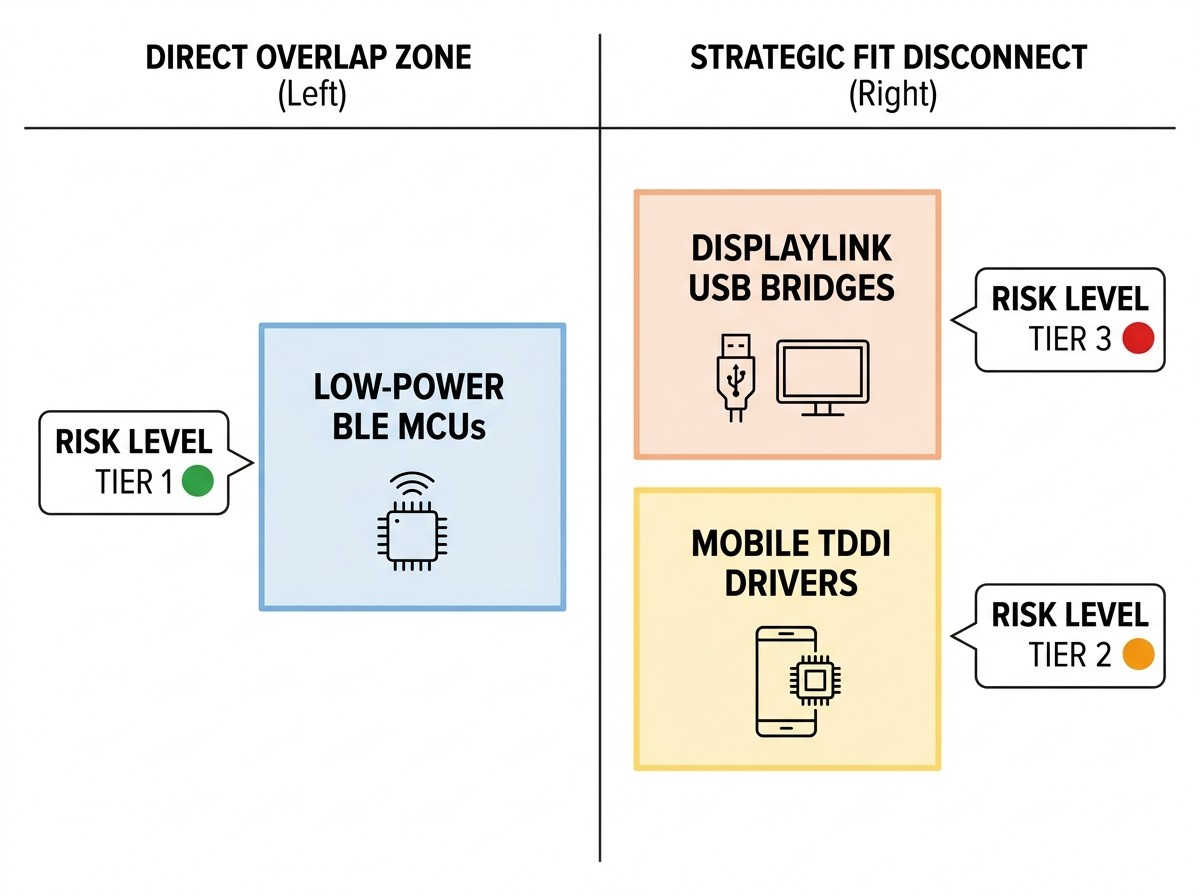
Evaluating BOM exposure requires distinguishing between Direct Overlap (where both companies sell competing parts) and Strategic Fit Disconnect (where legacy parts do not align with onsemi's long-term corporate thesis).
Direct Overlap Zone: Low-Power Wireless
The single genuine head-to-head overlap between onsemi and Synaptics occurs in low-power wireless microcontrollers and connectivity ICs.
onsemi Line: The RSL10 and RSL15 Bluetooth Low Energy (BLE) MCU family. The RSL15, built on an Arm Cortex-M33 core with Arm TrustZone and Smart Sense ultra-low-power mode, is optimized for long battery life in industrial and medical nodes.
Synaptics Line: Multi-protocol Wi-Fi, Bluetooth, and GPS combination platforms (including Veros and legacy wireless connectivity lines).
For low-power edge nodes requiring ultra-low sleep currents and hardware-level security, the onsemi RSL15 remains an industry-leading platform. Conversely, for systems requiring integrated Wi-Fi and Bluetooth co-existence, Synaptics brings broader protocol coverage. Because both lines target overlapping low-power wireless sockets, this category represents the highest probability rationalization zone post-2027.
Strategic Fit Disconnect: The Tier-1 Watch List
The larger risk on active BOMs sits in product lines that carry no technical connection to onsemi's stated focus on "Physical AI," power management, and industrial sensing. Acquirers routinely rationalise legacy product lines that generate acceptable gross margins but fall outside the long-term strategic thesis.
Synaptics product lines on the Tier-1 Watch List include:
PC Touchpad and Fingerprint Controllers: Human-interface devices for traditional PC and notebook clients.
Mobile Touch and Display Driver Integration (TDDI): Display driver ICs for smartphone and mobile displays.
DisplayLink Video Interfaces: High-performance USB graphics bridge controllers, including the DL-6000 and DL-7000 series.
Legacy CX Audio Codecs: Audio processing ICs for PC audio and voice accessories.
While Synaptics' DisplayLink family remains a market standard for multi-monitor USB compression, its high-volume consumer orientation differs fundamentally from onsemi’s core automotive and industrial power focus.
Core Alignment Zone (Low Risk)
Synaptics' Astra Edge AI Platform (featuring SL2600 and SL2610 MPUs with integrated NPU acceleration) complements onsemi’s Intelligent Sensing Group (image sensors) and Power Solutions Group (PMICs). This combination aligns directly with the Physical AI thesis and represents low rationalization risk.
| Product Category | Primary Vendor | Portfolio Alignment | Primary Risk Factor | Risk Level |
|---|---|---|---|---|
| Low-Power BLE MCUs | onsemi (RSL10/15) vs. Synaptics | Head-to-Head Overlap | Duplicate portfolio rationalization | Tier 2 (Moderate) |
| Edge AI MPUs (Astra) | Synaptics (Astra SL2600/10) | High Strategic Fit | System integration focus | Tier 3 (Low) |
| DisplayLink USB Bridges | Synaptics (DL-6000/7000) | Low Strategic Fit | Non-core interface technology | Tier 1 (High) |
| Mobile TDDI & Touch | Synaptics | Low Strategic Fit | Margin profile & non-core market | Tier 1 (High) |
| Legacy Audio Codecs | Synaptics (CX Series) | Low Strategic Fit | Age of platform & non-core focus | Tier 1 (High) |
| Automotive Image Sensors | onsemi (ISG) | High Strategic Fit | Core growth driver | Tier 3 (Low) |
The Operational Risk Checklist: A 5-Column BOM Evaluation Table
Hardware program managers can copy this evaluation framework directly into internal component review meetings to systematically categorize active part numbers across onsemi and Synaptics portfolios.
| Part Category | Why It Is at Risk | Risk Tier | Recommended Action | Decision Deadline |
|---|---|---|---|---|
| Low-Power BLE MCUs (onsemi RSL10/15 vs. Synaptics) | Direct portfolio overlap in short-range wireless connectivity. | Tier 2 | Audit footprint compatibility; map secondary BLE options. | Q1 2027 |
| PC Touchpad & Fingerprint ICs | Non-core to onsemi's industrial and automotive Physical AI thesis. | Tier 1 | Identify alternative human-interface suppliers. | Q4 2026 |
| Mobile TDDI Drivers | Non-core consumer display drivers with shifting margin profiles. | Tier 1 | Consult display module vendors on long-term driver roadmaps. | Q4 2026 |
| DisplayLink USB Bridges (DL-6000/7000) | Legacy desktop docking ICs outside onsemi's power/sensor scope. | Tier 1 | Cross-reference native DisplayPort/HDMI video bridge ICs. | Q1 2027 |
| Legacy Audio Codecs (CX Series) | High product age with non-aligned edge compute architecture. | Tier 1 | Qualify drop-in alternate codecs for industrial designs. | Q1 2027 |
| Astra Edge AI Platform (SL2600/2610) | High strategic fit; key compute platform for combined AI vision. | Tier 3 | Maintain current design-in; monitor post-close software tooling. | Q2 2027 |
| onsemi Legacy Discrete & Logic | Ongoing fab consolidation (closing legacy fabs in South Korea/Czech Republic). | Tier 2 | Map standard logic and discrete cross-reference parts. | Q2 2027 |
Last-Time-Buy Mathematics and Unbudgeted Storage Realities
When an EOL notice is issued post-merger, engineering teams often guess inventory needs, leading either to early line-down conditions or excess capital write-offs. Sourcing managers should rely on a structured LTB calculation model.
The Quantitative LTB Formula
LTB Quantity = (Program Life in Months × Monthly Build Rate × (1 + Yield Loss %) × (1 + Service & Spares %)) + Safety Stock
Worked Numeric Example
Consider an industrial edge gateway using a Synaptics DisplayLink IC or an onsemi legacy wireless MCU:
Remaining Program Life: 36 months
Monthly Build Rate: 2,500 units/month
Manufacturing Yield Loss: 2% (0.02)
Field Service & Spares Allocation: 5% (0.05)
Safety Stock Buffer: 5,000 units
Step-by-step calculation:
Base production demand: 36 months × 2,500 units/month = 90,000 units
Process yield and spares multiplier: 1 + 0.02 + 0.05 = 1.07
Production-adjusted requirement: 90,000 × 1.07 = 96,390 units
Total LTB Commitment: 96,390 + 5,000 safety stock = 101,390 units
Storage Realities and Hidden Engineering Costs
Purchasing 101,390 units upfront introduces secondary engineering costs that are frequently left out of program budgets:
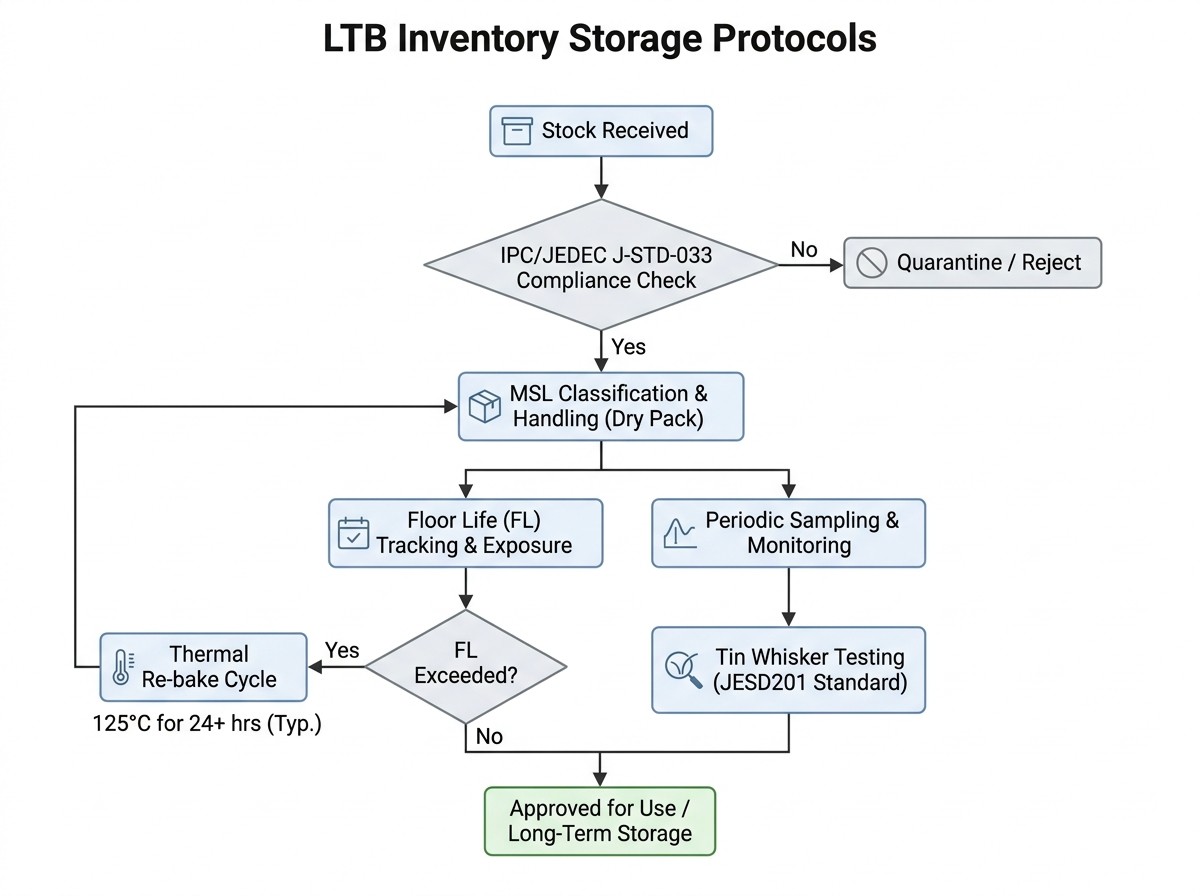
Moisture Sensitivity Level (MSL) Controls: Components rated at MSL 3 (governed by IPC/JEDEC J-STD-033) have a floor life of 168 hours at ≤30°C/60% RH once unsealed. Storing components for 36 months requires humidity-controlled dry cabinets (≤5% RH) or vacuum moisture-barrier bagging with active desiccant. Components stored beyond floor-life thresholds require a mandatory 125°C thermal re-bake prior to surface-mount assembly to prevent package cracking ("popcorning").
Lead Finish Degradation: Components with pure tin (Sn) lead finishes stored past two years face oxidation and tin-whisker risks, requiring periodic solderability dip testing before placement on production lines.
Cash-Flow Inflation Exposure: Committing upfront capital to a multi-year inventory buffer strains operational cash flow. Sourcing teams must balance these inventory commitments against broader component market trends, such as 2026 memory strategic sourcing tactics for DRAM and NAND price hikes, which are already inflating overall BOM costs.
When to Trigger a Second Source and Practical Supply Monitoring
Waiting for an official EOL notice before searching for alternate components significantly increases program costs. Sourcing teams should use objective, non-calendar triggers to begin qualifying alternate options.
Non-Calendar Second-Source Triggers
Qualifying an alternate component should begin immediately when any of the following operational conditions occur:
NRND Status Shift: The vendor transitions the component to Not Recommended for New Designs (NRND).
Lifecycle Commitment Refusal: The vendor or distributor declines to provide a written 5-year supply commitment during quarterly business reviews.
Lead-Time Disconnect: Distributor lead times exceed your internal PCB redesign and requalification cycle time.
Tier-1 Risk Audit Rating: The component falls into a Tier-1 risk category (e.g., DisplayLink, mobile TDDI, or legacy audio codecs) during internal BOM audits.
Qualifying second-source sensor, interface and wireless connectivity ICs; onsemi and Synaptics cross-reference parts during routine scheduled board revisions costs up to 80% less than executing an emergency redesign during a line-down situation.
Supply Chain Monitoring Protocols
Hardware program teams should implement four practical monitoring steps:
Subscribe to PCN RSS Feeds: Set up automated alerts via onsemi's PCN feed to monitor Initial PCN (IPCN) and Final PCN (FPCN) notices, which standard IPC rules require 90 days prior to implementation.
Utilize Cross-Reference Tools: Map pin-compatible and functional alternates early using manufacturer and distributor cross-reference search databases.
Formally Require Lifecycle Status in QBRs: Direct authorized distributors to report component lifecycle codes (Active, NRND, EOL, LTB) at every Quarterly Business Review.
Maintain an M&A Standing Review Item: Keep a standing M&A risk agenda item on program reviews from Q3 2026 through the mid-2027 close. This proactive posture aligns with broader market strategies outlined in the power semiconductors shortage outlook and lead times analysis.
Actionable Roadmap: Five Steps for This Quarter
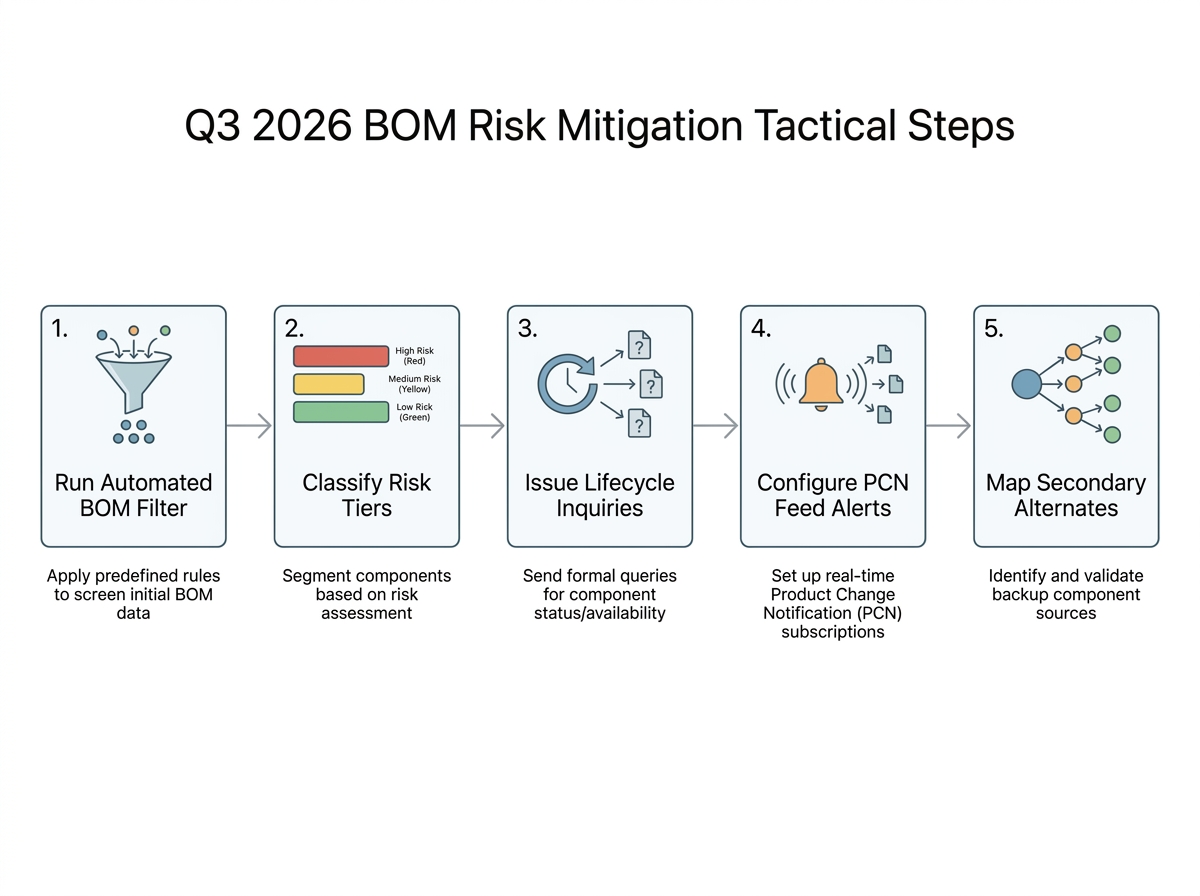
Engineering and procurement teams can complete these five operational steps in under one week to secure active designs:
Run an Automated BOM Filter: Filter all active production BOMs to isolate every active onsemi and Synaptics manufacturer part number (MPN).
Classify Parts by Risk Tier: Assign Risk Tier 1, 2, or 3 to each identified MPN using the audit table provided in Section IV.
Issue Lifecycle Inquiries: Send a formal lifecycle status request to authorized distributors for all identified Tier-1 parts, requesting written supply horizon confirmation.
Configure PCN Feed Alerts: Register lead engineers on the onsemi PCN portal for all active part families.
Map Secondary Alternates: Identify and document pin-compatible alternate parts for high-risk single-sourced nodes. Engineering teams seeking drop-in replacements or sourcing second-source sensor, interface and wireless connectivity ICs; onsemi and Synaptics cross-reference parts through authorized channels can utilize UTMEL's onsemi manufacturer catalog to review cross-reference options, verify component traceability, and secure long-term stocking support.
Frequently Asked Questions
When will onsemi officially issue PCNs or EOL notices for Synaptics products?
No joint PCNs or EOL notices can be issued before the transaction legally closes in mid-2027. Pre-merger antitrust regulations under the Hart-Scott-Rodino Act legally prohibit both companies from coordinating product cancellations prior to deal close.
Are onsemi RSL15 or Synaptics BLE microcontrollers at risk of immediate cancellation?
No. Both lines will remain fully available throughout the 12-to-18-month pendency window. Because low-power wireless represents a direct overlap zone, engineering teams should evaluate alternate BLE platforms prior to the mid-2027 closing date.
What is the difference between direct overlap risk and strategic fit risk?
Direct overlap risk occurs where both companies manufacture competing products for the same application (e.g., low-power BLE MCUs). Strategic fit risk affects legacy product lines (e.g., DisplayLink, mobile TDDI, PC touchpads) that generate revenue but do not align with onsemi's long-term automotive, industrial, and Physical AI core focus.
How do I prevent production line shutdowns if a single-sourced part goes EOL?
Establish non-calendar triggers—such as NRND status shifts or lead times exceeding internal redesign cycles—and pre-qualify alternate components or drop-in cross-references before an official EOL notice occurs.
What storage standards apply when managing long-term Last-Time-Buy inventory?
Long-term inventory storage is governed by IPC/JEDEC J-STD-033 standards. Moisture-sensitive devices (MSL 3) require relative humidity control (≤5%) or dry-packing, along with mandatory 125°C re-baking cycles if floor life limits are exceeded prior to board assembly.
References
onsemi to Acquire Synaptics to Enable the Next Generation of Intelligent Systems for Physical AI — onsemi (Semiconductor Components Industries, LLC)
Synaptics Exhibit 99.3 Form 8-K Disclosure — U.S. Securities and Exchange Commission
Handling, Packing, Shipping and Use of Moisture/Reflow Sensitive Surface Mount Devices (IPC/JEDEC J-STD-033) — JEDEC Solid State Technology Association
 UTMEL
UTMEL
We are the professional distributor of electronic components, providing a large variety of products to save you a lot of time, effort, and cost with our efficient self-customized service. careful order preparation fast delivery service
 The 2026 Memory Super-Cycle: Navigating the 500% Surge in DRAM and NAND Flash PricesUTMEL17 June 20267580
Driven by massive AI capital expenditures, the 2026 semiconductor market is experiencing a historic memory super-cycle, sending DRAM and NAND Flash prices soaring. With manufacturers prioritizing high-margin AI memory like HBM, severe shortages have spilled over to mature nodes, impacting automotive and IoT sectors. To navigate this volatility, procurement teams must secure long-term agreements, diversify suppliers, and optimize designs to mitigate rising BOM costs.
Read More HBM4 and the Shift to Customized AI Memory: The Advanced Packaging BottleneckUTMEL22 June 20261431
The JEDEC HBM4 standard transitions high-bandwidth memory to a customized architecture featuring a 2048-bit interface and logic base dies. While delivering extreme bandwidth for AI accelerators, its resource-intensive production triggers a global DRAM supply squeeze. Procurement teams must navigate rising prices, advanced packaging bottlenecks, and extended lead times by adopting strategic supply chain planning.
Read More AI Computing Power Gap: How Token Consumption is Reshaping Server Component SourcingUTMEL23 June 2026458
As global token consumption drives the transition to high-density 100kW+ AI data centers, power delivery networks require advanced Wide-Bandgap semiconductors (SiC/GaN) and high-capacitance MLCCs. This shift has triggered a component procurement crisis with lead times exceeding 24 weeks. To bypass shortages, hardware buyers must abandon just-in-time manufacturing and leverage independent global distributor networks to secure critical power and passive components.
Read More Power Semiconductor Procurement After the Nexperia Shake-Up—NXP for Stability, ON for Technology, or Nexperia for Value?UTMEL04 November 20254548
The recent supply chain turmoil surrounding Netherlands-based Nexperia has sent shockwaves through the global semiconductor industry, forcing procurement professionals to re-evaluate their sourcing strategies.
Read More The BSPDN Revolution: Overcoming IR Drop in Sub-2nm GAAFET Nodes with Backside Power DeliveryUTMEL25 June 2026303
As semiconductor manufacturing enters the sub-2nm era, Backside Power Delivery Networks (BSPDN) are replacing traditional front-side routing to overcome critical IR drop bottlenecks. By separating power and signal delivery, chipmakers like Intel and TSMC drastically improve performance and density in GAAFET designs. However, this radical shift introduces manufacturing complexities, thermal challenges, and demands advanced packaging and power management solutions.
Read More
Subscribe to Utmel !
![110060947]() 110060947
110060947Seeed Technology Co., Ltd
![1.69508.8100000]() 1.69508.8100000
1.69508.8100000RAFI USA
![SLI-343P8G3F]() SLI-343P8G3F
SLI-343P8G3FROHM Semiconductor
![1203410303]() 1203410303
1203410303Molex
![SGNE06C080MT150N25]() SGNE06C080MT150N25
SGNE06C080MT150N25TDK Corporation
![1-22279-6]() 1-22279-6
1-22279-6TE Application Tooling
![0402N180J500CT]() 0402N180J500CT
0402N180J500CTWalsin Technology Corporation
![H100X044H1T-2]() H100X044H1T-2
H100X044H1T-2Panduit Corp
![SLI-343P8C3F]() SLI-343P8C3F
SLI-343P8C3FROHM Semiconductor
![83500000005]() 83500000005
83500000005Littelfuse Inc.