Product
 Brand
Brand Articles
 Tools
Tools
MCU with Built-in NPU: How to Pick an Edge AI Microcontroller in 2026
If you are evaluating edge AI microcontrollers with an integrated neural processing unit, start by ignoring the headline TOPS number. The first decision that matters is which tier of device your application needs — always-on sensor, control-plus-inference, or vision — because memory, toolchain maturity and lifecycle stage all override any single performance figure. This guide covers how to make that tier decision, how to check whether your model will fit before you buy an evaluation board, and why sorting parts by vendor-quoted GOPS in a spreadsheet produces a ranking that means nothing.
1. The Comparability Problem: Why You Cannot Sort by TOPS
Pick five NPU-equipped MCUs and line up their advertised throughput. The numbers look like a coherent ranking until you notice they are not the same measurement.
Texas Instruments describes its TinyEngine NPU in relative terms only, claiming up to 90 times lower inference latency and more than 120 times lower energy per inference against comparable MCUs with no accelerator[1]. No absolute GOPS figure was published for TinyEngine in the announced MSPM0 and AM13Ex parts.
STMicroelectronics quotes 600 GOPS at 1 GHz for the Neural-ART accelerator in the STM32N6, and separately describes roughly 3 TOPS as an average figure across real workloads[2].
Renesas specifies 256 GOPS for the Arm Ethos-U55 NPU in the RA8P1[4].
Infineon configures the same Ethos-U55 IP differently in PSOC Edge E84, publishing approximately 0.3 TOPS with the NPU clocked at 400 MHz.
NXP's eIQ Neutron NPU in the MCX N series is described in the region of 5 GOPS[3].
These figures cannot be placed in one sortable column without deceiving yourself. The reasons are concrete:
Operations counted per MAC. This is the trap that catches the most people. A multiply-accumulate unit performs one multiply and one add. Some vendors count that as two operations, some as one. The same silicon at the same clock can therefore be quoted at either X or 2X, and the unit label — GOPS versus GMAC/s — is often the only clue which convention is in use. Check it before comparing anything.
NPU clock and MAC width. Ethos-U55 is configurable in MAC-per-cycle width, and vendors clock it differently. Two parts using identical Arm NPU IP can differ several-fold in quoted throughput for reasons that have nothing to do with how your model will run.
Data types. Some figures assume INT8 throughout; others assume mixed precision. A throughput number without a stated data type is not actionable.
Operator coverage. Any figure assumes the NPU executes the whole graph. That stops being true the moment your model contains an operator the NPU does not implement, and the CPU takes over. See Section 4.
Peak versus average. ST's 600 GOPS is a peak rate; the roughly 3 TOPS average figure describes real workloads. One part, two legitimately different numbers, measured differently.
The practical rule: treat published throughput as a rough capacity class, never as a comparator. Benchmark your own model, in your own quantisation format, on the vendor's evaluation board. That is the only figure you can act on.
2. Segment by Class: The Three Tiers of Edge AI MCUs
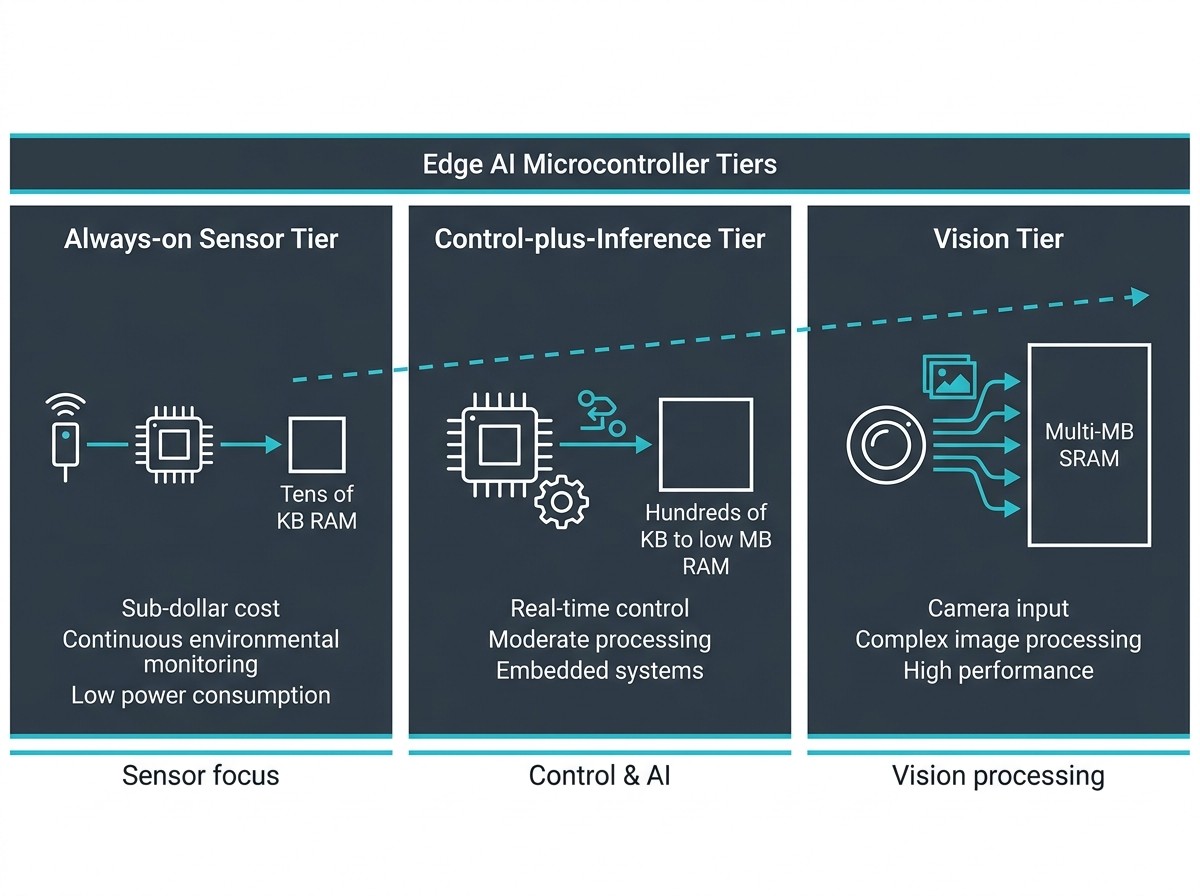
Parts in this field differ by more than two orders of magnitude in on-chip memory and by more than an order of magnitude in unit cost. A single ranked table across the whole space is misleading. Divide it into three tiers first.
Always-on sensor tier
Models are tiny: anomaly detection on accelerometer data, wake-word triggers, simple classification. Unit cost is sub-dollar and memory is measured in tens of kilobytes. The TI MSPM0G5187, at under one US dollar in 1,000-unit quantities[1], defines this tier — and that price is the reason the tier exists at all, because it puts inference into products that could never have justified a more capable part.
Control-plus-inference tier
The MCU runs a real-time control loop — motor control, power conversion — while performing inference concurrently for keyword spotting, predictive maintenance or sensor fusion. On-chip memory runs from hundreds of kilobytes into the low megabytes. TI AM13Ex, NXP MCX N and Renesas RA8P1 sit here, as do the lower configurations of Infineon PSOC Edge.
Vision tier
Camera input, image classification or object detection, often a graphical display. Working memory is measured in megabytes, and external flash and RAM become architecture decisions rather than afterthoughts. ST STM32N6 and Infineon PSOC Edge E84 sit here. Higher-memory configurations of the Renesas RA8P1 can also serve vision workloads; confirm the memory configuration against the specific part number, since it varies within the family.
Selecting the tier is the hard part. Once the tier is settled, comparing parts inside it is a mechanical check of memory, toolchain fit and availability.
3. Memory Is the Binding Constraint, Not Throughput
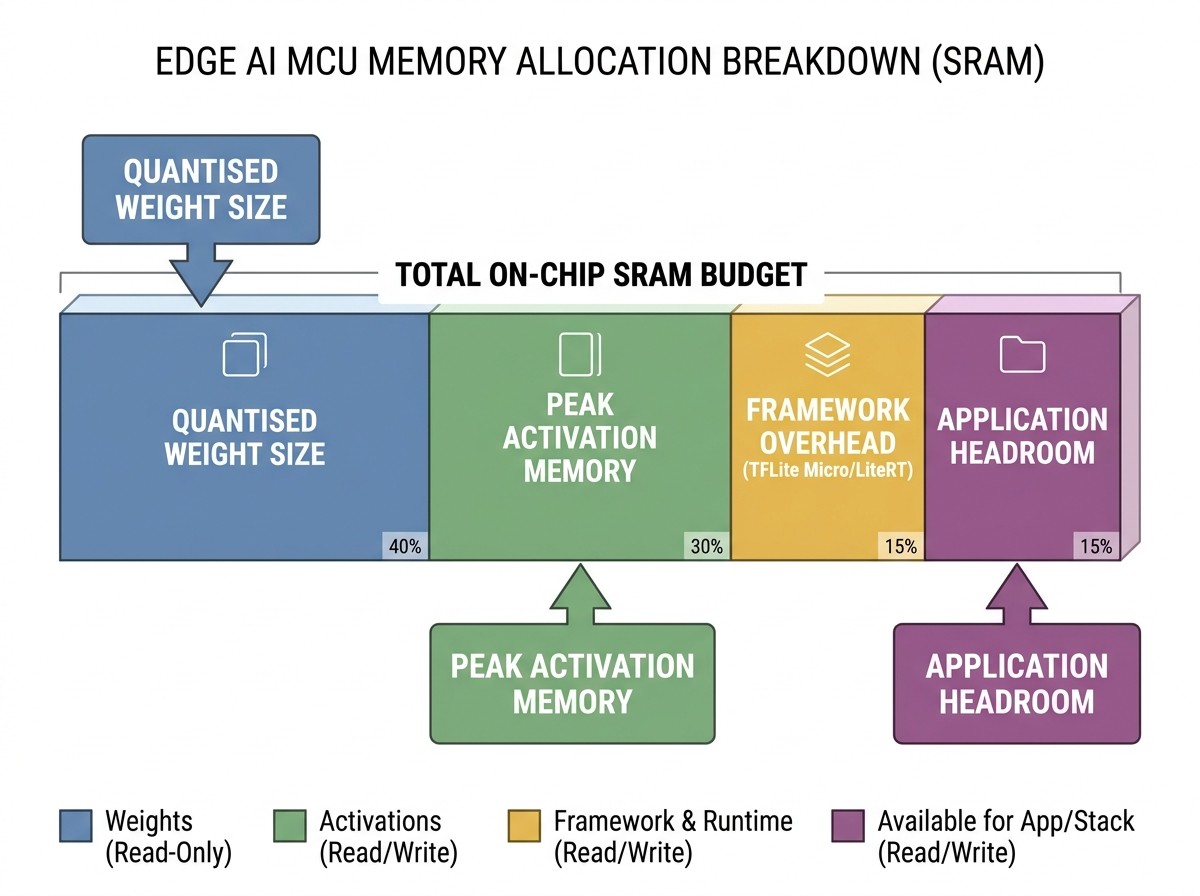
The model, its activation tensors and the inference runtime all have to fit in available memory. A 600-GOPS NPU is useless if the model does not load.
The spread between parts is stark. The STM32N6 provides 4.2 MB of contiguous embedded RAM but no internal flash at all[2]. Application code, weights and the bootloader all live in external memory reached over a high-speed interface such as hexa-SPI or OCTOSPI, or through the flexible memory controller. That adds components to the BOM, consumes board area, and creates a boot-time dependency on external devices, with knock-on effects for power sequencing, reliability and cost. If the product cannot absorb those trade-offs, the STM32N6 is the wrong part no matter what its NPU can do. For how external memory requirements are currently rippling through sourcing, see 2026 Memory Strategic Sourcing Tactics.
At the other end, the MSPM0G5187 offers 128 KB of flash and 32 KB of SRAM[1]. That budget has to cover application code, the inference runtime, the quantised weights and the activation buffers. A MobileNet-class image classifier will not fit, however aggressively it is pruned and quantised — which is the point of the tier, not a shortcoming of the part.
Before ordering an evaluation board, estimate the budget with four numbers:
Quantised weight size. INT8 weights for your architecture, in kilobytes.
Peak activation memory. The largest set of tensors that must be live simultaneously during inference. This depends on the graph, not the parameter count, and a framework profiler will report it.
Framework overhead. The TensorFlow Lite for Microcontrollers or LiteRT runtime typically adds tens of kilobytes of RAM[5], scaling with the operator set you link in.
Application headroom. Stack, heap and buffers for everything that is not inference.
Add them up. If the total exceeds on-chip memory and external memory is unacceptable for your design, move up a tier or shrink the model before committing to a part number. Doing this arithmetic first is what keeps an evaluation board from becoming a two-week detour.
4. Toolchain Maturity and the Hidden Trap of Operator Support
The toolchains are easy to name — ST Edge AI Suite, TI's Code Composer Studio with Edge AI Studio, NXP eIQ Toolkit, Renesas Flexible Software Package, Infineon ModusToolbox — and all of them will import a quantised TensorFlow Lite or ONNX model. Third-party platforms such as Edge Impulse and the TFLite Micro project add another translation layer. The pitch is smooth: export from your training environment, run the conversion tool, deploy.
The trap is operator coverage. NPU APIs are not standardised. An Arm Ethos-U NPU takes models compiled through Arm's Vela compiler, and its supported operator set is finite and documented. A vendor-proprietary NPU such as ST's Neural-ART or NXP's eIQ Neutron implements its own graph compiler and its own subset of operations. If your model contains an operator the NPU does not accelerate, that operator falls back to the CPU and the accelerator's advantage can disappear entirely.
Worth noting that the fallback penalty varies. On a part whose CPU is a Cortex-M55 or M85 with Helium vector extensions, a fallback operator still runs reasonably fast. On a smaller core it does not. Either way the inference budget you planned around the NPU no longer holds.
Audit your model's operator list against the NPU's documented support before selecting a part. The process is mundane and non-negotiable:
Convert your
.tflitemodel to JSON using the FlatBuffers compiler against the TFLite schema, then read off the operator codes. For ONNX, list the node op types directly.Cross-reference those operators against the vendor's supported-operator documentation. For Ethos-U targets this is published in the Vela repository; proprietary NPUs document theirs in the SDK.
For any operator that is missing, ask three questions: can the graph be rewritten to avoid it, does the vendor supply an equivalent custom operator, and can the CPU absorb that operator inside the latency budget.
Treat silent fallback as the real risk. An operator that produces a clear error is a problem you solve in an afternoon. One that quietly runs on the CPU is a problem you discover after board bring-up.
There is a strategic dimension worth weighing separately from performance. Parts built around Arm's Ethos-U — the Renesas RA8P1 and Infineon PSOC Edge among them — share a common compiler and operator-support profile, so porting a model between Ethos-U devices from different vendors is far easier than moving to or from a proprietary NPU. If you expect to second-source the MCU or reuse the ML pipeline across several product lines, that portability has real value. A proprietary NPU may win on paper throughput while costing you rework that no spec sheet shows.
5. Availability and Lifecycle: Production Versus Preproduction
The moment a new edge AI MCU family is announced, the datasheet looks finished. The silicon often is not.
Take the two TI families announced together in March 2026. The MSPM0G5187 was released in production quantities. The AM13E23019, announced the same day, was available only in preproduction quantities, with additional package and memory variants scheduled through the end of 2026[1]. Preproduction status has three practical consequences for a schedule:
Errata are not final. First-revision silicon commonly carries functional or electrical limitations corrected in a later stepping. Designing around it means tracking stepping changes and accepting the possibility of a board revision.
Volume is not committed. A distributor can ship evaluation quantities without being able to commit production volume until the device reaches full release. A 500-board pilot is usually fine. A 50,000-unit ramp is a different conversation.
Specifications can still move. Package options, memory sizes and occasionally peripheral details change between preproduction and release.
For any first-generation NPU MCU, ask your distributor three questions:
What is the current silicon stepping, and is a new revision expected before my production window?
When does the device reach full production release, and what lead time is committed for production quantities?
Are there known errata affecting the NPU or its memory interfaces specifically?
For designs booked into 2026 production slots, the MCU Power Management Availability Forecast 2026 covers lead-time risk across the wider MCU landscape.
6. When Not to Use an NPU
An NPU adds silicon cost, board complexity and toolchain overhead. More significantly, it commits the product to a model lifecycle: training data pipelines, retraining, regression testing on hardware, and a route to update deployed devices. Plenty of embedded products are better off without one.
Classical DSP, thresholding or a state machine already solves it. A great many features labelled AI in product briefs are a filtered sensor reading with a hysteresis band. If you can write a closed-form algorithm in C that fits in a couple of kilobytes and never needs updating, an NPU is overhead rather than capability.
The model already meets its latency budget on the CPU. A Cortex-M55 or M85 with Helium and CMSIS-NN delivers substantial inference performance for small and mid-size models. If CMSIS-NN gives you 10 ms and your budget is 50 ms, the NPU buys you nothing except a more complicated build.
Duty cycle is very low. A device that wakes once a minute for a 5 ms inference spends essentially its whole life asleep. The NPU's dynamic-power advantage never accumulates, and its static leakage can leave the NPU-equipped part behind on total energy.
The model needs precision or operators the NPU cannot provide. An accelerator built for INT8 convolution will not help a model that genuinely requires floating-point operations. If the CPU has to execute a significant fraction of the graph, the NPU is dead silicon.
The team has no path to maintain a model. An NPU is not a fixed-function block you design in and forget. It is a commitment to collecting data, retraining, revalidating on hardware, and shipping updates for the life of the product. If no one owns that, the feature degrades quietly in the field.
Volume cannot amortise the qualification effort. Qualifying a new MCU family, validating the toolchain, tracking errata and training the firmware team costs engineering weeks that a low-volume product will never recover.
Decision test: if you cannot state the model, its input rate and its latency budget in a single sentence, you are not ready to select an NPU part. Work that out first; the hardware choice follows from it.
7. 2026 Edge AI MCU Shortlist by Tier
Use the tables below to shortlist, not to rank. Every performance and memory figure is vendor-reported. Do not compare throughput across rows or across tables — Section 1 explains why a sorted GOPS column is meaningless here.
Always-on sensor tier
| Part | Core and Clock | NPU | On-chip Memory | Toolchain | Availability | Best Fit |
|---|---|---|---|---|---|---|
| TI MSPM0G5187 | 80 MHz Cortex-M0+ | TinyEngine | 128 KB flash, 32 KB SRAM | Edge AI Studio in Code Composer Studio | Production; under US$1 at 1k units | Anomaly detection on sensor data, wake-word triggers, simple classification under tight power and cost budgets. |
Control-plus-inference tier
| Part | Core and Clock | NPU | Toolchain | Availability | Best Fit |
|---|---|---|---|---|---|
| TI AM13E23019 | 200 MHz Cortex-M33 | TinyEngine | AM13E2 MCU SDK; FreeRTOS, Zephyr, bare metal | Preproduction as of March 2026 | Real-time motor control with concurrent inference; predictive maintenance on motor and power systems. |
| NXP MCX N94x | Dual 150 MHz Cortex-M33 | eIQ Neutron | eIQ Toolkit | Production | Industrial IoT nodes, keyword spotting, designs needing dual-core separation of control and application code. |
| Renesas RA8P1 | 1 GHz Cortex-M85 + 250 MHz Cortex-M33 | Ethos-U55, 256 GOPS | Flexible Software Package | Production | Control loops needing Helium vector processing alongside accelerated inference; higher-memory configurations also reach vision workloads. |
Vision tier
| Part | Core and Clock | NPU | On-chip Memory | Toolchain | Availability | Best Fit |
|---|---|---|---|---|---|---|
| ST STM32N6 | 800 MHz Cortex-M55 with Helium | Neural-ART, 600 GOPS peak | 4.2 MB RAM, no internal flash | ST Edge AI Suite, TouchGFX | Production | Image classification, object detection and graphical UI, where external memory is architecturally acceptable. |
| Infineon PSOC Edge E84 | 400 MHz Cortex-M55 + 200 MHz Cortex-M33 | Ethos-U55, approx. 0.3 TOPS | - | ModusToolbox | Production | Vision with sensor fusion and a 2.5D graphics stack; gesture and presence-based HMI. |
| Manufacturer | Device / Variant | On-Chip Flash | On-Chip MRAM | On-Chip RRAM | On-Chip SRAM | Notes |
|---|---|---|---|---|---|---|
| Texas Instruments | AM13E23019 | 512 KB | — | — | 128 KB | Flash consists of two banks of up to 256 KB each. |
| NXP | MCX N94x — MCXN947 | 2 MB | — | — | 512 KB | SRAM consists of up to 480 KB general SRAM plus 32 KB ECC SRAM. Approximately 416 KB is available when full ECC protection is enabled. |
| NXP | MCX N94x — MCXN946 | 1 MB | — | — | 352 KB | SRAM consists of up to 320 KB general SRAM plus 32 KB ECC SRAM. |
| Renesas | RA8P1 — Standard variants | None | 512 KB or 1 MB | — | 2 MB | Flash is not included in standard non-SiP variants. |
| Renesas | RA8P1 — SiP variants | 4 MB or 8 MB SiP Flash | 1 MB | — | 2 MB | The serial Flash is integrated in the package but is not located on the MCU die. Dual-core SRAM includes 256 KB CM85 TCM, 128 KB CM33 TCM, and 1,664 KB user SRAM. |
| Infineon | PSOC Edge E84 — 4 MB System SRAM variants | — | — | 512 KB | 5.5 MB total | Total includes 4 MB System SRAM, 1 MB low-power SRAM, and 512 KB CM55 TCM. |
| Infineon | PSOC Edge E84 — 5 MB System SRAM variants | — | — | 512 KB | 6.5 MB total | Total includes 5 MB System SRAM, 1 MB low-power SRAM, and 512 KB CM55 TCM. |
8. A Five-Step Selection Sequence
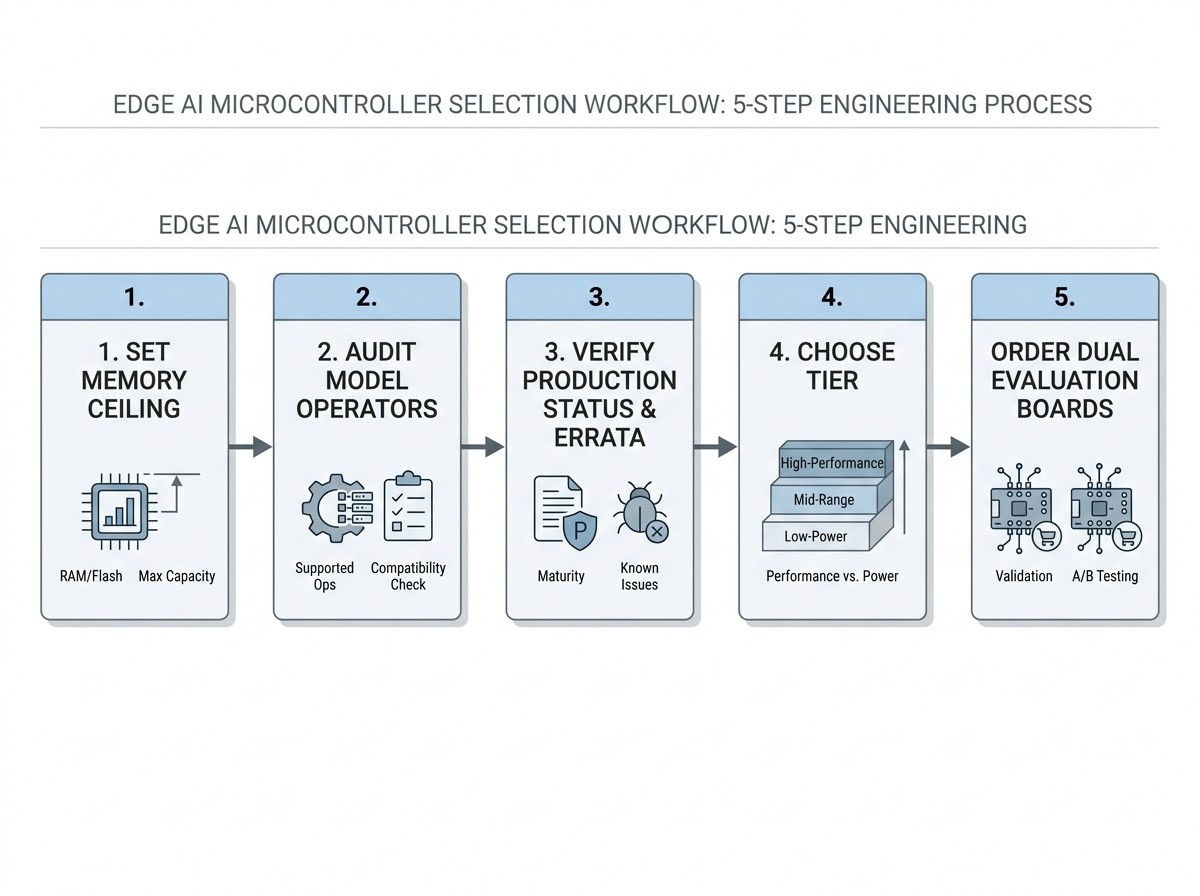
Set the hard memory ceiling. Decide whether the board can carry external flash and RAM at all. If it cannot, eliminate every part that requires them and cap model size to what fits on-chip once the runtime is linked.
Audit your model's operators. Extract the operator list from your quantised model and compare it against each candidate NPU's documented support. Drop any candidate that cannot accelerate a required operator without CPU fallback.
Verify production status and errata. Pull the current errata sheet for every shortlisted part, confirm whether the stepping is final, and check lead times with a distributor. Carry at most one preproduction part, and only if the schedule can absorb a stepping change.
Choose the tier. Map the application to always-on, control-plus-inference or vision. The memory ceiling and operator audit will already have narrowed the field; the tier makes the final cut explicit.
Order evaluation boards for two candidates, not one. Bench your model on both, measuring inference latency, power during inference, and how much friction the toolchain adds from model import to flashing. The difference between a clean flow and a week of linker-script debugging is invisible on paper.
Frequently Asked Questions
Why should I not rank edge AI microcontrollers by TOPS or GOPS?
Because the figures are not the same measurement. Vendors differ on whether a multiply-accumulate counts as one operation or two, which alone can double a number; they clock configurable NPU IP differently; they assume different data types; and peak figures assume the NPU executes the entire model graph. Benchmark your own model on an evaluation board instead.
What is the real memory constraint when deploying a model on an MCU?
On-chip RAM, usually. It has to hold the quantised weights, the peak activation tensors, the framework runtime, and everything the application needs that is not inference. Estimate all four before choosing a part.
What happens when an NPU does not support an operator in my model?
That operator falls back to the CPU. The failure is silent rather than loud, which is what makes it dangerous — latency and power both degrade, and on a part with a smaller CPU core the NPU's advantage can vanish completely. Audit operator coverage before selecting silicon.
How does a part with no internal flash change the board design?
The STM32N6 is the clearest example: with 4.2 MB of RAM and no internal flash, code and weights must sit in external memory over a high-speed interface. That means extra BOM components, more board area, a revised power sequence, and a boot path that depends on an external device.
When is an NPU unnecessary?
When classical DSP or a state machine already solves the problem; when the model meets its latency budget on a Helium-capable CPU with CMSIS-NN; when the inference duty cycle is so low that static leakage outweighs the efficiency gain; when the model needs precision the NPU does not support; or when nobody on the team owns the model's ongoing maintenance.
References
TI expands microcontroller portfolio and software ecosystem to enable edge AI in every device — Texas Instruments, March 10, 2026
STM32N6 series — STMicroelectronics product page
eIQ Neutron Neural Processing Unit — NXP product page
RA8P1: 1 GHz Arm Cortex-M85 and Ethos-U55 NPU based AI microcontroller — Renesas product page
How to choose an edge AI device — Edge Impulse documentation
 UTMEL
UTMEL
We are the professional distributor of electronic components, providing a large variety of products to save you a lot of time, effort, and cost with our efficient self-customized service. careful order preparation fast delivery service
 Getting Started with Arduino: What is Arduino and How to Use Arduino BoardsUTMEL28 September 20237149
Arduino is an open-source electronics platform that includes software and programmable circuit boards, allowing beginners to build electronic projects by writing simple code. The article provides an overview of Arduino, including different board types, basic components, how to use the boards, and project ideas like an automated plant watering system.
Read More IoT Chips Lead Time 2026: Navigating MCU, PMIC, and Sensor ShortagesUTMEL15 July 2026738
Navigating component supply and allocation challenges in the 2026 IoT market. This procurement trend brief provides electronics engineers and component sourcing teams with a data-driven analysis of the IoT chips lead time 2026 landscape, detailing supply bottlenecks and alternative design strategies.
Read More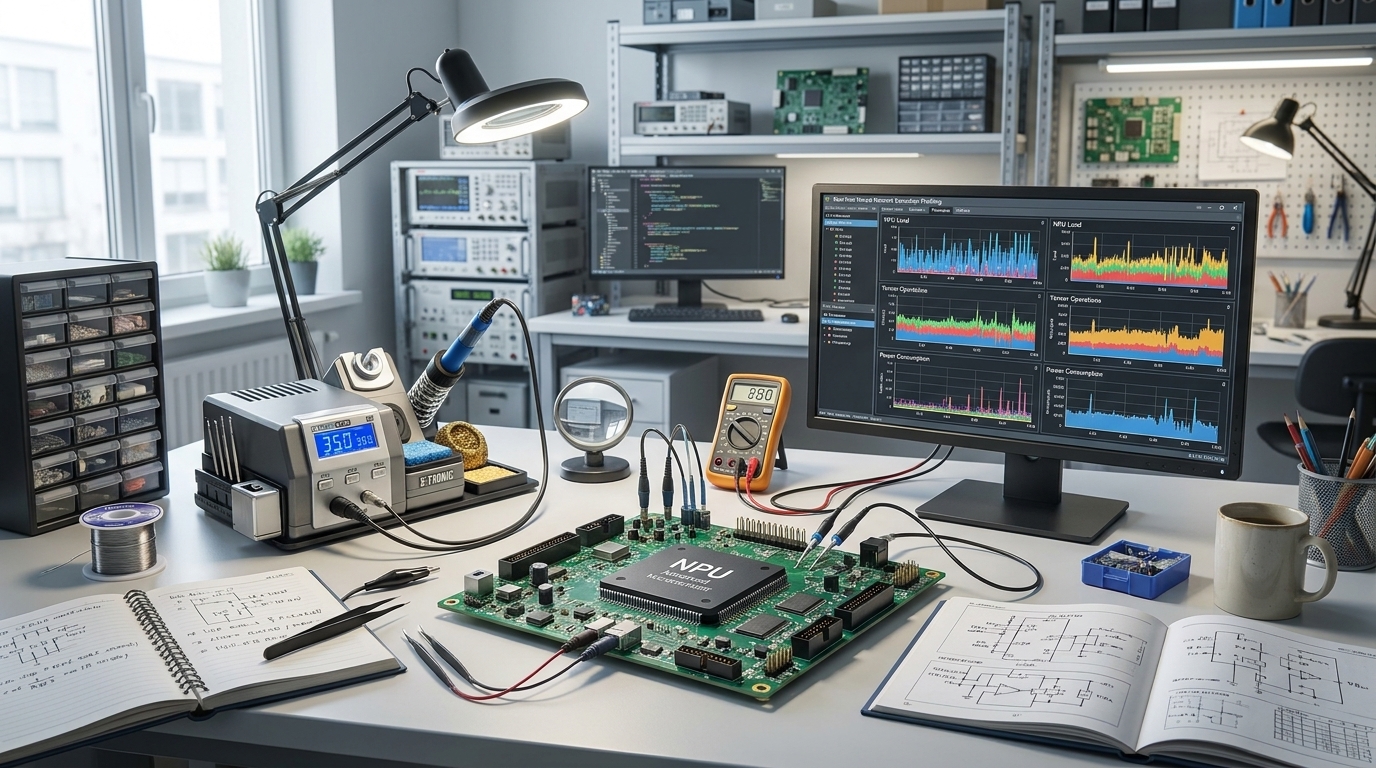 MCU with Built-in NPU: How to Pick an Edge AI Microcontroller in 2026UTMEL30 July 20261152
Evaluating Edge AI microcontrollers requires looking beyond vendor-quoted TOPS metrics. This guide explains how to segment candidate parts into sensor, control, or vision tiers, calculate binding SRAM constraints, verify NPU operator support to avoid CPU fallbacks, and navigate production lifecycle risks. Follow a practical five-step engineering sequence to benchmark real models on physical evaluation boards.
Read More Top 5 Microcontrollers Defining IoT, Edge AI, and Power Efficiency in 2026: Sourcing and Selection GuideUTMEL15 August 2026587
This guide reviews the top five microcontrollers defining 2026 embedded designs—ESP32-S3, STM32U5, MSPM0G5187, CH32V003, and nRF54. It evaluates how contiguous SRAM limits, power duty cycling, and hardware acceleration impact edge AI and IoT performance. It also details strategic procurement methods for navigating mature-node supply chain risks, dual-footprint layouts, and component authentication.
Read More Arduino vs. Raspberry Pi: A Detailed ComparisonUTMEL24 April 20255762
Hello everyone, welcome to the new post today.This guide is going to talk in detail about Arduino vs. Raspberry Pi to clarify their differences and help you pick the right board based on your needs.
Read More
Subscribe to Utmel !
![SFCA040GH1AO2TO-I-6B-21P-STD]() SFCA040GH1AO2TO-I-6B-21P-STD
SFCA040GH1AO2TO-I-6B-21P-STDSwissbit
![SFSD016GN1AM1TO-E-ZK-22P-STD]() SFSD016GN1AM1TO-E-ZK-22P-STD
SFSD016GN1AM1TO-E-ZK-22P-STDSwissbit
![SFCF0256H1AF1TO-I-MS-523-STD]() SFCF0256H1AF1TO-I-MS-523-STD
SFCF0256H1AF1TO-I-MS-523-STDSwissbit
![SFCF0032H1BK1WI-C-MS-513-STD]() SFCF0032H1BK1WI-C-MS-513-STD
SFCF0032H1BK1WI-C-MS-513-STDSwissbit
![SFCF016GH1AF4TO-I-MS-523-STD]() SFCF016GH1AF4TO-I-MS-523-STD
SFCF016GH1AF4TO-I-MS-523-STDSwissbit
![SFUI1024J2AB1TO-I-MS-2A1-STD]() SFUI1024J2AB1TO-I-MS-2A1-STD
SFUI1024J2AB1TO-I-MS-2A1-STDSwissbit
![SFCF0256H1BK1WI-C-MS-513-STD]() SFCF0256H1BK1WI-C-MS-513-STD
SFCF0256H1BK1WI-C-MS-513-STDSwissbit
![MTA16ATF4G64HZ-3G2E2]() MTA16ATF4G64HZ-3G2E2
MTA16ATF4G64HZ-3G2E2Micron Technology Inc.
![MTA4ATF1G64HZ-3G2F1]() MTA4ATF1G64HZ-3G2F1
MTA4ATF1G64HZ-3G2F1Micron Technology Inc.
![SDCIT2/8GB]() SDCIT2/8GB
SDCIT2/8GBKingston