Product
 Brand
Brand Articles
 Tools
Tools
Smartphone RF Chips Availability Forecast 2026: Lead-Time Risks and Alternatives
Procurement teams navigating the 2026 semiconductor market must separate consumer-facing marketing hype from component-level supply realities. While the broader semiconductor market is projected to reach $975 billion in 2026—accelerating to a 26% year-on-year growth rate—generative AI chips alone account for roughly $500 billion of this total, representing over half of all global chip sales. This massive capital concentration has created a dual-track supply chain where high-margin data center chips are absorbing global foundry capacity, indirectly threatening mobile production even when RF silicon itself remains relatively stable.
For electronics engineers and component sourcing teams, the primary challenge is not necessarily a direct shortage of RF wafers, but rather the "AI Cannibalization" effect. High-margin AI infrastructure is absorbing advanced packaging and wafer capacity, leaving consumer electronics manufacturers, particularly mid-tier and budget smartphone OEMs, facing severe Bill of Materials (BOM) cost pressures.
The 2026 Semiconductor Landscape: Separating AI Hype from RF Reality
The dominant narrative in the electronics industry centers on the explosive growth of artificial intelligence. However, many industry reports conflate device-level marketing ("AI Phones" and "AI PCs") with component-level realities. While tech giants heavily promote on-device AI capabilities to stimulate consumer demand, the underlying silicon supply chain tells a different story.
The downturn in personal electronic device shipments is being fueled by intense demand for memory chips from artificial intelligence infrastructure. Major technology companies are investing heavily in data centers, absorbing large shares of global memory supply. Consequently, chip manufacturers are intentionally prioritizing high-margin, hyper-scale data center clients over consumer electronics manufacturers. This has tightened inventories and pushed up input costs across the board.
This supply-side squeeze has created a stark divide in the market, often referred to as the "Survival of the Biggest." Massive players like Apple and Samsung are largely insulated from the worst of this crisis. Their immense scale, pricing power, and tight supply chain control allow them to secure components (whether memory or RF) that smaller vendors cannot.
In contrast, mid-tier and budget device manufacturers face severe BOM cost pressures. To survive the component price hikes, manufacturers are heavily pivoting their product roadmaps toward mid-range and premium models. The profit margins on these devices are thick enough to absorb the rising cost of internal chips, whereas smaller vendors may be forced to completely abandon the entry-level smartphone segment by 2026.
Current Lead Times for Smartphone RF Chips (2026 Outlook)
As of mid-2026, standard RF components and specialized RF packaging are experiencing reported lead times of approximately 16 to 26 weeks. While these lead times are stretched compared to historical averages, they remain relatively stable compared to the 40+ week delays seen in programmable logic and advanced AI silicon.
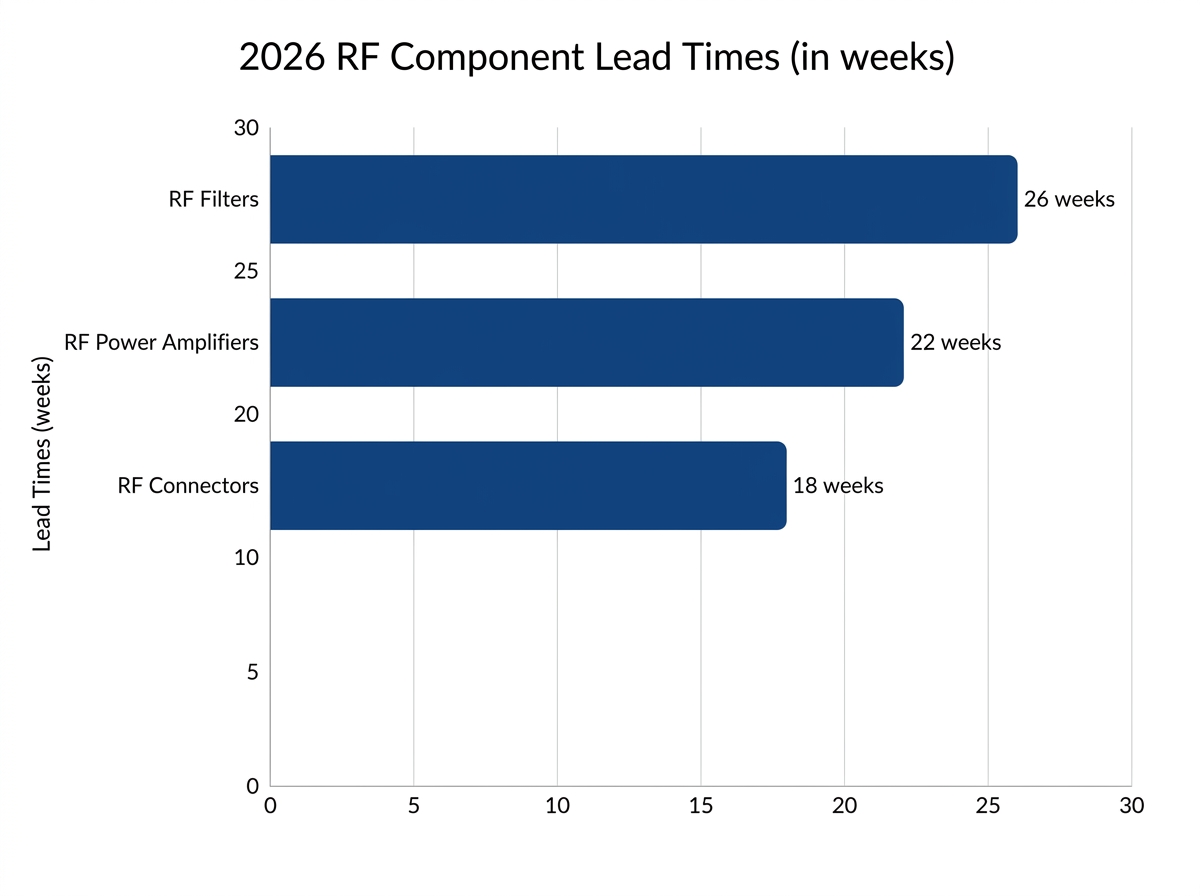
Understanding the specific lead times for individual components within the RF front-end (RFFE) is critical for accurate production scheduling:
RF Power Amplifiers: These active components are critical for signal transmission. When sourcing an RF power amplifier, procurement teams should expect lead times to hover around the 18-to-22-week mark, depending on the specific frequency bands and power ratings required.
RF Connectors: Physical board integration remains stable, but high-frequency applications require specialized connectors. Understanding the basic introduction to RF connector types is essential for engineers looking to design in multi-sourced alternatives early in the product lifecycle.
RF Filters: SAW (Surface Acoustic Wave) and BAW (Bulk Acoustic Wave) filters are experiencing the tightest constraints within the RFFE, with lead times pushing toward the 24-to-26-week upper limit. Selecting the right RF filter technology is crucial, as high-performance 5G bands require specialized substrates that are currently in short supply.
While the smartphone RF chips lead time 2026 remains manageable compared to advanced logic, buyers must treat these figures as industry benchmarks rather than guaranteed delivery windows. Actual lead times vary significantly by specific part number and manufacturer allocation. Recent industry forecasts underestimated the severity of the shortage, which has worsened in recent months, meaning current lead-time projections for 2026 may still be too optimistic.
How AI Accelerator Chip Demand Impacts Mobile Supply Chains
The surge in AI data center demand is indirectly pressuring mobile supply chains through memory allocation and advanced packaging bottlenecks. Even if RF chips are available within a 16-to-26-week window, a smartphone cannot ship without memory and advanced packaging.
Producing 1 GB of High Bandwidth Memory (HBM) for AI data centers consumes roughly three times the wafer capacity of standard LPDDR5X mobile memory. This has triggered a memory "supercycle," causing mobile DRAM and NAND prices to surge an estimated 70% to over 100% quarter-over-quarter in Q2 2026, pushing memory's share of the smartphone BOM from 15% to 25%. This capacity squeeze is driven by the relentless demand for high-performance AI accelerators, which are monopolizing advanced packaging lines and wafer allocation at leading foundries.
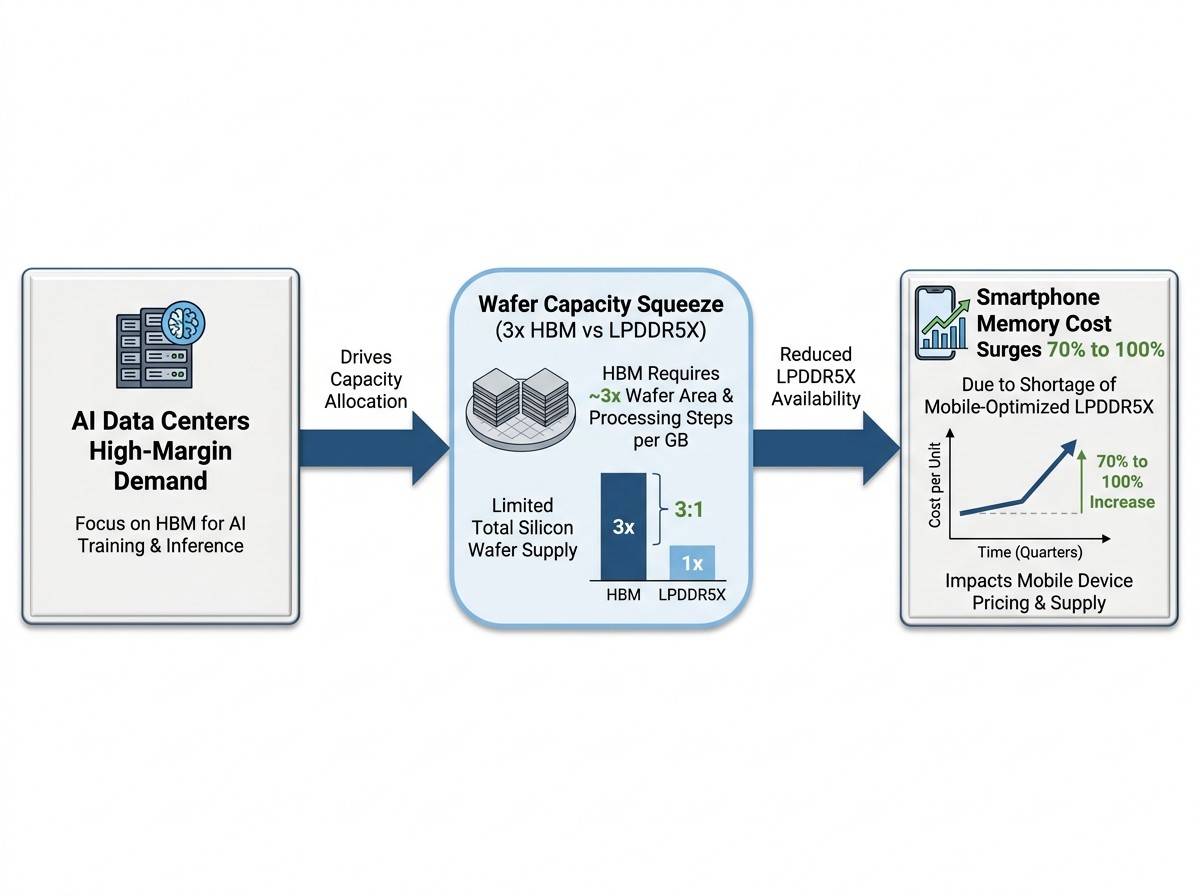
This bottleneck extends beyond memory. The AI PC chips lead time 2026 and AI accelerator chips lead time 2026 are stretching past 40 weeks, creating a ripple effect across the entire semiconductor ecosystem. The AI accelerator chips trends 2026 show that as on-device AI becomes a standard marketing requirement, smartphone OEMs are forced to compete for the same advanced node capacity (3nm/4nm/5nm) used by data center accelerators, further squeezing the availability of advanced mobile SoCs and co-packaged RF front-end modules.
Global Smartphone Market Faces Record Slump In 2026 Amid Chip Shortage | WION
Alternative Sourcing Options for RF Front-End (RFFE) Components
To mitigate supply chain friction, procurement teams are diversifying away from single incumbents (like Broadcom, Skyworks, Qorvo, and Murata) and leveraging specialized nodes like RF-SOI and FD-SOI.
A significant share of semiconductor market value is concentrating in specialized nodes like RF-SOI and FD-SOI, which are critical for 5G mmWave and IoT edge AI because they offer superior power efficiency, lower latency, and higher RF integration compared to traditional bulk CMOS.
When evaluating alternative sourcing options, engineers must utilize a strict validation checklist, as "drop-in replacements" for RF components rarely exist without engineering overhead:
Datasheet Verification Checklist
Pin-to-pin compatibility: Ensure alternative RF switches or filters match the exact footprint of the primary component.
Thermal performance: Verify that alternative power amplifiers can handle the same thermal dissipation without degrading signal integrity.
Frequency band support: Confirm that alternative filters cover the exact frequency bands required for regional carrier compliance.
Alternative Sourcing for Edge AI and Accelerator Chips
As mobile devices integrate more AI, sourcing merchant silicon becomes risky. Compare off-the-shelf NPUs with alternative architectural approaches.
2026 AI Compute Sourcing Matrix
| Sourcing Option | Performance | Supply Risk | Upfront Cost | Best For |
|---|---|---|---|---|
| Merchant Silicon | High | High | Low | Standard high-volume devices |
| Custom ASICs | Optimized | Low (Controlled) | High | Premium proprietary hardware |
| IP Licensing (ARM, RISC-V) | Flexible | Low | Medium | Custom SoC integration |
While custom ASICs and IP licensing offer total supply control, they require significant in-house design expertise and upfront engineering costs. For most mid-tier OEMs, the practical path forward involves multi-sourcing merchant silicon and working with independent distributors to secure allocation.
Procurement Strategies for Electronics Engineers in 2026
To navigate the volatile 2026 landscape, procurement teams must shift from Just-In-Time (JIT) to Just-In-Case (JIC) inventory models for high-risk BOM items.
During allocation periods, the risk of encountering counterfeit or substandard parts in the gray market increases significantly. Sourcing teams must rely on independent, certified distributors to access the spot market safely.
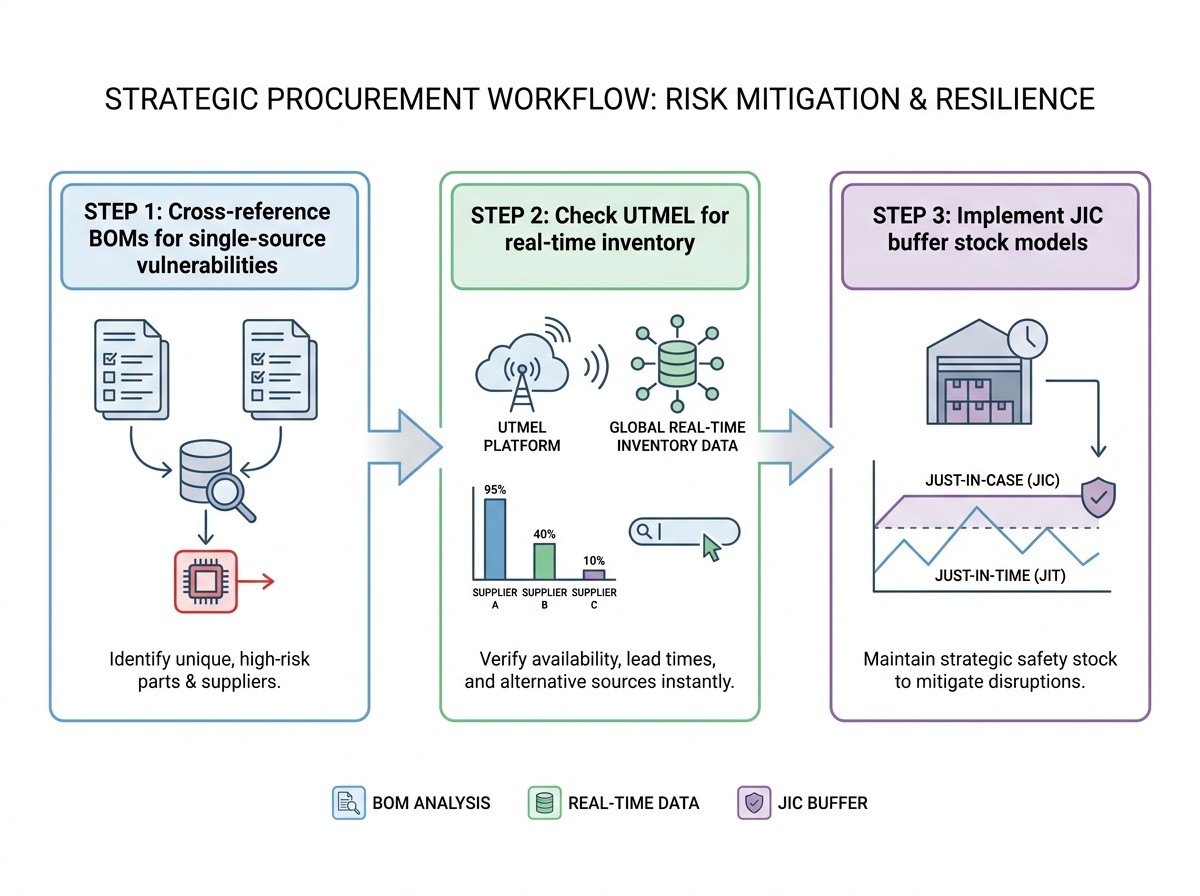
3-Step Mitigation Checklist
Cross-reference BOMs: Identify single-source vulnerabilities in your RF front-end and memory configurations.
Check Real-Time Availability: Use UTMEL to perform instant availability and price checks by specific part number.
Leverage Alternative Sourcing: Partner with UTMEL to source alternative processors, RF front-end components, image sensors, and memory to keep production lines running.
Frequently Asked Questions (FAQ)
What is the forecast for smartphones in 2026?
Worldwide smartphone shipments are forecast to decline 13.9% year-on-year in 2026 to 1.09 billion units, marking the steepest annual contraction on record due to acute memory supply constraints and rising component costs.
What company makes AI accelerator chips for edge devices?
Traditional mobile SoC makers like Qualcomm and MediaTek are expanding their portfolios to offer specialized edge AI accelerators, alongside custom IP providers like ARM and RISC-V design houses.
Why are budget smartphones most at risk in 2026?
Because essential chips make up a disproportionately large percentage of the total Bill of Materials (BOM) in cheap phones, rising component costs (particularly memory) destroy their profitability, forcing smaller vendors to abandon the entry-level segment.
Sources and references used for this guide
2025 Mobile Outlook Report
Source type: industry institution
Used for: Benchmark data indicating RF lead times averaging 14 weeks.
Caution: Market research forecast; actual lead times vary by specific part number.Q2 2026 Smartphone Memory Trends: DRAM &
Source type: industry institution
Used for: Context on how memory trends and component delays impact smartphone shipments.
Caution: Forecast data subject to market changes.Powering 5G RF, IoT Basebands & Edge AI
Source type: reputable professional source
Used for: Technical background on RF-SOI and FD-SOI technologies in 5G ecosystems.
Caution: Used for technical context, not real-time pricing/stock.2026 Global Semiconductor Industry Outlook
Source type: reputable professional source
Used for: Macro-level semiconductor industry trends for 2026.
Caution: Broad industry overview; does not guarantee specific component availability.
 UTMEL
UTMEL
We are the professional distributor of electronic components, providing a large variety of products to save you a lot of time, effort, and cost with our efficient self-customized service. careful order preparation fast delivery service
 HDMI RF Modulators: Architecture, Setup, Types, and Commercial ApplicationsUTMEL18 May 2026819
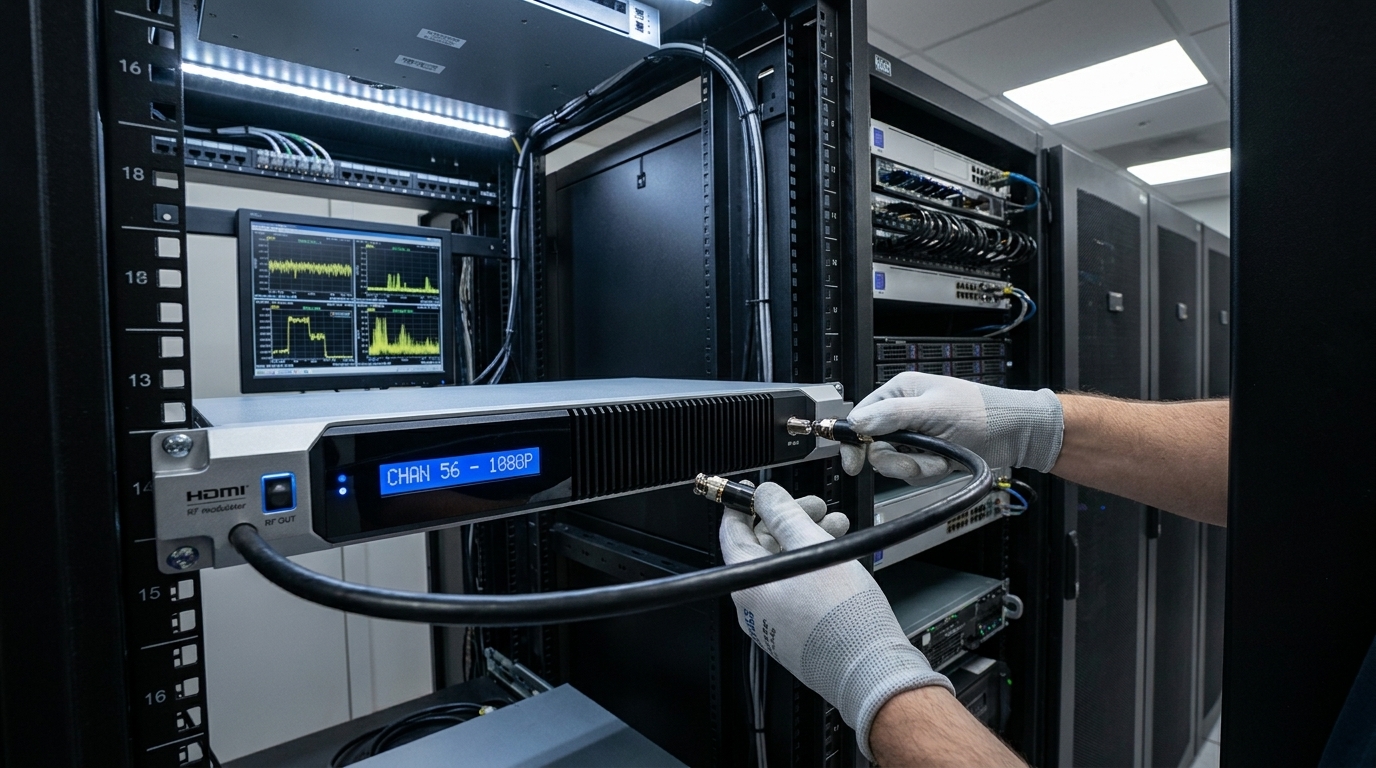
An HDMI RF modulator is a specialized hardware device designed to encode and modulate baseband digital audio and video signals into radio frequency (RF) formats. By converting an HDMI source into an RF signal, these devices allow high-definition content to be distributed over standard coaxial cable infrastructure.
Read More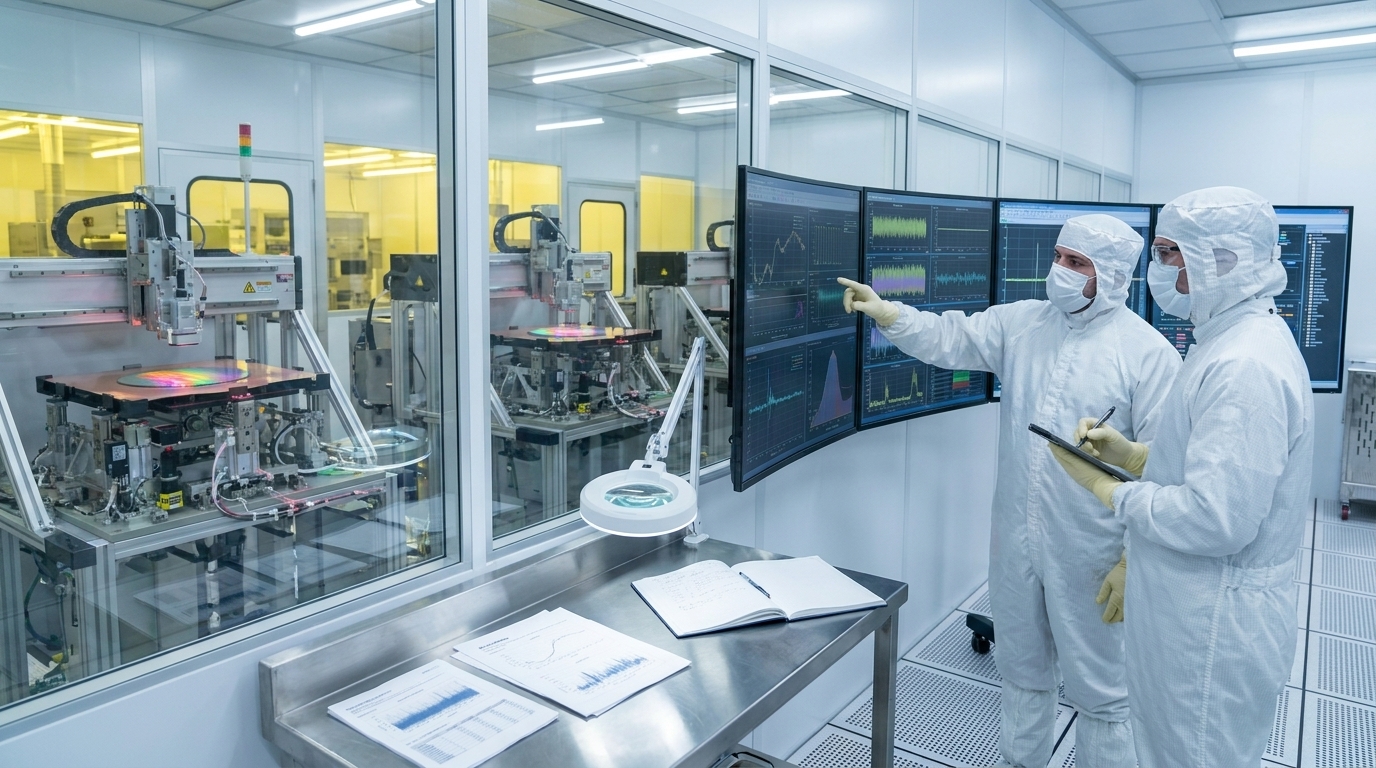 Smartphone RF Chips Availability Forecast 2026: Lead-Time Risks and AlternativesUTMEL14 July 2026504
In 2026, the smartphone supply chain faces intense pressure as generative AI chips monopolize wafer and packaging capacity. Consequently, mobile manufacturers endure rising BOM costs and a projected 13.9% drop in shipments. While RF front-end lead times hover at 16 to 26 weeks, procurement teams must adopt multi-sourcing strategies, leverage specialized nodes like RF-SOI, and transition to "Just-in-Case" inventory models to survive.
Read More Explain in Detail the Three Sharp Weapons to Eliminate EMC: Capacitors/Inductors/Magnetic BeadsUTMEL24 December 20214977
Filter capacitors, common mode inductors, and magnetic beads are all typical components in EMC design circuits, and they're the three main tools for reducing electromagnetic interference.The notion of removing the three principal EMC weapons from the design is examined in-depth in this article.
Read More Everything You Need to Know about RF ChipUTMEL14 January 202621616
RF chip is one of the most important cores of cell phone terminals. The RF chip is responsible for RF transceiver, frequency synthesis, and power amplification.
Read More What are Electromagnetic Waves?UTMEL07 December 20215822
Hello everyone, I am Rose. Today I will introduce Electromagnetic waves to you. Electromagnetic waves are a type of electromagnetic energy.It can be considered the most perfect signal carrier because it can be carried without restriction in open space, as well as through metal transmission lines and controlled freely.
Read More
Subscribe to Utmel !
![AEDT-9810-Z00]() AEDT-9810-Z00
AEDT-9810-Z00Broadcom Limited
![MT9V126IA3XTC-DR]() MT9V126IA3XTC-DR
MT9V126IA3XTC-DRON Semiconductor
![3315Y-001-016L]() 3315Y-001-016L
3315Y-001-016LBourns Inc.
![E2J-JC4A]() E2J-JC4A
E2J-JC4AOmron Automation and Safety
![NOIP1SN5000A-QDI]() NOIP1SN5000A-QDI
NOIP1SN5000A-QDION Semiconductor
![MT9T031C12STC-DP]() MT9T031C12STC-DP
MT9T031C12STC-DPON Semiconductor
![AR0134CSSC00SUEA0-DPBR]() AR0134CSSC00SUEA0-DPBR
AR0134CSSC00SUEA0-DPBRON Semiconductor
![NOIP1SN0500A-QDI]() NOIP1SN0500A-QDI
NOIP1SN0500A-QDION Semiconductor
![OV07675-A23A]() OV07675-A23A
OV07675-A23AOmniVision Technologies Inc
![AR0144CSSM20SUKA0-CRBR1]() AR0144CSSM20SUKA0-CRBR1
AR0144CSSM20SUKA0-CRBR1ON Semiconductor