

 Product
 Brand
Brand Articles
 Tools
Tools
RG6 VS RG59: Who is the winner?



RG6 versus RG59 appears to be a popular comparison among coaxial cable buyers. That is correct. The two most widely used coax wires are RG6 and RG59. Which one do you think you should pick? It depends on how you intend to use it. As a result, understanding the differences between RG6 and RG59 cables is critical for making the best decision. What's the difference between an RG6 cable and an RG59 cable? Allow Magi to educate you on the differences between RG6 and RG59 coax.

The difference between RG59 & RG6 coax cables
Introduction
Coaxial cables, sometimes known as 'coax,' are the most common cables used in video and satellite installations. The RG59 and RG6 cables are two types of cables that can be used for various applications. The biggest difference between the two is the size of the RG6, which is larger than the RG59. The RG6 cable's inner conductor core is thicker, as is the shielding within the rubber sheath.
What is a Coaxial Cable?
It's a form of copper wire with a metal shield or other such components. This cable's purpose is to keep interference out of the cable. This cable is mostly used to connect a satellite antenna to a television set. There are several variants of this cable, but we'll focus on the RG6 and RG59 coaxial cables in this post.
What is RG?
RG ratings are used to differentiate between different types of coaxial cables. The acronym RG stands for "radio guide," a long-forgotten military word. The number identifies the various cable specifications, however, it is assigned at random, so don't expect any sort of order in the numbers. There have been dozens of coaxial cables developed throughout the years, but the only ones that most people need to worry about are RG 6 and RG 59 cables, so we'll focus on those two types here.
Overview of RG6
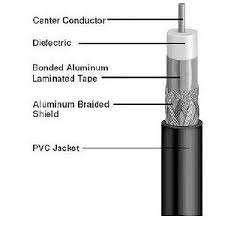
The RG6 cable was created with higher data frequency needs in mind. Because of its bigger conductor, this cable provides greater signal quality. It has a copper center conductor of 18 AWG. Satellite and internet transmissions are compatible with this connection. The thicker dielectric insulation on RG6 coaxial is also present. It has a particular type of shielding that can tolerate signals at Gigahertz frequencies. Both foil and braided shielding are used in RG6,
Overview of RG59

RG59 has been around for a long time. This wire was used to connect televisions. This cable can still be found in most older homes and commercial structures. The copper wire conductor of the RG59 coax cable is 20 AWG. Because this cable has a smaller conductor, it cannot provide the same signal quality as RG6. Its shielding also fails to keep Gigahertz-level signals contained within the cables. This cable became practically obsolete as a result of all of these issues.
The insulation of the RG59 cable is braided. It's made for megahertz interference with lengthy waveforms. Because of this, it's ideal for low-frequency communications. It's suitable for anything with a frequency of less than 50MHz.
Properties of RG6 cables:
1. RG6 cables are made of foil shields and braided aluminum shields.
2. They have better insulation properties.
3. The inner conductor is thicker at the 18 AWG copper center. This helps RG6 cables provide more extended distance proficiency and better bandwidth.
4. The frequency range is better, which means if you are looking for a cable to serve the purpose of a higher frequency range, RG6 is your answer.
5. RG6 cables have low attenuation even though the cables are long.
6. Problems with RG6 come when you need them to work below 50 Mhz. They are not efficient in this case and you will need to use RG59. But these cables work better with frequencies over 50Mhz.
7. Fewer signal loss problems are reported with RG6.
Properties of RG59 cables:
1. RG59 cables are made of 95% copper shields, which helps them block RFI inclusion.
2. Insulation is not as good as RG6 cables.
3. The inner conductor of RG59 cables is a thin – 20 AWG copper center. This makes its diameter smaller than RG6.
4. The frequency range is lower. RG6 can work even with 3Ghz, but RG59 may start showing inefficiency upon touching 2 GHz.
5. If you need to work below 50 Mhz, RG59 is the way to go.
6. RG6 provides lower attenuation when compared to RG59. This is a significant drawback for RG59 cables.
Different applications of RG6 vs RG59
According to the description above, we know that RG6 and RG59 are used for different purposes. Let’s make it in detail.
1.RG6: Satellite DSS applications, CATV
2. RG59: Plasma TV, component video, video projectors, and other baseband video applications, CCTV. One cannot use these cables for satellite feeds because they do not have foil shields.
RG59 vs RG6: Signal Loss
What is the difference in signal loss between RG6 and RG59 coax cable? The shielding has something to do with signal loss. A cable's shielding can help to ensure optimum signal quality. The better the signal shielding, the less signal interference. Braided Mesh and Foil shielding are the most common types of shielding found in coaxial cables.
Both forms of shielding are used in RG6 cables to prevent signal interference. However, some RG59 cables are only shielded on one side. As a result, RG6 cables often have lesser signal loss than RG59 cables.
Furthermore, signal loss is proportional to transmission distance. The farther the cables are run, the greater signal loss occurs. In comparison to RG59 cables, RG6 cables can transport signals over longer distances while maintaining superior signal quality. As a result, RG6 cables are typically used for high-frequency applications such as television connections, whereas RG59 cables are better suited to low-frequency and short-distance transmission.
As a result, the graphic below might help you better comprehend the topic of coax RG6 versus RG59 on signal loss. It compares the signal loss of RG6 and RG59 at various frequencies.
| Frequency | 50Mhz | 100Mhz | 400Mhz | 900Mhz | 1000Mhz |
| RG6 | 1.5dB | 2.0dB | 4.3dB | 6.8dB | 7.0dB |
| RG59 | 2.4dB | 3.4dB | 7.0dB | 11.1dB | 12.0dB |
RG6 vs RG59 Cable: How To Tell?
What is the difference between RG6 and RG59 coax cables? There are messages on the PVC jacket of each coaxial cable if you look closely. It aids in determining whether this is an RG6, RG11, or RG59 coax cable. However, if the type names are overlooked, the cables may not be qualified or professional. These coaxial wires should not be purchased.
Another technique to distinguish between RG6 and RG59 coax cables is to compare their diameters. RG6 has a 6.90mm outer diameter, while RG59 has a 6.15mm outer diameter. Because it has a thicker center conductor, RG6 wire is thicker than RG59 cable. You'll see the difference when you separate the two cords.
Conclusion
RG6 cable has stronger insulation and greater shielding than RG5 cable. It's best for high-bandwidth or high-frequency communications like the Internet, Cable TV, and Satellite TV. If you're not sure which cable to choose, RG6 is the best option.
RG59 cable is thinner and less shielded than RG6 cable. Only low bandwidth and low-frequency applications, such as CCTV installations, are recommended.
Is RG6 superior to RG59?
In comparison to RG59 cables, RG6 cables can transport signals over longer distances while maintaining superior signal quality. As a result, RG6 cables are typically used for high-frequency applications such as television connections, whereas RG59 cables are better suited to low-frequency and short-distance transmission.
What does the abbreviation RG59 mean?
In the Joint Electronics Type Designation System of the United States military, RG (for radio guide) was initially a unit indicator for bulk radio frequency (RF) cable. The suffix /U denotes that the item is intended for general utility use. The number 59 was assigned in a certain order.
Is it possible to utilize RG6 for CCTV?
RG6 can be utilized for video surveillance. It's also available with a solid copper core / inner conductor and copper braiding that's 95 percent copper. RG6 can be run longer distances without losing visual quality than RG59, but it is a thicker, more stiff cable that is less practical to deal with (especially around corners).
Which coaxial cable has the least amount of signal loss?
For long cable lines (more than 100 feet), Cable Type 400 or even better Cable Type 600 Low Loss Coaxial Cable is the best option for minimizing signal loss due to cabling.
Is it possible to utilize RG59 cable for satellite?
A crimped-on or twisted-on connector is frequently an indicator of an RG59 cable, simply because this type of connector isn't common anymore, and RG59 cable isn't either. Crimp and twist-on connections can be used on RG6 cables, however, they are not suitable for satellite television.
 STM32F407ZET6 Microcontroller: Features, Applications and Datasheet
24 November 20237331
 ADA4622-4 Precision Op-Amp: Features, Pinout and Datasheet
13 December 20211545
 LM2936M-5.0 Voltage Regulator: Pinout, Specification, and Datasheet
25 June 20212450
 Exploring the STM32F103x8 and STM32F103xB Series Microcontrollers by STMicroelectronics
29 February 20241851
 LM324D Operational Amplifier: Pinout, Features and Datasheet
12 May 20215910
 STM32H743I-EVAL: Specifications, Features and Applications
23 July 2025602
 BTA16-600B Triacs: BTA16-600B Datasheet PDF, Pinout, Circuit
22 April 202236345
 Comprehensive Guide to XC7Z010-1CLG400C Specifications and Features
21 February 20251563
 TSMC's Global Distribution
25 March 20223853
 How to Find the Ideal Voltage Reference for Your Application
11 July 20251309
 Solid State Relay Basics: Working, Features and Structure
17 September 202010105
 Flyback Diode Relay Selection: How to Choose the Right Diode for a Relay Coil
11 June 20261392
 The Introduction of Oscilloscope Probes
11 January 20228062
 What is Chiplet?
17 November 20214370
 7 Promising Semiconductor Stocks Amid U.S.-China Chip War
18 September 20234274
 Top 10 Technology Trends in the Global Semiconductor Industry in 2022
08 January 20229315
Belden Inc.
In Stock
United States
China
Canada
Japan
Russia
Germany
United Kingdom
Singapore
Italy
Hong Kong(China)
Taiwan(China)
France
Korea
Mexico
Netherlands
Malaysia
Austria
Spain
Switzerland
Poland
Thailand
Vietnam
India
United Arab Emirates
Afghanistan
Åland Islands
Albania
Algeria
American Samoa
Andorra
Angola
Anguilla
Antigua & Barbuda
Argentina
Armenia
Aruba
Australia
Azerbaijan
Bahamas
Bahrain
Bangladesh
Barbados
Belarus
Belgium
Belize
Benin
Bermuda
Bhutan
Bolivia
Bonaire, Sint Eustatius and Saba
Bosnia & Herzegovina
Botswana
Brazil
British Indian Ocean Territory
British Virgin Islands
Brunei
Bulgaria
Burkina Faso
Burundi
Cabo Verde
Cambodia
Cameroon
Cayman Islands
Central African Republic
Chad
Chile
Christmas Island
Cocos (Keeling) Islands
Colombia
Comoros
Congo
Congo (DRC)
Cook Islands
Costa Rica
Côte d’Ivoire
Croatia
Cuba
Curaçao
Cyprus
Czechia
Denmark
Djibouti
Dominica
Dominican Republic
Ecuador
Egypt
El Salvador
Equatorial Guinea
Eritrea
Estonia
Eswatini
Ethiopia
Falkland Islands
Faroe Islands
Fiji
Finland
French Guiana
French Polynesia
Gabon
Gambia
Georgia
Ghana
Gibraltar
Greece
Greenland
Grenada
Guadeloupe
Guam
Guatemala
Guernsey
Guinea
Guinea-Bissau
Guyana
Haiti
Honduras
Hungary
Iceland
Indonesia
Iran
Iraq
Ireland
Isle of Man
Israel
Jamaica
Jersey
Jordan
Kazakhstan
Kenya
Kiribati
Kosovo
Kuwait
Kyrgyzstan
Laos
Latvia
Lebanon
Lesotho
Liberia
Libya
Liechtenstein
Lithuania
Luxembourg
Macao(China)
Madagascar
Malawi
Maldives
Mali
Malta
Marshall Islands
Martinique
Mauritania
Mauritius
Mayotte
Micronesia
Moldova
Monaco
Mongolia
Montenegro
Montserrat
Morocco
Mozambique
Myanmar
Namibia
Nauru
Nepal
New Caledonia
New Zealand
Nicaragua
Niger
Nigeria
Niue
Norfolk Island
North Korea
North Macedonia
Northern Mariana Islands
Norway
Oman
Pakistan
Palau
Palestinian Authority
Panama
Papua New Guinea
Paraguay
Peru
Philippines
Pitcairn Islands
Portugal
Puerto Rico
Qatar
Réunion
Romania
Rwanda
Samoa
San Marino
São Tomé & Príncipe
Saudi Arabia
Senegal
Serbia
Seychelles
Sierra Leone
Sint Maarten
Slovakia
Slovenia
Solomon Islands
Somalia
South Africa
South Sudan
Sri Lanka
St Helena, Ascension, Tristan da Cunha
St. Barthélemy
St. Kitts & Nevis
St. Lucia
St. Martin
St. Pierre & Miquelon
St. Vincent & Grenadines
Sudan
Suriname
Svalbard & Jan Mayen
Sweden
Syria
Tajikistan
Tanzania
Timor-Leste
Togo
Tokelau
Tonga
Trinidad & Tobago
Tunisia
Turkey
Turkmenistan
Turks & Caicos Islands
Tuvalu
U.S. Outlying Islands
U.S. Virgin Islands
Uganda
Ukraine
Uruguay
Uzbekistan
Vanuatu
Vatican City
Venezuela
Wallis & Futuna
Yemen
Zambia
Zimbabwe