

 Product
 Brand
Brand Articles
 Tools
Tools
Flyback Diode Relay Selection: How to Choose the Right Diode for a Relay Coil
Quick Answer
For most DC relay coils, choose a flyback diode with a reverse-voltage rating higher than the relay coil supply voltage and a forward-current rating at least equal to the relay coil current, with practical margin. A common general-purpose choice is a 1N400x rectifier diode, such as 1N4001 through 1N4007, when the relay is switched on and off at normal mechanical relay speeds.
Wire the diode in reverse bias across the relay coil: the cathode, usually marked by a stripe, goes to the positive side of the coil, and the anode goes to the switched low-side or ground side. In normal operation the diode does not conduct. When the relay is switched off, the coil’s stored magnetic energy forward-biases the diode and gives the current a safe path to decay.
The main trade-off is speed. A simple diode protects the switching transistor or microcontroller driver, but it can also slow relay release. If fast drop-out time matters, consider a Zener-assisted clamp or TVS diode instead of a plain diode, but only after checking the driver’s voltage rating.
What a Flyback Diode Does in a Relay Circuit
A relay coil is an inductor. When current flows through the coil, energy is stored in its magnetic field. When the switch, transistor, MOSFET, or driver IC turns the coil off, the coil tries to keep the current flowing. If there is no safe path for that current, the voltage can rise high enough to stress or damage the switching device, create arcing, or inject noise into nearby circuitry.
A flyback diode, also called a freewheeling diode or suppression diode, is placed across the relay coil so it is normally reverse-biased. When the coil is turned off, the voltage across the coil reverses, the diode conducts, and the coil current circulates through the diode-coil loop until the stored energy is dissipated.
In practical terms, the flyback diode is not there to “power” the relay. It is there to protect the driver and reduce the voltage spike created when the relay is de-energized.
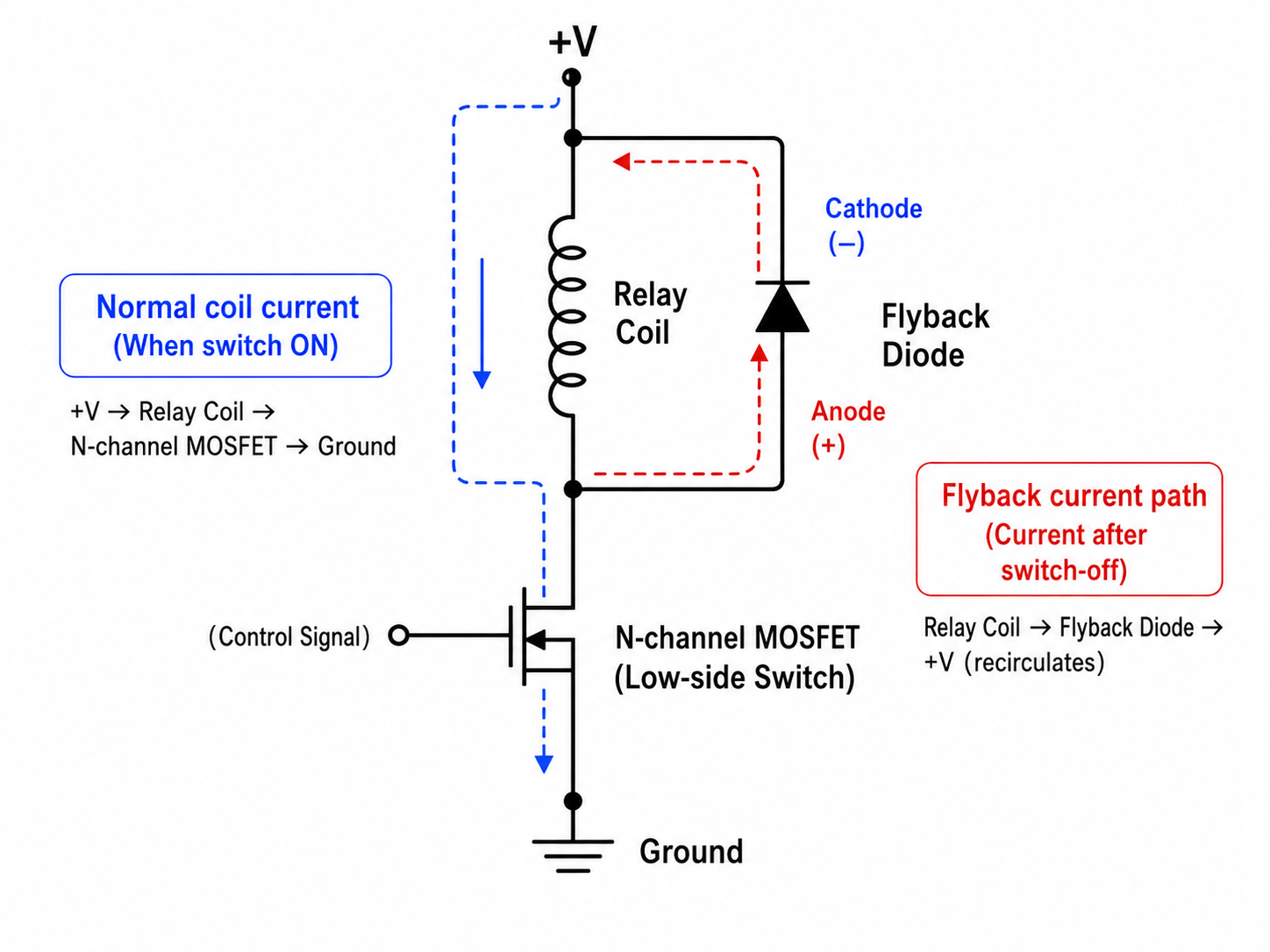
In a typical low-side relay driver circuit, the flyback diode is connected across the coil in reverse bias during normal operation.
Flyback Diode Relay Selection Framework
Before choosing a diode, collect four pieces of information:
Relay coil voltage
This is usually marked as 5V, 12V, 24V, or another DC coil voltage in the relay datasheet.Relay coil current or coil resistance
If the datasheet gives coil current, use that value. If it gives coil resistance, estimate coil current with:coil current = coil voltage / coil resistanceSwitching frequency and control method
A relay switched occasionally by a transistor is different from an inductive load driven with PWM. For normal relay switching, diode recovery speed is usually not the first concern.Release-time requirement
A plain diode clamps the coil at a low voltage, which protects the driver but allows current to decay more slowly. If the relay must release quickly, the clamp method matters.
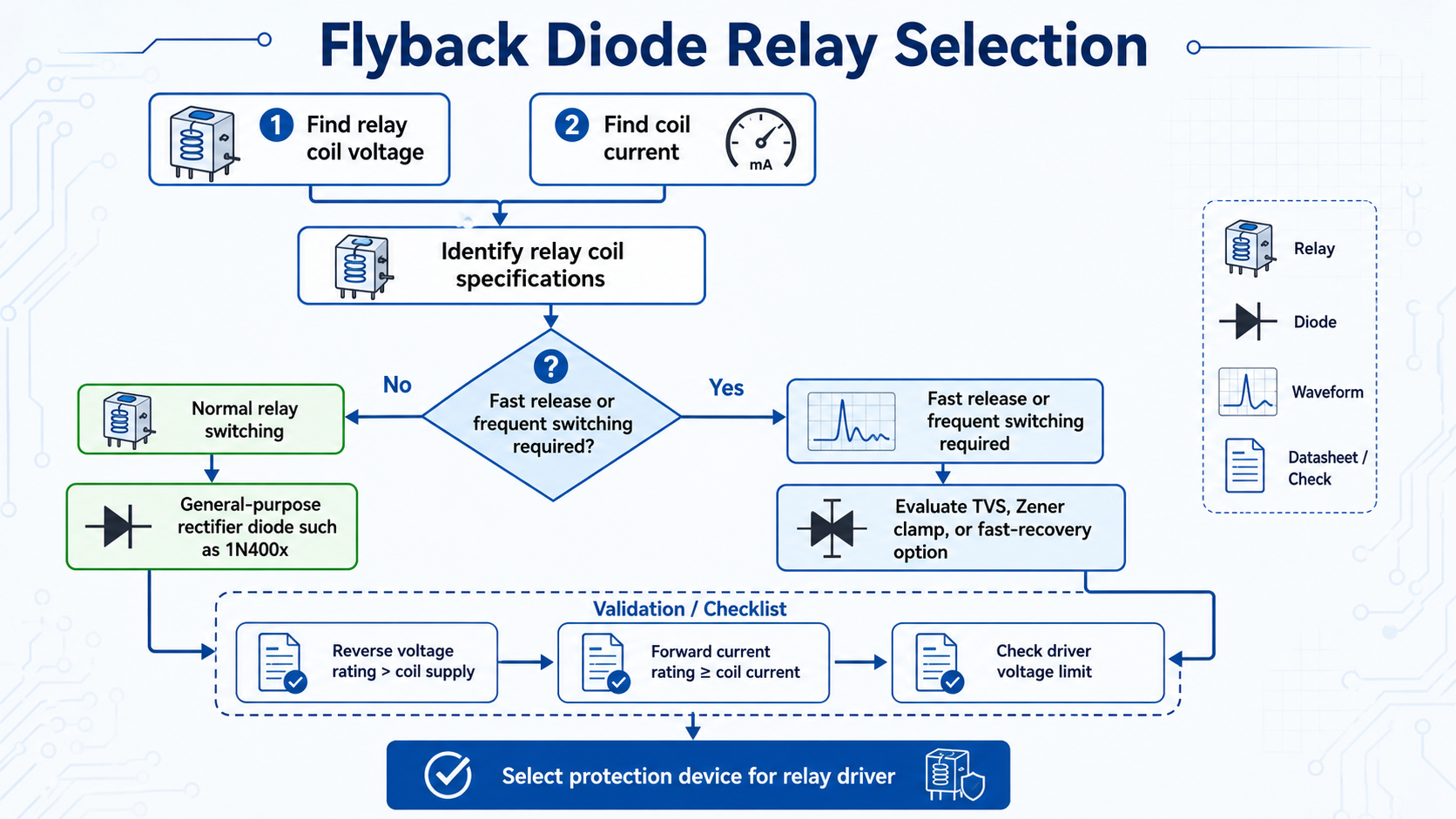
A practical flyback diode selection process starts with coil voltage and coil current, then checks switching frequency and release-time requirements.
The Three Main Diode Ratings That Matter
1. Reverse Voltage Rating
During normal operation, the diode is reverse-biased by the relay supply voltage. The diode’s reverse-voltage rating must be higher than the coil supply voltage.
As a simple rule, choose a reverse-voltage rating at least equal to the coil voltage, and preferably with margin. For low-voltage relay circuits, many engineers choose a diode with much higher voltage headroom because common rectifier diodes are inexpensive and widely available.
Examples:
| Relay coil voltage | Minimum practical reverse-voltage idea | Common practical choice |
|---|---|---|
| 5V relay | Above 5V | 1N4001 or another suitable rectifier |
| 12V relay | Above 12V, often with 2x or more margin | 1N4001–1N4007 |
| 24V relay | Above 24V, with margin for noise and supply variation | 1N4002–1N4007, depending on design margin |
Do not choose the diode only by coil voltage if the environment is electrically noisy. Industrial control cabinets, long wiring, motors, contactors, and inductive loads nearby can justify additional voltage margin.
2. Forward Current Rating
When the relay is switched off, the diode current initially starts around the relay coil current. That means the diode’s forward-current rating should be at least the coil current, with margin.
For many small signal relays, the coil current may be tens of milliamps to a few hundred milliamps, so a 1A rectifier diode is often more than enough. For larger relays, contactors, solenoids, or coils with high stored energy, check the diode’s current, surge, thermal, and energy-related limits instead of assuming that a small signal diode is enough.
3. Surge, Thermal, and Energy Handling
For ordinary small relays, voltage and current ratings usually answer most of the selection question. For larger inductive loads, frequent switching, hot environments, or compact PCB layouts, thermal behavior matters more.
Check:
Average forward current rating
Non-repetitive surge rating
Package size and thermal resistance
Ambient temperature
Switching repetition rate
Whether the diode is expected to absorb repeated inductive energy events
A diode that looks oversized electrically may still run too warm if the coil is switched frequently or if the enclosure has poor airflow.
Common Diode Choices for Relay Flyback Protection
| Diode option | Best for | Strength | Drawback | Buyer / design note |
|---|---|---|---|---|
| 1N4001–1N4007 general-purpose rectifier | Most ordinary DC relay coils | Cheap, available, easy to use, enough current for many small relays | Can slow relay release; not ideal for high-frequency switching | Good default for simple 5V, 12V, and 24V relay circuits when release speed is not critical |
| 1N4148 / 1N914 small-signal diode | Very small relay coils with low coil current | Small and fast | Less current and surge margin than 1A rectifiers | Use only after checking coil current and surge margin |
| Schottky diode | Low-voltage or fast-switching circuits where reverse recovery matters | Fast recovery, low forward drop | Lower reverse-voltage options and higher leakage may matter; low forward drop does not automatically mean faster relay release | Better for some switching designs than for solving mechanical relay release delay |
| Fast-recovery rectifier, such as UF400x family | Repetitive or faster switching environments | Better recovery behavior than standard rectifiers | Often unnecessary for simple mechanical relay on/off control | Consider when the coil or inductive load is being switched frequently |
| Diode plus Zener, or TVS clamp | Faster relay release or controlled clamp voltage | Allows coil current to decay faster than a plain diode | Higher clamp voltage stresses the transistor, MOSFET, or driver | Use only when the driver voltage rating and relay behavior are verified |
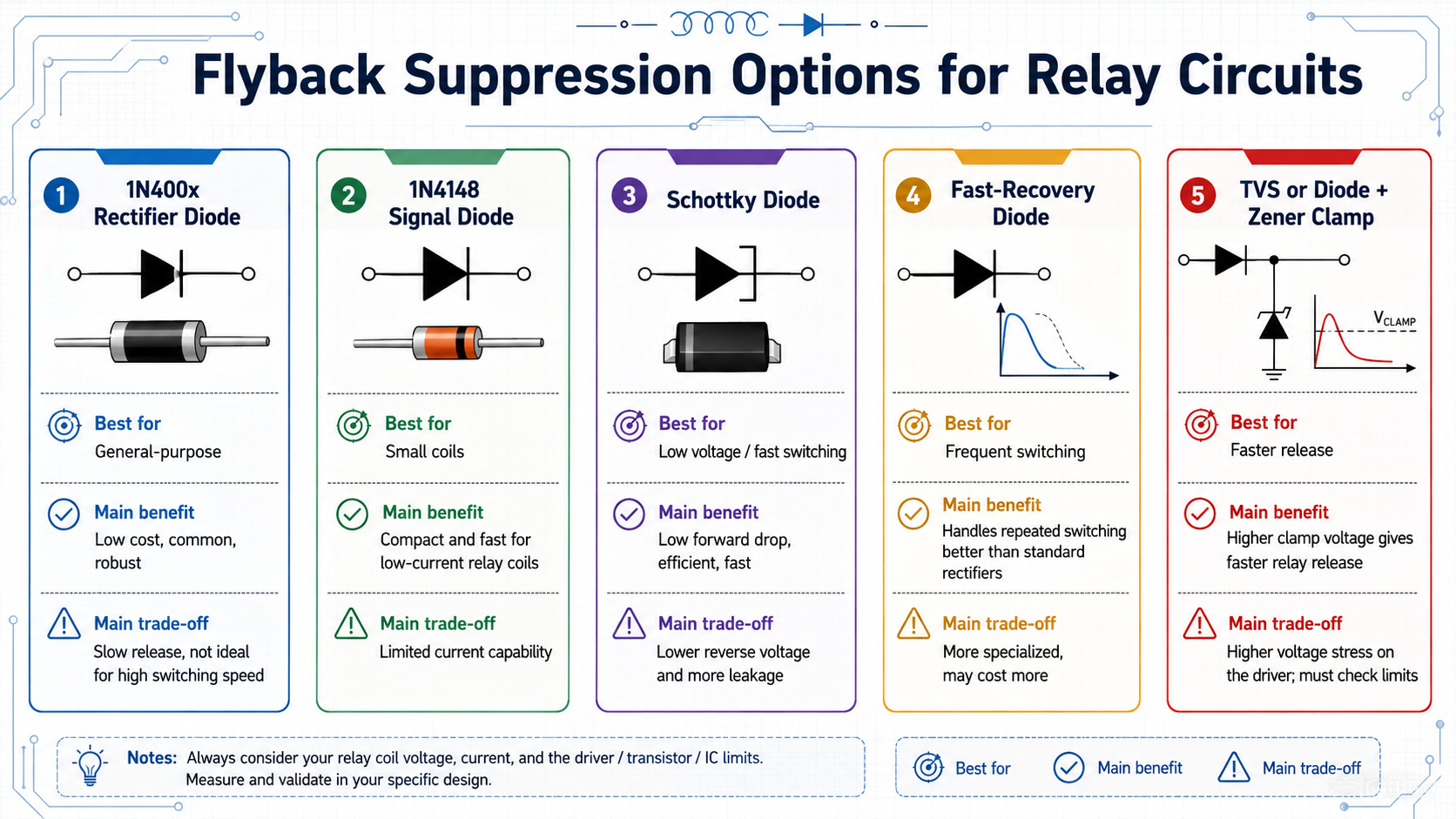
Different suppression components solve different design priorities: simplicity, current margin, recovery speed, or faster relay release.
Is 1N4007 Always the Best Flyback Diode?
Not always. A 1N4007 is popular because it has high reverse-voltage headroom and a 1A average rectified current rating in common datasheets. For many low-voltage relay coils, that makes it a convenient, safe, general-purpose choice.
However, “common” does not mean “always best.” A 1N4001 may already be sufficient for a small 5V or 12V relay. A 1N4148 may be fine for a tiny coil if the current is low enough. A TVS diode or diode-plus-Zener clamp may be better if fast relay release is more important than the lowest possible clamp voltage.
The best flyback diode is the one that matches the relay coil, driver, switching rate, release-time requirement, and operating environment.
How to Wire a Flyback Diode Across a Relay Coil
For a typical low-side switched relay circuit:
Connect the relay coil between positive supply and the transistor or MOSFET switch.
Connect the diode directly across the coil.
Connect the diode cathode to the positive coil terminal.
Connect the diode anode to the switched side of the coil.
In normal operation, the diode is reverse-biased and does not conduct. When the switch opens, the coil voltage reverses and the diode becomes forward-biased.
What Happens If the Diode Is Installed Backwards?
If the diode is installed in forward bias across the supply during normal operation, it can act like a short circuit. That may damage the diode, the power supply, the PCB trace, or the switching device.
Always confirm the coil polarity, diode stripe, and switching topology before powering the circuit.
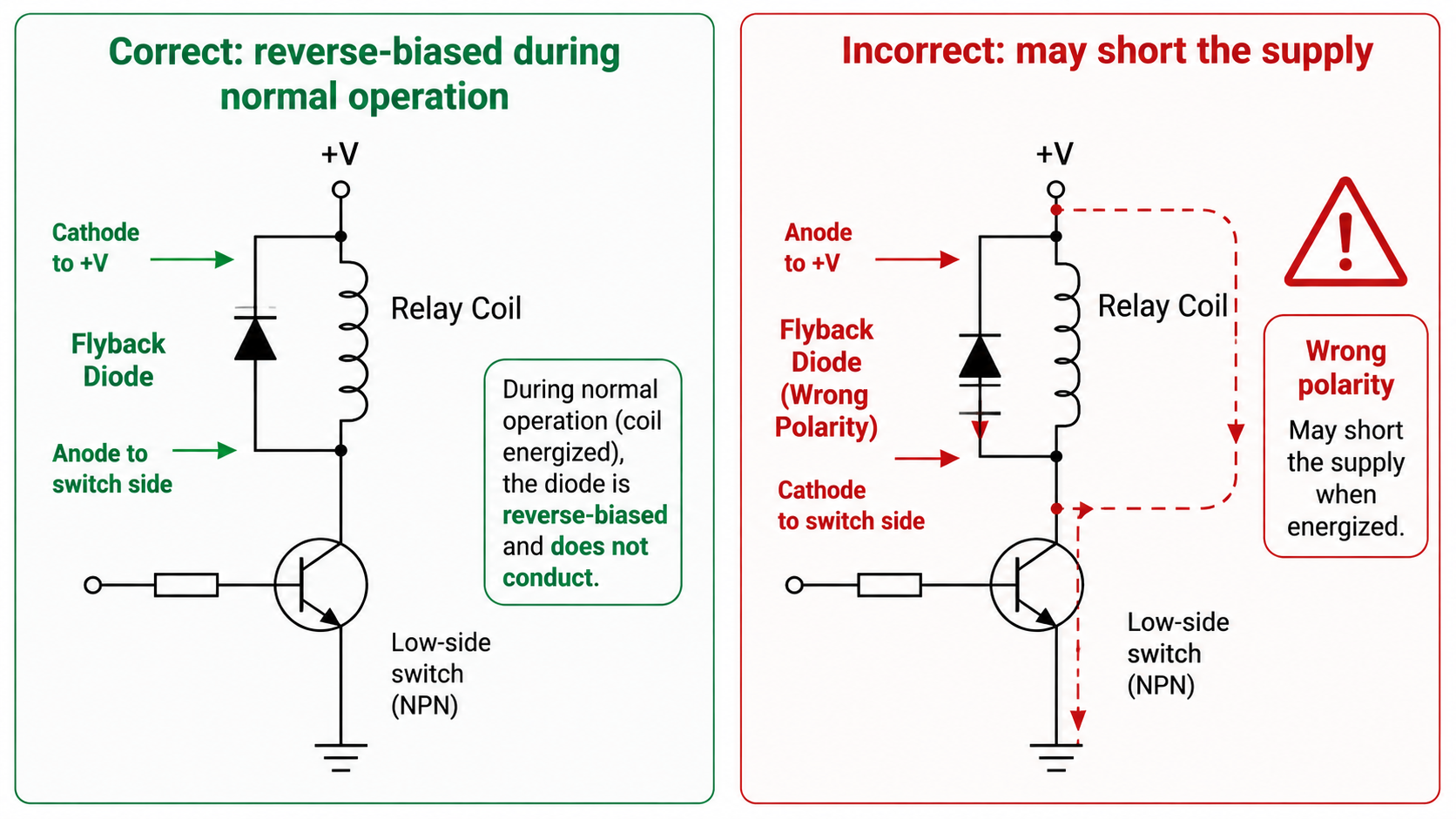
The diode stripe, or cathode, should face the positive side of the relay coil in a typical DC relay driver circuit.
Where Should the Flyback Diode Be Placed?
Place the diode so the loop formed by the relay coil and diode is compact. In many designs, that means placing it physically close to the relay coil terminals or routing it tightly across the coil on the PCB.
The goal is to give the coil current a short, controlled path when the switch opens. A large loop can radiate more noise and may reduce the effectiveness of suppression. In wiring harnesses or control cabinets, keep the suppression component close to the inductive device when possible.
For PCB designs, also pay attention to:
Ground return paths
Relay coil current loops
Trace width
Driver transistor voltage rating
Nearby sensitive analog or MCU traces
Connector and harness routing
12V Relay Example
Suppose a 12V relay coil draws 80mA.
A practical selection process would be:
Coil voltage: 12V
Coil current: 80mA
Diode reverse-voltage rating: choose above 12V, preferably with margin
Diode forward-current rating: choose above 80mA, preferably with margin
Switching speed: normal mechanical relay switching, not PWM
Release time: not critical
A 1N4001 can often satisfy the basic voltage and current requirements in this type of circuit. A 1N4007 may also be used if it is already in your BOM or easier to source. The difference is not that 1N4007 makes the relay “more protected” in every meaningful way; it simply offers much higher reverse-voltage headroom.
24V Relay Example
For a 24V relay coil, the same logic applies, but voltage margin becomes more important.
A practical approach:
Confirm the coil is DC, not AC.
Read coil current from the relay datasheet.
Select a diode with reverse-voltage rating above 24V, with enough margin for your environment.
Select a forward-current rating above coil current.
If used in an industrial cabinet, consider noise, wiring length, and surge environment.
If release time affects safety, timing, or contact life, evaluate a TVS or diode-plus-Zener clamp.
A common rectifier diode may still work well, but do not choose blindly. A 24V industrial system may see more electrical noise than a small bench circuit.
Why a Plain Flyback Diode Can Slow Relay Release
A plain silicon diode clamps the coil voltage at a low forward voltage. That low clamp voltage protects the switching device, but it also means the coil current decays slowly. Because the relay armature depends on coil current and magnetic field strength, slower current decay can delay contact release.
This may not matter in many hobby, MCU, appliance, or basic control circuits. It can matter in applications where contact timing, fast release, or contact wear is important.
If release speed matters, consider:
Diode plus Zener clamp
TVS diode clamp
RC snubber
MOV or other suppression method for specific relay/load conditions
A relay driver IC with built-in clamp behavior
The important point is that faster release usually comes from allowing a higher clamp voltage, not merely choosing a “faster” standard diode. The driver must be rated to withstand that higher voltage.
Why Search Results and AI Answers Disagree
Search results often disagree because they answer slightly different problems.
Some answers recommend 1N4007 because it is cheap, common, and has high voltage headroom. That is a practical sourcing answer.
Some answers say 1N4001 is enough because the minimum electrical requirement for a small relay may only be the coil current and coil voltage. That is a minimum-rating answer.
Some answers mention Schottky or fast-recovery diodes because they are thinking about reverse recovery, PWM, or high-frequency switching. That is not always relevant to a mechanical relay switched occasionally.
Some answers recommend TVS or Zener clamps because they care about relay release speed or contact behavior. That is a timing and suppression-design answer.
So the apparent disagreement is not necessarily a contradiction. It reflects different priorities: minimum rating, sourcing convenience, switching speed, release time, EMI, or industrial robustness.
Common Mistakes to Avoid
Mistake 1: Choosing Only by Relay Voltage
A diode must handle both reverse voltage and coil current. For larger coils, also check surge and thermal behavior.
Mistake 2: Installing the Diode Backwards
A reversed diode can short the supply during normal operation. Always check the diode stripe and relay coil polarity.
Mistake 3: Ignoring Relay Release Time
A plain diode is simple and effective, but it can slow drop-out. If timing matters, evaluate a higher-voltage clamp method.
Mistake 4: Assuming Any Diode Works for Any Inductive Load
A small relay coil, a large contactor, a solenoid, and a motor winding are not the same problem. The energy and switching frequency can be very different.
Mistake 5: Confusing Relay Coil Protection with Contact Protection
A flyback diode across the coil protects the coil driver. It does not directly protect the relay contacts from arcing caused by the load side. If the relay contacts switch an inductive load, the load may need its own suppression strategy.
Who Should Not Use a Simple 1N400x Flyback Diode?
A 1N400x diode may not be the right answer if:
The relay must release very quickly.
The coil is driven with high-frequency PWM.
The circuit uses a driver with specific clamp requirements.
The coil current or stored energy is large.
The relay is in a high-noise industrial system.
Contact timing affects safety or product reliability.
The device already includes internal suppression.
The relay coil is AC, not DC.
In these cases, review the relay datasheet, driver datasheet, and suppression recommendations before choosing the clamp component.
Practical Selection Checklist
Use this checklist before finalizing the diode:
Is the relay coil DC?
What is the coil voltage?
What is the coil current?
Is the diode reverse-voltage rating comfortably above the coil supply voltage?
Is the diode forward-current rating above the coil current?
Is there enough surge and thermal margin?
Is the relay switched occasionally, frequently, or with PWM?
Does the relay need fast release?
Can the switching transistor, MOSFET, or driver IC tolerate the clamp voltage?
Is the diode installed reverse-biased across the coil?
Is the diode placed close enough to keep the coil-diode loop compact?
Does the load switched by the relay contacts need separate suppression?
Does the relay or driver already include internal protection?
FAQ
What diode should I use for a 12V relay?
For many small 12V DC relay coils, a 1N4001–1N4007 rectifier diode can work, provided the current rating exceeds the relay coil current and the reverse-voltage rating has sufficient margin. If release speed matters, consider a higher-voltage clamp method instead of a simple diode.
What diode should I use for a 24V relay?
Choose a diode with a reverse-voltage rating above 24V and a forward-current rating above the coil current. A common rectifier diode may be suitable, but industrial 24V systems often justify extra voltage margin and closer attention to wiring, noise, and release time.
Is 1N4007 good for relay flyback protection?
Yes, 1N4007 is often a practical flyback diode for many low-voltage DC relay coils because it has high reverse-voltage headroom and a common 1A current rating. It is not automatically the best choice for every relay, especially when fast release or high-frequency switching is required.
Can I use 1N4148 as a relay flyback diode?
Possibly, but only for small relay coils where the coil current and surge requirements are within the diode’s ratings. For general-purpose relay circuits, a 1N400x rectifier often provides more current margin.
Does the flyback diode go across the relay coil or the transistor?
In the usual relay suppression layout, the diode is connected across the relay coil in reverse bias. The goal is to provide a short current loop for the coil when the switch opens. Some designs place suppression across the switching element, but that is a different clamp strategy and should be evaluated with the driver voltage rating.
Does a flyback diode slow down a relay?
Yes, a plain flyback diode can slow relay release because it allows the coil current to decay at a relatively low clamp voltage. If fast release is important, use a suppression method that allows a higher clamp voltage, such as a diode-plus-Zener or TVS clamp, while staying within the driver’s voltage limits.
Do I need a flyback diode if I use a relay module?
Maybe not. Many relay modules already include a diode, transistor driver, optocoupler, or other suppression component. Check the module schematic or product documentation before adding another diode.
Do AC relays need the same flyback diode?
No. A simple DC flyback diode across an AC relay coil would conduct on part of the AC waveform and is not the right solution. AC relay coils typically need different suppression methods, such as RC snubbers or MOVs, depending on the application.
Final Recommendation
For ordinary DC relay circuits, start with the relay coil voltage and coil current. Choose a diode with enough reverse-voltage and forward-current margin, wire it reverse-biased across the coil, and keep the loop compact. A 1N400x diode is a practical default for many small relay coils, but it is not a universal answer.
If the relay must release quickly, if the coil is large, if switching is frequent, or if the circuit is in an industrial environment, treat the flyback diode as part of a suppression design rather than a one-part checkbox. In those cases, compare a plain diode, diode-plus-Zener, TVS clamp, or relay-driver solution against the driver voltage rating, EMI requirement, and relay timing requirement.
Sources and References Used for This Guide
TE Connectivity, “The Application of Relay Coil Suppression with DC Relays”
Cadence PCB Solutions, “Selecting Flyback Diodes for 5V Relay Coil Suppression”
Plant Engineering, “Considerations for Choosing the Right Flyback Diode and Rating”
Fairchild / ON Semiconductor, “1N4001–1N4007 General-Purpose Rectifiers” datasheet
Electrical Engineering Stack Exchange, “How to Choose a Flyback Diode for a Relay?”
Altium, “Using Flyback Diodes in Relays Prevents Electrical Noise in Your Circuits”
DigiKey TechForum discussions on relay flyback voltage and TVS diode suppression
EEVblog engineering forum discussions on flyback diode selection and relay release behavior
 UTMEL
UTMEL
We are the professional distributor of electronic components, providing a large variety of products to save you a lot of time, effort, and cost with our efficient self-customized service. careful order preparation fast delivery service
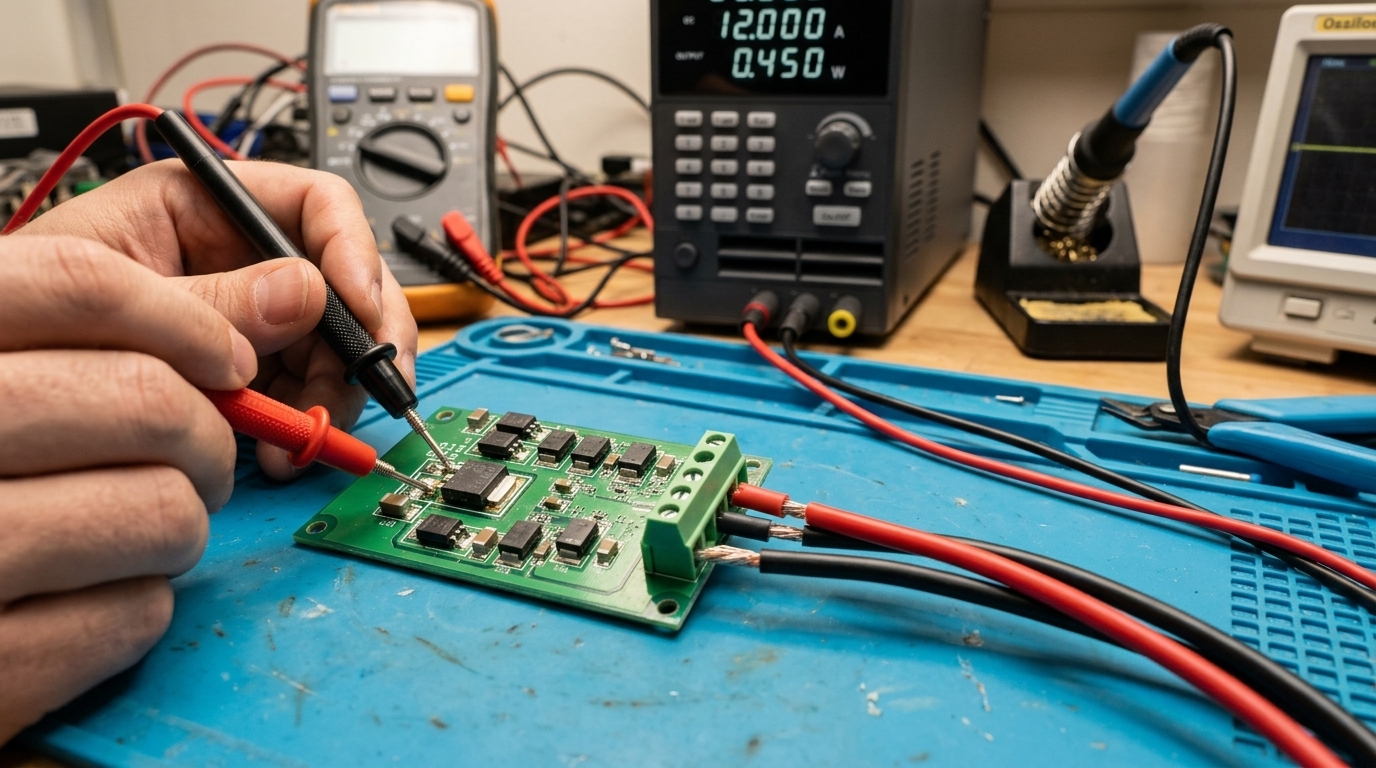 Reverse-Polarity Protection for DC Inputs: Diode and MOSFET Trade-OffsUTMEL24 October 2026115
This technical guide compares series diodes and high-side P-channel MOSFETs for DC input reverse-polarity protection. It analyzes forward voltage drop, conduction power loss, and the three-stage startup sequence through the MOSFET body diode. Designers and repair engineers also gain practical verification checklists covering drain-to-source orientation, Zener gate clamping, absolute maximum voltage ratings, and when to step up to active ideal-diode controllers.
Read More All You Need to Know About Rectifier CircuitUTMEL24 April 202518200
All You Need to Know About Rectifier Circuit
Read More 15 Key Elements of Diode SelectionUTMEL26 November 202119505
Hello everyone, I am Rose. Welcome back to the new post today. Diodes are one of the most common components in our circuit boards. So, what factors should be considered when selecting models?
Read More What is a PIN Diode?UTMEL04 February 202110635
While diodes with a simple PN junction are by far the most common type of diode in operation, in a variety of applications, other forms of diode may be used. The PIN diode is one type that is used for a number of circuits. In a variety of places, this diode type is used. For RF switching, the PIN diode is very fine, and the PIN structure in photodiodes is very useful as well.
Read More Microwave Diode: Introduction and TypesUTMEL07 January 202126625
Microwave diodes are diodes that work in the microwave frequency band. It is a solid-state microwave device. Microwave band usually refers to the frequency from 300 MHz to 3000 GHz. After the discovery of the point contact diode effect at the end of the 19th century, microwave diodes such as PIN diodes, varactor diodes, and Schottky diode tubes appeared one after another. Microwave diodes have the advantages of small size and high reliability, and are used in microwave oscillation, amplification, frequency conversion, switching, phase shifting and modulation.
Read More
Subscribe to Utmel !
![MMZ2012Y600BT000]() MMZ2012Y600BT000
MMZ2012Y600BT000TDK Corporation
![ACH4518-333-TD01]() ACH4518-333-TD01
ACH4518-333-TD01TDK Corporation
![35F0121-0SR-10]() 35F0121-0SR-10
35F0121-0SR-10Laird-Signal Integrity Products
![BLM15BD750SN1D]() BLM15BD750SN1D
BLM15BD750SN1DMurata Electronics
![BLM18KG102SH1D]() BLM18KG102SH1D
BLM18KG102SH1DMurata Electronics
![BLA31AG221SN4D]() BLA31AG221SN4D
BLA31AG221SN4DMurata Electronics
![BLM41AF151SN1L]() BLM41AF151SN1L
BLM41AF151SN1LMurata Electronics
![BK1608HM601-T]() BK1608HM601-T
BK1608HM601-TTaiyo Yuden
![BK2125LM252-T]() BK2125LM252-T
BK2125LM252-TTaiyo Yuden
![742792063]() 742792063
742792063Würth Elektronik


