

 Product
 Brand
Brand Articles
 Tools
Tools
AD9528 Clock Generator Integration Notes: Solving PLL Unlocking and Phase Noise

AD9528 Clock Generators 72 Pins 72-VFQFN Exposed Pad, CSP 72 Terminals Surface Mount 3.3V Cut Tape (CT)


AD9528 Clock Generators 72 Pins 72-VFQFN Exposed Pad, CSP 72 Terminals Surface Mount 3.3V Cut Tape (CT)
Discover design and integration notes for the AD9528 dual-PLL clock generator. Learn how to optimize phase noise, fix PLL1 unlocking, and compare alternatives.
- Critical Electrical Specifications and System Impact
- Overcoming PLL1 Unlocking and Initialization Failures
- Optimizing Phase Noise Performance at Low Offsets
- Software Configuration: Escaping the Device Tree Nightmare
- Application Contexts
- Competitors, Alternatives, and Replacement Strategy
- Datasheet, Pinout, and Layout Verification
- Frequently Asked Questions
- Specifications
- Parts with Similar Specs
- Datasheet PDF
The AD9528 is a two-stage phase-locked loop (PLL) with an integrated JESD204B/JESD204C SYSREF generator designed for multiple device synchronization and clock jitter reduction. Primarily utilized in high-speed data acquisition and cellular infrastructure, this component acts as the timing heartbeat for complex arrays of ADCs, DACs, and transceivers where deterministic latency and ultra-low phase noise are non-negotiable.
When evaluating this clock generator for a new bill of materials (BOM) or debugging an existing prototype, engineers must look beyond the top-line jitter specs. The realities of integrating a dual-loop architecture involve strict power sequencing, precise register configurations, and careful loop filter design.
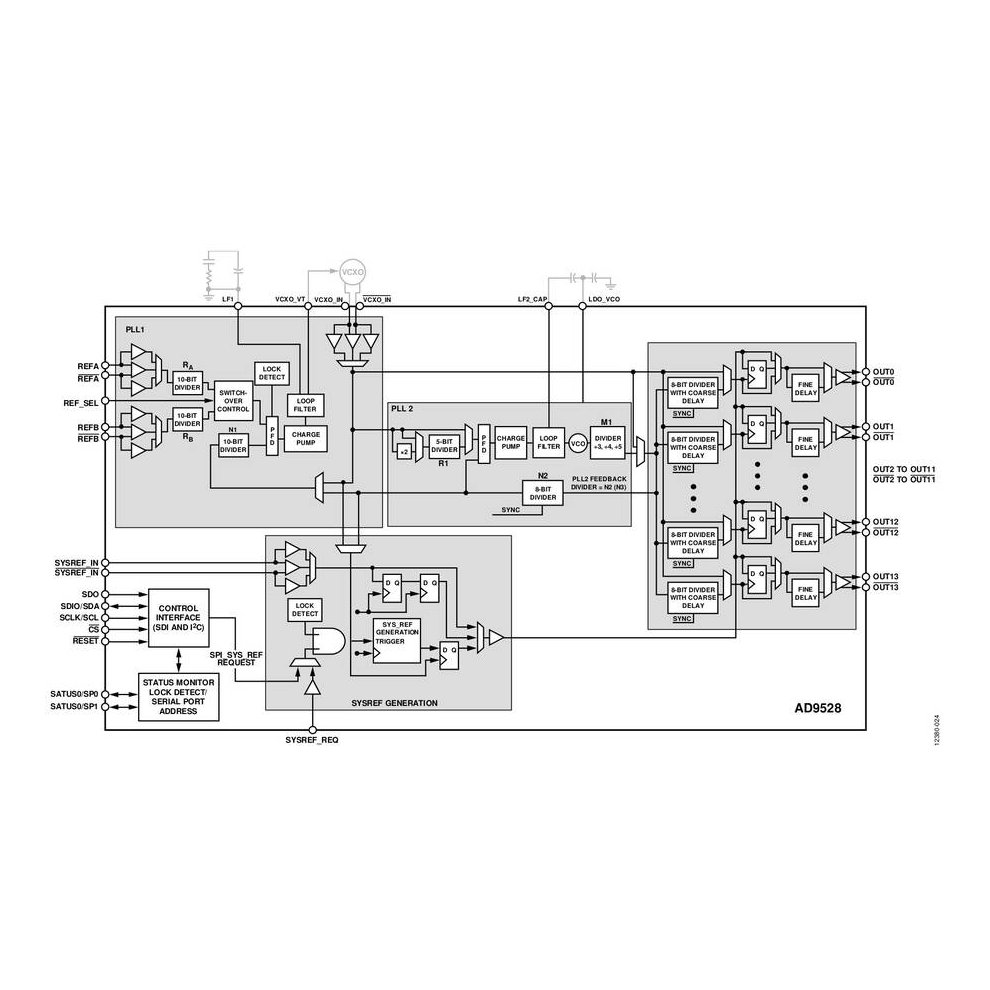
Core Architecture: Dual PLL (PLL1 for jitter cleaning/reference selection, PLL2 for high-frequency VCO generation).
Output Flexibility: 14 independent outputs, software-configurable for HSTL or LVDS signaling.
Primary Application: Clocking high-speed data converters (ADCs, DACs, DDSs) requiring JESD204B/C SYSREF alignment.
Key Integration Challenge: Manually calculating register values for the two-stage PLL and SYSREF dividers is highly error-prone without vendor software.
Critical Electrical Specifications and System Impact
Clock generators are evaluated on their ability to maintain signal integrity across multiple distribution paths without introducing timing errors that would degrade a data converter's Signal-to-Noise Ratio (SNR).
VCO Tuning Range (3.6 GHz to 4.0 GHz): The internal voltage-controlled oscillator operates in this high-frequency band. The specific tuning range dictates the allowable integer and fractional divider ratios used to hit your target output frequencies. Operating near the edges of this range requires careful attention to the PLL2 loop filter design to maintain lock over temperature variations.
Absolute Output Jitter (<160 fs at 122.88 MHz): In high-performance wireless transceivers, jitter translates directly to phase noise, which degrades the Error Vector Magnitude (EVM) of transmitted signals and the sensitivity of receivers. Sub-160 femtosecond performance places this device firmly in the "carrier-grade" category.
Typical Output-to-Output Skew (20 ps): When synchronizing multiple JESD204B converters, the SYSREF and device clocks must arrive at all endpoints with tightly controlled phase alignment to achieve deterministic latency. A 20 ps skew across 14 outputs provides generous timing margin for PCB trace length mismatch.
14 Configurable Outputs: The ability to toggle individual outputs between HSTL and LVDS allows mixed-signal boards to drive different logic families without requiring external level translators, saving significant board space and BOM cost.
Overcoming PLL1 Unlocking and Initialization Failures
One of the most common hurdles engineers face during board bring-up with the AD9528 is PLL1 failing to lock to the reference clock, or unexpectedly dropping lock with the onboard VCXO. Because the dual-PLL architecture relies on PLL1 to clean the noisy system reference before feeding it to PLL2, a failure here cascades through the entire timing tree.
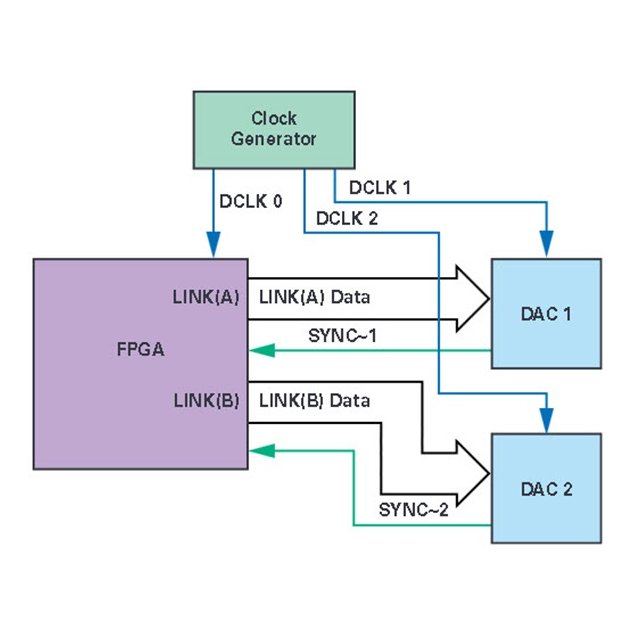
If you are experiencing unexpected unlocking, the root cause is rarely a defective chip; it is almost always power delivery or initialization sequencing.
First, probe the LDO_VCO voltage. The internal VCO requires a highly stable 2.5V supply to operate correctly. If the external supply network is drooping under dynamic load, or if the internal LDO is improperly bypassed, the VCO will drift out of the tuning band, causing a lock failure.
Secondly, verify the SPI register initialization sequence. The digital frequency lock detect circuitry is highly sensitive to the order in which registers are written. If the reference clock inputs are not stable before the PLL1 dividers are engaged, the state machine can hang. Always ensure the reference clocks are actively toggling before asserting the final software reset and calibration commands over the SPI/I2C port.
Optimizing Phase Noise Performance at Low Offsets
While the broadband jitter of this component is excellent, meeting aggressive phase noise targets at low frequency offsets (e.g., 100 Hz) requires manual intervention in the loop dynamics. Users often find that the default evaluation board settings do not provide the necessary low-frequency noise rejection for sensitive medical instrumentation (like MRI or ultrasound receivers) or multicarrier GSM base stations.
To fix this, you must manipulate the trade-off between PLL1 and PLL2. 1. Reduce the PLL1 loop bandwidth: A narrower loop bandwidth on the first stage forces the system to rely more heavily on the clean, external VCXO for close-in phase noise rather than the noisy upstream system reference. 2. Increase the PLL2 charge pump current: Driving the internal VCO with a higher charge pump current improves the phase noise profile of the second stage, though it will require recalculating the external loop filter components (resistors and capacitors) to maintain phase margin and stability.
Software Configuration: Escaping the Device Tree Nightmare
Because this device features a two-stage PLL, duty cycle correction for odd divider settings, and an integrated JESD204B/C SYSREF generator, the internal register map is vast. Calculating the correct clock rates, divider ratios, and SYSREF delays manually to write into a Linux device tree or bare-metal C code is exceptionally difficult and a primary source of integration delays.
Do not attempt to calculate these registers by hand. The standard engineering practice is to use the manufacturer's evaluation software (ADIsimCLK). This tool allows you to visually construct the timing tree, input your target phase noise requirements, and automatically generate the correct register hex dumps. You can then export these configurations directly into your microcontroller's initialization routines, bypassing the complex math required for dual-loop frequency planning.
Application Contexts
The component's architecture dictates its use in environments where multiple high-speed devices must act in perfect unison.
Wireless Infrastructure (LTE/GSM Base Stations): The dual-loop architecture is purpose-built to take a jittery backplane reference (like a recovered SyncE clock), clean it with a high-Q VCXO via PLL1, and distribute pristine LO reference clocks to RF transceivers.
Medical Instrumentation (Ultrasound and MRI): Phased-array systems require dozens of ADCs to sample returning signals simultaneously. The 14 outputs and 20 ps skew ensure that the beamforming algorithms are not corrupted by timing mismatch between channels.
ATE and High-Performance Instrumentation: Automated test equipment relies on the digital frequency lock detect and duty cycle correction to provide reliable, variable-frequency test vectors to devices under test (DUTs) without introducing measurement artifacts.
Competitors, Alternatives, and Replacement Strategy
When dealing with supply chain constraints or evaluating second-source options, the clock generator market is highly specialized. There are no true "drop-in" replacements for complex JESD204B clockers, as every manufacturer utilizes different register maps, pinouts, and loop filter architectures.
If you are looking at alternatives to the AD9528, the primary competitors include:
Texas Instruments LMK04828: This is the most direct functional rival. It also features a dual-PLL architecture and JESD204B SYSREF generation. However, the LMK04828 has a completely different SPI register structure and footprint. Moving from Analog Devices to TI will require a full PCB respin and a complete rewrite of the initialization firmware.
Silicon Labs Si5345: Silicon Labs utilizes a DSPLL architecture rather than a traditional analog dual-PLL. This often results in a smaller external component footprint (fewer external loop filter capacitors), but the phase noise profile behaves differently, particularly at low offsets.
Renesas 8V97003 & Silicon Labs Si53306: These are often evaluated in similar BOMs, though they may serve slightly different roles depending on whether the primary goal is sheer fanout (Si53306) or wideband RF generation.
Procurement Note: Because migrating between these parts requires immense software and hardware qualification effort, procurement teams should secure long-term pipeline visibility for their chosen clock generator early in the design phase.
Datasheet, Pinout, and Layout Verification
Before finalizing your schematic capture and PCB layout, several critical physical parameters must be verified against the manufacturer's documentation.
Thermal Pad Grounding: The exposed paddle on the bottom of the package is not just for thermal dissipation; it is the primary electrical ground for the internal RF circuitry. It must be soldered to a continuous ground plane using a dense matrix of thermal vias. Failure to do so will result in degraded phase noise and erratic VCO behavior. Exact thermal derating will depend heavily on your PCB copper area, so checking the manufacturer's specific layout guidelines is strictly required here.
Power Supply Decoupling: The device features multiple power domains (VCO, charge pump, digital, and output drivers). Do not tie all VDD pins to a single rail without proper LC filtering. The outputs will easily couple switching noise back into the sensitive VCO supply if the decoupling network is inadequate.
Loop Filter Proximity: The passive components for both PLL1 and PLL2 loop filters must be placed as close to the designated pins as physically possible to prevent EMI injection into the high-impedance charge pump nodes.
Frequently Asked Questions
Why does the AD9528 fail to lock on the onboard VCXO during cold boot?This is typically caused by either a voltage drop on the internal LDO_VCO (which must be strictly maintained at 2.5V) or an incorrect SPI initialization sequence where the dividers are engaged before the reference clock has stabilized.
How can I improve the phase noise performance at 100 Hz offset?You must adjust the trade-off between the two PLL stages. Use ADIsimCLK to reduce the loop bandwidth of PLL1 (relying more on the clean VCXO) and simultaneously increase the charge pump current of PLL2.
Can I replace the AD9528 with the TI LMK04828 without changing my PCB?No. While they serve the exact same functional role in a JESD204B system (dual-PLL jitter cleaning and SYSREF generation), they have different pinouts, different loop filter requirements, and entirely different software register maps. A hardware respin and firmware rewrite are mandatory.
Do I have to write the device tree configuration manually for Linux integration?It is highly discouraged. Calculating the correct odd-divider duty cycle corrections and SYSREF timing manually is prone to severe errors. Use the AD9528 Evaluation Software (ADIsimCLK) to generate the required register configurations and export them to your driver.
Specifications
Parts with Similar Specs
- ImagePart NumberManufacturerPackage / CaseNumber of PinsPLLInputFrequency (Max)Supply VoltageRoHS StatusFactory Lead TimeView Compare
![AD9528BCPZ-REEL7]()
AD9528BCPZ-REEL7
72-VFQFN Exposed Pad, CSP
72
Yes with Bypass
CMOS, HSTL, LVDS
1.25GHz
3.3 V
ROHS3 Compliant
8 Weeks
![AD9516-5BCPZ-REEL7]()
64-VFQFN Exposed Pad, CSP
64
Yes
CMOS, LVDS, LVPECL
-
3.3 V
ROHS3 Compliant
8 Weeks
![AD9520-3BCPZ]()
64-VFQFN Exposed Pad, CSP
64
Yes
CMOS, LVDS, LVPECL
2.4GHz
3.3 V
ROHS3 Compliant
8 Weeks
![AD9516-5BCPZ]()
64-VFQFN Exposed Pad, CSP
64
Yes
CMOS, LVDS, LVPECL
2.4GHz
-
ROHS3 Compliant
8 Weeks


Datasheet PDF
- Datasheets :
- Other Related Documents :
- PCN Design/Specification :
- ConflictMineralStatement :
 PCA9615DP IC-Bus Buffer: Pinout, Datasheet and Advantages
13 September 20212743
 PT4115 High Brightness LED Driver: 30A, 1.2V Step-down Driver, Equivalent and Pinout
06 January 202216007
 Designing with ATTINY13A: Datasheet, Pinout, and Motor Control Guide
31 January 2026420
 LT1016 10ns UltraFast Comparator: Datasheet, Pinout, and High-Speed Design Analysis
19 March 2026445
 Generating Negative Rails with LMC7660: A Deep Dive into CMOS Voltage Conversion
28 February 2026244
 UC3843N SMPS Controller: Pinout, Equivalent and Datasheet
18 March 20224227
 STM32F303VCT6TR Microcontroller: 72MHz,100-LQFP, Pinout and Features
22 January 20221151
![CDSOT23-SM712 Tvs Diode Surface SOT-23-3 14V Clamp[FAQ]: Datasheet, Pinout, and Applications](https://res.utmel.com/Images/Article/9fea5c62-7b3d-490f-89eb-f71899f86d2b.png) CDSOT23-SM712 Tvs Diode Surface SOT-23-3 14V Clamp[FAQ]: Datasheet, Pinout, and Applications
CDSOT23-SM712 Tvs Diode Surface SOT-23-3 14V Clamp[FAQ]: Datasheet, Pinout, and Applications02 April 20222788
 IoT Chips Lead Time 2026: Navigating MCU, PMIC, and Sensor Shortages
15 July 2026826
 MCU with Built-in NPU: How to Pick an Edge AI Microcontroller in 2026
30 July 20261283
 Diode Basis: Symbol, Types and Applications
09 January 202615524
 What is a Fixed Inductor?
15 April 202113509
 FPGA vs SoC: A Comprehensive Comparison Guide
13 May 20256132
 Semiconductor Devices: Impact on IoT and Modern Communication (Part-1)
22 July 20242753
 What Is the Future of Brain-like Computing?
26 April 20221237
 Introduction to BGA Package
07 December 20216329
Analog Devices Inc.
In Stock
United States
China
Canada
Japan
Russia
Germany
United Kingdom
Singapore
Italy
Hong Kong(China)
Taiwan(China)
France
Korea
Mexico
Netherlands
Malaysia
Austria
Spain
Switzerland
Poland
Thailand
Vietnam
India
United Arab Emirates
Afghanistan
Åland Islands
Albania
Algeria
American Samoa
Andorra
Angola
Anguilla
Antigua & Barbuda
Argentina
Armenia
Aruba
Australia
Azerbaijan
Bahamas
Bahrain
Bangladesh
Barbados
Belarus
Belgium
Belize
Benin
Bermuda
Bhutan
Bolivia
Bonaire, Sint Eustatius and Saba
Bosnia & Herzegovina
Botswana
Brazil
British Indian Ocean Territory
British Virgin Islands
Brunei
Bulgaria
Burkina Faso
Burundi
Cabo Verde
Cambodia
Cameroon
Cayman Islands
Central African Republic
Chad
Chile
Christmas Island
Cocos (Keeling) Islands
Colombia
Comoros
Congo
Congo (DRC)
Cook Islands
Costa Rica
Côte d’Ivoire
Croatia
Cuba
Curaçao
Cyprus
Czechia
Denmark
Djibouti
Dominica
Dominican Republic
Ecuador
Egypt
El Salvador
Equatorial Guinea
Eritrea
Estonia
Eswatini
Ethiopia
Falkland Islands
Faroe Islands
Fiji
Finland
French Guiana
French Polynesia
Gabon
Gambia
Georgia
Ghana
Gibraltar
Greece
Greenland
Grenada
Guadeloupe
Guam
Guatemala
Guernsey
Guinea
Guinea-Bissau
Guyana
Haiti
Honduras
Hungary
Iceland
Indonesia
Iran
Iraq
Ireland
Isle of Man
Israel
Jamaica
Jersey
Jordan
Kazakhstan
Kenya
Kiribati
Kosovo
Kuwait
Kyrgyzstan
Laos
Latvia
Lebanon
Lesotho
Liberia
Libya
Liechtenstein
Lithuania
Luxembourg
Macao(China)
Madagascar
Malawi
Maldives
Mali
Malta
Marshall Islands
Martinique
Mauritania
Mauritius
Mayotte
Micronesia
Moldova
Monaco
Mongolia
Montenegro
Montserrat
Morocco
Mozambique
Myanmar
Namibia
Nauru
Nepal
New Caledonia
New Zealand
Nicaragua
Niger
Nigeria
Niue
Norfolk Island
North Korea
North Macedonia
Northern Mariana Islands
Norway
Oman
Pakistan
Palau
Palestinian Authority
Panama
Papua New Guinea
Paraguay
Peru
Philippines
Pitcairn Islands
Portugal
Puerto Rico
Qatar
Réunion
Romania
Rwanda
Samoa
San Marino
São Tomé & Príncipe
Saudi Arabia
Senegal
Serbia
Seychelles
Sierra Leone
Sint Maarten
Slovakia
Slovenia
Solomon Islands
Somalia
South Africa
South Sudan
Sri Lanka
St Helena, Ascension, Tristan da Cunha
St. Barthélemy
St. Kitts & Nevis
St. Lucia
St. Martin
St. Pierre & Miquelon
St. Vincent & Grenadines
Sudan
Suriname
Svalbard & Jan Mayen
Sweden
Syria
Tajikistan
Tanzania
Timor-Leste
Togo
Tokelau
Tonga
Trinidad & Tobago
Tunisia
Turkey
Turkmenistan
Turks & Caicos Islands
Tuvalu
U.S. Outlying Islands
U.S. Virgin Islands
Uganda
Ukraine
Uruguay
Uzbekistan
Vanuatu
Vatican City
Venezuela
Wallis & Futuna
Yemen
Zambia
Zimbabwe
![ADF4118BRU-REEL7]() ADF4118BRU-REEL7
ADF4118BRU-REEL7Analog Devices Inc.
![AD9522-3BCPZ]() AD9522-3BCPZ
AD9522-3BCPZAnalog Devices Inc.
![AD9518-4ABCPZ]() AD9518-4ABCPZ
AD9518-4ABCPZAnalog Devices Inc.
![AD9517-3ABCPZ]() AD9517-3ABCPZ
AD9517-3ABCPZAnalog Devices Inc.
![AD9520-0BCPZ]() AD9520-0BCPZ
AD9520-0BCPZAnalog Devices Inc.
![AD9542BCPZ-REEL7]() AD9542BCPZ-REEL7
AD9542BCPZ-REEL7Analog Devices Inc.
![AD9574BCPZ]() AD9574BCPZ
AD9574BCPZAnalog Devices Inc.
![ADF4110BCPZ]() ADF4110BCPZ
ADF4110BCPZAnalog Devices Inc.
![ADF4113HVBRUZ]() ADF4113HVBRUZ
ADF4113HVBRUZAnalog Devices Inc.
![ADF4150HVBCPZ]() ADF4150HVBCPZ
ADF4150HVBCPZAnalog Devices Inc.


