Product
 Brand
Brand Articles
 Tools
Tools


The sourcing pressure behind this question is visible in recent component inquiries. Normalized Kynix inquiry data for Samsung increased 50.9% month over month from June to July 2026. This is a directional trend within the Kynix dataset, not a measure of Samsung sales, shipments, revenue, market share, or industry-wide growth.
This guide evaluates six selected Samsung CL-series parts as a practical engineering shortlist. It explains how to read Samsung CL, Murata GRM, and Yageo CC ordering codes, then compares nominally matched candidates. Every row still requires electrical, mechanical, lifecycle, and application approval before a BOM change.
Key Takeaways
A matching 0402, 0603, or 0805 code establishes the board-area class, but not necessarily the same thickness or dimensional tolerance.
X5R and X7R identify temperature-characteristic classes. They do not guarantee equal effective capacitance under DC bias.
The capacitance code and rated voltage must match, but the application category, termination, reliability level, and lifecycle status also need review.
One starting part in this analysis, CL05A106MP5NUNC, is currently marked NRND by Samsung. Lifecycle information can therefore change the sourcing decision even when nominal specifications align.
The Murata and Yageo parts below are cross-reference candidates for validation, not automatic substitutes.
Why a Nominal MLCC Match Is Only the First Filter
MLCC ordering codes are compact specifications. Engineers can usually screen a large list by matching case size, dielectric, capacitance, tolerance, and rated voltage. That is valuable: a 0402 X7R 100 nF 16 V part should not be compared with a 0603 X5R 100 nF 10 V part. The problem is what the short code leaves out or hides in manufacturer-specific fields.
For Class 2 dielectrics such as X5R and X7R, nominal capacitance is measured under defined test conditions. The capacitance available in a powered circuit can be lower because of DC bias, temperature, aging, and AC-voltage effects. Body height also matters. Two parts can share the same EIA footprint while presenting different thicknesses to the pick-and-place process, solder-joint geometry, enclosure clearance, or conformal-coating process. A robust cross-reference process therefore has two stages: screen by nominal code, then qualify by the actual circuit and manufacturing conditions.
How to Read Samsung CL Series Part Numbers
Samsung Electro-Mechanics provides a live MLCC product search and part-numbering guide. A normal CL code encodes the series, EIA size, temperature characteristic, capacitance, tolerance, rated voltage, thickness, additional product-control fields, and packaging option. The exact guide should always be checked because internal, product, and special codes are not interchangeable across every lineup.
Consider CL10A106MA8NRNC:
CL identifies a multilayer ceramic capacitor.
10 is Samsung's 0603-inch / 1608-metric size code.
A identifies X5R for this product, with a stated temperature range of -55 to +85 degrees C.
106 is the capacitance code: 10 followed by six zeros in pF, or 10 uF.
M means a capacitance tolerance of +/-20%.
A in the rated-voltage position corresponds to 25 Vdc for this part.
8 is the thickness code used on the 0.80 mm nominal body.
The remaining control fields define product variants, and the final C is a packaging code listed on the official product page.
The six Samsung starting parts in this guide use size codes 05, 10, and 21, corresponding to 0402 / 1005, 0603 / 1608, and 0805 / 2012. In the cited products, temperature code A is X5R and B is X7R. Capacitance codes 103, 104, and 106 correspond to 10 nF, 100 nF, and 10 uF.
How to Read Murata GRM Series Part Numbers
Murata divides a GRM ordering code into the series, length/width code, thickness code, temperature characteristic, rated voltage, nominal capacitance, tolerance, an individual specification code, and a package code. The fields cannot be translated character-for-character from Samsung because the two manufacturers group dimensions and control information differently.
For example, GRM188R61E106MA73D can be read as:
GRM: Murata's general-purpose chip MLCC series for the applications listed on the product page.
18: 1.6 mm by 0.8 mm length/width class, corresponding to EIA 0603.
8: the thickness dimension code for this construction.
R6: X5R temperature characteristic.
1E: 25 Vdc rated voltage.
106: 10 uF nominal capacitance.
M: +/-20% capacitance tolerance.
A73: Murata's individual specification/control code.
D: the package specification code.
Do not discard the control and package fields when creating a purchasing record. A family-level value such as GRM188R61E106M is not a complete order code. Use the current Murata product page or specification sheet to confirm the full part number, supported applications, reel option, and lifecycle before releasing a PO.
How to Read Yageo CC Series Part Numbers
Yageo's preferred global part-number format makes the major selection fields relatively visible: CC series, inch-based size, tolerance, packing style, temperature characteristic, rated-voltage code, process/termination fields, and capacitance code.
Using CC0603MRX5R8BB106 as an example:
CC identifies the general-purpose MLCC family.
0603 is the EIA case size, equivalent to 1608 metric.
M is +/-20% tolerance.
R identifies a 7-inch tape-and-reel packing style in the cited ordering guide.
X5R is the temperature-characteristic field.
8 is the 25 V rated-voltage code. In the candidate set below, codes 6, 7, 8, and 9 represent 10 V, 16 V, 25 V, and 50 V.
BB contains process and termination information for the cited Class 2 construction.
106 is 10 uF.
Yageo's generated part sheets also separate nominal specifications from simulation plots. The simulation pages are explicitly described as typical responses rather than product specifications. Treat them as design evidence to be reviewed under the intended operating conditions, not as guaranteed limits.
Samsung-to-Murata-and-Yageo Cross-Reference Candidates
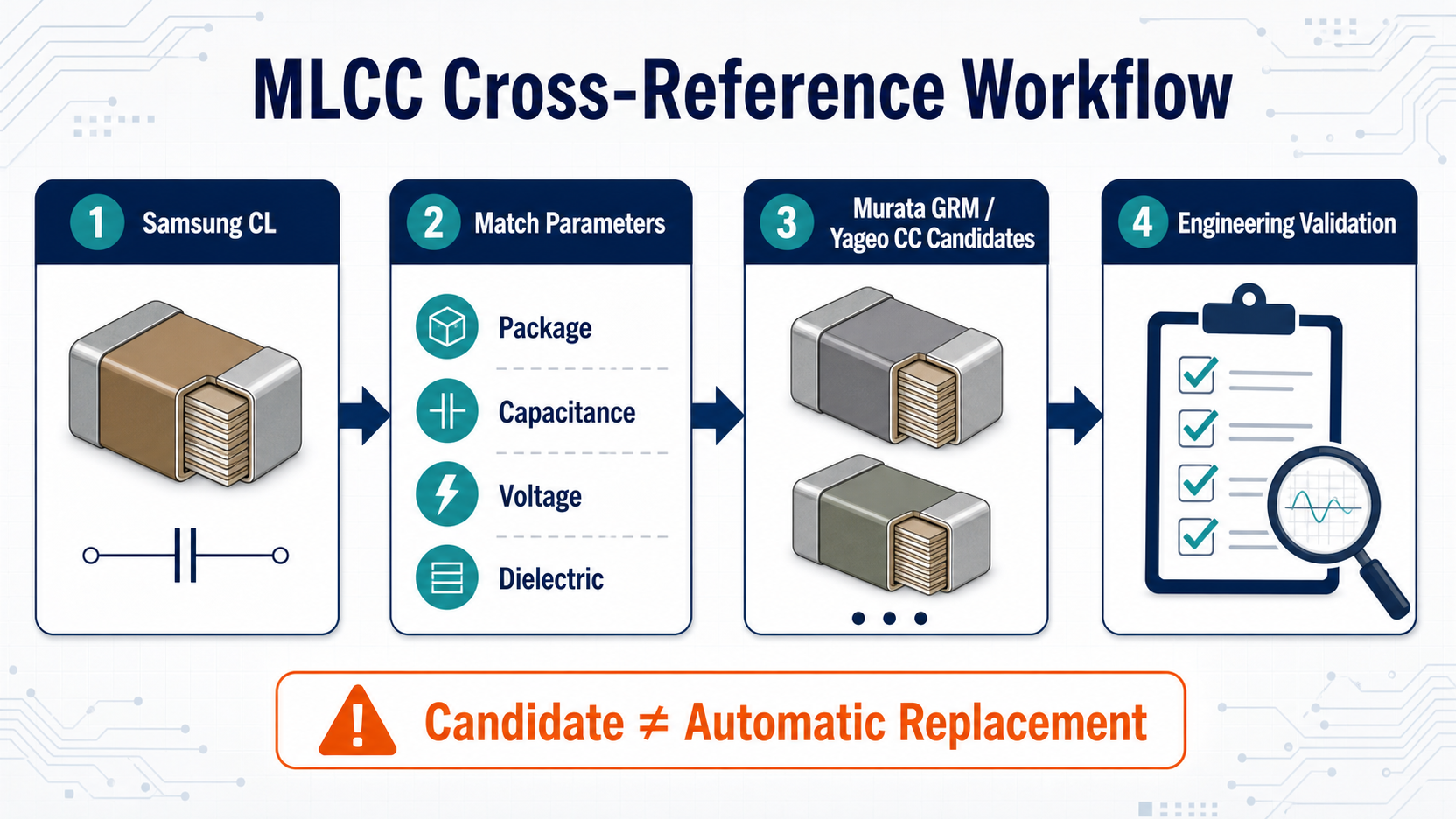
The table below matches nominal capacitance, tolerance, rated voltage, dielectric, and EIA case size. Dimensions and important restrictions are shown in the notes. Packaging suffixes are included so the candidate is a usable order-code starting point.
| Samsung starting part | Verified nominal specification | Murata GRM candidate | Yageo CC candidate | Validation notes |
|---|---|---|---|---|
| CL10A106MA8NRNC | 0603, X5R, 10 uF, +/-20%, 25 Vdc; 1.60 x 0.80 x 0.80 mm nominal | GRM188R61E106MA73D | CC0603MRX5R8BB106 | Strong nominal match. Compare DC-bias curves at the rail voltage and confirm dimensional tolerance, termination, application category, and reel requirements. |
| CL05B104KO5NNNC | 0402, X7R, 100 nF, +/-10%, 16 Vdc; 1.00 x 0.50 x 0.50 mm nominal | GRM155R71C104KA88D | CC0402KRX7R7BB104 | The three nominal sets align closely. Confirm the specific application class, electrical-characteristic curves, termination requirements, and approved packaging. |
| CL05A106MP5NUNC | 0402, X5R, 10 uF, +/-20%, 10 Vdc; Samsung status: NRND | GRM155R61A106ME11D | CC0402MRX5R6BB106 | High-review row. Samsung recommends CL05A106MP6NUN#; the Murata candidate is limited to mobile devices, and the Yageo sheet states AEC-Q200: No. Validate lifecycle, permitted application, height, and effective capacitance. |
| CL21A106KOQNNNE | 0805, X5R, 10 uF, +/-10%, 16 Vdc; 1.25 mm nominal thickness | GRM21BR61C106KE15L | CC0805KRX5R7BB106 | The Murata body is also 1.25 mm nominal. The cited Yageo body is 0.85 mm nominal, so assembly clearance and solder-joint/process review are required even though the footprint class and electrical headline match. |
| CL10A106KP8NNNC | 0603, X5R, 10 uF, +/-10%, 10 Vdc; 0.80 mm nominal thickness | GRM188R61A106KAALD | CC0603KRX5R6BB106 | Nominal electrical and body-size match. Compare tolerance windows, DC-bias behavior, permitted applications, termination, and packaging before approval. |
| CL05B103KB5NNNC | 0402, X7R, 10 nF, +/-10%, 50 Vdc; 1.00 x 0.50 x 0.50 mm nominal | GRM155R71H103KA88D | CC0402KRX7R9BB103 | Nominal candidate pair. Recheck the current Murata product page, voltage derating, application scope, insulation requirements, termination, and reel code at release. |
Important: a candidate in this table has passed a nominal parameter screen; it has not passed your circuit qualification. Current manufacturer pages and approval sheets take precedence over this summary.
DC Bias: Compare Effective Capacitance, Not Just the Reel Label
X5R and X7R are high-permittivity Class 2 dielectrics. Their compact capacitance density is useful, but capacitance changes when a DC voltage is applied. Murata's SimSurfing guidance explains that high-dielectric-constant MLCCs such as X5R show a DC-bias effect, while temperature-compensating types such as C0G/NP0 show little change by comparison. Samsung's cited product pages provide DC-bias graphs with measurement conditions, and Yageo's generated sheets point users to simulation data while warning that simulated responses are typical rather than specifications.
This is why two 10 uF, X5R, 10 V, 0603 parts can produce different rail ripple or transient response. The correct comparison is not simply “10 uF versus 10 uF.” It is the effective capacitance at the intended DC voltage, temperature, AC measurement amplitude, frequency, and expected aging point. If one tool reports a curve at a different AC test amplitude or temperature, do not subtract the two percentages as though they came from the same test.
A practical workflow is:
Enter the exact full order code in each manufacturer's product tool.
Read the DC-bias curve at the maximum normal operating rail voltage, not only at a convenient midpoint.
Apply capacitance tolerance and the relevant temperature change to the biased value.
Include aging or lifetime assumptions required by the design standard.
Verify that the resulting minimum capacitance still satisfies ripple, stability, hold-up, filter, or timing requirements.
Confirm the result with bench measurements on production-intent samples when the capacitor is functionally critical.
For more background, see Utmel's guides to MLCC DC-bias characteristics and ceramic capacitor dielectric classes.
Package Size, Height, and Pick-and-Place Implications
EIA case size primarily describes the length and width class. It does not promise the same thickness. The CL21A106KOQNNNE row makes the distinction visible: the Samsung and Murata parts have a 1.25 mm nominal thickness, while the cited Yageo candidate has a 0.85 mm nominal thickness. A shorter component may fit the same land pattern, but the change can still affect paste volume, solder fillet geometry, inspection settings, mechanical support, acoustic behavior, or process qualifications.
Dimensional tolerance windows also differ. CL10A106KP8NNNC lists 1.60 x 0.80 x 0.80 mm with +/-0.10 mm on each dimension, while the cited Murata and Yageo candidates use different width, length, or thickness tolerance bands. On a tolerant standard footprint this may be manageable; on a densely packed assembly, a rigid keep-out, or a tightly controlled inspection program, it must be reviewed rather than assumed.
Packaging is another separate field. Samsung's final suffix, Murata's final package code, and Yageo's packing-style character specify reel or tape options. Matching electrical performance does not ensure that feeder format, quantity per reel, tape material, or pitch matches the existing line setup.
Six Checks Before Approving an MLCC Substitute
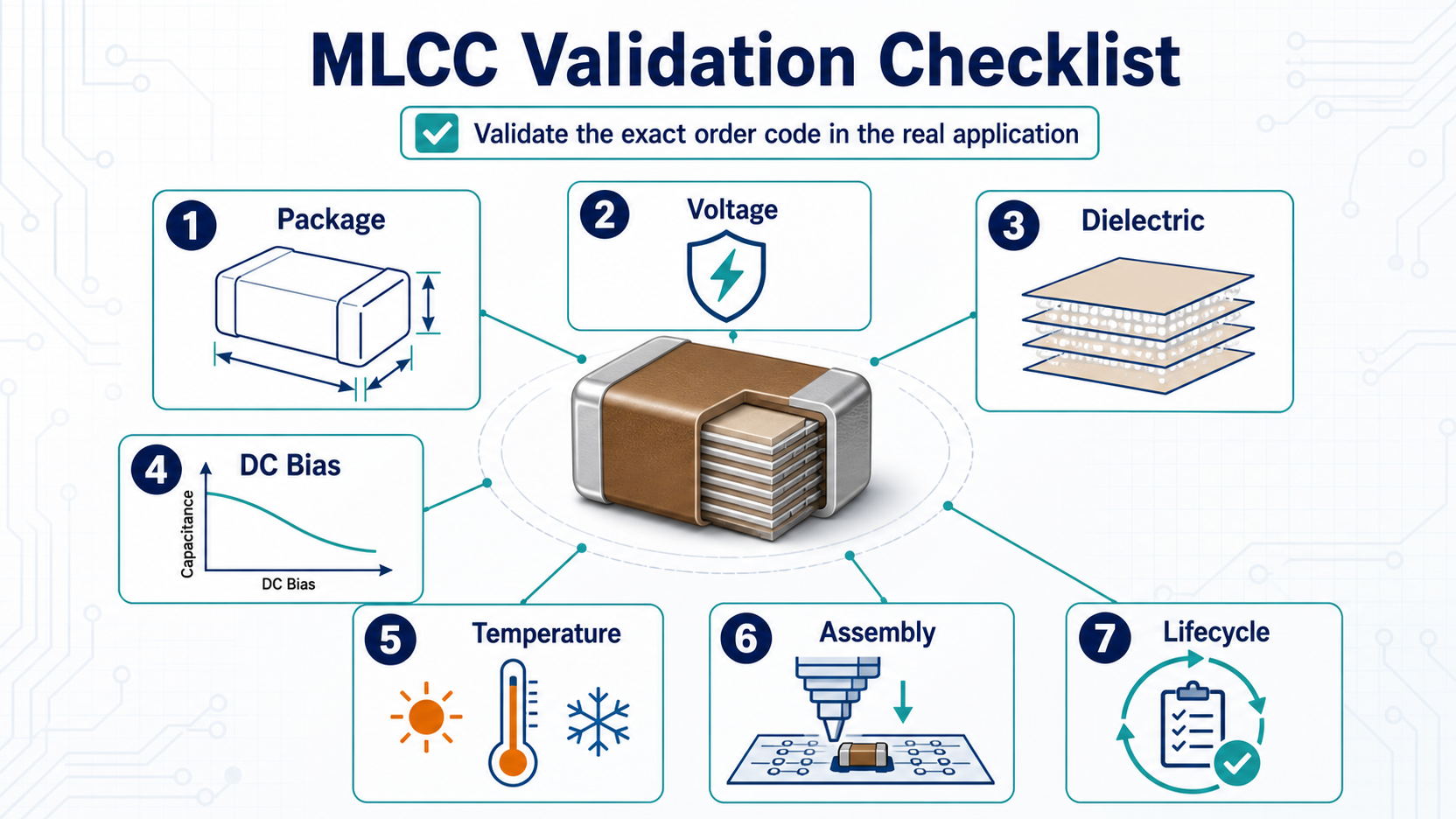
Electrical headline: match nominal capacitance, tolerance, rated voltage, dielectric/TCC class, and any required ESR, insulation-resistance, dissipation-factor, or ripple limits.
Effective capacitance: compare DC-bias, temperature, AC-voltage, frequency, and aging behavior using the exact order codes and relevant operating conditions.
Mechanical envelope: compare length, width, thickness, terminal dimensions, tolerance windows, recommended land pattern, board-flex exposure, and clearance to adjacent structures.
Application and qualification: verify consumer, industrial, mobile, medical, infotainment, or automotive eligibility; AEC-Q200 status; reliability level; and any project-specific approval list.
Lifecycle and traceability: check mass-production, NRND, discontinuation, manufacturer recommendation, PCN history, lot/date-code constraints, and documentation needed by quality.
Manufacturing and purchasing: confirm termination, RoHS/REACH requirements, tape and reel option, packing quantity, feeder compatibility, approved vendor route, sample validation, and current quotation.
What the Kynix Inquiry Signal Means for Sourcing
The Kynix data is used here only to establish that normalized Samsung inquiry activity followed an upward trend from June to July 2026, rising 50.9% month over month. It does not establish the availability, pricing, lifecycle, or technical suitability of any individual part.
That pattern supports a practical content and sourcing response: buyers need a validated multi-source shortlist, not just another product-page copy. It does not prove that the parts are globally scarce, overpriced, discontinued, or unavailable from every channel. In fact, five of the six cited Samsung pages currently show mass-production status, while CL05A106MP5NUNC is the lifecycle exception marked NRND. The right response is to separate lifecycle, technical fit, and current commercial availability.
Frequently Asked Questions
Can I replace a Samsung CL MLCC by matching only capacitance, voltage, dielectric, and case size?
No. Those fields create a shortlist, but approval should also cover effective capacitance under DC bias, body dimensions, termination, application restrictions, qualification, lifecycle, packaging, and circuit-level validation.
Are X5R and X7R equivalent dielectric classes?
No. Both are Class 2 dielectrics, but their specified temperature ranges differ. The cited X5R parts specify -55 to +85 degrees C, while the cited X7R parts specify -55 to +125 degrees C. Neither label by itself defines the part's DC-bias curve.
Why can two 10 uF MLCCs behave differently on the same rail?
Different dielectric formulations and constructions can produce different DC-bias, temperature, AC-voltage, frequency, aging, ESR, and ESL behavior. Compare the exact manufacturer curves at the intended operating conditions and verify the result in the circuit.
What should I do with CL05A106MP5NUNC in an existing BOM?
Start with a lifecycle review because Samsung currently marks the part NRND and recommends CL05A106MP6NUN#. Then compare the recommended Samsung part and any Murata or Yageo candidate against the original height, application scope, effective capacitance, termination, and manufacturing requirements. Do not treat the recommendation as permission to skip qualification.
Does a matching 0402, 0603, or 0805 code guarantee the same component height?
No. The EIA code identifies the length/width class. Thickness and its tolerance are separate fields, as shown by the 0805 candidates in this guide.
How can Utmel help with an MLCC cross-reference request?
Prepare the original part number, quantity, target application, operating voltage, temperature range, qualification level, preferred packaging, and any approved-vendor constraints. Submit them through the Utmel RFQ and BOM upload page so the commercial check can be separated from the engineering qualification.
Source and Validate MLCC Candidates with Utmel
Use this table to create a technically credible shortlist, then validate the exact order codes against current manufacturer documents and your production requirements. Utmel's ceramic capacitor catalog can support part discovery, while the RFQ page accepts a BOM and part-level purchasing requirements. Availability should be confirmed by quotation; a catalog page alone is not proof of stock.



![LR41 Battery, LR41 Battery Equivalent, LR41 and SR41 Cell Battery [FAQ]](https://res.utmel.com/Images/Article/edaf2000-e788-42b0-b239-6f7d52115528.jpg)