

 Product
 Brand
Brand Articles
 Tools
Tools
Difference Between BS170 N-Channel MOSFET vs. 2N7000 N-Channel MOSFET [Video&FAQ]


N-Channel Bulk 5Ohm @ 200mA, 10V ±20V 40pF @ 10V 60V TO-226-3, TO-92-3 (TO-226AA)
The 2N7000 and BS170 are two N-channel enhancement-mode MOSFETs with differing lead configurations and current ratings that are utilized for low-power switching applications. Other variations 2N7002, VQ1000J, and VQ1000P are sometimes listed together on the same datasheet. But what is the difference between the two of them? This article will answer your questions and show you their similarities and differences, as well as their interchangeability.

MOSFET BS170→2N7000
- What is a BS170 N-Channel MOSFET?
- What is a 2N7000 N-Channel MOSFET?
- BS170 vs 2N7000 Features Comparison
- BS170 vs 2N7000 Applications Comparison
- BS170 vs 2N7000 Where to use?
- BS170 vs 2N7000 As a Circuit
- BS170 vs 2N7000 Specs
- BS170 vs 2N7000 Equivalents
- BS170 vs 2N7000 Package
- BS170 vs 2N7000 Interchangeability
- Product Datasheet
What is a BS170 N-Channel MOSFET?

Pinout
The BS170 is a well-known N-channel MOSFET in a TO-92 package. Fairchild's patented high-density DMOS cell technology was used to create this product.
This ultra-high-density technology is designed to reduce state resistance while delivering stable, reliable, and quick switching.
It can be used for switching as well as amplification. It can drive a load of 500mA when used as a switch. It has fast switching capabilities and can swap load in roughly 7 nanoseconds, allowing it to be employed in high-speed circuits.
It can also operate at low voltages, making it a suitable MOSFET for use in portable and battery-powered devices. It can also be used as an amplifier, and it can be employed in audio amplifier circuits as well as for other general-purpose signal amplification needs.
Low voltage and low current applications, such as tiny servo motor control, power MOSFET gate drivers, and other switching applications, are also suited for the BS170.
What is a 2N7000 N-Channel MOSFET?
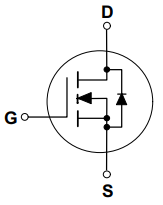
Pinout
The 2N7000 is an N-channel enhancement mode Field-Effect Transistor made with Fairchild's DMOS technology , which has a high cell density . This high-density method was created to reduce on-state resistance while providing durable, dependable, and quick switching performance. It can deliver pulsed current up to 2A and can be used in most applications requiring up to 400mA DC.
BS170 vs 2N7000 Features Comparison
BS170 Features
• Pb-Free device
• Low offset and error voltage
• Easily driven without buffer
• High density cell design to minimize ON-state resistance RDS(ON)
• Voltage controlled small signal switch
• Particularly suits for low voltage, low current application
• High saturation current capability
• Rugged and Reliable
• Fast switching (TON = 4ns)
2N7000 Features
• Small signal N-Channel MOSFET
• Drain-Source Voltage (VDS) is 60V
• Continuous Drain Current (ID) is 200mA
• Pulsed Drain Current (ID-peak) is 500mA
• Gate threshold voltage (VGS-th) is 3V
• Gate-Source Voltage is (VGS) is ±20V
• Turn ON and Turn off time is 10ns each.
• Available in To-92 Package
BS170 vs 2N7000 Applications Comparison
BS170 Applications
• Battery operated systems
• Solid-state relays
• Drivers: Relays, Solenoids , Lamps, Hammers, Displays, Memories, Transistors, etc.
• Direct Logic-Level Interface: TTL /CMOS
2N7000 Applications
• Switching High voltage loads
• Commonly used for small signal switching
• LED dimmers or flashers
• Low power Analog converters or inverters
BS170 vs 2N7000 Where to use?
| BS170 | 2N7000 |
| Designed for low voltage, low current applications like as servo motor control, power MOSFET gate drivers, and other switching applications using DMOS technology. Most applications that require up to 500mA DC current use the BS170. In addition, it's used in high-speed circuits. | The 2N7000 is an N-channel MOSFET with a tiny signal. MOSFETs are high-current, high-voltage power electronic switches that are similar to transistors. The 2N7000 MOSFET can switch loads that are less than 60V (VDS) and draw less than 200mA. (ID). This mosfet is packaged in a small TO-92 package and has a 3V threshold voltage, so if you're searching for a little mosfet to switch a load, this IC might be right for you. |
BS170 vs 2N7000 As a Circuit
| BS170 As a circuit | 2N7000 As a circuit |
|
|
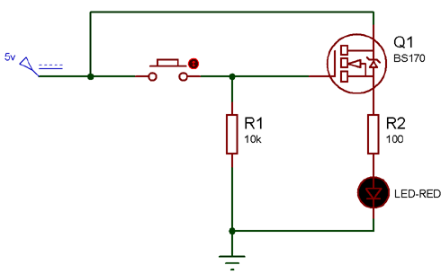
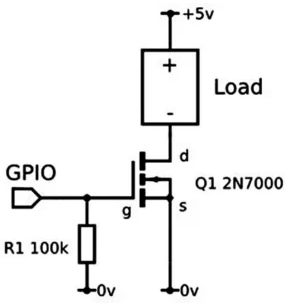
| We're only utilizing a BS170 N-channel MOSFET to switch on and off an LED in this design. A 5v DC source is used to connect the Gate and Drain terminals, and the LED is attached to the Source. MOSFET conduct current through Drain to Source as the gate pulse is delivered by turning on the switch, and LED begins to glow. The LED will stay on till the gate pulse is applied. LED turns off once the gate pulse is eliminated. | A resistor is connected on the gate, the load is connected on the drain, and the source is grounded, as shown in the diagram of the switching model circuit utilizing 2N7000. When we send a signal to a MOSFET, the resistor regulates the voltage and passes it to the gate for switching, and the load will operate as expected after MOSFET activity. |
BS170 vs 2N7000 Specs
| Characteristics | BS170 | 2N7000 |
| Drain to source voltage (VDSS) | 60V | 60V |
| Drain to gate voltage (VDG) | 60V | 60V |
| Gate to source voltage (VGS) | 20V | 20V |
| Gate to source breakdown voltage (BVVSS) | 60V | 60V |
| Drain current (ID) | 500mA | 200mA |
| Power dissipation | 830mW | 400mW |
| Gate to body leakage current forward (IGSSF) | – | 10nA |
| Gate to source threshold voltage (VGS(th)) | 0.8V | 0.8V |
| Zero gate voltage drain current (IDSS) | 0.5uA | 1uA |
| Package | TO-92 | TO-92 |
BS170 vs 2N7000 Equivalents
BS170 vs 2N7000 Package
The followings show you the Package of two MOSFETs.
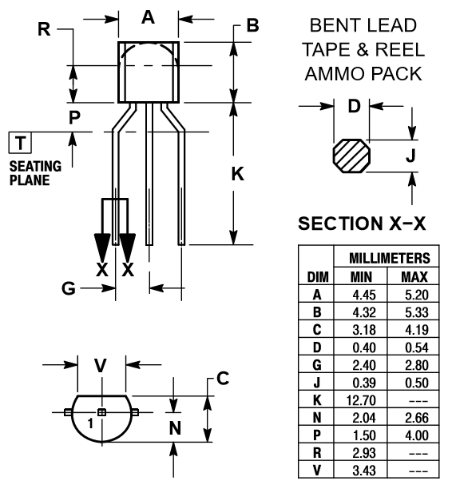
BS170 Package
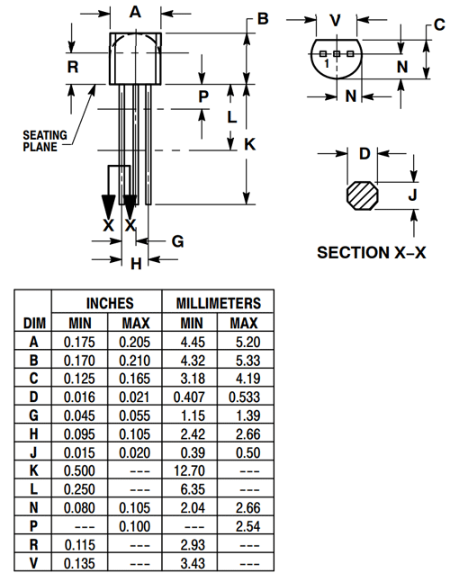
2N7000 Package
BS170 vs 2N7000 Interchangeability
Both the 2N7000 and the BS170 are 60 V devices that come in a TO-92 package. 200 mA can be switched using the 2N7000. With a maximum on-resistance of 5 at 10 V Vgs, the BS170 can switch 500 mA. The 2N7002 is a comparable part to the 2N7000, however, it is packaged differently.
Because their voltage specs, such as terminal voltage and threshold voltage values, are the same, the 2N7000 and BS170 MOSFETs are the most similar devices.
However, in terms of current specifications, the BS170 has a greater load capability; its power dissipation is twice that of the 2N7000.
Product Datasheet
What is a BS170?
BS170 is a well-known N channel MOSFET manufactured in the TO-92 package. produced using Fairchild's proprietary high-density DMOS cell technology. This ultra-high-density process is designed to minimize resistance in the state while providing robust, reliable, and fast switching performance.
Is BS170 a NMOS?
The BS170 is an N-channel enhancement-mode Field Effect Transistor produced using high cell density, DMOS technology. This very high-density process has been designed to minimize on-state resistance while providing rugged, reliable, and fast switching performance.
How does a 2N7000 work?
In 2N7000, the conduction between source and drain is carried out by the movement of electrons. In this transistor, the source and drain are made up of n-type material while its body and substrate are made up of p-type material.
What type of transistor is 2N7000?
The 2N7000 is an N-channel enhancement-mode Field Effect Transistor produced using high cell density, DMOS technology. This very high-density process has been designed to minimize on-state resistance while providing rugged, reliable, and fast switching performance.
What package does the BS170 come with?
TO-92.
What type of technology was Fairchilds DMOS cell technology used to create the BS170?
Ultra-high-density.
What can the BS170 be used for?
Switching.
What can the BS170 drive when used as a switch?
500mA.
How long can the BS170 swap load in?
7 nanoseconds.
What types of devices is the BS170 a suitable MOSFET?
Portable and battery-powered devices.
What type of applications are also suited for the BS170?
Low current.
What is the 2N7000?
Field-Effect Transistor.
What was Fairchilds DMOS technology created?
Reduce on-state resistance.
What can the 2N7000 deliver?
Pulsed current up to 2A.
 MAX16054AZT+T Controller: Circuits, Pinout, and Datasheet
09 March 20224833
 Unraveling the Silicon Labs C8051F000/1/2/5/6/7 and C8051F010/1/2/5/6/7 Series Mixed-Signal 32KB ISP FLASH MCUs
29 February 2024245
 MAX3232IPWR: Driver, Receiver, 15kV
29 March 2022358
 ATTINY2313 8-bit AVR Microcontroller: Pinout, Datasheet and Programming
01 November 20218533
 LF353N Dual JFET Input Op-Amp: Datasheet, Pinout and Equivalents
15 September 202112958
 TPS5430DDAR Converter: Features, Applications and Datasheet
06 December 20232741
 NC7SB3157P6X: Overview, Features, and Applications
14 December 2023850
 L7806CV Voltage Regulator: Pinout, Schematic Diagram, and Circuits
16 August 202110465
 Trusted Vibration Sensors for Homeowners and Industry Professionals
17 July 20251489
 What Is a Decoupling Capacitor? Function, Placement, and Selection Guide
14 July 202613772
 What is a Force Sensor?
19 April 202112207
 Essential Tips for Maintaining Safety Relays in Industrial Settings
10 July 20252699
 Assessing the Effectiveness of Transient Voltage Suppressors in Modern Electronics
05 June 2025653
 Vibration Isolator: Types and Applications
13 January 202112891
 Software Tools for NXP Microcontroller Development
06 June 20251958
 How to Test and Diagnose CAN Bus Transceiver Failures
07 June 20257679
ON Semiconductor
In Stock: 2000
United States
China
Canada
Japan
Russia
Germany
United Kingdom
Singapore
Italy
Hong Kong(China)
Taiwan(China)
France
Korea
Mexico
Netherlands
Malaysia
Austria
Spain
Switzerland
Poland
Thailand
Vietnam
India
United Arab Emirates
Afghanistan
Åland Islands
Albania
Algeria
American Samoa
Andorra
Angola
Anguilla
Antigua & Barbuda
Argentina
Armenia
Aruba
Australia
Azerbaijan
Bahamas
Bahrain
Bangladesh
Barbados
Belarus
Belgium
Belize
Benin
Bermuda
Bhutan
Bolivia
Bonaire, Sint Eustatius and Saba
Bosnia & Herzegovina
Botswana
Brazil
British Indian Ocean Territory
British Virgin Islands
Brunei
Bulgaria
Burkina Faso
Burundi
Cabo Verde
Cambodia
Cameroon
Cayman Islands
Central African Republic
Chad
Chile
Christmas Island
Cocos (Keeling) Islands
Colombia
Comoros
Congo
Congo (DRC)
Cook Islands
Costa Rica
Côte d’Ivoire
Croatia
Cuba
Curaçao
Cyprus
Czechia
Denmark
Djibouti
Dominica
Dominican Republic
Ecuador
Egypt
El Salvador
Equatorial Guinea
Eritrea
Estonia
Eswatini
Ethiopia
Falkland Islands
Faroe Islands
Fiji
Finland
French Guiana
French Polynesia
Gabon
Gambia
Georgia
Ghana
Gibraltar
Greece
Greenland
Grenada
Guadeloupe
Guam
Guatemala
Guernsey
Guinea
Guinea-Bissau
Guyana
Haiti
Honduras
Hungary
Iceland
Indonesia
Iran
Iraq
Ireland
Isle of Man
Israel
Jamaica
Jersey
Jordan
Kazakhstan
Kenya
Kiribati
Kosovo
Kuwait
Kyrgyzstan
Laos
Latvia
Lebanon
Lesotho
Liberia
Libya
Liechtenstein
Lithuania
Luxembourg
Macao(China)
Madagascar
Malawi
Maldives
Mali
Malta
Marshall Islands
Martinique
Mauritania
Mauritius
Mayotte
Micronesia
Moldova
Monaco
Mongolia
Montenegro
Montserrat
Morocco
Mozambique
Myanmar
Namibia
Nauru
Nepal
New Caledonia
New Zealand
Nicaragua
Niger
Nigeria
Niue
Norfolk Island
North Korea
North Macedonia
Northern Mariana Islands
Norway
Oman
Pakistan
Palau
Palestinian Authority
Panama
Papua New Guinea
Paraguay
Peru
Philippines
Pitcairn Islands
Portugal
Puerto Rico
Qatar
Réunion
Romania
Rwanda
Samoa
San Marino
São Tomé & Príncipe
Saudi Arabia
Senegal
Serbia
Seychelles
Sierra Leone
Sint Maarten
Slovakia
Slovenia
Solomon Islands
Somalia
South Africa
South Sudan
Sri Lanka
St Helena, Ascension, Tristan da Cunha
St. Barthélemy
St. Kitts & Nevis
St. Lucia
St. Martin
St. Pierre & Miquelon
St. Vincent & Grenadines
Sudan
Suriname
Svalbard & Jan Mayen
Sweden
Syria
Tajikistan
Tanzania
Timor-Leste
Togo
Tokelau
Tonga
Trinidad & Tobago
Tunisia
Turkey
Turkmenistan
Turks & Caicos Islands
Tuvalu
U.S. Outlying Islands
U.S. Virgin Islands
Uganda
Ukraine
Uruguay
Uzbekistan
Vanuatu
Vatican City
Venezuela
Wallis & Futuna
Yemen
Zambia
Zimbabwe
![2N7002LT1G]() 2N7002LT1G
2N7002LT1GON Semiconductor
![NTA4153NT1G]() NTA4153NT1G
NTA4153NT1GON Semiconductor
![FDB24AN06LA0]() FDB24AN06LA0
FDB24AN06LA0ON Semiconductor
![FDI2532]() FDI2532
FDI2532ON Semiconductor
![FDD16AN08A0-F085]() FDD16AN08A0-F085
FDD16AN08A0-F085ON Semiconductor
![BSS138K]() BSS138K
BSS138KON Semiconductor
![BSS138LT1G]() BSS138LT1G
BSS138LT1GON Semiconductor
![BSS138L]() BSS138L
BSS138LON Semiconductor
![NVR5198NLT1G]() NVR5198NLT1G
NVR5198NLT1GON Semiconductor
![NDS0605]() NDS0605
NDS0605ON Semiconductor


