Product
 Brand
Brand Articles
 Tools
Tools
In-Depth Analysis of Q1 2026 Memory Chip Market & Stocking Guide
Introduction: The Memory Market's Fiery Start and the Dawn of a "Supercycle"
Summary: The memory chip market in 2026 is experiencing an unprecedented pricing supercycle driven by explosive AI demand. With manufacturers reallocating capacity to High Bandwidth Memory (HBM) and enterprise SSDs, conventional DRAM and NAND flash prices are projected to surge by up to 95% and 60% respectively in Q1 2026. Procurement teams must lock in orders early and diversify suppliers to navigate this severe supply shortage.
The year 2026 has kicked off with an unprecedented surge in the memory chip market, a trend that began in late 2025 and has now intensified into a full-blown pricing storm. Both original manufacturers and the spot market are witnessing historic highs, signaling the potential start of a memory "supercycle." As a procurement manager or an engineer designing the next generation of products, understanding this volatile landscape is not just important—it's critical for survival.
To put this into perspective, market analysts are sounding the alarm with startling figures. Official forecasts from industry trackers like TrendForce predict that contract prices for conventional DRAM could leap by an astonishing 90-95% quarter-over-quarter (QoQ) in the first quarter of 2026 alone [1]. More specific and alarming are the whispers from the supply chain, suggesting that quotes for certain high-demand server DRAM modules have already skyrocketed by around 90% compared to the previous quarter [2]. This article delves into the profound reasons behind this dramatic price hike, analyzes the impact across different memory segments, and provides professional procurement guidance from Utmel to help you navigate these turbulent times.
Deep Dive: Why Are DRAM Prices Skyrocketing?
DRAM prices are skyrocketing in 2026 because major semiconductor manufacturers are aggressively reallocating their production capacity toward High Bandwidth Memory (HBM) to satisfy the massive demand from AI data centers, creating a severe supply shortage for conventional memory chips.
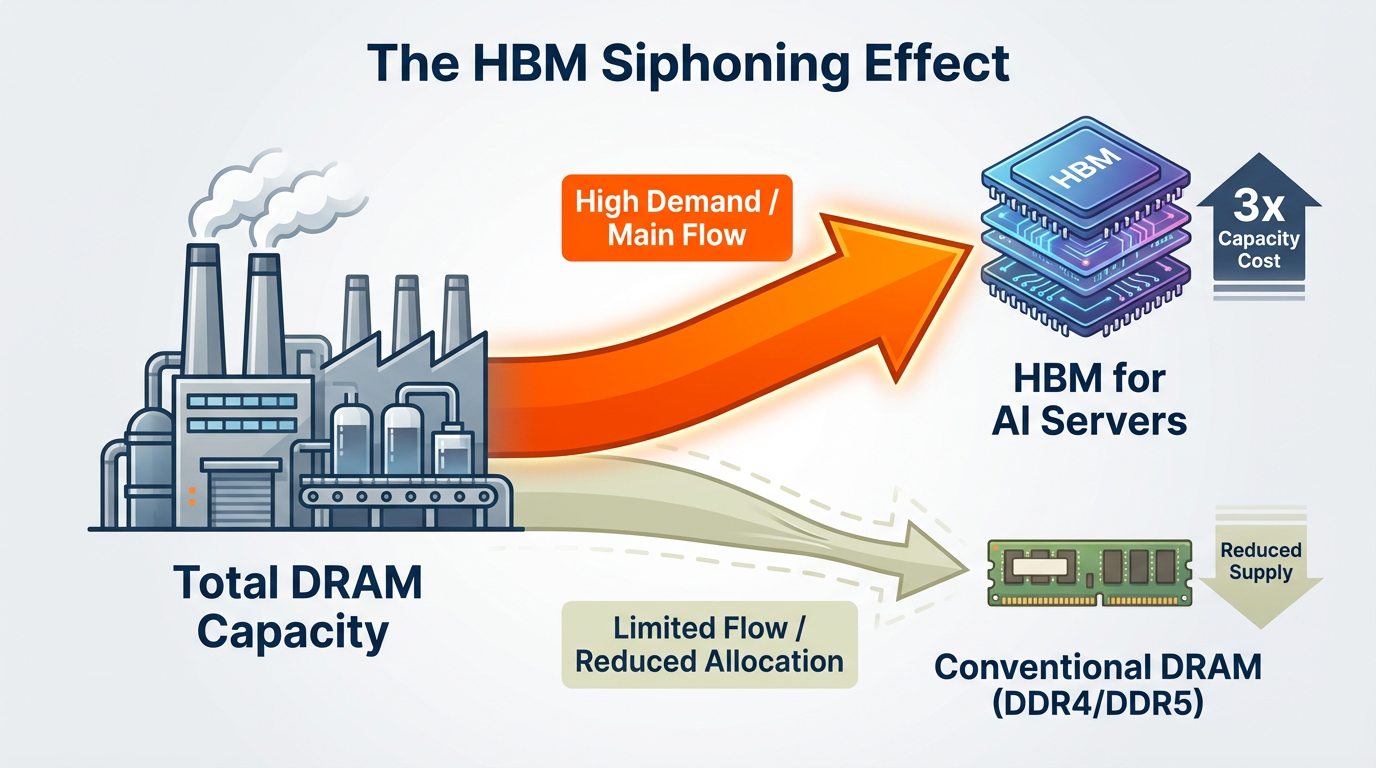
The HBM Siphoning Effect: AI's Insatiable Appetite
The primary catalyst for the current DRAM shortage is the explosive growth of Artificial Intelligence (AI). The demand for High Bandwidth Memory (HBM), a specialized, high-performance DRAM essential for training and running large AI models, has forced major manufacturers like Samsung and SK Hynix to make a pivotal strategic shift. They are reallocating a significant portion of their production capacity, particularly their most advanced process nodes, to maximize HBM output.
This reallocation is not a simple one-to-one exchange. According to executives at Micron, producing one bit of HBM memory requires sacrificing the production of approximately three bits of conventional DRAM[3]. This 3:1 trade-off ratio creates a massive "siphoning effect," where the immense demand for HBM effectively vacuums up the available manufacturing capacity, leaving a much smaller pie for standard memory products.
Conventional Capacity Under Pressure: The DDR4/DDR5 Squeeze
As HBM production takes precedence, the output of conventional memory, including the widely used DDR4 and the newer DDR5, is inevitably curtailed. This has led to a severe supply-demand imbalance. While demand from traditional sectors like PCs, smartphones, and consumer electronics remains steady or is growing, the supply is shrinking. Manufacturers are prioritizing their most lucrative customers—hyperscale data centers and AI developers—who are less price-sensitive and are locking in capacity for the entire year [4].
This has created a stark price inversion phenomenon, where the spot price (the price for immediate delivery on the open market) is significantly higher than the contract price (the pre-negotiated price for large, long-term orders). This inversion is a classic indicator of an extreme shortage, as desperate buyers are willing to pay a substantial premium to secure any available stock. For procurement teams, this means that relying on last-minute spot market purchases has become an incredibly expensive and risky gamble.
Explore our inventory of leading memory brands to secure your supply:
Utmel's Samsung/SK Hynix/Micron Brand Zone
Why Are NAND Flash and Enterprise SSD Prices Surging?
NAND Flash and enterprise SSD prices are surging because the rapid expansion of AI infrastructure requires massive, high-speed storage, forcing suppliers to prioritize high-margin enterprise drives over consumer client SSDs.
Demand-Driven Inflation
The pricing pressure is not confined to DRAM. The NAND Flash market, which forms the basis for Solid-State Drives (SSDs), is experiencing a parallel surge. This is primarily driven by the same force: the build-out of data centers and AI servers. These systems require vast amounts of high-speed, high-capacity storage to handle massive datasets for AI training and inference. The demand for enterprise-grade SSDs has exploded, pulling the entire NAND market along with it.
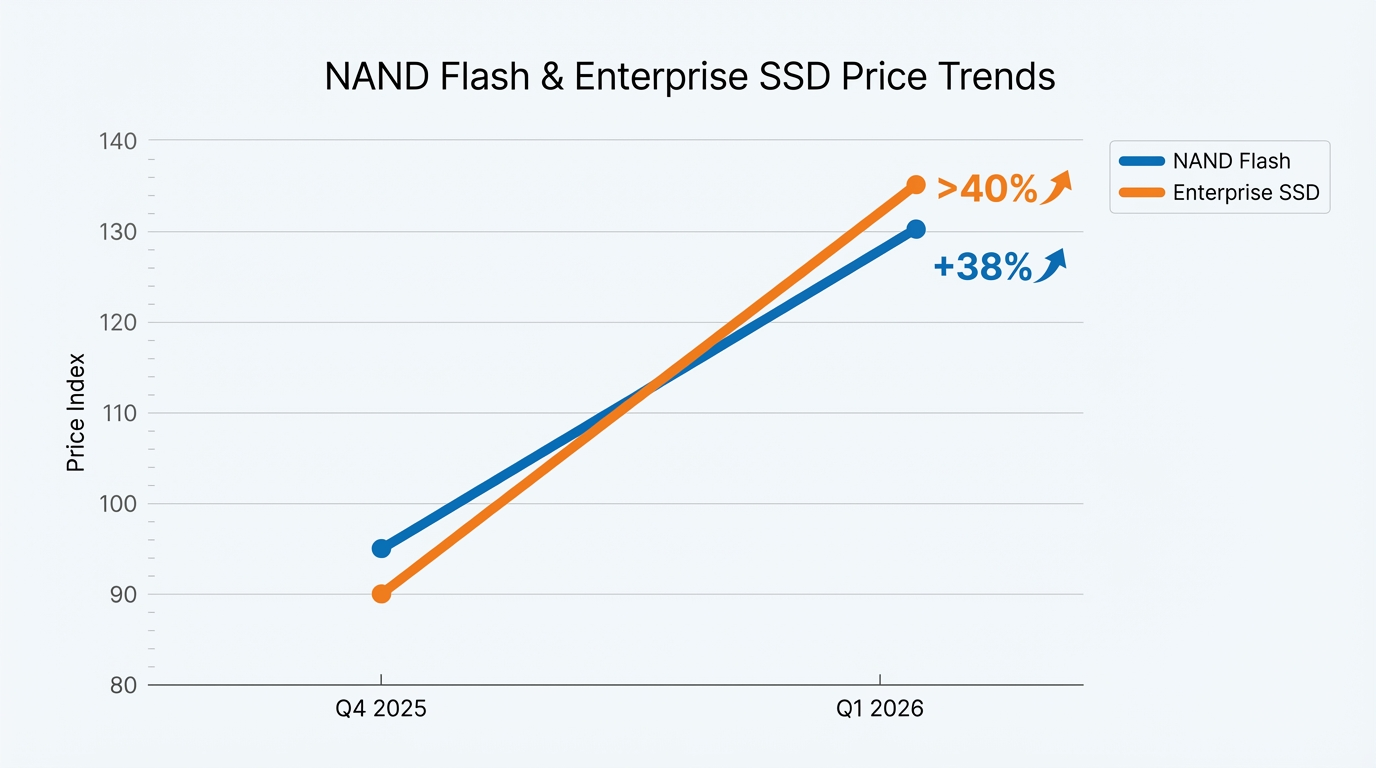
The price increase propagates through the supply chain, starting from the NAND wafers themselves and moving up to the final SSD modules. TrendForce forecasts that NAND Flash contract prices will rise by a substantial 55-60% in Q1 2026, with some segments seeing even steeper hikes [1].
The Epicenter of the Shortage: Enterprise SSDs
Within the NAND market, enterprise SSDs are unequivocally the "disaster zone." They are facing the most severe combination of price hikes and shortages. As manufacturers shift their focus to these high-margin products, the supply of client SSDs (for PCs and consumer devices) is also being squeezed, with projected price increases exceeding 40% QoQ, while enterprise SSDs face hikes of 53-58% [1]. This makes sourcing high-capacity SSDs for servers, workstations, and data-intensive applications a major challenge for businesses worldwide.
The situation is so acute that enterprise SSDs are projected to become the single largest application segment for NAND Flash in 2026, overtaking smartphones and PCs [1]. This structural shift underscores the long-term nature of the current supply constraints.
Find the high-performance storage you need in our catalog:
Utmel's SSD & Flash Product Directory
Q1 2026 Market Outlook: Will the Surge Stop?
Based on current capacity allocations and relentless AI demand, the memory price surge will not stop in early 2026; analysts project prices will remain elevated throughout the year until new fabrication plants come online in 2027.
Based on the current capacity allocation strategies of major suppliers and the relentless demand from the AI sector, a price correction in the first or second quarter of 2026 is highly unlikely. The supply-demand gap is expected to persist, if not widen. A report from Tom's Hardware, citing industry analysis, suggests that data centers could consume as much as 70% of all memory produced in 2026 , a situation described as a "permanent reallocation" of capacity[5].
The most significant threat to businesses is no longer just the price, but the risk of extended lead times and an inability to procure components at any cost. The market is rapidly shifting towards a state of "money can't buy chips," where even those willing to pay exorbitant prices may face empty shelves and delivery times stretching for months. This poses a severe risk to production schedules and product launches.
Q1 2026 Price Forecast Summary
| Memory Category | Q1 2026 QoQ Contract Price Forecast [1] |
|---|---|
| Server DRAM | ~ 90% Increase |
| Conventional DRAM (Overall) | 90-95% Increase |
| Client SSD | > 40% Increase |
| NAND Flash (Overall) | 55-60% Increase |
Procurement Strategy & The Utmel Solution
Key Categories to Watch
Procurement managers must now strategically focus on the most vulnerable product categories:
Server Memory Modules (DIMMs): Especially high-density DDR5 RDIMMs, which are at the heart of the supply crunch.
High-Capacity Enterprise SSDs: Drives with 4TB, 8TB, and higher capacities are becoming exceedingly difficult to source.
Standard DDR4/DDR5: While not as extreme as server memory, supply is tightening across the board, impacting all sectors.
Recommendations for Procurement Managers
Lock In Orders Early: Do not wait for prices to stabilize or decline. The data strongly suggests the upward trend will continue. It is advisable to plan for at least two quarters ahead and place orders now to secure supply and pricing.
Embrace the Spot Market Strategically: While contract pricing is ideal, the reality is that long lead times from manufacturers are becoming untenable. A reliable distributor like Utmel, with access to the global spot market, can be a lifeline for bridging supply gaps and meeting urgent needs.
Diversify Your Supplier Base: Relying on a single source is more dangerous than ever. Working with a global distributor provides access to a wider network of inventory, increasing your chances of finding the components you need.
The Utmel Advantage
In a market defined by scarcity, Utmel's global supply chain network and deep market expertise are invaluable. We maintain a broad inventory of hard-to-find components, including legacy DDR4, cutting-edge DDR5, and enterprise-grade SSDs. Our team can help you navigate the complexities of the spot market, verify component authenticity, and secure the critical parts needed to keep your production lines running.
The Supercycle is Here. Don't Get Left Behind.
The memory market has fundamentally shifted. Proactive and strategic procurement is the only way to mitigate the risks of price volatility and crippling shortages.
Frequently Asked Questions
When will RAM prices drop in 2026?
Analysts expect RAM prices to remain elevated throughout 2026, with potential stabilization only occurring in late 2026 or 2027. Meaningful price drops are unlikely until new fabrication capacity from major manufacturers like Samsung and SK Hynix becomes fully operational to meet AI demand.
Why are SSD prices going up in 2026?
SSD prices are surging because manufacturers are shifting NAND flash production toward high-margin enterprise SSDs required for AI data centers. This reallocation leaves consumer and client SSD markets severely undersupplied, driving contract prices up by over 50 percent in early 2026.
Is DDR4 memory still being manufactured?
Yes, but production is rapidly declining. Manufacturers are phasing out older DDR4 lines to prioritize DDR5 and High Bandwidth Memory (HBM). This structural shift makes legacy DDR4 modules increasingly scarce and expensive for businesses maintaining older server and PC architectures.
References
[1] TrendForce. (2026, February 2). Memory Price Outlook for 1Q26 Sharply Upgraded; QoQ Increases of All Product Categories to Hit Record Highs. Retrieved from https://www.trendforce.com/presscenter/news/20260202
[2] Tom's Hardware. (2026, March 5). Spiralling memory spot prices could trigger 'industry cycle collapse'. Retrieved from https://www.tomshardware.com/
[3] CNBC. (2026, January 10). AI memory is sold out, causing an unprecedented surge in prices. Retrieved from https://www.cnbc.com/2026/01/10/micron-ai-memory-shortage-hbm-nvidia-samsung.html
[4] SK hynix Newsroom. (2026, January 5). 2026 Market Outlook: SK hynix's HBM to Fuel AI Memory Supercycle. Retrieved from https://news.skhynix.com/2026-market-outlook-focus-on-the-hbm-led-memory-supercycle/
[5] Tom's Hardware. (2026, January 18). Data centers will consume 70 percent of memory chips made in 2026. Retrieved from https://www.tomshardware.com/pc-components/ram/data-centers-will-consume-70-percent-of-memory-chips-made-in-2026-supply-shortfall-will-cause-the-chip-shortage-to-spread-to-other-segments
 UTMEL
UTMEL
We are the professional distributor of electronic components, providing a large variety of products to save you a lot of time, effort, and cost with our efficient self-customized service. careful order preparation fast delivery service
 Getting Started with Arduino: What is Arduino and How to Use Arduino BoardsUTMEL28 September 20237151
Arduino is an open-source electronics platform that includes software and programmable circuit boards, allowing beginners to build electronic projects by writing simple code. The article provides an overview of Arduino, including different board types, basic components, how to use the boards, and project ideas like an automated plant watering system.
Read More IoT Chips Lead Time 2026: Navigating MCU, PMIC, and Sensor ShortagesUTMEL15 July 2026754
Navigating component supply and allocation challenges in the 2026 IoT market. This procurement trend brief provides electronics engineers and component sourcing teams with a data-driven analysis of the IoT chips lead time 2026 landscape, detailing supply bottlenecks and alternative design strategies.
Read More MCU with Built-in NPU: How to Pick an Edge AI Microcontroller in 2026UTMEL30 July 20261161
Evaluating Edge AI microcontrollers requires looking beyond vendor-quoted TOPS metrics. This guide explains how to segment candidate parts into sensor, control, or vision tiers, calculate binding SRAM constraints, verify NPU operator support to avoid CPU fallbacks, and navigate production lifecycle risks. Follow a practical five-step engineering sequence to benchmark real models on physical evaluation boards.
Read More Top 5 Microcontrollers Defining IoT, Edge AI, and Power Efficiency in 2026: Sourcing and Selection GuideUTMEL15 August 2026599
This guide reviews the top five microcontrollers defining 2026 embedded designs—ESP32-S3, STM32U5, MSPM0G5187, CH32V003, and nRF54. It evaluates how contiguous SRAM limits, power duty cycling, and hardware acceleration impact edge AI and IoT performance. It also details strategic procurement methods for navigating mature-node supply chain risks, dual-footprint layouts, and component authentication.
Read More Arduino vs. Raspberry Pi: A Detailed ComparisonUTMEL24 April 20255765
Hello everyone, welcome to the new post today.This guide is going to talk in detail about Arduino vs. Raspberry Pi to clarify their differences and help you pick the right board based on your needs.
Read More
Subscribe to Utmel !
![SH8M64GAETCEBAI01]() SH8M64GAETCEBAI01
SH8M64GAETCEBAI01Smart Global Holdings
![SDSDQAD-064G-859]() SDSDQAD-064G-859
SDSDQAD-064G-859Western Digital Corporation
![SFSD8192N3BM1TO-I-GE-1D1-STD]() SFSD8192N3BM1TO-I-GE-1D1-STD
SFSD8192N3BM1TO-I-GE-1D1-STDSwissbit
![MTFC128GAOAOEA-WT ES]() MTFC128GAOAOEA-WT ES
MTFC128GAOAOEA-WT ESMicron Technology
![ROB0170]() ROB0170
ROB0170DFRobot
![U102]() U102
U102M5Stack
![XKSIM-304]() XKSIM-304
XKSIM-304CIT
![MTA72ASS16G72LZ-3G2B3]() MTA72ASS16G72LZ-3G2B3
MTA72ASS16G72LZ-3G2B3Micron Technology
![SFCF0032H1BK1MT-I-MS-553-SMA]() SFCF0032H1BK1MT-I-MS-553-SMA
SFCF0032H1BK1MT-I-MS-553-SMASwissbit
![SFCF1024H1BK2MT-I-MO-553-ECI]() SFCF1024H1BK2MT-I-MO-553-ECI
SFCF1024H1BK2MT-I-MO-553-ECISwissbit