

 Product
 Brand
Brand Articles
 Tools
Tools
Essential Tips for Maintaining Safety Relays in Industrial Settings
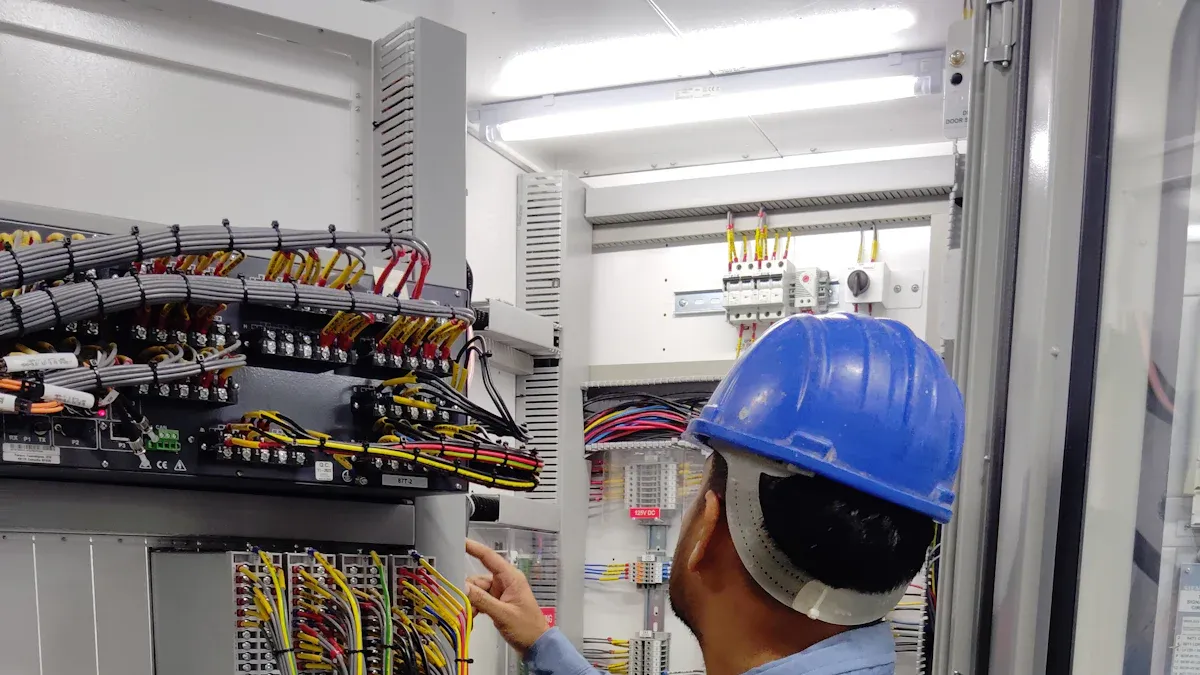
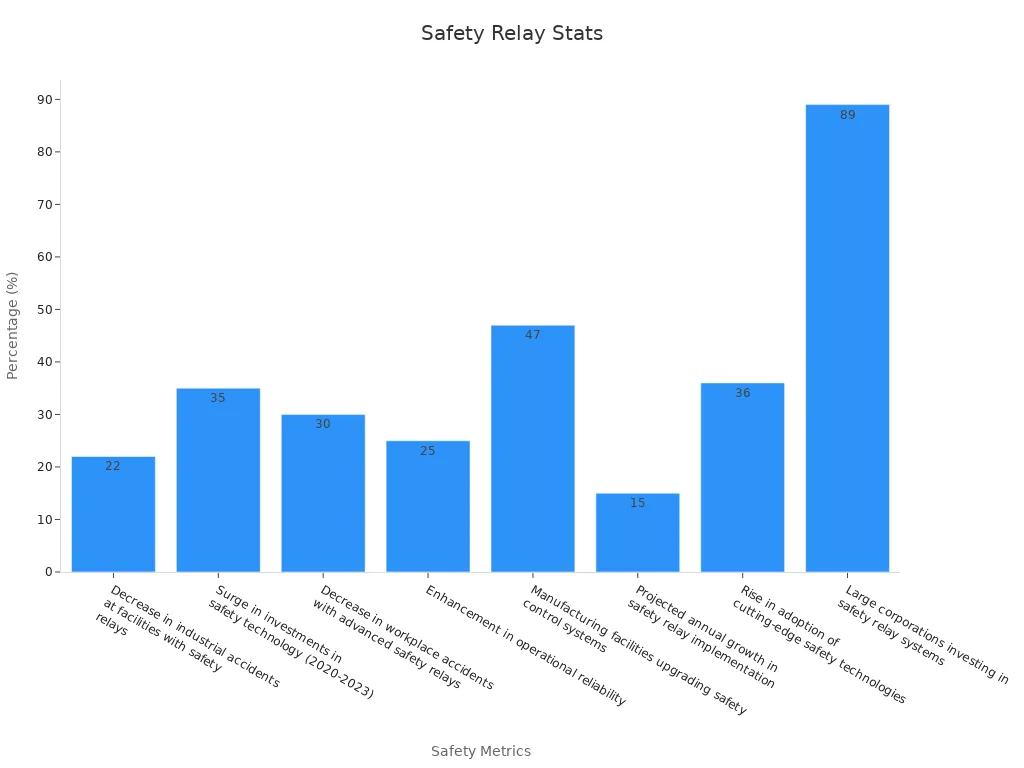
Neglecting safety relay upkeep exposes you to serious risks. Emergency repairs often cost up to ten times more than planned maintenance, and 70% of equipment failures are preventable. When you skip regular checks, you face costly downtime, lost profits, and even higher employee turnover. Reliable safety relays protect your workplace and boost operational reliability by 25%. The chart below shows how safety relay adoption leads to fewer accidents and greater safety across industries.
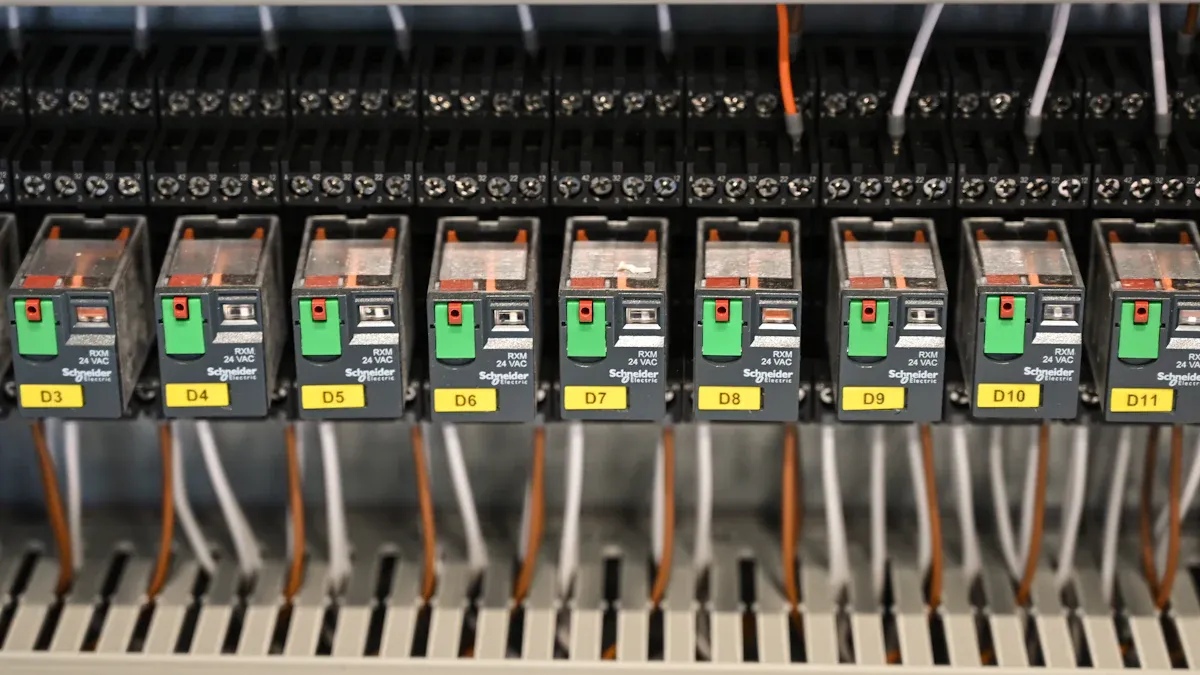
Regular maintenance of safety relay devices helps you avoid breakdowns, keep safety devices working, and ensure dependable safety systems.
Safety Relays Overview
What Are Safety Relays
You use safety relays to protect people and machines in industrial settings. These devices monitor and control safety functions, such as emergency stops and door interlocks. When a problem occurs, a safety relay reacts quickly to stop dangerous machinery. This fast response helps prevent injuries and equipment damage.
Industrial safety relays use an electromagnetic coil and a movable armature. When you apply power, the coil creates a magnetic field. This field moves the armature, which opens or closes contacts. Contacts can be Normally Open (NO) or Normally Closed (NC). This design ensures that safety relays work reliably in control systems.
Here is a table that shows the key features and performance metrics of safety relays:
| Aspect | Details |
|---|---|
| Relay Structure | Channels, contact types (NO, NC) |
| Principle of Operation | Electromagnetic coil and armature mechanism |
| Safety Features | Forcibly guided contacts, redundant design, monitoring functions |
| Electrical Parameters | Input/output voltage and current ratings, max switching capacity, contact resistance |
| Protection Features | Overload protection, DVDT capability |
| Diagnostic Coverage | Diagnostic coverage (DC) as per EN ISO 13849 standard |
| Environmental Factors | Ambient temperature, seismic and dust resistance, heat dissipation |
| Compliance Standards | EN ISO 13849, IEC 62061 |
| Example Specifications | Power supply: 24 V DC; Relay outputs: 3NO + 1NC; Max switching: 12 A; Contact resistance: <100 mΩ |
Why Maintenance Is Critical
You must keep safety relays in good condition to ensure reliable operation. Over time, dust, heat, and vibration can affect how these devices work. If you ignore regular checks, the risk of failure increases. When a safety relay fails, safety devices may not work as expected. This can lead to accidents or machine damage.
Studies show that the reliability of safety relays drops as they age. Maintenance plays a big role in keeping them safe. When you perform timely inspections and repairs, you restore the relay’s ability to protect your workplace. Regular maintenance helps you spot problems early and fix them before they cause harm.
Tip: Schedule routine checks for all safety relays. Early action keeps your safety systems strong and dependable.
Safety Relay Maintenance
Inspection Schedules
You should set up a regular inspection schedule for every safety relay in your facility. Start by checking each relay at least once every three months. Some high-use machines may need monthly checks. During each inspection, look for signs of wear, loose wiring, or discoloration. Use a checklist to make sure you do not miss any steps. Always follow the manufacturer's guidelines and your company’s safety standards. Regular monitoring helps you catch problems early and keeps your safety systems reliable.
Tip: Mark inspection dates on a visible calendar near your control panels. This helps everyone remember when the next check is due.
Voltage and Power Checks
You must always check voltage and power before working on a safety relay. Never exceed the rated voltage for any relay. Turn off all power sources before you begin any work. Use only approved voltage testers and follow the correct procedures. The table below shows why careful voltage checks matter for safety and cost:
| Evidence Aspect | Details |
|---|---|
| Injury Statistics | - 18.3% of facilities had personal injury using handheld voltage testers over 5 years. - 11.7% experienced plant operation interruptions due to voltage testing incidents. - 2,210 nonfatal electrical injuries in 2017 (35% increase from 2016). - 60% of arc and burn incidents occurred at low voltages (<1,000 V), mostly on three-phase systems. - Estimated 20% reduction in electrical injuries possible by better absence-of-voltage verification. |
| Procedural Validation | - NFPA 70E-2015 Article 120.56 requires testing each phase conductor both phase-to-phase and phase-to-ground. - Test instruments must be verified on a known voltage source before and after testing. - Permanently mounted Absence-of-Voltage Testers (AVTs) like VeriSafe meet NFPA 70E-2018 Article 120.5 requirements. |
| Device Features Supporting Safety | - Automated voltage absence verification without exposure to hazardous voltages. - Tests phase-to-phase and phase-to-ground. - Built-in pre/post verification tests. - Rated Safety Integrity Level (SIL) 3 per IEC 61508. - Reduces reliance on PPE and human error. |
| Economic Impact | - Average direct cost of electrical injury: $50,000 to $80,000. - Indirect costs can be nearly four times direct costs. - 51% of injured workers missed over one week of work; 40% missed two weeks or more. |
| Training and Complexity | - Handheld testers require extensive training and PPE. - Complexity and time consumption can lead to procedural shortcuts and normalization of deviance. - Permanently mounted AVTs reduce complexity and risk of human error. |
You can reduce electrical injuries by 20% if you verify the absence of voltage before starting work. Always test your voltage tester on a known live source before and after use. This step proves your tester works and keeps you safe.
Cleaning and Environment
A clean environment helps your safety relay work better and last longer. Dust, moisture, and chemicals can cause serious problems. Here are some key points to remember:
Dust and conductive particles can get between relay contacts, causing failures or short circuits.
High temperature and humidity can lead to oxidation and condensation inside the relay, which damages contacts and insulation.
Corrosive gases, such as sulfuric or organic vapors, can form films on contacts and cause corrosion.
Water, chemicals, or oil can cause rust, resin breakdown, and even burns on relay surfaces.
Magnetic dust can stick to relay parts and lower performance.
You should keep your relay cabinets closed and use filters if needed. Clean the area around your safety relays often. Avoid placing relays near sources of heat, moisture, or chemicals. A controlled environment prevents malfunctions and extends the life of your safety relay.
Testing Procedures
You need to test each safety relay to make sure it works as designed. Use both manual and automated tests. Functional testing checks that the relay responds to input signals and changes state correctly. Many facilities use relays rated for Safety Integrity Level (SIL) 3, which means they have passed strict audits and tests. These tests include checking the mechanical linkage of force-guided contacts and monitoring logic circuits. Third-party organizations, such as TÜV, audit these procedures to meet IEC 61508 standards. When you use SIL-rated relays, you get higher reliability and safety. Manufacturers also take responsibility for safety calculations, which reduces your workload and risk.
Note: Always document your test results. This record helps you track relay performance and spot trends over time.
Safe Replacement Steps
When you need to replace a safety relay, follow these steps to stay safe:
Turn off all power sources and lock out the circuit.
Use a voltage tester to confirm the absence of voltage.
Remove the old relay using insulated tools.
Check the wiring for damage or loose connections.
Install the new relay, making sure you match the wiring to the diagram.
Double-check all connections before restoring power.
Test the new relay to verify safe operation.
Never work on live circuits. Always avoid direct contact with exposed wires. Use proper wiring practices and follow all safety standards. Correct configuration and careful installation help prevent future problems.
⚠️ Always wear appropriate personal protective equipment (PPE) when working with electrical systems.
Common Safety Relay Faults
You will face several common faults when working with safety relays. Early detection helps you avoid downtime and keeps your safety systems strong. Regular inspection and testing let you spot problems before they cause harm.
Emergency Stop Issues
The emergency stop button is a critical part of any safety relay system. If this button fails, machines may not stop when needed. You should check the wiring and contacts for wear or corrosion. Sometimes, dust or moisture can block the signal. Test the emergency stop button during every inspection. If you notice slow response or no action, replace the faulty parts right away.
Tip: Always label and test each emergency stop button so everyone knows it works.
Door Interlock Problems
Door interlocks prevent machines from running when guards or doors are open. Common faults include broken actuators, misaligned sensors, or loose wiring. You should inspect the sensing mechanisms and actuators for damage. Make sure the door closes fully and the interlock engages. If you find any misalignment or wear, fix it before restarting the machine.
Sensor and Light Curtain Faults
Sensors and light curtains protect workers by stopping machines if someone enters a danger zone. Common faults here include dirty lenses, wiring issues, or failed sensors. Clean the sensors and check for loose connections. Test the system by breaking the light curtain beam to see if the safety relay responds. Replace any faulty sensors to keep your safety system reliable.
Relay Hardware Wear
Relay hardware can wear out over time. Contact erosion, coil overheating, and mechanical failure are common faults. You should track the number of switching cycles for each safety relay. Replace relays that reach their service life limits. The table below shows how often these faults occur and their impact:
| Aspect | Statistic / Description | Explanation |
|---|---|---|
| Failure Rate | 1,000 FIT for 3-pole forced-contact relay | About 16% fail after 20 years in typical use |
| Fault Distribution | Bathtub curve: early, random, wear faults | Early and wear faults rise over time; random faults stay constant |
| Service Life Metrics | B10 and B10d (dangerous failures) | B10 is cycles at 10% failure; B10d focuses on dangerous failures |
| Wear Failures | Related to switching cycles and load | More cycles mean more wear and higher chance of contact erosion |
| Fault Types | Coil overheating, mechanical failure, contact corrosion | Each type needs a different troubleshooting method |
| Redundancy Impact | Hardware fault tolerance and diagnostics help | Using two relays in series lowers failure risk, but common cause faults remain |
You can reduce the risk of common faults by following a strict inspection schedule. Early action saves money and keeps your safety relay system dependable.
Troubleshooting Safety Relays
Troubleshooting keeps your safety relay system reliable and your workplace safe. You need to know how to spot problems and fix them quickly. This section gives you step-by-step guidance for the most common issues.
Diagnosing Emergency Stops
When the emergency stop button fails, you risk serious accidents. Start troubleshooting by checking the wiring and connections. Look for loose wires or corrosion. Test the button to see if it sends a signal to the safety relay. If the machine does not stop, check the relay contacts for wear or dirt.
You should understand the diagnostic categories for emergency stop circuits. The table below shows how different diagnostic methods improve troubleshooting and safety:
| Diagnostic Category | Diagnostic Coverage (DCavg) | Fault Tolerance | Architecture Requirements | Performance Level (PL) | Description |
|---|---|---|---|---|---|
| Category 1 | None | No | Single-channel | PL=c (minimum for EMO) | Basic, well-tried safety principles, no diagnostics |
| Category 2 | 60% < DC ≤ 90% | No | Single-channel | PL=c | Some diagnostics, no fault tolerance |
| Category 3 | High (≥ 90%) | Yes | At least two channels | Higher than PL=c | Fault tolerant, redundancy required |
| Category 4 | High (≥ 90%) | Yes | At least two channels | Highest PL | Fault tolerant with continuous diagnostics |
You get better results when you use systems with high diagnostic coverage and redundancy. These systems catch faults early and keep your emergency stop working. Always reset the emergency stop manually. Never allow automatic resets. This step keeps your equipment in a safe state.
Tip: Always de-energize equipment when you activate the emergency stop. This action prevents unexpected restarts and protects workers.
Fixing Door Interlocks
Door interlocks stop machines when guards or doors open. If you find a problem, start troubleshooting by checking the actuator and sensor alignment. Make sure the door closes fully and the interlock engages. Inspect the wiring for damage or loose connections.
You should test the interlock by opening and closing the door several times. Watch the safety relay to see if it responds each time. If the relay does not react, replace the faulty sensor or actuator. Keep the area clean to prevent dust from blocking the sensors.
Note: Always follow lockout/tagout procedures before you repair or adjust door interlocks.
Resolving Sensor Faults
Sensors and light curtains protect workers by stopping machines when someone enters a danger zone. Troubleshooting sensor faults starts with a visual inspection. Clean the sensor lenses and check for dirt or debris. Examine the wiring for signs of wear or damage.
Test the sensor by breaking the beam or triggering the device. Watch the safety relay for a response. If the relay does not activate, replace the sensor. Modern relays provide real-time alerts, which help you spot problems faster and take action before a failure causes downtime.
Clean sensors regularly.
Replace damaged wires.
Test the system after every repair.
⚡ Quick action on sensor faults keeps your safety system strong and prevents accidents.
Replacing Relay Components
You must replace worn or damaged relay components to keep your safety system reliable. Start troubleshooting by identifying relays that show signs of wear, such as slow switching or burned contacts. Remove power before you begin any repair.
The table below highlights the benefits of timely relay component replacement:
| Aspect | Evidence Summary |
|---|---|
| Operational Efficiency | Timely replacement of overload and relay components prevents overheating and electrical overloading, minimizing power interruptions and disruptions. |
| Equipment Lifespan | Continuous monitoring by relays reduces stress on machinery, extending equipment life and reducing repair frequency. |
| Control and Monitoring | Modern relays provide real-time alerts enabling prompt corrective actions, stabilizing processes and improving reliability. |
| Cost-Effectiveness | Updated relays reduce maintenance costs and improve plant efficiency by preventing downtime and costly repairs. |
| Replacement Components | Electronic Shock Relays protect against electrical surges; Mechanical Shock Guards protect against mechanical torque surges, both preventing downtime. |
| Compliance and Safety | Products comply with multiple standards (UL, CE, CCC, CSA, IEC, ATEX, etc.), ensuring reliability and safety in various environments. |
Follow these steps for safe replacement:
Turn off all power and lock out the circuit.
Use a voltage tester to confirm the absence of voltage.
Remove the old relay with insulated tools.
Check the wiring for damage.
Install the new relay and match the wiring to the diagram.
Test the new relay to verify safe operation.
You improve operational efficiency and extend equipment life when you replace components on time. This approach reduces repair costs and keeps your safety relay system dependable.
Best Practices for Safety Relays
Staff Training
You need to train your staff to understand how protection systems work and how to respond in different situations. When your team knows what to do, you lower the risk of safety relay failures. Regular updates and hands-on practice help everyone stay sharp. Trained workers can spot problems early and take the right steps to keep your systems safe. Experts recommend that you keep your team’s skills current with ongoing training and professional guidance. This approach makes sure your safety relay systems work as they should.
Well-trained staff are your first line of defense against safety risks.
Quality Components
You should always choose high-quality components for your safety relay systems. Reliable parts help prevent malfunctions and keep your workplace safe. Look for these features when selecting components:
Force-guided contacts and fault-proof semiconductor outputs prevent malfunctions.
Rigorous testing ensures each relay meets strict performance standards.
Integrated diagnostics and constant signal monitoring allow early detection of problems.
Compliance with standards like SIL 3 certification means the relay meets key safety functions.
Immunity to test pulses keeps your system stable.
Removable terminal boards make replacement and testing easier.
You can also improve safety by using components designed for critical situations, adding redundancy, and applying isolation techniques. Regular testing and maintenance help you catch issues before they become serious.
Preventive Maintenance
You protect your equipment and people when you follow a preventive maintenance plan. Here are steps you can take:
Inspect and test protective relays every year to ensure proper operation.
Check for physical damage, wear, and contamination during visual and mechanical inspections.
Perform electrical tests to verify relay functions, such as pickup contacts and timing.
Confirm that relay operation triggers the correct circuit breaker.
Replace defective relays right away to maintain safety.
Use structured checklists to standardize your process and reduce mistakes.
A strong maintenance routine helps you avoid unexpected failures and costly repair work.
Documentation
You should keep clear records of all inspections, tests, and repairs. Good documentation helps you track the history of each safety relay. When you record every step, you make it easier to spot trends and plan future maintenance. Use checklists and logs to organize your information. This habit supports compliance with safety standards and improves your overall safety program.
Accurate records help you prove your commitment to safety and make audits easier.
You keep your workplace safe when you follow regular safety relay checks and maintenance. Industry studies show that using certified devices, training your team, and testing safety functions often leads to fewer failures.
Modern testing tools and standards like IEC 61508 and ISO 13849 help you improve safety and reliability.
Safety devices use special designs for fault tolerance and require careful selection.
Review your safety relay protocols today. Take action to protect your team and equipment.
FAQ
How often should you inspect safety relays?
You should inspect safety relays every three months. High-use machines may need monthly checks. Regular inspections help you find problems early and keep your safety systems working.
What signs show a safety relay needs replacement?
Look for slow switching, burned contacts, or unusual noises. If you see any of these signs, replace the relay right away. Quick action prevents bigger problems.
Can you clean safety relays with water or solvents?
Never use water or harsh solvents to clean safety relays. Use a dry cloth or a soft brush. Keep the area around the relay free from dust and debris.
Why is documentation important for safety relay maintenance?
Good records help you track inspections, repairs, and tests. You can spot patterns and plan future maintenance. Accurate documentation also helps you meet safety standards and pass audits.
 UTMEL
UTMEL
We are the professional distributor of electronic components, providing a large variety of products to save you a lot of time, effort, and cost with our efficient self-customized service. careful order preparation fast delivery service
 What is Time Delay Relay?UTMEL18 December 202514288
Hello everyone, I am Rose. Today I will introduce Time Relay to you. A Time Relay is an electrical component that is used on a circuit with a lower voltage or lower current to turn on or off a circuit with a higher voltage and bigger current or to regulate a higher voltage or larger power. This article will introduce some basic knowledge of Time Relay.
Read More What is Safety Relay?UTMEL12 April 202524666
Safety relays represent a critical advancement in industrial automation technology, serving as essential components in machine safety systems. Unlike standard relays, safety relays are specifically engineered to provide reliable protection in potentially hazardous environments. This article explores the fundamental aspects of safety relays, including their operational principles, wiring configurations, and proper implementation methods in industrial settings.
Read More What is Relay?UTMEL15 November 20217097
Hello everyone, I am Rose. Welcome back to the new post today. Relay is an autonomous electrical appliance used in electric drive systems for control, protection, and signal conversion. It is suitable for remote connection and disconnection of AC and DC small-capacity control circuits.
Read More AC Contactor: What is Self-Locking?UTMEL01 March 202211570
AC contactors often use three arc extinguishing methods: double-break electric arc extinguishing, longitudinal seam arc extinguishing and grid arc extinguishing. It is used to eliminate the arc generated by the moving and static contacts during the opening and closing process.This article mainly introduce the principle of AC Contactor self-locking.
Read More Weak Current Control Strong Current: How to use the Relay?UTMEL28 November 20225785
Hello everyone, I am Rose. Welcome to the new post today. Today I will introduce relay to you. Including its definition, parameters, working principle and so on.
Read More
Subscribe to Utmel !
![RC0603FR-071KL]() RC0603FR-071KL
RC0603FR-071KLYageo
![RC0805FR-071KL]() RC0805FR-071KL
RC0805FR-071KLYageo
![RC0201JR-070RL]() RC0201JR-070RL
RC0201JR-070RLYageo
![RC0402JR-070RL]() RC0402JR-070RL
RC0402JR-070RLYageo
![RC0603FR-075K1L]() RC0603FR-075K1L
RC0603FR-075K1LYageo
![RC0402FR-071KL]() RC0402FR-071KL
RC0402FR-071KLYageo
![AC0402FR-0710KL]() AC0402FR-0710KL
AC0402FR-0710KLYageo
![RC0402FR-074K7L]() RC0402FR-074K7L
RC0402FR-074K7LYageo
![RC0402JR-0710KL]() RC0402JR-0710KL
RC0402JR-0710KLYageo
![RC0402FR-07200KL]() RC0402FR-07200KL
RC0402FR-07200KLYageo


