Product
 Brand
Brand Articles
 Tools
Tools
What is a SAW Sensor? Types, Working and Applications

Surface acoustic wave technologies
Catalog
| Ⅰ Introduction |
| Ⅱ SAW sensor structure types |
| Ⅲ SAW sensor working principle |
| Ⅳ SAW sensor applications |
Ⅰ Introduction
Acoustic surface wave sensors can accurately measure physical, chemical information (such as temperature, stress, gas density). Due to the small size, the surface wave device is known as a new era of wireless and small sensors; at the same time, it has strong compatibility with integrated circuits and has been widely used in the field of simulated digital communication and sensing.
The SAW sensor can focus the signal on the surface of the substrate. It has a high operating frequency, high information-sensitive accuracy. It can quickly convert the detected information into electrical signal output, with real-time information detection characteristics. Additionally, SAW sensors also have the advantages of miniaturization, integrated, passive, low cost, low power, direct frequency signal output.
There has been formed a variety of types including acoustic surface wave pressure sensors, acoustic surface wave temperature sensors, acoustic surface wave biological genes, acoustic surface wave chemical gas phase sensors, and intelligent sensors.
The sound surface wave is an elastic wave propagating in a solid shallow surface, with a variety of modes. Rayleigh is the most widely used sound surface wave. Different types of sound surface waves have different characteristics, and the sensors made of them can be applied to different occasions detection.
Ⅱ SAW sensor structure types
The two basic configurations of the acoustic surface wave sensor are delay lines and resonators. and Figure 1 shows the sensor structure category of delay linear and resonant type. The delayed line-type and resonurable sound surface wave sensor is constructed by a piezoelectric substrate, a fork finger transducer, and a transmitting gate.

Figure 1. SAW sensor types
The delayed line-type SAW sensor receives a sinusoidal excitation signal through an antenna and is transmitted to the interdigital transducer, IDT. The sinusoidal signal is excited on the piezoelectric substrate, and the conversion of acoustic waves and electrical signals is realized. The sound surface wave propagates on the piezoelectric substrate after a period of time-delayed reaching the reflective gate, the reflective gate reflects partial acoustic wave, and the reflected sound wave is converted into a sinusoidal excitation signal by IDT, thereby achieving electroacoustic conversion.
The resonant sound surface wave sensor places IDT in 2 full reflection reflective gates. When the frequency of the excitation of the sound surface wave is equal to the resonator frequency, the SAW forms a standing wave between the reflective gate, and the energy reflected in the reflective gate reaches the maximum. The external excitation signal is loaded on the input IDT, and the IDT converts the electrical signal into a sound surface wave. The acoustic surface wave propagates along the surface of the piezoelectric crystal to both sides, and the two-side reflective gate reflects the output IDT, and finally realizes acoustic/electrical conversion.
Ⅲ SAW sensor working principle
The SAW device typically uses piezoelectric crystals (e.g., quartz crystals, etc.) as a medium. Then it generates sound waves by an additional positive voltage and propagating via a substrate, and then converted into an electrical signal output. The mainly active effect of the SAW sensor is the piezoelectric effect. Various factors need to be considered when designing: such as relative dimensions, sensitivity, efficiency, and the like. Generally, the signal frequency range of the wireless passive surface wave sensor ranges from 40 MHz to several GHz. Figure 2 shows the common structure commonly seen by the sound surface wave sensor, and the main part includes a piezoelectric substrate, an antenna, a sensitive film, IDT, and the like. The sensitive layer of the sensor achieves a change in frequency by changing the speed of the acoustic surface wave.

Figure 2. SAW sensor structure
Wireless passive SAW system package: transmitter, receiver, sound surface wave device, communication channel. The transmitter and receiver combine a single module of the transceiver or the interpreter. Figure 3 is a sound surface wave system and its interrelated base parts. The reader transmits the power to the sound surface wave device, which can be a continuous wave or pulse of the transceiver input. Generally, the power size obtained by the sound surface wave device has a limit to reducing the maximum transmit power, thereby obtaining the same average power. According to the isotropic radiator, the received signal is typically emitted by an efficient radiation power antenna.
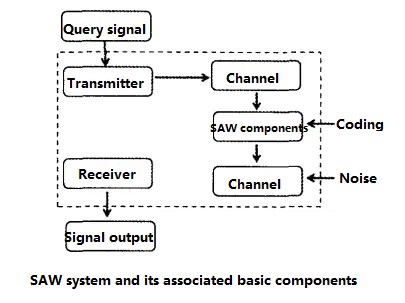
Figure 3. SAW system and its components
The wave velocity and frequency of the SAW device will drift as a change in the external environment. The acoustic surface wave gas sensor is to utilize such a performance of a gas-sensitive film that is selectively adsorbed to adsorbed gas in the surface of the piezoelectric crystal. The gas-sensitive film interacts with the gas to be tested (chemical or biological effects, or Physical adsorption), causes the membrane layer mass and conductivity of the gas-sensitive film to change, causing the acoustic surface wave frequency of the piezoelectric crystal to drift. The gas concentration is different and the degree of the film layer is different, that is, the variation of the wave frequency is also different. The change in reaction gas concentration can be accurately reactive by measuring the change in the acoustic surface wave frequency.
Ⅳ SAW sensor applications
1. Application of SAW Sensor in Intelligent Substation
In order to overcome the disadvantages of smart substation such as complex temperature detection environment, non-contact, low precision, and high cost. Researchers have developed a passive radio surface wave smart temperature sensor applicable to intelligent substations. The detection mechanism of the temperature sensor and sensor transceiver system are studied, and the development-based passive radio surface wave sensor is constructed of a smart substation temperature detection system. The experimental results show that the passive radio surface wave temperature sensor can thoroughly solve the installation of electric equipment temperature measurement, strong electromagnetic interference, high temperature, and high signal transmission, etc.
2. Application of SAW sensor in electric power equipment
Since the power equipment is working in high voltages, strong loads, and long-term non-power-on, the requirements for the temperature measuring device is naturally higher. The distribution of strong electric fields around the operating medium high voltage power equipment, and the temperature detecting sensor must have passive or self-sufficient functionality to ensure the safety of power equipment. In addition, the power devices are required to maintain a particular safety distance, so the volume of the detecting device should be as small as possible. Each of the various models of power equipment should be adapted, and the equipment maintenance cycle should be as long as possible to ensure long-term operation of the power equipment. The researchers studied the possibility of monitoring the temperature change of the power system during monitoring of the temperature change of the power system, and also developed a radio-frequency energy power sensor. The system is mainly composed of a dual-channel reader and a plurality of sensor nodes, and the sensor's node obtains energy from the energy delivered from the reader, while the transmitted radiofrequency energy is used as wake-up information of the data conflict. RF energy collection technology is a very suitable scientific surface wave sensor technology for power equipment.
3. Application of SAW sensor in train
The train running speed results in increased traction power, increasing the friction impact between the wheel and the rail, the vibration amplitude, and the dynamic effect of the axle. With the wear of the train axle, the axle will increase the amount of heat, increase the vibration amplitude, thereby accelerating the expansion of the axle defect, affecting the normal operation of the train. The SAW temperature sensor is a detection device that reflects the status of the train axle. Generally, the SAW temperature sensor detection system is mainly composed of 3 parts: an acoustic surface wave temperature sensing chip, signal reader and wireless relay, background monitoring system. Since the SAW temperature sensing chip is passive wireless, additional power is required. The acoustic surface wave temperature sensor can be mounted on a vehicle axle that requires temperature measurement, accurately track the temperature change of the heating point.
The advantage of the SAW temperature sensor is mainly manifested in: the temperature measurement chip can wirelessly communicate with the antenna and signal reader. Each signal read/write device corresponds to multiple detection points, plug, and play, easy to expand the scale. Signal reader processes temperature signals into digital signals to transmit to the background monitoring system, thereby achieving long-distance no relay transmission. The background monitor uses time division multiplexing or frequency division multiplexing and other means simultaneously control 1 - - 100 signal readers, and each signal reader can simultaneously correspond to multiple acoustic surface temperature sensors.
4. SAW sensor application in humidity detection
Humidity detection plays an increasingly important role in warehousing, food, greenhouse, environmental monitoring, instrument electrical, transportation, weather, military, etc. Due to the conventional environment, humidity is a very difficult measurement parameter. Therefore, humidity measurements need high sensitivity, fast response speed.
Zhejiang University's topic group conducted an in-depth analysis of response mechanisms such as vocal surface wave sensor disturbance and its quality load effect, acoustic electrical dismissal effect. At the same time, the high-frequency sound surface wave single-end resonator is also prepared as the basic replacement element of the wet sensor as a high-frequency sensor and has developed a high-performance sound surface wave high-frequency oscillation circuit and a complete detection system. The new type of fork refers to a series-type sound surface wave sensor structure that provides a new idea for the design of the high-frequency surface wave sensor to meet its application in humidity detection.
 UTMEL
UTMEL
We are the professional distributor of electronic components, providing a large variety of products to save you a lot of time, effort, and cost with our efficient self-customized service. careful order preparation fast delivery service
1.How does a SAW sensor work?
For surface acoustic wave (SAW) sensors, the device operation itself is fairly simple: An electromagnetic impulse signal is sent to the device via a wired connection or wireless antenna. The electromagnetic signal is transduced into a surface acoustic wave by an interdigital transducer (IDT).
2.What is a SAW device?
SAW devices are used as filters, oscillators, and transformers, devices that are based on the transduction of acoustic waves. The transduction from electric energy to mechanical energy (in the form of SAWs) is accomplished by the use of piezoelectric materials.
3.What are acoustic sensors used for?
Currently, use of the acoustic sensors is broader than detecting sound. In particular, they became increasingly popular for detecting mechanical vibrations in a solid for the fabrication of such sensors as microbalances and surface acoustic wave (SAW) devices.
4.How do the acoustic sensors work?
Virtually all acoustic wave devices and sensors use a piezoelectric material to generate the acoustic wave. Piezoelectric acoustic wave sensors apply an oscillating electric field to create a mechanical wave, which propagates through the substrate and is then converted back to an electric field for measurement.
5.How do you find the center frequency of a SAW device?
The center frequency, f0, is equal to the SAW velocity divided by the electrode-to-electrode spacing, p, and the amplitude of each cycle, hi, is proportional to the corresponding transducer electrode length, li.
 The Key Role of Electronic Components in IoT DevicesUTMEL01 September 20235614
The article discusses the pivotal role of electronic components in Internet of Things (IoT) devices. IoT devices work by capturing real-world data using sensors, processing it through a microcontroller, and then sending it to the cloud for further analysis.
Read More How to Identify the Perfect Proximity Sensor for Your ApplicationUTMEL19 July 20251528
Find the best proximity sensors for your project by evaluating material, sensing range, environment, and system needs to ensure optimal performance and reliability.
Read More Trusted Vibration Sensors for Homeowners and Industry ProfessionalsUTMEL17 July 20251197
Compare top vibration sensors for home and industrial use. Find trusted options for security, predictive maintenance, and equipment protection.
Read More Wiring and Mounting Photoelectric Sensors in 2025UTMEL15 July 20251420
Wire and mount photoelectric sensors in 2025 with step-by-step safety, wiring, and alignment tips for reliable installation and optimal sensor performance.
Read More Essential Tips for Picking the Best Gas SensorUTMEL15 July 20252738
Find out how to select gas sensors by matching target gases, environment, and compliance needs for reliable and accurate gas detection in any setting.
Read More
Subscribe to Utmel !