Product
 Brand
Brand Articles
 Tools
Tools
3-D Printing as Part of the Next Industrial Revolution
The advent of 3-D printing is an integral part of what many are dubbing the fourth industrial revolution, aka Industry 4.0 or the Industrial Internet of Things. The recent convergence of cyber-physical systems, the Internet of Things, and the Internet of Services, has all served to bring customers and suppliers closer together.
Humanity has streamlined the process of manufacturing several times over the course of its history. First, we channeled water and steam to mechanize production. Then we learned to harness electrical power for mass production. Next, electronics and information technology helped us increase automation. Now with 3-D design and printing, we’re able to blend the physical, virtual, biological, and chemical. While previous industrial revolutions took the means of production out of people’s homes, some future 3-D printing scenarios put manufacturing machinery back in the general public’s hands – a new mechanized cottage industry with all the best of personalization and creativity blended with the efficiency of machine production.
Building on the previous industrial revolution, Henry Ford’s moving assembly line, and the dawn of mass production, 3-D printing now offers scope for improvisation in addition to creating things with speed with fairly high standards of quality. The standard product no longer needs to be so standard. 3-D printing was born from the PC and laser printing industries, taking the best qualities of both. Like both of those industries, 3-D printing –or additive manufacturing – has been around for decades. Starting with stereolithography technology back in 1984, using UV lasers to solidify photopolymer for the creation of 3-D parts layer by layer. A plethora of other systems and patents emerged throughout the 1980s, 1990s, and early 2000s, though most were still exorbitantly expensive and focused on industrial applications, mainly processes for prototyping.
In parallel to the big industrial 3-D printers for aerospace and automotive, however, many firms also continued developing less expensive user-friendly systems of which we’re only just starting to see the tip of the iceberg – many of them raising money through crowdfunding websites and enjoying huge success and publicity from the maker movement. 3-D printing has become a key player in the maker movement by giving regular people the ability to take an idea and turn it into a finished product with a CAD file, some filament, and the press of a button.
Large technological leaps have been made in personal 3-D printers, taking them mainstream, as the number of applications have ballooned and people have found ways to share printers, making even larger ones accessible to the general public.
What has, in the past, only been possible to make on the industrial level can now be made in small tech workshops, or even people’s homes. Small businesses selling 3-D printed art, jewelry, furniture, and tools are springing up on a monthly basis as 3-D printing also helps people save on transport and other logistics. It is, of course, premature and naïve to suggest 3-D printing is about to become the premiere solution for all manufacturing needs. For prototyping, product development, innovation, cost reduction, and efficiency, however, it’s clear to see the value and potential 3-D printing offers, especially for low-batch runs. Things can be printed on-demand, less material is required, and nearly none wasted.
The advantages of 3-D printing will eventually solve a number of supply-chain challenges, especially with printing speeds expected to increase by a significant 88% in the next five to seven years.
Today, more than 100 years since the birth of the standardized product, 3-D printing is making it possible for people both within large industries and small businesses to create customized products on demand at affordable prices.
It may be too early to describe the emergence of 3-D printing as a new industrial revolution, but as the technology becomes faster, cheaper, and more sophisticated, moving from rapid prototyping to advanced manufacturing, there’s little doubt it will have wide-reaching impacts on industry and the global economy.
 UTMEL
UTMEL
We are the professional distributor of electronic components, providing a large variety of products to save you a lot of time, effort, and cost with our efficient self-customized service. careful order preparation fast delivery service
 UTMEL 2024 Annual gala: Igniting Passion, Renewing BrillianceUTMEL18 January 20245043
As the year comes to an end and the warm sun rises, Utmel Electronics celebrates its 6th anniversary.
Read More Electronic Components Distributor Utmel to Showcase at 2024 IPC APEX EXPOUTMEL10 April 20246034
Utmel, a leading electronic components distributor, is set to make its appearance at the 2024 IPC APEX EXPO.
Read More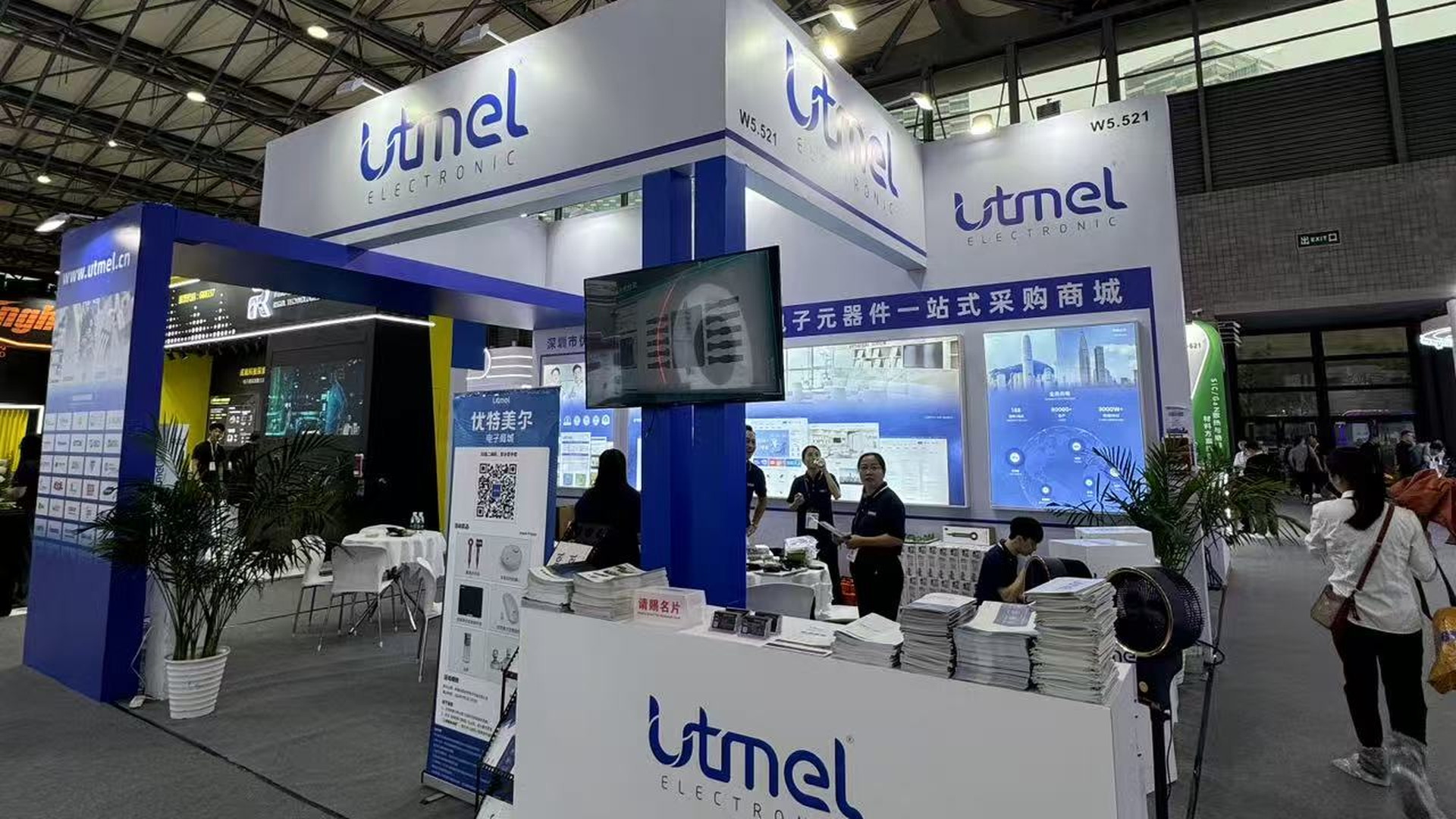 UTMEL Showcases One-Stop Electronic Component Sourcing Services at electronica Shanghai 2026UTMEL07 July 2026292
SHANGHAI, China, July 7, 2026 - UTMEL, a one-stop electronic components sourcing platform operated by Shenzhen Utmel Intelligent Electronic Co., Ltd., successfully participated in electronica Shanghai 2026, held from July 1 to 3, 2026 at the Shanghai New International Expo Centre.
Read More Electronic components distributor UTMEL to Showcase at electronica ChinaUTMEL07 June 20244617
The three-day 2024 Electronica China will be held at the Shanghai New International Expo Center from July 8th to 10th, 2024.
Read More Electronic components distributor UTMEL Stands Out at electronica china 2024UTMEL09 July 20245218
From July 8th to 10th, the three-day electronica china 2024 kicked off grandly at the Shanghai New International Expo Center.
Read More
Subscribe to Utmel !
![PT10LH01-501A2020-PM-S]() PT10LH01-501A2020-PM-S
PT10LH01-501A2020-PM-SAmphenol Piher Sensing Systems
![AME15-24SMAZ-E]() AME15-24SMAZ-E
AME15-24SMAZ-Eaimtec
![AMEOF3-24SLJZ-450]() AMEOF3-24SLJZ-450
AMEOF3-24SLJZ-450aimtec
![AMEOF3-12SBJZ-324]() AMEOF3-12SBJZ-324
AMEOF3-12SBJZ-324aimtec
![AMEOF1-9SJZ-120]() AMEOF1-9SJZ-120
AMEOF1-9SJZ-120aimtec
![PT10LH01-205A2020]() PT10LH01-205A2020
PT10LH01-205A2020Amphenol Piher Sensing Systems
![PT10LH01-221A2020-PM-S]() PT10LH01-221A2020-PM-S
PT10LH01-221A2020-PM-SAmphenol Piher Sensing Systems
![PT15NV02-101A2020-S]() PT15NV02-101A2020-S
PT15NV02-101A2020-SAmphenol Piher Sensing Systems
![PT10LV10-303A2020]() PT10LV10-303A2020
PT10LV10-303A2020Amphenol Piher Sensing Systems
![PT10LH01-303A2020]() PT10LH01-303A2020
PT10LH01-303A2020Amphenol Piher Sensing Systems