Product
 Brand
Brand Articles
 Tools
Tools
Component Date Code Verification: How to Validate CoCs and Ensure Traceability
Digital component date code verification and Certificate of Conformance (CoC) validation are the primary defense mechanisms against counterfeit electronics entering high-reliability supply chains. True component traceability requires a three-pronged approach: mandating specific documentation in the Request for Quote (RFQ), cross-referencing date and lot codes against Original Component Manufacturer (OCM) databases, and physically inspecting components for signs of tampering. Accepting a generic CoC without lot-level verification exposes procurement teams to salvaged, degraded, or counterfeit parts, leading to field failures and failed aerospace or defense audits.
This guide covers the structural elements of a meaningful CoC, how to verify component date codes, physical red flags to watch for, and how to write an RFQ that prevents post-quote disputes over traceability.
Structural Elements of a Meaningful Certificate of Conformance
A meaningful Certificate of Conformance must explicitly link a physical batch of components to a specific purchase order using lot numbers, date codes, and authorized signatures, rather than just providing a generic statement of quality.
The Four Essential Elements of a CoC
In visual stress tests and document breakdowns, experts point out that a standard CoC is structured into four distinct elements: the Header, Product Data Details, the Conformity Statement, and Authorization. A CoC is essentially worthless without the final element—Authorization and Credibility. An unsigned or undated conformity statement cannot serve as documented proof during audits. Furthermore, visual demonstrations of real-world workflows show that an "Approved" status must physically transfer onto a shipping box labeled with the exact part number and lot number, creating a verifiable physical-to-digital link.
📺 What Is a Certificate of Conformity (CoC), Elements & Why It Matters | Whiteboard Explainer
Why Optional Fields are Mandatory for Traceability
Under the Product Data Details section of a standard template, fields like "Lot number" and "Purchase order" are often listed as optional by generic template issuers. However, linking the buyer's Purchase Order (PO) directly on the CoC is the ultimate mechanism for traceability. As experts point out, "This ensures there is no doubt which exact product or batch the certificate applies to." Because the certificate issuer can regulate its scope and elements, buyers must proactively mandate that these specific traceability markers be included before purchasing.
Manufacturer CoC vs. Distributor CoC
A generic distributor CoC without a direct link back to the Original Component Manufacturer (OCM) offers little to no warranty or liability protection. A major vulnerability for procurement teams is assuming a distributor CoC is a blanket guarantee of quality. A CoC only ensures a product meets predefined specifications and requirements. If you do not explicitly stipulate a specific date code requirement or technical tolerance in your initial agreement, the distributor's CoC will not cover it.
Component Date Code Verification: Formats and Red Flags
Component date code verification involves cross-referencing the industry-standard Year/Week (YYWW) format printed on the part against the manufacturer's official production timelines to ensure the component is genuine and within its usable shelf life.
Understanding Standard Date Code Formats
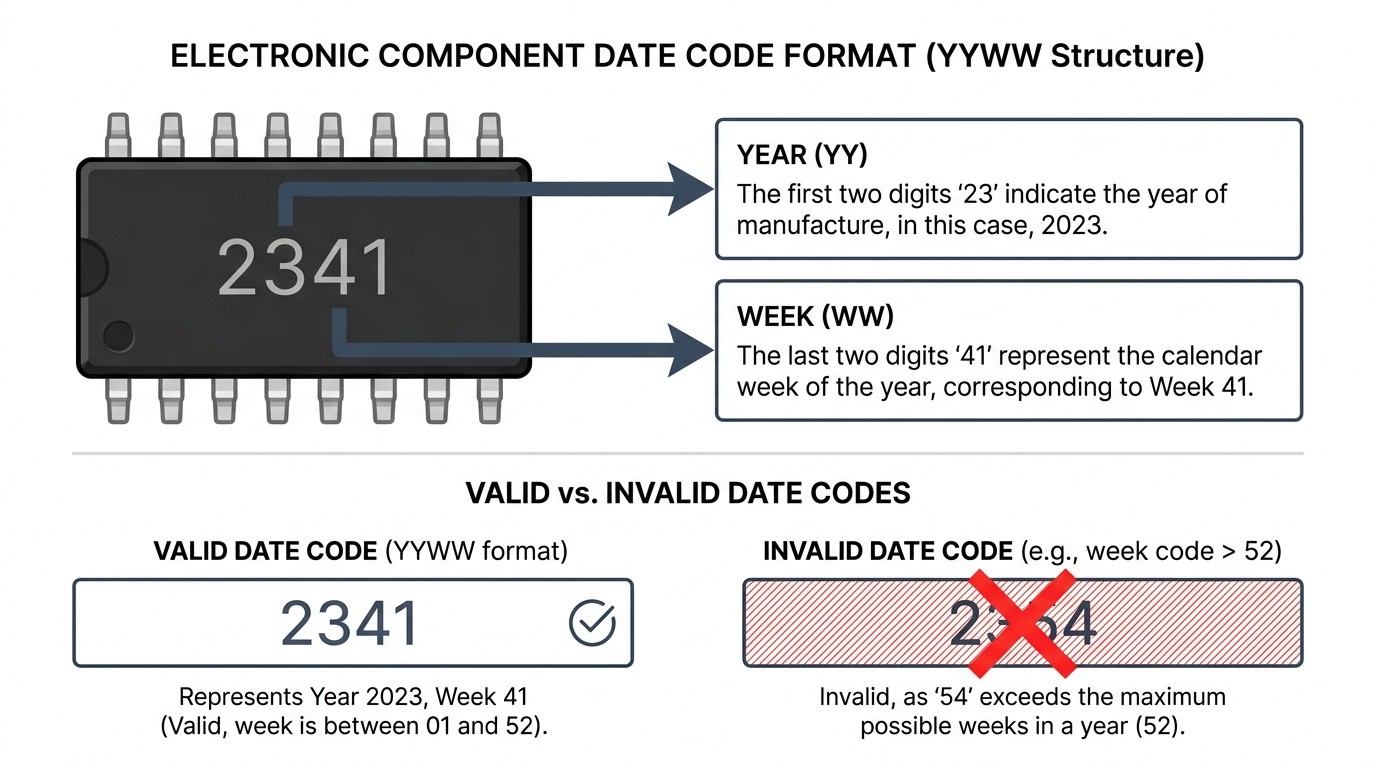
The electronics industry predominantly uses a four-digit YYWW format for date codes. For example, a code of "2341" indicates the component was manufactured in the 41st week of 2023. Verification requires cross-referencing these codes against specific OCM datasheets and historical databases. Counterfeiters frequently laser-etch invalid date codes that do not align with the manufacturer's actual production timeline, such as a week "54" or a year after the component was officially declared End-of-Life (EOL).
The Mixed Date Code Red Flag
Finding mixed date codes or lot codes within a single factory-sealed reel, tube, or tray is a primary indicator of salvaged, refurbished, or aggregated parts. Original manufacturers package components sequentially. Consequently, a reel containing parts with date codes spanning multiple years or disparate weeks triggers immediate escalation under aerospace and defense mitigation protocols, as it invalidates the accompanying paperwork.
Age-Related Degradation and Shelf Life
Date code verification also dictates component viability regarding moisture sensitivity and solderability. Under the IPC/JEDEC J-STD-033 standard, the baseline calculated shelf life for moisture-sensitive devices (MSDs) in a sealed Moisture Barrier Bag (MBB) is 12 months at <40°C and <90% relative humidity. However, recent 2025/2026 manufacturer updates, such as Vishay's September 2025 Product Change Notification, are extending this certification to 24 months at <30°C and <70% RH. Components exceeding these date code thresholds require controlled baking before reflow soldering to prevent moisture-induced failure.
Physical Inspection: When Components Do Not Match the Paperwork
Physical inspection verifies that the component's external markings, such as country of origin and date codes, perfectly match the provided documentation and show no signs of resurfacing or laser-etching alterations.
Detecting Blacktopping and Remarking
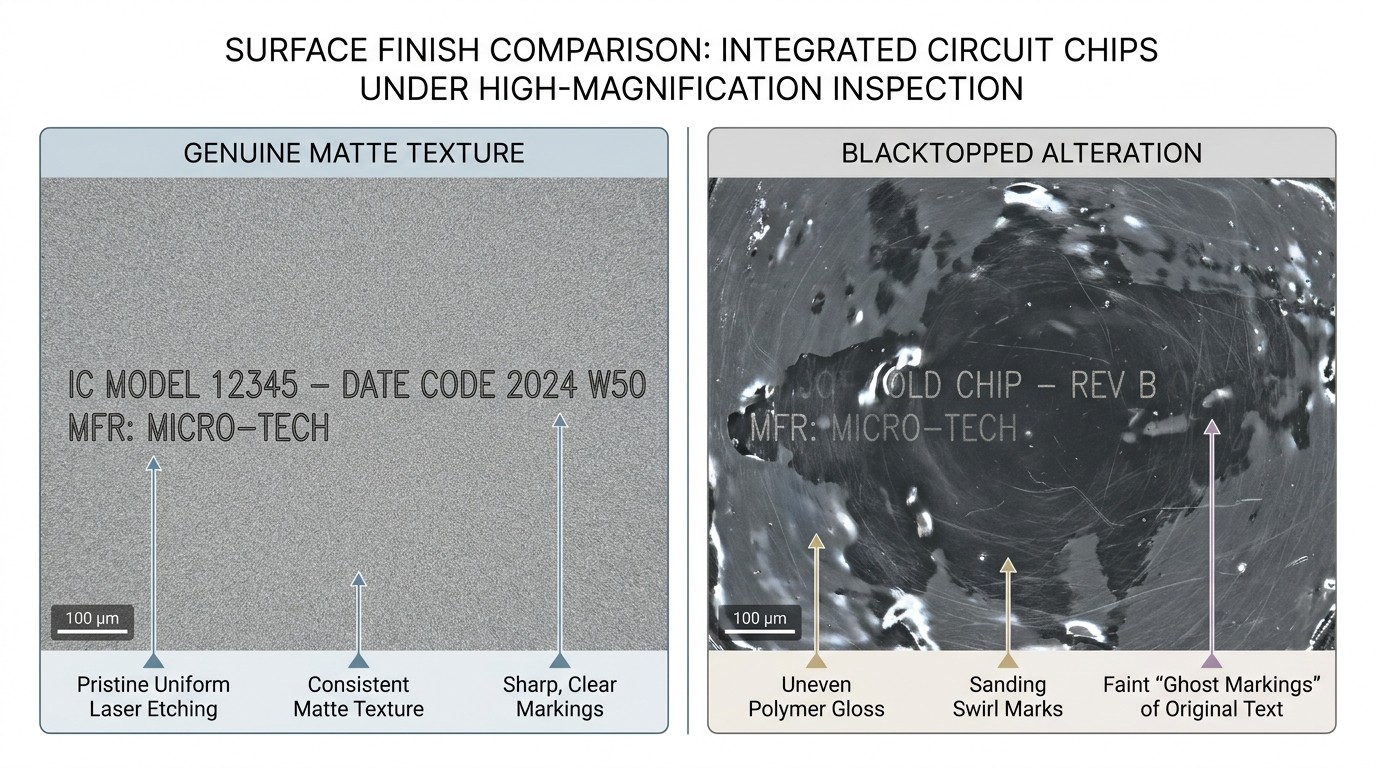
Counterfeiters frequently use a process called "blacktopping" to cover old markings on salvaged chips. They apply a new polymer coating over the component's surface and laser-etch new, fake date codes to make the batch appear uniform and recent. Visual date code verification must account for the physical texture and reflectivity of the component surface to detect these fraudulent alterations.
Visual Inspection Standards
IDEA-STD-1010-B is the primary open-market visual inspection standard. It requires inspectors to use at least 30X magnification to examine part markings, surface indents, and pins for evidence of resurfacing, "ghost markings" (faint traces of original text beneath the blacktop), or directional laser burns. This standard provides a concrete, measurable framework for physical inspection rather than relying on naked-eye observation.
Advanced Forensic Testing
When paperwork is suspect or physical anomalies are detected, visual inspection must escalate to forensic testing. Resistance to Solvents (RTS) testing exposes blacktopping by dissolving the fake polymer layer. X-Ray Fluorescence (XRF) verifies the elemental composition of the leads (e.g., checking for prohibited lead-free compliance failures), while Scanning Acoustic Microscopy (SAM) detects internal delamination or die inconsistencies that indicate a salvaged part.
How to Write an RFQ That Guarantees Traceability
To guarantee traceability, an RFQ must legally bind the supplier to provide lot-level documentation, Original Component Manufacturer (OCM) traceability, and specific compliance standards before the quote is finalized.
Establishing Traceability Before the Quote
Traceability requirements must be established before the quote is issued. If you do not ask for lot-level traceability in the RFQ, the supplier is not obligated to provide it on the CoC. Waiting until the components arrive to demand OCM documentation results in post-quote disputes and leaves the buyer with no legal recourse to return the parts.
Essential RFQ Boilerplate Clauses
Procurement teams must embed specific compliance clauses into their RFQ templates. These clauses must mandate evidence of OCM traceability and define the exact compliance documents required.
Traceability RFQ Checklist:
OCM Traceability Mandate: Require an unbroken chain of documentation back to the Original Component Manufacturer.
Date Code Restrictions: Specify the maximum acceptable age for components (e.g., "No date codes older than 24 months without prior written approval").
Mixed Lot Prohibition: Explicitly state that mixed date codes within a single reel or tube will be rejected at the receiving dock.
PO and Lot Number Inclusion: Mandate that the supplier's CoC must explicitly list the buyer's Purchase Order number and the manufacturer's lot number.
AS6081 Compliance (For Distributors): Require independent distributors to adhere to AS6081 standards for counterfeit mitigation.
Cross-Checking Against Prior Supplier CoCs
Robust procurement workflows involve maintaining an internal database of supplier documentation. Buyers should cross-reference new CoCs against prior shipments from the same supplier to detect inconsistencies in formatting, authorized signatures, or laboratory names. Fraudulent CoCs often feature vague template language or data that directly contradicts the physical attributes marked on the components.
Traceability for Obsolete and Surplus Components
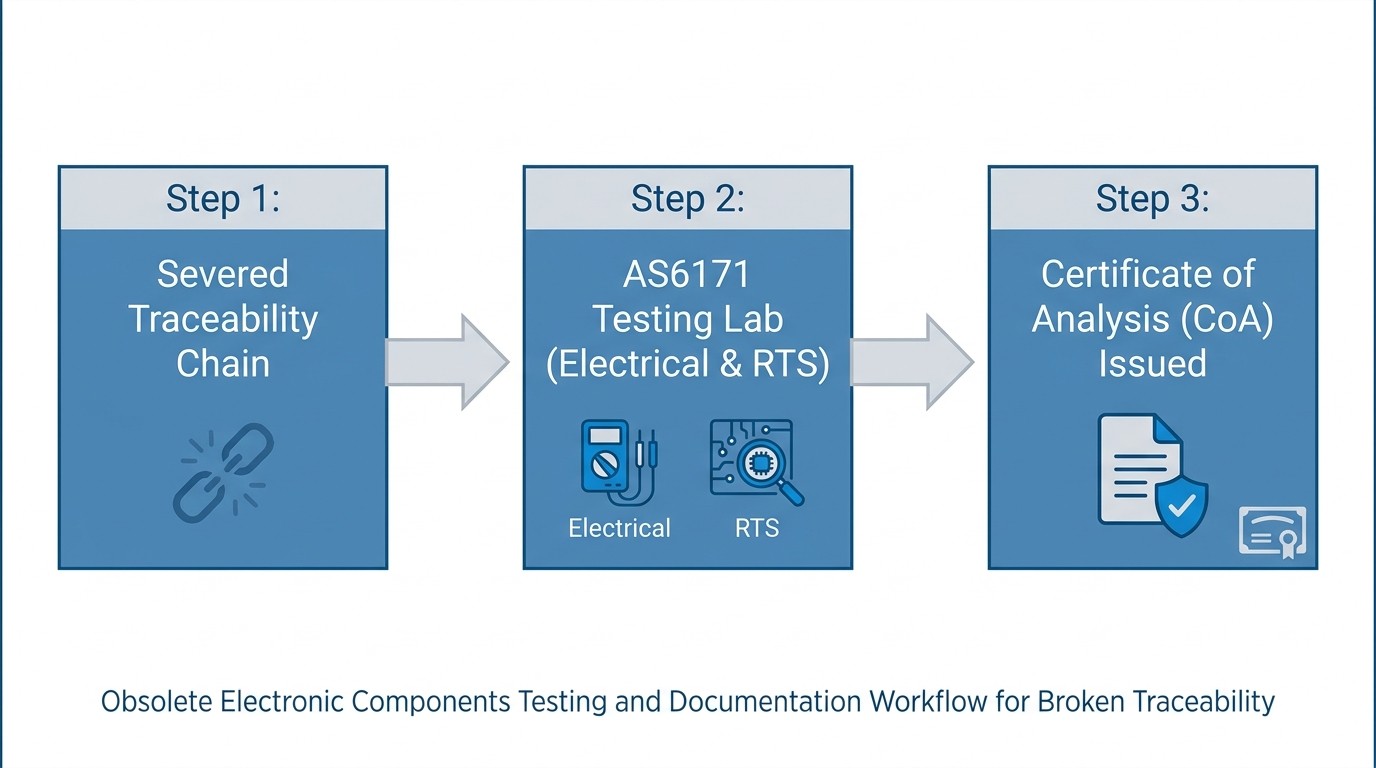
When sourcing obsolete components where original manufacturer traceability is broken, buyers must rely on independent laboratory testing and Certificates of Analysis (CoA) rather than generic distributor Certificates of Conformance.
The Broken Traceability Chain
For End-of-Life (EOL) or obsolete parts, the original OCM CoC is often lost. Independent distributors procure these parts on the open market, meaning the unbroken chain of custody is severed. In these scenarios, a standard distributor CoC is insufficient evidence of authenticity.
Certificate of Conformance (CoC) vs. Certificate of Analysis (CoA)
According to the May 2026 Assyro AI Component/Pharma COA Guide, a CoC is a legal attestation that a product meets specifications without detailing specific test conditions. Conversely, a CoA provides actual lot-specific numerical laboratory test data (e.g., electrical parameters, purity) and adheres to ALCOA+ data integrity principles. Buyers of surplus or obsolete parts must demand a CoA rather than a generic CoC when the original manufacturer's paperwork is unavailable.
AS6171 Testing as a Substitute for Paperwork
When traceability is broken, regulatory standards mandate a continuum of verification testing. The AS6081 standard (Revision A, updated April 21, 2023) governs independent distributors but explicitly removed its internal test methods. It now mandates that distributors refer to the AS6171 standard for standardized counterfeit detection testing (e.g., High Risk Level 2 electrical testing). Meanwhile, AS5553 remains the standard strictly for OEMs and manufacturers integrating the parts. An "AS6081 certified" distributor does not automatically mean the parts were tested; the RFQ must specifically demand AS6171-compliant lab testing for obsolete parts.
Community Consensus and Real-World Friction
Users on community forums often report that post-quote disputes arise when buyers assume a generic CoC implies lot-level traceability. A common consensus among procurement professionals is that without a PO number explicitly tied to the lot code on the CoC, the document is virtually useless during an AS9100 audit. Real-world testing suggests that relying solely on paperwork without implementing IDEA-STD-1010-B visual inspections at the receiving dock is the most common point of failure in counterfeit mitigation.
Closing Summary and Next Steps
Component date code verification and CoC validation are inseparable processes. Paperwork must match physical reality, and expectations must be set at the RFQ stage. A generic CoC lacking lot-level traceability, test data, or specific tolerances is a major red flag in supply chain risk management. By enforcing strict RFQ clauses, demanding AS6171 testing for obsolete parts, and utilizing 30X magnification for visual inspections, procurement teams can secure their supply chains against counterfeit intrusion.
Next Step: Download our free "Component Traceability Visual Inspection Cheat Sheet" to help your receiving department standardize their vetting process and spot fake date codes and invalid CoCs.
Frequently Asked Questions
What happens if a distributor refuses to provide a direct manufacturer CoC?
If a distributor cannot provide an OCM CoC, the buyer must demand a Certificate of Analysis (CoA) backed by independent AS6171 testing to verify the component's authenticity and electrical viability.
Are mixed lot codes in a single shipment always a sign of counterfeit parts?
While not always counterfeit, mixed lot codes within a single factory-sealed reel or tube indicate the parts have been aggregated, salvaged, or refurbished, which breaks the chain of traceability and introduces high reliability risks.
How can I verify a CoC if the original component manufacturer is out of business?
For obsolete parts from defunct manufacturers, verification shifts from documentation to physical and electrical testing. A credible, third-party inspection report following AS6171 testing methods becomes the primary proof of authenticity.
What makes a generic distributor CoC legally meaningless?
A generic distributor CoC is legally meaningless if it lacks a direct link to the OCM, fails to list the specific lot number and buyer's PO, and only guarantees "predefined specifications" without detailing what those specifications are.
What is the difference between AS5553 and AS6081?
AS5553 is the counterfeit mitigation standard that applies to Original Equipment Manufacturers (OEMs) and integrators, while AS6081 applies specifically to independent distributors procuring and selling parts on the open market.
 UTMEL
UTMEL
We are the professional distributor of electronic components, providing a large variety of products to save you a lot of time, effort, and cost with our efficient self-customized service. careful order preparation fast delivery service
 Modeling Wide Band-Gap Semiconductors for Enhanced PerformanceRakesh Kumar, Ph.D.31 January 20243883
The article delves into the challenges faced by silicon-based power electronic devices and highlights the potential of wide band-gap semiconductors. It also emphasizes the importance of modeling power semiconductor devices and provides insights into various models. For electrical energy conversion to be dependable and effective, power electronics and semiconductor device technologies are essential.
Read More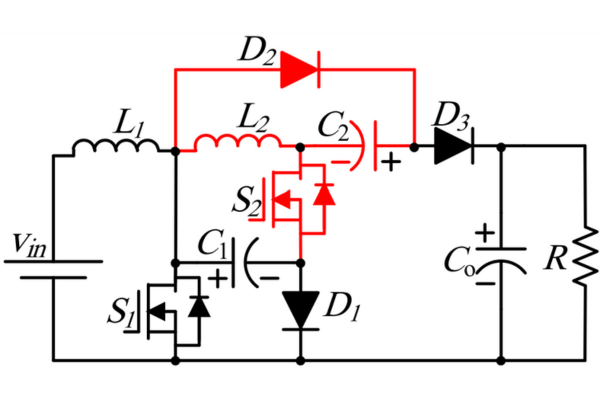 Optimizing Energy Management with Non-Isolated DC-DC ConvertersRakesh Kumar, Ph.D.04 February 20243509
The article classifies DC-DC converters and discusses the benefits and limitations of them. It proposes a modified DC-DC converter topology that combines the Cuk and Positive Output Super Lift Luo topologies to achieve a higher voltage gain with fewer components.
Read More ‘6G Networks’ - Pioneering the Next Era of Connectivity And InnovationRakesh Kumar, Ph.D.18 March 20243843
The article provides a comprehensive overview of the evolving landscape of mobile networks, the requirements that will shape the future of mobile communication, and the innovative technologies driving the transition to 6G.
Read More Review of IoT-Based Smart Home Security Systems- Part 1Rakesh Kumar, Ph.D.28 March 20244317
The article discusses the evolution of IoT-based smart home security systems, integrating advanced technologies like Raspberry Pi, PIR sensors, and voice recognition for enhanced user experience and efficiency.
Read More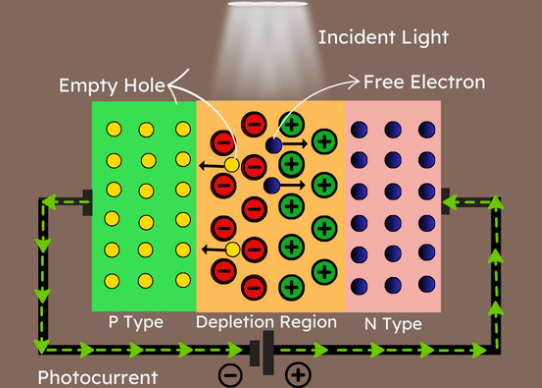 Understanding Photodiodes: Working Principles and Applications - Part 2Rakesh Kumar, Ph.D.24 May 20245587
The article provides a comprehensive overview of photodiodes, focusing on their operational principles, key factors affecting their efficiency, advantages, and disadvantages, and highlights their diverse applications.
Read More
Subscribe to Utmel !
![FC110075924]()
![OT-200-M6-L22]() OT-200-M6-L22
OT-200-M6-L22Blockmaster
![T30UXIA-806636]() T30UXIA-806636
T30UXIA-806636Banner Engineering
![MC000750]() MC000750
MC000750Multicomp
![MC000775]() MC000775
MC000775Multicomp
![MC000773]() MC000773
MC000773Multicomp
![M83519/2-18]() M83519/2-18
M83519/2-18TE Connectivity
![63-0000-0197]() 63-0000-0197
63-0000-0197Amphenol
![148783-EA]() 148783-EA
148783-EAAlpha Wire
![0054414499]() 0054414499
0054414499Apex Tool Group