Product
 Brand
Brand Articles
 Tools
Tools
A simple guide to flow sensors and their working principle

A flow sensor helps you measure how much liquid or gas moves through a pipe or channel. You can think of it as a device that detects the speed and amount of fluid flow. Flow sensors work by sensing changes in pressure, temperature, or movement as fluid passes by. You will find flow sensors in many places where controlling fluid flow is important.
Flow sensors support industries such as automotive, aerospace, medical devices, HVAC, and water management.
The need for accurate fluid flow measurement grows as more smart buildings and devices use flow technology.
Leading companies like Honeywell and Siemens drive innovation in flow sensors for better fluid flow control.
Flow Sensors Overview
What Are Flow Sensors
You use flow sensors to measure how much liquid or gas moves through a pipe or channel. These devices help you track the speed and amount of fluid flow in real time. Flow sensors play a key role in many industries, from healthcare to automotive. They convert the movement of fluids into electrical signals, making it easy for you to monitor and control systems.
Did you know?
The global market for flow sensors reached about USD 1.2 billion in 2023. Experts expect it to grow to USD 3.4 billion by 2032, with a 12.1% annual growth rate. This growth shows how important flow measurement has become in modern technology.
Here is a quick look at where you might find flow sensors:
| Aspect | Details |
|---|---|
| Key Industries | Healthcare, Pharmaceuticals, Chemical, Food & Beverage, Biotechnology, Environmental Monitoring, Industrial Automation, Aerospace, Automotive, Consumer Electronics |
| Sensor Types | Thermal, Pressure, Coriolis, Ultrasonic, Optical |
| Applications | Drug delivery, process control, air and water quality monitoring, fuel management, printers |
You can see that flow sensors support many types of flow measurement, from medical devices to environmental monitoring.
How Flow Sensors Work
Flow sensors measure the rate at which a fluid passes through a specific area. You can think of flow as the amount of substance moving per unit of time. Flow sensors use different methods to detect and measure flow. Some use heat, others use pressure, and some use sound waves.
Thermal flow sensors heat a small part of the fluid and measure how much energy the fluid absorbs. Faster flow means more energy is needed to keep the temperature steady.
Pressure-based sensors use the difference in pressure between two points to calculate flow rate. Devices like Venturi tubes or orifice plates help with this type of flow measurement.
Ultrasonic sensors send sound waves through the fluid. The time it takes for the waves to travel tells you the flow rate.
Some advanced sensors, like Coriolis types, measure mass flow directly by detecting changes in vibration caused by fluid movement.
Flow sensors often work without moving parts, which makes them reliable and easy to maintain. You can use them for both liquids and gases. Accurate flow measurement helps you control processes, ensure safety, and improve efficiency. Direct flow measurement is possible with some sensor types, giving you precise data for critical applications.
Types of Flow Sensors
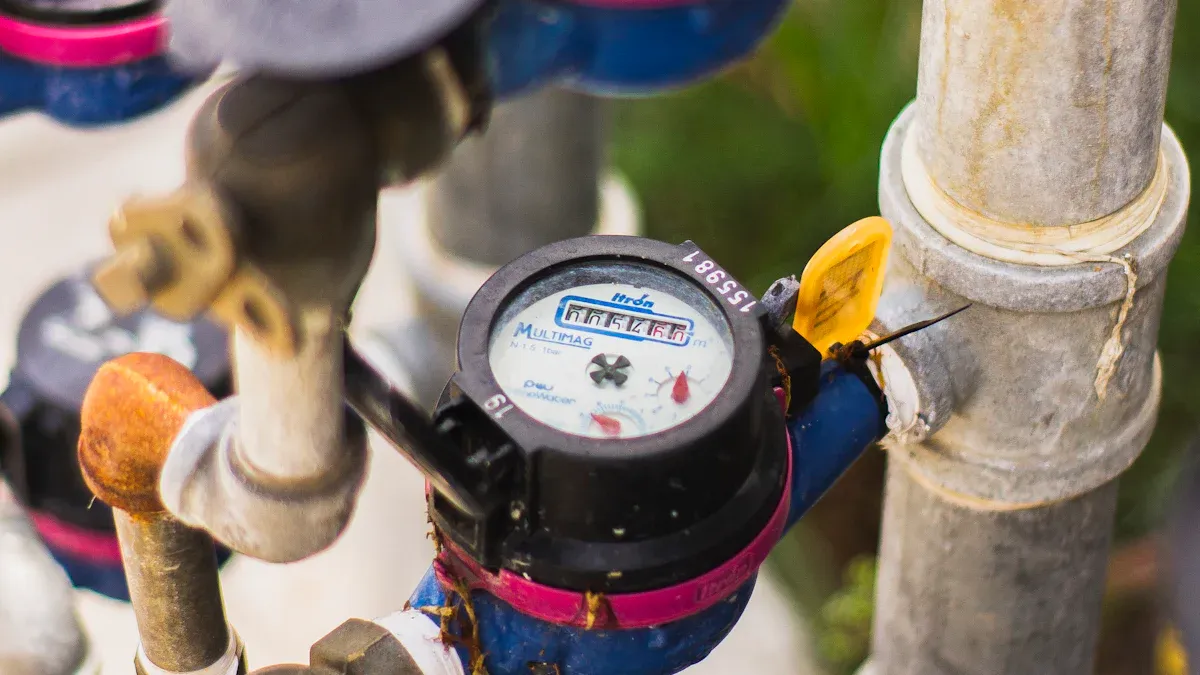
Flow sensors come in several types, each designed to measure fluid flow in a unique way. You can choose the best type for your needs by understanding how each one works and where it fits best.
Mechanical
Mechanical flow sensors use moving parts to measure fluid flow. You often see these as paddle wheels, turbines, or spring-supported pistons inside pipes. When fluid flows through the pipe, it pushes against these parts, causing them to move. The sensor counts the movement to calculate the flow rate.
For example, a differential pressure flow sensor uses a small restriction, like an orifice plate or a Venturi tube, to create a pressure drop. You can measure this pressure difference to find out how fast the fluid is moving. These sensors work well in water systems, HVAC units, and even in food production plants. In one case, a pitot tube flow meter helped a food processing plant cut energy costs by 8% through better air management.
Tip: Mechanical flow sensors, including MEMS types, offer high accuracy and reliability. You can use them in industries like pharmaceuticals and food production, where even small flow changes matter. Their long lifetime and ability to support remote monitoring make them a smart choice for many industrial applications.
| Metric | Value/Result | Description/Significance |
|---|---|---|
| Average lifetime at 120°C | 6.83 years | Shows strong durability under high temperatures. |
| Average lifetime at 150°C | 3.94 years | Still reliable at higher stress. |
| Average lifetime at 180°C | 2.49 years | Good performance even at extreme heat. |
| Goodness-of-fit residual errors | AD value = 3.48 | Confirms accurate life prediction. |
Electromagnetic
Electromagnetic flow sensors measure fluid flow using magnetic fields. When a liquid that can conduct electricity moves through a magnetic field, it creates a small voltage. The sensor detects this voltage and uses it to calculate the flow rate. You often find these sensors in water treatment plants and chemical factories.
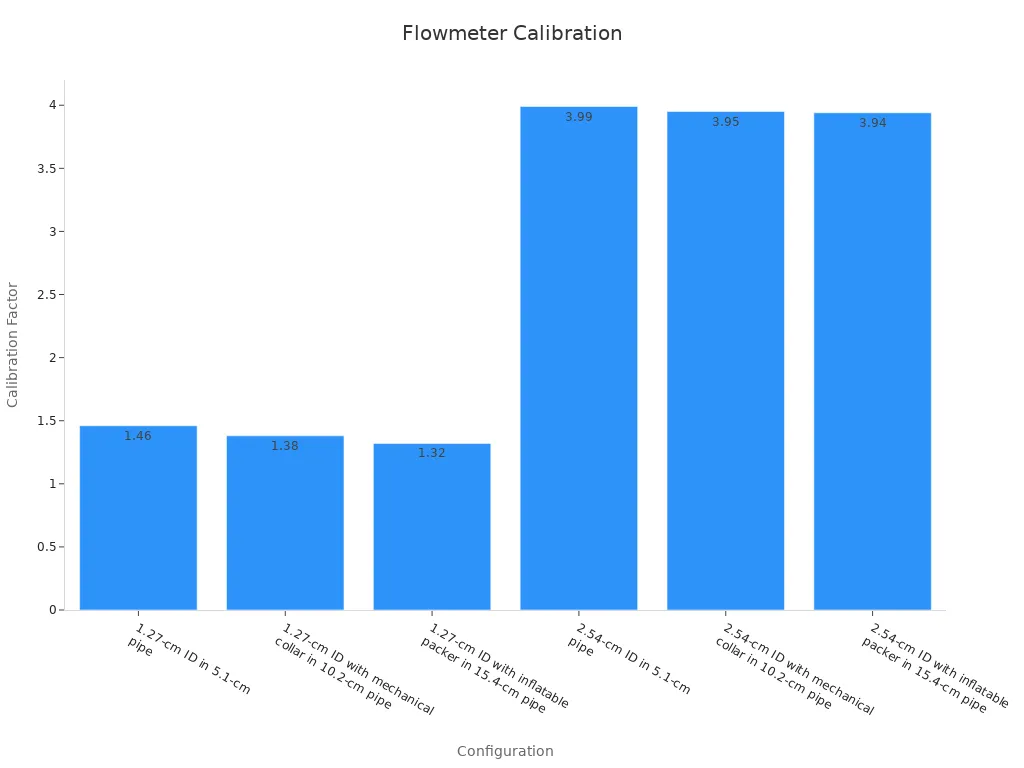
These sensors work best with clean or slightly dirty liquids, but not with gases or oils. They have no moving parts, so you get less wear and tear. Calibration tests show that electromagnetic flow sensors can measure flow rates from as low as 100 ml/min up to 40 liters per minute, with most errors under 2%. They also handle changes in pipe shape and bends better than other types.
| Flowmeter Size & Configuration | Calibration Factor (Liter/Min/Volt) |
|---|---|
| 1.27-cm ID in 5.1-cm pipe | 1.46 |
| 2.54-cm ID in 5.1-cm pipe | 3.99 |
| 2.54-cm ID with inflatable packer | 3.94 |
Note: Electromagnetic flow sensors show a measurement bias of only 0.1–0.5% and a systematic uncertainty of 0.6–0.7% even when installed near pipe elbows. This makes them a reliable choice for complex piping systems.
Thermal
Thermal mass flow sensors use heat to measure fluid flow. You will find a tiny heater and temperature sensors inside the device. When fluid flows past the heater, it carries heat away. The sensor measures how much heat the fluid takes, which tells you the flow rate. These sensors work well for both gases and liquids.
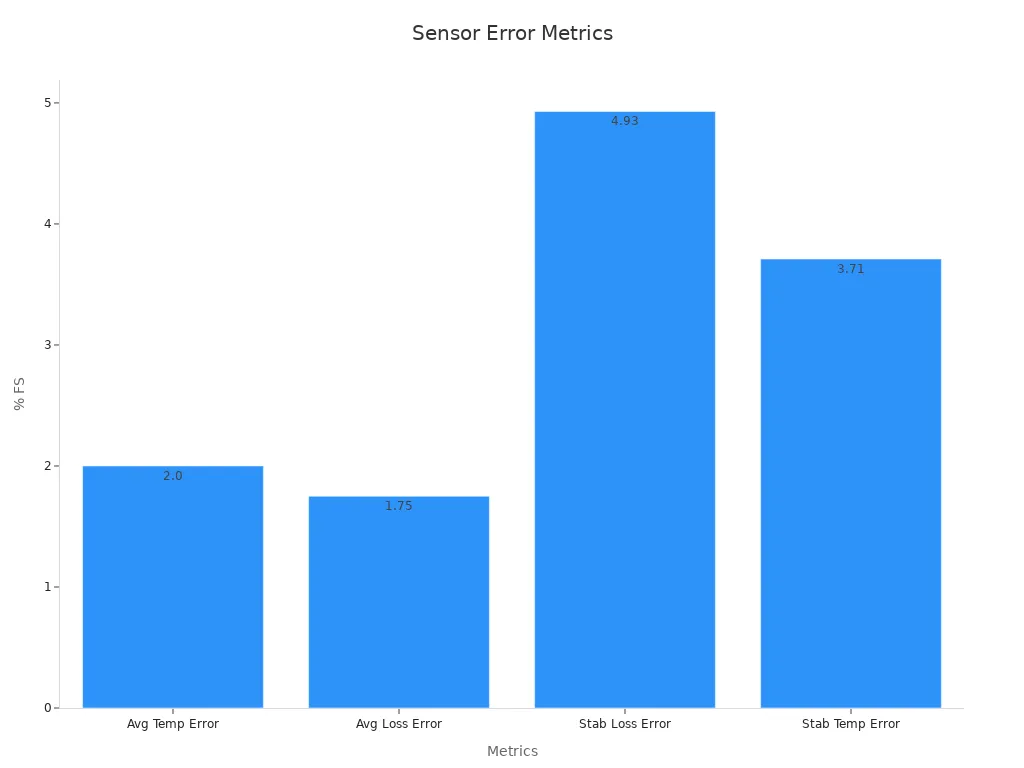
You can use thermal mass flow sensors in places where you need to measure very low or very high flow rates, such as in laboratories or for leak detection in factories. For example, the MT221 thermal mass flow sensor can detect leaks and monitor energy use with an accuracy of ±1.0%. Laboratory tests show that these sensors have a repeatability error as low as 1.27% and can measure flow speeds up to 30 meters per second. They also respond quickly, with some models reacting in just 235 milliseconds.
| Performance Metric | Value / Range | Notes / Explanation |
|---|---|---|
| Repeatability Error | 1.27% FS to 2.53% FS | High accuracy across flow speeds |
| Measurement Range | Up to 30 m/s | Wide range for many uses |
| Response Time (Thermal Loss) | 235 ms at 18 m/s | Fast response for real-time monitoring |
| Minimum Detectable Flow Velocity (MDFV) | 2.7 mm/s | Detects even tiny flows |
Did you know? Thermal mass flow sensors are popular in aerospace and defense because they offer high sensitivity, low noise, and strong stability—even in harsh environments.
Ultrasonic
Ultrasonic flow sensors use sound waves to measure fluid flow. The sensor sends sound waves through the fluid and measures how long they take to travel. If the fluid moves, the sound waves travel faster in one direction and slower in the other. The sensor uses this difference to calculate the flow rate.
You can use ultrasonic flow sensors for both liquids and gases. They work well in pipes that carry water, oil, or even air. These sensors do not touch the fluid, so you avoid contamination and reduce maintenance. Recent studies show that ultrasonic flow sensors can measure single-phase and multi-phase flows, even in pipes with bubbles or changing temperatures. A year-long test with over 600 measurements showed that different ultrasonic flow sensors can give varying results, so you should always check the accuracy for your specific application.
Engineers use ultrasonic flow sensors in water treatment, oil and gas, and even in medical devices.
Newer models use advanced signal processing and machine learning to improve accuracy, even in complex flows.
Vortex
Vortex flow sensors measure fluid flow by detecting tiny whirlpools, or vortices, that form when fluid passes a special object in the pipe. The sensor counts these vortices to find the flow rate. You can use vortex flow sensors for steam, gas, or liquid.
Wind tunnel tests show that the shape of the object inside the pipe affects how well the sensor works. T-shaped and trapezoidal objects create strong, steady vortices, which help the sensor measure flow more accurately. These sensors work best in clean fluids and are common in power plants and chemical factories.
Vortex flow sensors provide reliable measurements by tracking the frequency of vortex shedding.
You can improve accuracy by choosing the right shape for the bluff body inside the sensor.
Note: Vortex flow sensors help validate computer models and improve designs by providing precise, repeatable data on fluid flow and vortex patterns.
You can see that each type of flow sensor has its own strengths. The table below shows how different flow sensor segments and technologies compare in the market:
| Flow Sensor Segment/Technology | Market Share (2024) | Projected CAGR (2025-2032) | Key Drivers and Applications |
|---|---|---|---|
| Gas Segment | ~54.49% | N/A | Oil & gas, power generation, chemical processing; Honeywell International Inc. |
| Liquid Segment | N/A | ~7.04% | Water management, pharmaceuticals, food & beverage, medical devices; Siemens AG |
| Differential Flow Technology | ~32.17% (revenue) | N/A | Oil & gas, chemical, power generation; ABB Ltd. |
| Ultrasonic Technology | N/A | ~7.50% | Water/wastewater, food & beverage, pharmaceuticals; Endress+Hauser |
You can use this information to help choose the right flow sensor for your needs. Whether you need a differential pressure flow sensor for a water plant, a coriolis mass flow sensor for a lab, or thermal mass flow sensors for leak detection, you have many options to measure fluid flow accurately.
Working Principles
Mechanical Principle
You see mechanical flow sensors in action when a paddle wheel or turbine spins as fluid moves through a pipe. The core idea comes from Bernoulli’s principle, which links pressure and velocity. When fluid flows past an obstacle, it causes movement or a pressure drop. The sensor measures this change to determine the flow rate. In real-world use, you might find these sensors in water systems or even in tree sap studies. For example, field tests show that mechanical sensors can track sap flow in trees all season, matching changes in weather and plant growth. Engineers use formulas and simulations to design these sensors, making sure they stay accurate and reliable for flow measurement.
Tip: Regular calibration and careful design help mechanical sensors keep measurement errors low, even in tough conditions.
Electromagnetic Principle
Electromagnetic flow sensors use a clever trick from physics. When a conductive liquid moves through a magnetic field, it creates a small voltage. The sensor picks up this voltage and uses it to calculate the flow rate. This method works well for water and other liquids that carry electricity. Scientists have tested these sensors using computer models and real pipes. They found that electromagnetic sensors stay accurate, even when the pipe bends or the flow changes. This makes them a top choice for flow measurement in water treatment and chemical plants.
You do not need moving parts, so maintenance stays low.
The measurement stays steady, even if the flow changes direction or speed.
Thermal Principle
Thermal flow sensors rely on heat transfer. You find a tiny heater and temperature sensors inside the device. As fluid passes by, it carries heat away from the heater. The sensor measures how much heat leaves and uses this to figure out the flow rate. This method works for both gases and liquids. Scientists have built models to show how heat moves in these sensors. They use energy equations to predict how temperature changes with flow. In practice, you see thermal sensors in labs, factories, and even medical devices. They give you fast, accurate flow measurement, especially when you need to know the mass flow rate.
Note: The design of thermal sensors helps them work well in many settings, from HVAC systems to high-tech labs.
Other Principles
Some flow sensors use different ideas to measure flow. For example, ultrasonic sensors send sound waves through the fluid. The time it takes for the waves to travel tells you the flow measurement. Coriolis sensors use vibrating tubes. When fluid moves through, it twists the tubes slightly. The sensor measures this twist to find the flow rate. Each method has its own strengths. Coriolis sensors offer very high accuracy for mass flow rate, while ultrasonic sensors work well without touching the fluid. You also find vortex sensors, which count tiny whirlpools created by an object in the flow. The choice depends on what you need—accuracy, durability, or the type of fluid.
| Sensor Type | Principle Used | Best For |
|---|---|---|
| Coriolis | Tube vibration/twist | High-precision flow measurement |
| Ultrasonic | Sound wave timing | Non-contact flow measurement |
| Vortex | Vortex frequency | Steam, air, water systems |
You can see that each principle supports different needs in flow measurement, helping you pick the right sensor for your job.
Flow Sensor Applications
Everyday Uses
You see flow sensors in many places every day. These devices help you measure water use in your home, track air flow in HVAC systems, and even control the amount of gas in your stove. In medical devices, flow sensors make sure patients get the right amount of oxygen or medicine. Smart farming uses flow sensors to manage water and feed for animals. For example, companies use intelligent feeders with flow sensors to reduce waste and save money. In shrimp farming, smart feeders helped farmers achieve a full return on investment in less than a year. You also find flow sensors in water management systems, where they help predict problems and improve customer satisfaction.
| Company / Customer | Application Area | Usage of Flow Sensors / Related Sensors | Real-World Impact / Feedback |
|---|---|---|---|
| Colgate-Palmolive | Compressed Air Monitoring | IIoT-powered flow sensors | 15% efficiency boost, less waste |
| bioFeeder (Digi customer) | Shrimp Farming | Solar-powered feeders with flow sensors | 100% ROI in 6-12 months, lower labor and feed costs |
| Evoqua Water Technologies | Water Management | Digital system with pressure and flow sensors | Better insights, higher customer satisfaction |
💡 You can see how flow sensors make daily life easier and more efficient by improving measurement and control.
Industrial Uses
In factories and large plants, flow sensors play a key role in keeping everything running smoothly. You use them to track the flow rate of liquids and gases in pipes. This helps you control processes, reduce waste, and keep machines safe. In smart manufacturing, flow sensors provide real-time measurement data that helps you spot problems before they cause downtime. Companies use these sensors to improve quality, boost productivity, and meet safety rules. For example, manufacturers track key performance indicators like Overall Equipment Effectiveness (OEE) and cycle time using flow sensors. These measurements help you find bottlenecks, plan maintenance, and make better decisions. When you use flow sensors with IoT platforms, you get even more value from your measurement data.
Sensors give you the power to monitor, predict, and improve every part of your operation.
Choosing the Right Flow Sensor
You want to pick the best flow sensor for your needs. Start by thinking about what you need to measure. Look at the type of fluid, the flow rate range, and the level of accuracy you need. Consider how easy it is to install and maintain the sensor. Check if you need special features, like resistance to chemicals or high temperatures. Use a table like the one below to compare your options:
| Evaluation Criteria | Description | Example/Application |
|---|---|---|
| Operational Feasibility | How easy it is to use and set up | Simple sensors for basic water flow |
| Financial Feasibility | Cost and value for your budget | Affordable sensors for large projects |
| Accuracy | How close the measurement is to the real value | High-precision sensors for labs |
| Size Feasibility | Will the sensor fit in your space? | Small sensors for tight spots |
| Ease of Implementation | How quickly you can start using the sensor | Plug-and-play models |
| Maintenance and Calibration | How often you need to check or adjust the sensor | Low-maintenance sensors for factories |
| Support and Replacement Parts | Can you get help and spare parts easily? | Good support for long-term use |
🛠️ Always match the sensor to your application. The right choice gives you accurate measurement, saves time, and keeps your system running well.
You can see that flow sensor applications cover many areas, from your home to large factories. When you understand your needs and compare your options, you make the best choice for reliable measurement and control.
You use flow sensors to support accurate measurement in many settings, from homes to factories. Each sensor type offers unique benefits for measurement, such as ultrasonic for non-intrusive measurement or thermal for fast gas measurement. When you choose a sensor, consider measurement range, accuracy, and environmental factors. Good measurement helps you detect leaks, manage energy, and improve safety.
Key points for choosing a sensor:
Match the sensor to your measurement needs.
Check installation and maintenance for reliable measurement.
For more on measurement, explore industry blogs and buyer’s guides. Accurate measurement leads to better decisions and efficient systems.
FAQ
What is the main purpose of a flow sensor?
You use a flow sensor to measure how much liquid or gas moves through a pipe. This helps you control systems, check for leaks, and keep machines working safely.
Can you use one flow sensor for both liquids and gases?
Some flow sensors work for both liquids and gases. Always check the sensor’s specifications. You want to match the sensor to your fluid type for the best results.
How do you know which flow sensor to choose?
Start by asking:
What fluid do you want to measure?
How accurate do you need the reading?
What is your budget? Pick a sensor that fits your answers.
Do flow sensors need regular maintenance?
Most flow sensors need some maintenance. You should clean them and check their calibration. This keeps your measurements accurate and your system safe.
Where do you see flow sensors in daily life?
| Application | Example Use |
|---|---|
| Home | Water meters |
| Hospitals | Oxygen delivery |
| Factories | Process control |
| Farms | Irrigation systems |
You find flow sensors in many places that need safe and accurate fluid control.
 UTMEL
UTMEL
We are the professional distributor of electronic components, providing a large variety of products to save you a lot of time, effort, and cost with our efficient self-customized service. careful order preparation fast delivery service
 The Key Role of Electronic Components in IoT DevicesUTMEL01 September 20235180
The article discusses the pivotal role of electronic components in Internet of Things (IoT) devices. IoT devices work by capturing real-world data using sensors, processing it through a microcontroller, and then sending it to the cloud for further analysis.
Read More How to Identify the Perfect Proximity Sensor for Your ApplicationUTMEL19 July 20251095
Find the best proximity sensors for your project by evaluating material, sensing range, environment, and system needs to ensure optimal performance and reliability.
Read More Trusted Vibration Sensors for Homeowners and Industry ProfessionalsUTMEL17 July 2025801
Compare top vibration sensors for home and industrial use. Find trusted options for security, predictive maintenance, and equipment protection.
Read More Wiring and Mounting Photoelectric Sensors in 2025UTMEL15 July 2025989
Wire and mount photoelectric sensors in 2025 with step-by-step safety, wiring, and alignment tips for reliable installation and optimal sensor performance.
Read More Essential Tips for Picking the Best Gas SensorUTMEL15 July 20252216
Find out how to select gas sensors by matching target gases, environment, and compliance needs for reliable and accurate gas detection in any setting.
Read More
Subscribe to Utmel !