Product
 Brand
Brand Articles
 Tools
Tools
DeepMind Building AI That Thinks Like a Baby May Help Build Computer Models With Human Minds

What is Google's Deepmind AI Project?
Recently, DeepMind claimed to have developed an AI that can think like a baby by teaching the basic rules of the physical world.
The method they use is by teaching deep learning systems to learn 'intuitive physics' (the common sense rules of how the world works).
The paper was published on 11 July in Nature under the title "Intuitive physics learning in a deep-learning model inspired by developmental psychology". Human Behaviour.
Understanding the physical world is an effortless skill for most people, but it is a difficult challenge for AI. To deploy useful AI systems in reality, these models need to be able to understand the intuitive human sense of physics.
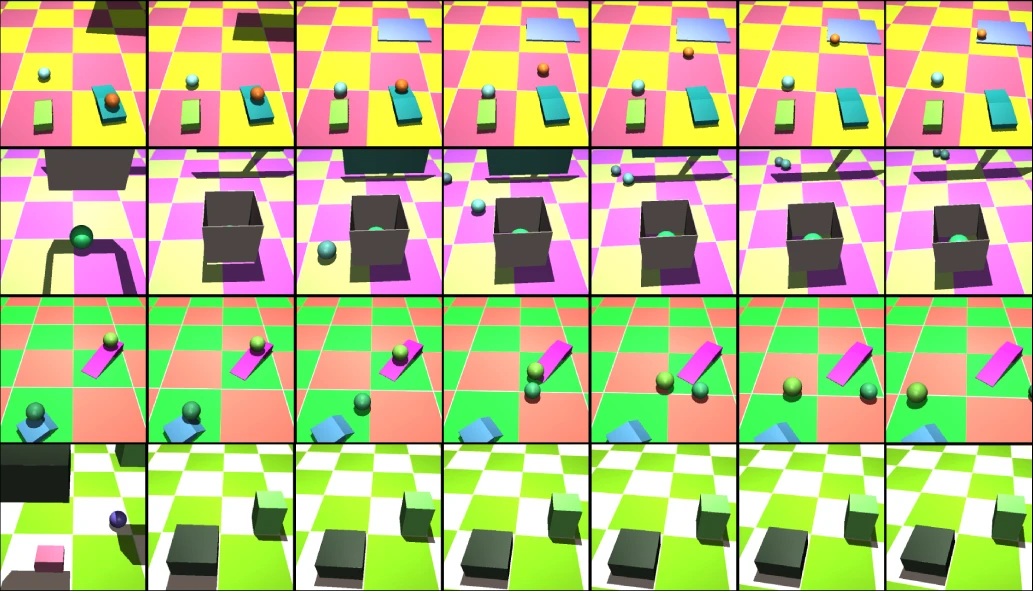
Figure | Example of a training video image (Source: Nature Human Behaviour)
The findings of this study have important implications for building AI models that have the same physical understanding as adults.
It is worth noting that back in 1950, Alan Turing, a British computer scientist, proposed training AI to have the intelligence of a child and then providing the appropriate experience to eventually increase AI intelligence to adult levels.
"Instead of trying to make a program that simulates adult thinking, why not try to make a program that simulates child thinking?" Turing wrote in his seminal research paper, Computing Machinery and Intelligence.
In the News & Views article accompanying the current paper, the researchers say, "Our study suggests that Turing may be right." It also mentions that very young children can be aware of "intuitive physics". With the right education, children will acquire adult brain thinking.
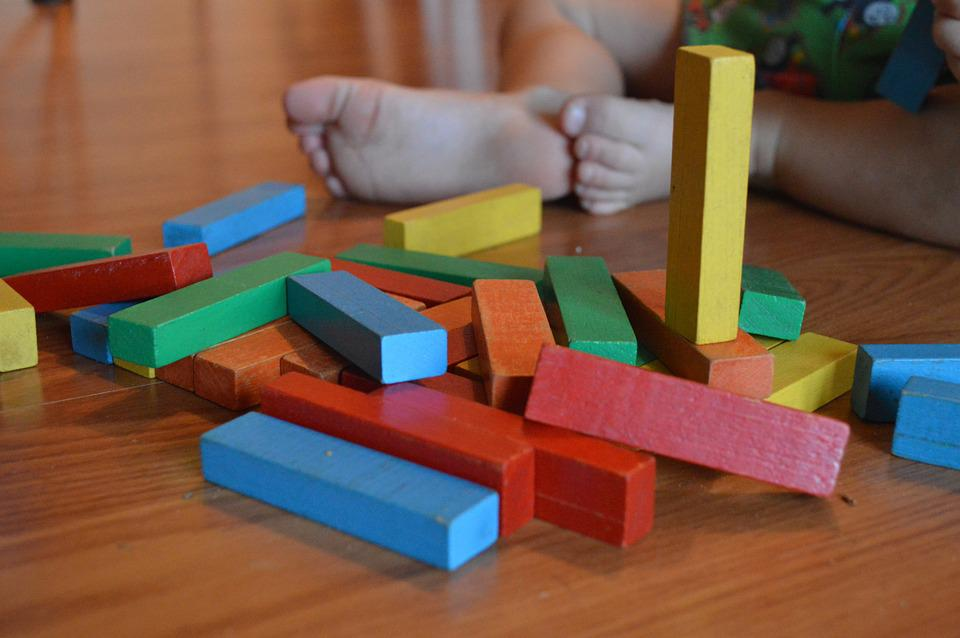
(Source: Pixabay)
We know that when you hold an apple in mid-air with your hand and let go of it, the apple does not remain in mid-air because it is not supported. We also know that if we let an apple fall from mid-air towards a table, it will not go straight through the table. This kind of common knowledge is all part of 'intuitive physics.
Furthermore, this knowledge is not unique to adults; three-month-old babies also have similar knowledge. Infants will react when they encounter 'magical' situations that seem to defy the rules of physics. For example, an infant may be surprised when an object suddenly disappears.
Simple knowledge of this kind is ubiquitous in our daily lives, but how humans achieve it is still not clear. And AI is not yet comparable to a few months old babies in terms of intuitive physics.
In this case, DeepMind tackled the problem through a common approach in the AI field, which wants AI models to learn a different set of physical concepts, especially ones that young children can understand, such as solidity and continuity, where objects do not pass through each other, interrupt and disappear.
The researchers introduced an open-sourced machine learning dataset, using the Violation-of-Expectation (VoE) paradigm from developmental psychology, designed to test a model called PLATO (Physics Learning through Auto-encoding and Tracking Objects) to test whether an AI called PLATO (Physics Learning through Auto-encoding and Tracking of Objects) can gain an understanding of intuitive physics from videos (containing simple objects such as cubes and balls).
PLATO is known to have undergone tens of hours of video training, and researchers have also developed for it the ability to predict how objects such as balls will react in various situations.
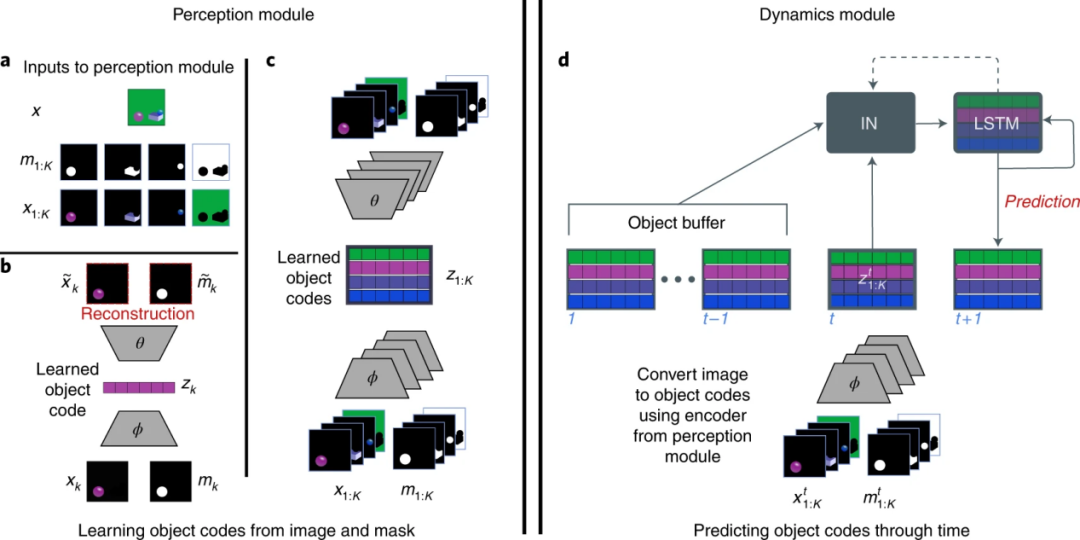
Figure | PLATO uses both perceptual and kinetic models to predict each object
(Source: Nature Human Behaviour)
Like a young child, PLATO shows 'surprise' when shown anything that doesn't make sense, such as objects moving around each other without interaction.
The results show that AI models can learn a different set of physical concepts and can also generalize expectations to new objects and events that are different from those used in training. This also fits in with some of the findings from the infant study. The results also show that AI systems modeled on infant studies outperform the usual 'learning from scratch' systems.
Overall, the study provides a powerful tool for understanding the way humans learn intuitive physics (PLATO) and provides some explanation for the question of whether infants and adults see the world in fundamentally similar ways.
It is understood that intuitive physics is based on discrete concepts such as object "solidity and continuity", and that having physical concepts is equivalent to forming a set of expectations about future development, which is also the basis for embodied intelligence.
Some species may be born with some knowledge of simple physics, but human concepts of 'intuitive physics' emerge early in life and are associated with the visual experience.
In the paper, the researchers say, "Our work provides at least a proof-of-concept that some core concepts in intuitive physics can be acquired through visual learning."
This DeepMind research into this specific area of intuitive physics may help to help build better computer models to simulate the human mind.
Reference:
1. Piloto, L.S., Weinstein, A., Battaglia, P. et al. Intuitive physics learning in a deep-learning model inspired by developmental psychology. Nat Hum Behav (2022). https://doi.org/10.1038/s41562-022-01394-8
2.https://www.dailymail.co.uk/sciencetech/article-11002519/Scientists-create-AI-think-like-baby.html
3.https://www.sciencealert.com/scientists-have-created-an-ai-that-can-think-just-like-a-human-baby
Related News
1、Chip Packaging Lead Time Has Grown to 50 Weeks
2、Eight Internet of Things (IoT) Trends for 2022
3、Demand for Automotive Chips Will Surge 300%
4、Volkswagen CFO: Chip Supply Shortage Will Continue Until 2024
5、BMW CEO: The Car Chip Problem Will Not Be Solved Until 2023
6、Shenzhen: This Year Will Focus on Promoting SMIC and CR Micro 12-inch Project
 UTMEL
UTMEL
We are the professional distributor of electronic components, providing a large variety of products to save you a lot of time, effort, and cost with our efficient self-customized service. careful order preparation fast delivery service
 UTMEL 2024 Annual gala: Igniting Passion, Renewing BrillianceUTMEL18 January 20245051
As the year comes to an end and the warm sun rises, Utmel Electronics celebrates its 6th anniversary.
Read More Electronic Components Distributor Utmel to Showcase at 2024 IPC APEX EXPOUTMEL10 April 20246041
Utmel, a leading electronic components distributor, is set to make its appearance at the 2024 IPC APEX EXPO.
Read More UTMEL Showcases One-Stop Electronic Component Sourcing Services at electronica Shanghai 2026UTMEL07 July 2026307
SHANGHAI, China, July 7, 2026 - UTMEL, a one-stop electronic components sourcing platform operated by Shenzhen Utmel Intelligent Electronic Co., Ltd., successfully participated in electronica Shanghai 2026, held from July 1 to 3, 2026 at the Shanghai New International Expo Centre.
Read More Electronic components distributor UTMEL to Showcase at electronica ChinaUTMEL07 June 20244627
The three-day 2024 Electronica China will be held at the Shanghai New International Expo Center from July 8th to 10th, 2024.
Read More Electronic components distributor UTMEL Stands Out at electronica china 2024UTMEL09 July 20245224
From July 8th to 10th, the three-day electronica china 2024 kicked off grandly at the Shanghai New International Expo Center.
Read More
Subscribe to Utmel !
![PT15NV02-102A2020-S]() PT15NV02-102A2020-S
PT15NV02-102A2020-SAmphenol Piher Sensing Systems
![PT10LV10-473A2020-S]() PT10LV10-473A2020-S
PT10LV10-473A2020-SAmphenol Piher Sensing Systems
![PT10LH01-102C2020]() PT10LH01-102C2020
PT10LH01-102C2020Amphenol Piher Sensing Systems
![PT15LV18-502A2020-S]() PT15LV18-502A2020-S
PT15LV18-502A2020-SAmphenol Piher Sensing Systems
![PT10MV10-201A2020-S]() PT10MV10-201A2020-S
PT10MV10-201A2020-SAmphenol Piher Sensing Systems
![PT10LH01-201A2020-S]() PT10LH01-201A2020-S
PT10LH01-201A2020-SAmphenol Piher Sensing Systems
![AMEOF3-15SLJZ-450]() AMEOF3-15SLJZ-450
AMEOF3-15SLJZ-450aimtec
![PT6KH-103C2020]() PT6KH-103C2020
PT6KH-103C2020Amphenol Piher Sensing Systems
![PT6KH-103B2020]() PT6KH-103B2020
PT6KH-103B2020Amphenol Piher Sensing Systems
![PT15NH06-102A2020-S]() PT15NH06-102A2020-S
PT15NH06-102A2020-SAmphenol Piher Sensing Systems