Product
 Brand
Brand Articles
 Tools
Tools
Intel CEO Reiterates: 2024 Will Achieve Process Leadership

Intel CEO: We will be a leader in chips again
Bloomberg information reported that Intel's chief executive officer Kissinger (Pat Gelsinger) said Intel is expected to reach an important technology milestone ahead of schedule to regain its technological leadership and will regain the foundry process throne at the end of 2024, earlier than the previous target of 2025.
Kissinger took over Intel last year and has been trying to restore Intel in the hands of the former chief executive who lost the semiconductor process technology leadership to reverse the competitive disadvantage with TSMC, Samsung. But to achieve this goal must be modified, upgrading the existing plant equipment can not. Kissinger originally promised investors that Intel will reach this goal in 2025. But he said in an interview with Bloomberg TV on the 29th: "Now, we think it will be at the end of 2024.
Since Kissinger took over as chief executive in February last year, Intel has announced a series of large investment projects, betting heavily on the construction of fabs in the United States and Europe, in an effort to get Intel back on track and expand towards new markets.
So far, this task appears to be extremely challenging. The financial test is not as expected, Intel shares closed down 6.9% to $ 43.59 on the 29th, down about 19% in the past year. Personal computer (PC) sales slowed, affecting Intel's PC processor revenue outlook; some Wall Street analysts also questioned, that Kissinger's turnaround plan faces daunting challenges.
Kissinger reiterated that he believes that the second half of 2022 will enter a period of accelerated growth in demand and orders.
Over the past year, the semiconductor industry oversupply, affecting the manufacturing of cars, iPhones, and other forestry products. Kissinger believes that the shortage of chip production may continue until 2024, the same as the previous forecast.
He was interviewed on the CNBC program, and also said the chip supply shortage may continue until the year after, the crux of the problem is the supply of key manufacturing tools is limited, and the expansion of capacity form obstacles. Kissinger said: "Partly, for this reason, we believe that overall, the semiconductor shortage will continue until 2024, longer than our previous estimate of 2023, simply because today even the equipment is experiencing shortages, making the challenge of increasing production intensifies."
2024, will be a turning point?
According to Intel's latest roadmap, their process will be launched according to the following timing.
In 2022, Intel will launch its 4nm process, the first time Intel has used EUV equipment, and the new process will offer a 20% performance boost over 7nm. Intel has previously talked about a 2x density increase for this generation, but now it just says "significant density increase", which we estimate at 1.8x.
Samsung 3nm, which is likely to be used only for internal use, has a 1.35x density improvement, a 35% performance improvement at the same power, and a 50% power reduction at the same performance. Its density improvement is not very impressive, but the performance and power improvements are likely due to the use of HNS technology. TSMC 3nm, based on FinFETs, will offer about 1.6x density improvement, 10% performance improvement at the same power, and 25% power reduction at the same performance.
In 2023, Intel will launch a 3nm process with 18% better performance, more dense libraries, and more EUV usage. We estimate a 1.09x increase in density, making it more like a half-node. Samsung 3GAP should be available for external customers and TSMC 3nm parts should be in the iPhone.
Intel's Intel 20A (20Å = 2nm) process will debut in the first half of 2024, and the new node will deliver a 15% performance boost. This will be Intel's first HNS (they call it RibbonFET) and they will also introduce backside power (they call it PowerVia). The backside power supply addresses IR power degradation while making front-end interconnects easier. We estimate that the density of this process is 1.6x higher than the previous generation.
The Intel 18A process will arrive early in the second half of 2024 and deliver a 10% performance improvement. We estimate a 1.06x increase in density, making this another half-node. This process has already started in 2025, and Intel says they have already delivered test equipment to customers.
In the second half of 2025, Samsung 2nm will be unveiled and we expect it to be HNS as it will be Samsung's third generation of HNS (counting 3GAE as the first generation and GAP as the second), while their previous generations will have relatively little density improvement and will have our prediction of 1.9x.
TSMC has not yet announced their 2nm process, only that they hope to have the best process by 2025. We may see their 2nm in 2024, but for now, we are putting it in 2025, where we expect to also use the HNS process and estimate a 1.33x improvement in density. We believe the density improvement will be modest because it is TSMC's first HNS, and because the 3nm process is so dense, further improvements will be more difficult.
Figure 9 illustrates how Intel can "flip the script" on the foundry by doing 4 nodes and the foundry doing 2 nodes.

Figure 9
We can now see how Intel, Samsung, and TSMC's densities compare by 2025. We have also added IBM's 2nm research facility based on their 2nm announcement. Figure 10 shows the density versus year and node.
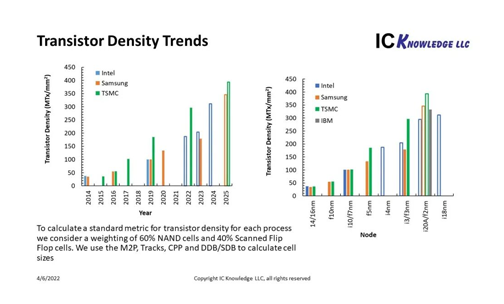
Figure 10
Looking at Figure 10, we expect TSMC to maintain its density lead through 2025.
The most complex part of our analysis is shown in Figure 11, where we compare performance. Without running the same design on different processes, it is difficult to compare processes to each other to obtain performance, and this rarely happens. The way we generated this graph is as follows.
Apple A9 is in production on Samsung 14nm and TSMC 16nm. Tom's hardware found the same performance for both versions, and we have normalized the performance of this node to Samsung and TSMC1.
From the 14/16nm node to 3nm, we used the company's announced performance improvements to plot relative performance. For 2nm, we have used our own predictions.
We do not have any designs running on Intel processes as well as Samsung or TSMC. However, both AMD and Intel produce X86 microprocessors, and AMD's microprocessor using TSMC's 7nm process already competes with Intel's 10nm Superfine processor with similar performance, and we set Intel 10SF to the same performance as TSMC 7nm. This is not ideal, assuming that both companies do equally well in terms of design, but is the best comparison. We then extended all other Intel nodes from the 10SF based on Intel's announcement.
Once again, we put IBM's 2nm on this chart based on IBM's 2nm announcement.

Figure 12
Our analysis leads us to believe that Intel may be able to achieve a performance lead on a year and node basis. This is consistent with Intel's stated goal of "performance leadership per watt". Assuming TSMC is referring to density, they may also be correct in claiming they will have the best process by 2025.
In short, we believe Intel can significantly accelerate its process development at a time when foundries are struggling. While we do not expect Intel to regain the density lead in the time frame studied, we do believe they can recapture the performance lead.
We should have good news on progress again by the end of 2022 when we see if Intel's 4nm comes out on time.
Related News
1、Chip Packaging Lead Time Has Grown to 50 Weeks
2、Eight Internet of Things (IoT) Trends for 2022
3、Demand for Automotive Chips Will Surge 300%
4、Volkswagen CFO: Chip Supply Shortage Will Continue Until 2024
5、BMW CEO: The Car Chip Problem Will Not Be Solved Until 2023
6、Shenzhen: This Year Will Focus on Promoting SMIC and CR Micro 12-inch Project
 UTMEL
UTMEL
We are the professional distributor of electronic components, providing a large variety of products to save you a lot of time, effort, and cost with our efficient self-customized service. careful order preparation fast delivery service
 UTMEL 2024 Annual gala: Igniting Passion, Renewing BrillianceUTMEL18 January 20245009
As the year comes to an end and the warm sun rises, Utmel Electronics celebrates its 6th anniversary.
Read More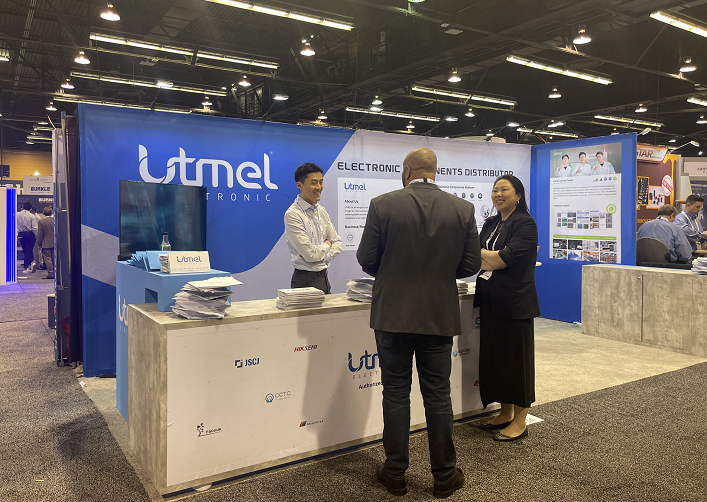 Electronic Components Distributor Utmel to Showcase at 2024 IPC APEX EXPOUTMEL10 April 20245994
Utmel, a leading electronic components distributor, is set to make its appearance at the 2024 IPC APEX EXPO.
Read More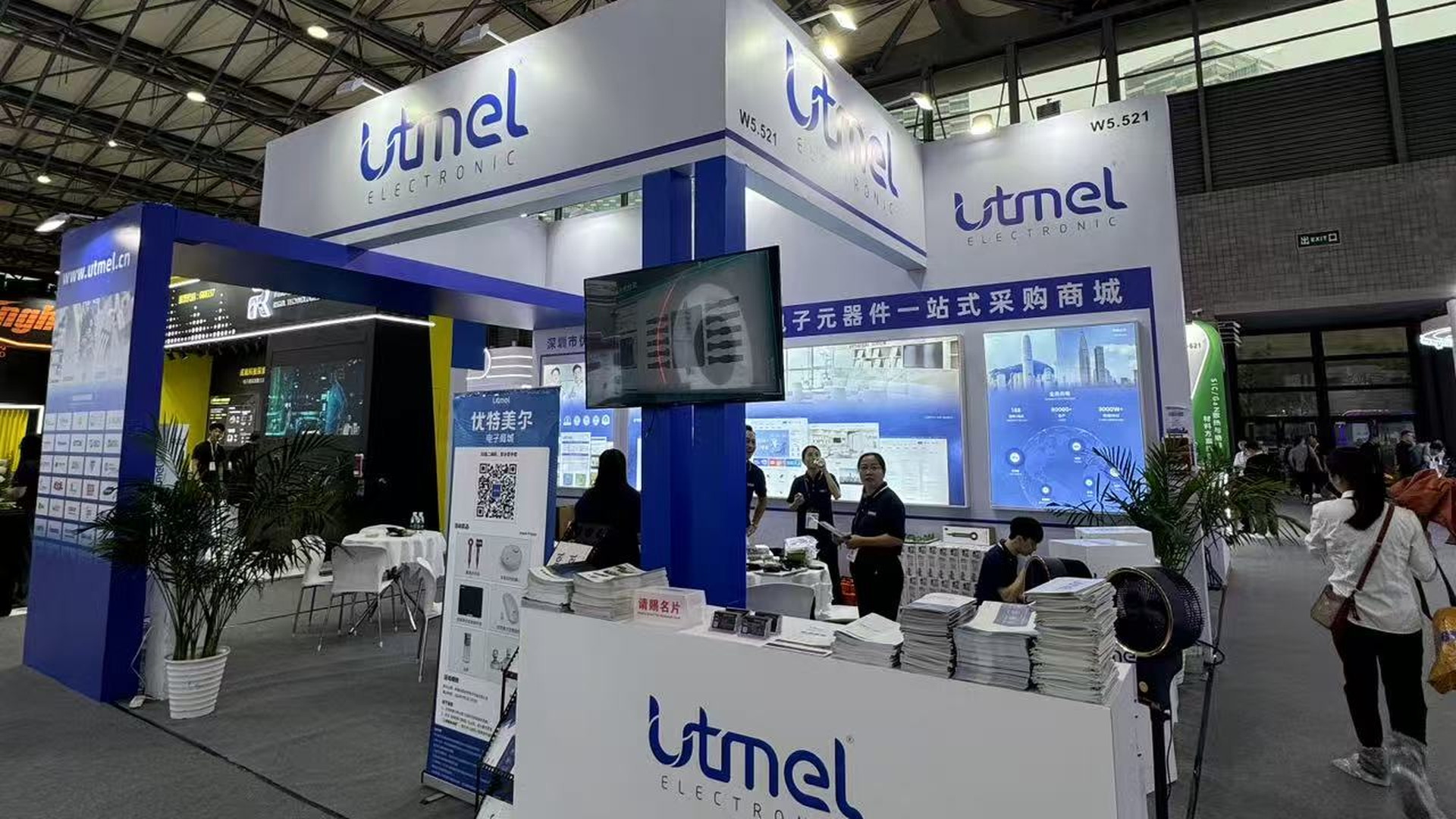 UTMEL Showcases One-Stop Electronic Component Sourcing Services at electronica Shanghai 2026UTMEL07 July 2026261
SHANGHAI, China, July 7, 2026 - UTMEL, a one-stop electronic components sourcing platform operated by Shenzhen Utmel Intelligent Electronic Co., Ltd., successfully participated in electronica Shanghai 2026, held from July 1 to 3, 2026 at the Shanghai New International Expo Centre.
Read More Electronic components distributor UTMEL to Showcase at electronica ChinaUTMEL07 June 20244584
The three-day 2024 Electronica China will be held at the Shanghai New International Expo Center from July 8th to 10th, 2024.
Read More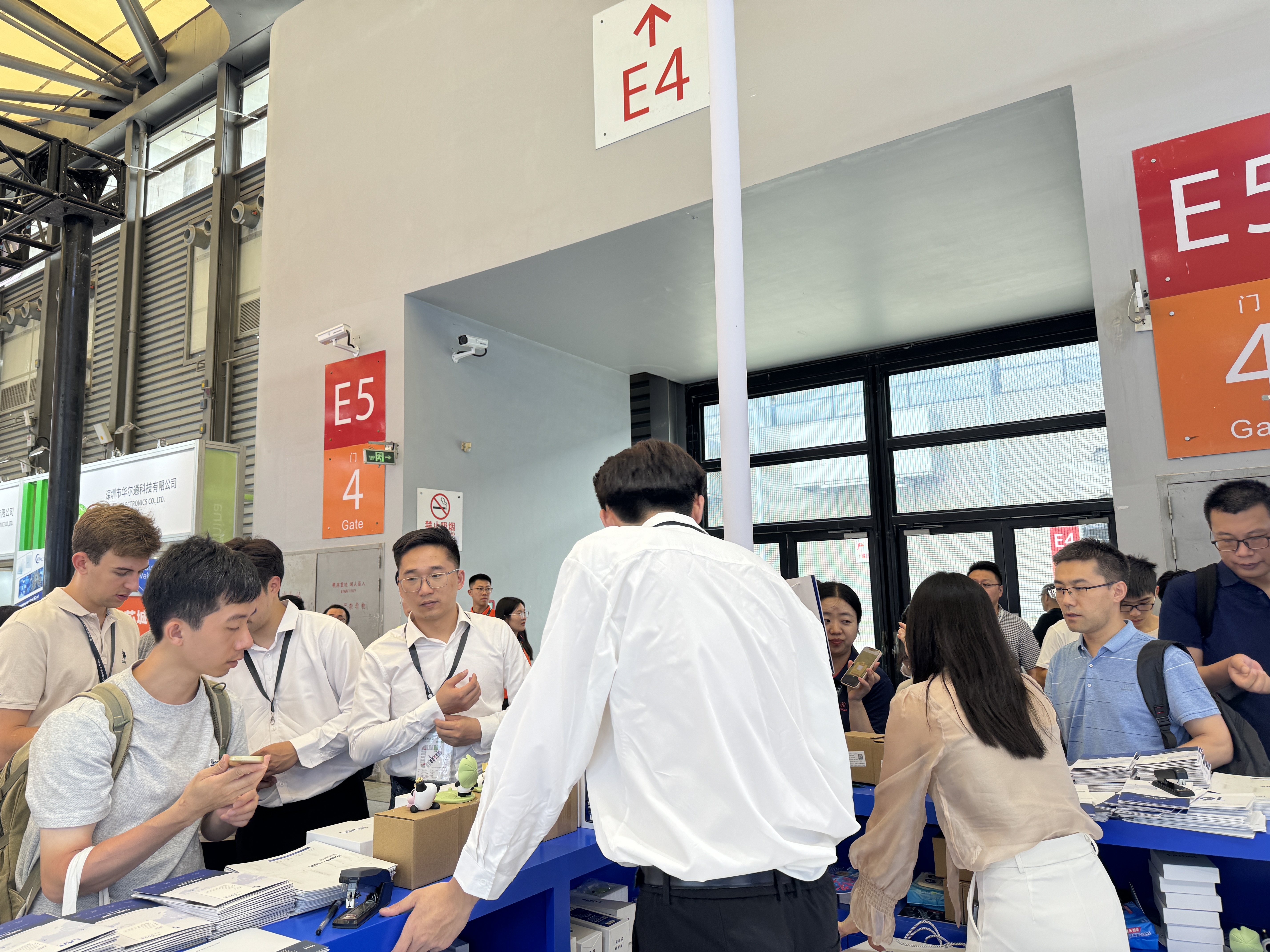 Electronic components distributor UTMEL Stands Out at electronica china 2024UTMEL09 July 20245185
From July 8th to 10th, the three-day electronica china 2024 kicked off grandly at the Shanghai New International Expo Center.
Read More
Subscribe to Utmel !
![PT15NH06-00839]() PT15NH06-00839
PT15NH06-00839Amphenol
![PT15YV18-01169]() PT15YV18-01169
PT15YV18-01169Amphenol
![PT15NV18-04631]() PT15NV18-04631
PT15NV18-04631Amphenol
![PT15LV18-10305]() PT15LV18-10305
PT15LV18-10305Amphenol
![PT6KH-02282]() PT6KH-02282
PT6KH-02282Amphenol
![PT15NH06-08515]() PT15NH06-08515
PT15NH06-08515Amphenol
![PT15WH06-04352]() PT15WH06-04352
PT15WH06-04352Amphenol
![PTC10LH01-00545]() PTC10LH01-00545
PTC10LH01-00545Amphenol
![PT15LV18-07074]() PT15LV18-07074
PT15LV18-07074Amphenol
![PTC10LV10-00645]() PTC10LV10-00645
PTC10LV10-00645Amphenol