Product
 Brand
Brand Articles
 Tools
Tools
BMM150 Sensor: Datasheet, Pinout and Applications


BMM150 Series 3.6 V Surface Mount Three-Axis Geomagnetic Sensor - WLCSP-12
The BMM150 is a standalone geomagnetic sensor for consumer market applications. This article mainly covers datasheet, pinout, applications, features, and other details about BMM150.
BMM150 Pinout


BMM150 CAD Model
Symbol

Footprint
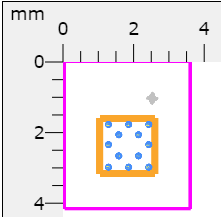
3D Model

BMM150 Description
The BMM150 is a standalone geomagnetic sensor for consumer market applications. It allows measurements of the magnetic field in three perpendicular axes. Based on Bosch’s proprietary FlipCore technology, the performance and features of BMM150 are carefully tuned and perfectly match the demanding requirements of all 3-axis mobile applications such as electronic compass, navigation, or augmented reality.
Specifications
- TypeParameter
- Factory Lead Time14 Weeks
- Mounting Type
The "Mounting Type" in electronic components refers to the method used to attach or connect a component to a circuit board or other substrate, such as through-hole, surface-mount, or panel mount.
Surface Mount - Package / Case
refers to the protective housing that encases an electronic component, providing mechanical support, electrical connections, and thermal management.
12-XFBGA, WLCSP - Surface Mount
having leads that are designed to be soldered on the side of a circuit board that the body of the component is mounted on.
YES - Operating Temperature
The operating temperature is the range of ambient temperature within which a power supply, or any other electrical equipment, operate in. This ranges from a minimum operating temperature, to a peak or maximum operating temperature, outside which, the power supply may fail.
-40°C~85°C TA - Packaging
Semiconductor package is a carrier / shell used to contain and cover one or more semiconductor components or integrated circuits. The material of the shell can be metal, plastic, glass or ceramic.
Tape & Reel (TR) - Published2012
- Part Status
Parts can have many statuses as they progress through the configuration, analysis, review, and approval stages.
Active - Moisture Sensitivity Level (MSL)
Moisture Sensitivity Level (MSL) is a standardized rating that indicates the susceptibility of electronic components, particularly semiconductors, to moisture-induced damage during storage and the soldering process, defining the allowable exposure time to ambient conditions before they require special handling or baking to prevent failures
1 (Unlimited) - Number of Terminations12
- Voltage - Supply
Voltage - Supply refers to the range of voltage levels that an electronic component or circuit is designed to operate with. It indicates the minimum and maximum supply voltage that can be applied for the device to function properly. Providing supply voltages outside this range can lead to malfunction, damage, or reduced performance. This parameter is critical for ensuring compatibility between different components in a circuit.
1.62V~3.6V - Current - Supply (Max)
The parameter "Current - Supply (Max)" in electronic components refers to the maximum amount of current that a component can draw from a power supply for its operation. This parameter is critical for ensuring that the power supply can adequately meet the demands of the component without causing damage or malfunction. Exceeding this specified maximum current can lead to overheating, reduced performance, or failure of the component. It is essential to consider this value when designing or integrating components into electronic circuits to maintain reliability and functionality.
20mA - Body Length or Diameter
Body length or diameter in electronic components refers to the physical dimensions of a component's housing, typically measured in millimeters or inches. It indicates the size of the component that affects its fit within a circuit board or system. This parameter is crucial for ensuring compatibility with the design and mounting of electronic devices. It can impact heat dissipation, electrical performance, and overall assembly efficiency. Accurate measurement of body length or diameter is essential for proper component selection and placement in electronic applications.
1.56mm - Body Breadth
Body breadth in electronic components refers to the width of the physical body of a component, such as a resistor, capacitor, or integrated circuit. This measurement is crucial for ensuring proper fit within a circuit board or enclosure. It can affect the component's thermal performance, mechanical stability, and overall compatibility with other components in a design. Body breadth is typically specified in millimeters or inches and is an important factor in the selection and design of electronic assemblies.
1.56 mm - Output Type
The "Output Type" parameter in electronic components refers to the type of signal or data that is produced by the component as an output. This parameter specifies the nature of the output signal, such as analog or digital, and can also include details about the voltage levels, current levels, frequency, and other characteristics of the output signal. Understanding the output type of a component is crucial for ensuring compatibility with other components in a circuit or system, as well as for determining how the output signal can be utilized or processed further. In summary, the output type parameter provides essential information about the nature of the signal that is generated by the electronic component as its output.
I2C, SPI - Operating Supply Voltage
The voltage level by which an electrical system is designated and to which certain operating characteristics of the system are related.
3.6V - Termination Type
Termination Type in electronic components refers to the method used to connect the component to a circuit board or other electronic devices. It specifies how the component's leads or terminals are designed for soldering or mounting onto a PCB. Common termination types include through-hole, surface mount, and wire lead terminations. The termination type is an important consideration when selecting components for a circuit design, as it determines how the component will be physically connected within the circuit. Different termination types offer varying levels of durability, ease of assembly, and suitability for specific applications.
SOLDER - Bandwidth
In electronic components, "Bandwidth" refers to the range of frequencies over which the component can effectively operate or pass signals without significant loss or distortion. It is a crucial parameter for devices like amplifiers, filters, and communication systems. The bandwidth is typically defined as the difference between the upper and lower frequencies at which the component's performance meets specified criteria, such as a certain level of signal attenuation or distortion. A wider bandwidth indicates that the component can handle a broader range of frequencies, making it more versatile for various applications. Understanding the bandwidth of electronic components is essential for designing and optimizing circuits to ensure proper signal transmission and reception within the desired frequency range.
10Hz - Resolution
Resolution in electronic components refers to the smallest increment of measurement or change that can be detected or represented by the component. It is a crucial specification in devices such as sensors, displays, and converters, as it determines the level of detail or accuracy that can be achieved. For example, in a digital camera, resolution refers to the number of pixels that make up an image, with higher resolution indicating a greater level of detail. In analog-to-digital converters, resolution is the number of discrete values that can be represented in the digital output, determining the precision of the conversion process. Overall, resolution plays a significant role in determining the performance and capabilities of electronic components in various applications.
13 b - Linearity
In electronic components, linearity refers to the relationship between the input and output signals of the component. A component is said to be linear if its output is directly proportional to its input over a specified range. In other words, when the input signal changes, the output signal changes in a consistent and predictable manner without introducing distortion or non-linear effects.Linearity is an important parameter in electronic components such as amplifiers, filters, and sensors, as it determines the accuracy and fidelity of signal processing. Non-linearities in components can lead to signal distortion, harmonic generation, and other undesirable effects that can degrade the performance of electronic systems.Engineers often characterize the linearity of components by measuring parameters such as gain error, harmonic distortion, and intermodulation distortion. By ensuring that components exhibit good linearity characteristics, designers can create electronic systems that accurately process signals and faithfully reproduce the desired output.
1 % - Sensing Method
The sensing method in electronic components refers to the technique or mechanism used to detect and measure physical phenomena such as temperature, pressure, light, or motion. This includes a variety of technologies such as resistive, capacitive, inductive, and optical sensing methods. The choice of sensing method affects the accuracy, response time, and application suitability of the electronic component. It plays a crucial role in determining how effectively a device can interact with and interpret its environment.
Hall Effect - Sensing Range
The sensing range of position sensors is the displacement between the sensing face of the sensor and the approaching measurement object that triggers a signal change in the sensor.
±1.3mT (X,Y), ±2.5mT (Z) - Ambient Temperature Range High
This varies from person to person, but it is somewhere between 68 and 77 degrees F on average. The temperature setting that is comfortable for an individual may fluctuate with humidity and outside temperature as well. The temperature of an air conditioned room can also be considered ambient temperature.
85°C - Axis
In electronic components, the parameter "Axis" typically refers to the orientation or direction along which a specific characteristic or measurement is being considered. For example, in a sensor or accelerometer, the axis may indicate the direction in which the device is measuring acceleration. In a motor or actuator, the axis may refer to the direction of movement or rotation.Understanding the axis of a component is crucial for proper installation, calibration, and operation. It helps in determining how the component will interact with other parts of a system and how its performance can be optimized. Different components may have multiple axes to consider, especially in complex systems where movement or measurements occur in multiple directions.Overall, the axis parameter provides important information about the spatial orientation or directionality of an electronic component, guiding engineers and technicians in effectively utilizing the component within a larger system.
X, Y, Z - Magnetic Field Range-Min
The parameter "Magnetic Field Range-Min" in electronic components refers to the minimum level of magnetic field strength that the component can effectively operate within without experiencing any adverse effects. This parameter is crucial for components that are sensitive to magnetic fields, such as sensors, actuators, and certain types of memory devices. Exceeding the specified minimum magnetic field range can lead to malfunctions, errors, or even permanent damage to the component. It is important to carefully consider and adhere to this parameter when designing or using electronic systems in environments where magnetic fields are present to ensure proper functionality and reliability.
1.2 mT - Magnetic Field Range-Max
The parameter "Magnetic Field Range-Max" in electronic components refers to the maximum level of magnetic field strength that the component can withstand without experiencing any adverse effects on its performance or functionality. This parameter is crucial for components that are sensitive to magnetic fields, such as sensors, actuators, and certain types of electronic circuits.Exceeding the specified maximum magnetic field range can lead to issues such as interference, distortion, or even permanent damage to the component. Manufacturers provide this information to help users understand the limitations of the component and ensure proper handling and installation to prevent any potential problems related to magnetic fields.It is important to consider the Magnetic Field Range-Max parameter when designing electronic systems or selecting components for applications where exposure to magnetic fields is a concern, to ensure reliable and stable operation of the components within their specified limits.
2.5 mT - Number of Axes3
- Height595μm
- RoHS Status
RoHS means “Restriction of Certain Hazardous Substances” in the “Hazardous Substances Directive” in electrical and electronic equipment.
ROHS3 Compliant
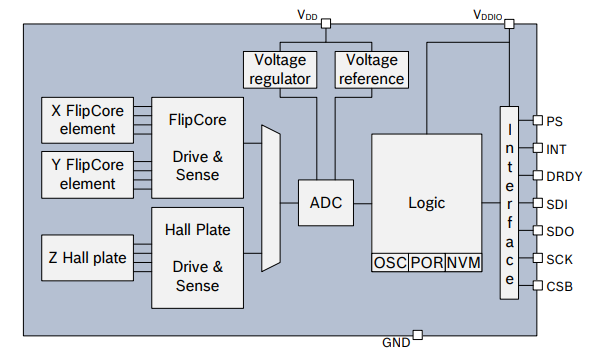
BMM150 Block Diagram
BMM150 Features
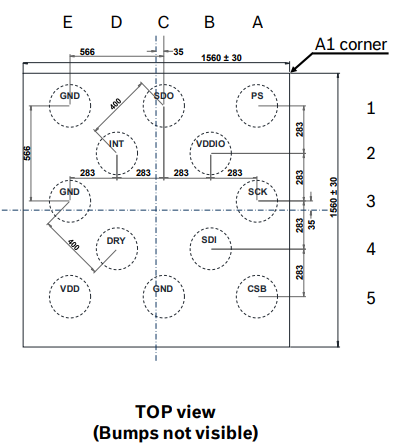
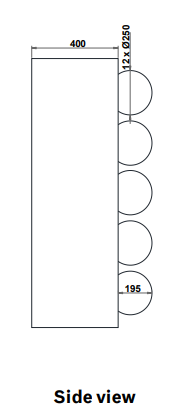
BMM150 is a low-power and low-noise 3-axis digital geo-magnetic sensor to be used in eCompass applications. The 12- pin wafer level chip scale package (WLCSP) with a footprint of only 1.56 x 1.56 mm² and 0.60 mm height provides the highest design flexibility to the developer of mobile devices.
BMM150 Applications
Magnetic heading information
Tilt-compensated electronic compass for map rotation, navigation and augmented reality
Gyroscope calibration in 9-DoF applications for mobile devices
In-door navigation, e.g. step counting in combination accelerometer
Gaming
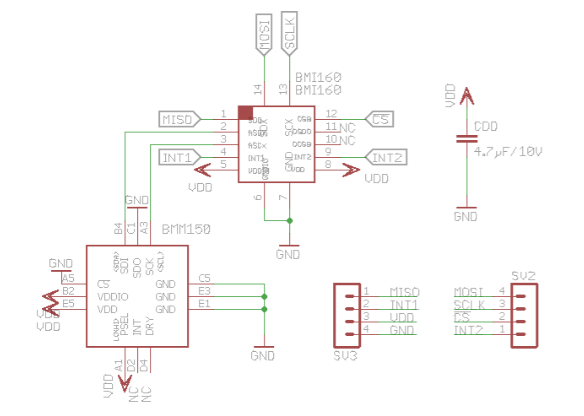
BMM150 Application Circuit
BMM150 Outline Dimension

BMM150 Manufacturer
Devoted to consumer electronics worldwide, Bosch Sensortec (fully owned by Robert Bosch GmbH as a subsidiary firm) provides a portfolio of MEMS(micro-electro-mechanical systems) based solutions and chips for applications in wearable devices, smartphones, tablets, and a number of products in the field of IoT(Internet of Things). With their great effort, more and more mobile devices are able to sense the world.
Trend Analysis
Datasheet PDF
- Datasheets :
- Environmental Information :
What is BMM150?
BMM150 is a low-power and low-noise 3-axis digital geomagnetic sensor to be used in compass applications. Applications like virtual reality or gaming on mobile devices such as mobile phones, tablet PCs, or portable media players require 9-axis inertial sensing including magnetic heading information.
What is BMM150 used for?
The low-power, low-noise BMM150 is a 3-axis digital geomagnetic sensor that perfectly matches the requirements of compass applications. By means of sensor data fusion software tailored to the hardware, the BMM150 provides absolute spatial orientation and motion vectors with high accuracy and dynamics.
How does BMM150 work?
The BMM150 is a standalone geomagnetic sensor for consumer market applications. An evaluation circuitry (ASIC) converts the output of the geomagnetic sensor to digital results which can be read out over the industry-standard digital interfaces (SPI and I2C).
 ADXL345 Accelerometer: Datasheet, Pinout and Alternatives
09 September 202110913
 LM311NG Single Comparator: Pinout, Equivalent and Datasheet
17 March 20222471
![MJE3055 Transistor: Diagram, Pinout, and Datasheet [Video&FAQ]](https://res.utmel.com/Images/Article/f1131d56-a501-42ec-b104-f8b6e7e166cc.png) MJE3055 Transistor: Diagram, Pinout, and Datasheet [Video&FAQ]
MJE3055 Transistor: Diagram, Pinout, and Datasheet [Video&FAQ]22 November 202116147
 AT90CAN12815MT: Technical Product Analysis
29 February 2024202
![BTA12 Triacs: Features, Pinout, and Datasheet [Video&FAQ]](https://res.utmel.com/Images/Article/0e2fa5b3-b023-4f7c-8a16-fb7d7e7972ef.png) BTA12 Triacs: Features, Pinout, and Datasheet [Video&FAQ]
BTA12 Triacs: Features, Pinout, and Datasheet [Video&FAQ]04 December 202115841
 TIP121 NPN Transistor: Darlington NPN, TIP121 Datasheet, Pinout
05 May 20223820
.png) AD558: A Versatile Digital to Analog Converter for Precise Voltage Output
AD558: A Versatile Digital to Analog Converter for Precise Voltage Output06 March 2024492
 AD9364BBCZ RF Transceiver ICs: Package,Datasheet,Specification
14 May 20212901
 Global Semiconductor Sales Experience a 2.3% Surge in July 2023
09 September 20233899
 MediaTek, Qualcomm Announce Joining Russia Sanctions
10 March 20226372
 LDO VS DC to DC Converter
11 March 202211999
 Global Ceramic Capacitors Market In-Depth Analysis to 2025
10 December 20258087
 CCTC Authorized Distributor | UTMEL Electronics
22 February 20258061
 Sourcing for Embodied AI: How Large Action Models (LAMs) are Driving the Edge AI Chip Explosion
22 July 2026231
 How Zener Diodes Work: Characteristics and Selection Guide
16 July 202625853
 5 Easy Ways to Choose Sample-and-Hold Amplifiers
06 June 20253645
Bosch Sensortec
In Stock
United States
China
Canada
Japan
Russia
Germany
United Kingdom
Singapore
Italy
Hong Kong(China)
Taiwan(China)
France
Korea
Mexico
Netherlands
Malaysia
Austria
Spain
Switzerland
Poland
Thailand
Vietnam
India
United Arab Emirates
Afghanistan
Åland Islands
Albania
Algeria
American Samoa
Andorra
Angola
Anguilla
Antigua & Barbuda
Argentina
Armenia
Aruba
Australia
Azerbaijan
Bahamas
Bahrain
Bangladesh
Barbados
Belarus
Belgium
Belize
Benin
Bermuda
Bhutan
Bolivia
Bonaire, Sint Eustatius and Saba
Bosnia & Herzegovina
Botswana
Brazil
British Indian Ocean Territory
British Virgin Islands
Brunei
Bulgaria
Burkina Faso
Burundi
Cabo Verde
Cambodia
Cameroon
Cayman Islands
Central African Republic
Chad
Chile
Christmas Island
Cocos (Keeling) Islands
Colombia
Comoros
Congo
Congo (DRC)
Cook Islands
Costa Rica
Côte d’Ivoire
Croatia
Cuba
Curaçao
Cyprus
Czechia
Denmark
Djibouti
Dominica
Dominican Republic
Ecuador
Egypt
El Salvador
Equatorial Guinea
Eritrea
Estonia
Eswatini
Ethiopia
Falkland Islands
Faroe Islands
Fiji
Finland
French Guiana
French Polynesia
Gabon
Gambia
Georgia
Ghana
Gibraltar
Greece
Greenland
Grenada
Guadeloupe
Guam
Guatemala
Guernsey
Guinea
Guinea-Bissau
Guyana
Haiti
Honduras
Hungary
Iceland
Indonesia
Iran
Iraq
Ireland
Isle of Man
Israel
Jamaica
Jersey
Jordan
Kazakhstan
Kenya
Kiribati
Kosovo
Kuwait
Kyrgyzstan
Laos
Latvia
Lebanon
Lesotho
Liberia
Libya
Liechtenstein
Lithuania
Luxembourg
Macao(China)
Madagascar
Malawi
Maldives
Mali
Malta
Marshall Islands
Martinique
Mauritania
Mauritius
Mayotte
Micronesia
Moldova
Monaco
Mongolia
Montenegro
Montserrat
Morocco
Mozambique
Myanmar
Namibia
Nauru
Nepal
New Caledonia
New Zealand
Nicaragua
Niger
Nigeria
Niue
Norfolk Island
North Korea
North Macedonia
Northern Mariana Islands
Norway
Oman
Pakistan
Palau
Palestinian Authority
Panama
Papua New Guinea
Paraguay
Peru
Philippines
Pitcairn Islands
Portugal
Puerto Rico
Qatar
Réunion
Romania
Rwanda
Samoa
San Marino
São Tomé & Príncipe
Saudi Arabia
Senegal
Serbia
Seychelles
Sierra Leone
Sint Maarten
Slovakia
Slovenia
Solomon Islands
Somalia
South Africa
South Sudan
Sri Lanka
St Helena, Ascension, Tristan da Cunha
St. Barthélemy
St. Kitts & Nevis
St. Lucia
St. Martin
St. Pierre & Miquelon
St. Vincent & Grenadines
Sudan
Suriname
Svalbard & Jan Mayen
Sweden
Syria
Tajikistan
Tanzania
Timor-Leste
Togo
Tokelau
Tonga
Trinidad & Tobago
Tunisia
Turkey
Turkmenistan
Turks & Caicos Islands
Tuvalu
U.S. Outlying Islands
U.S. Virgin Islands
Uganda
Ukraine
Uruguay
Uzbekistan
Vanuatu
Vatican City
Venezuela
Wallis & Futuna
Yemen
Zambia
Zimbabwe