

 Product
 Brand
Brand Articles
 Tools
Tools
LIS3DH Accelerometer: Datasheet, Pinout, Functionality, and Block Diagram

STMICROELECTRONICS LIS3DH MEMS Accelerometer, 3-Axis, Digital, X, Y, Z,2g,4g,8g,16g, 1.71 V, 3.6 V, LGA


STMICROELECTRONICS LIS3DH MEMS Accelerometer, 3-Axis, Digital, X, Y, Z,2g,4g,8g,16g, 1.71 V, 3.6 V, LGA
The LIS3DH is an ultra low-power high performance three axes linear accelerometer belonging to the “nano” family, with digital I2C/SPI serial interface standard output.

SparkFun LIS3DH Accelerometer
LIS3DH Description
The LIS3DH is an ultra-low-power high performance three-axis linear accelerometer belonging to the "nano" family, with digital I2C/SPI serial interface standard output. The device features ultra-low-power operational modes that allow advanced power saving and smart embedded functions.
The LIS3DH has dynamically user-selectable full scales of ±2g/±4g/±8g/±16g and is capable of measuring accelerations with output data rates from 1 Hz to 5.3 kHz. The self-test capability allows the user to check the functioning of the sensor in the final application. The device may be configured to generate interrupt signals using two independent inertial wake-up/free-fall events as well as by the position of the device itself. Thresholds and timing of interrupt generators are programmable by the end user on the fly. The LIS3DH has an integrated 32-level first-in, first-out (FIFO) buffer allowing the user to store data in order to limit intervention by the host processor. The LIS3DH is available in small thin plastic land grid array package (LGA) and is guaranteed to operate over an extended temperature range from -40°C to +85°C.
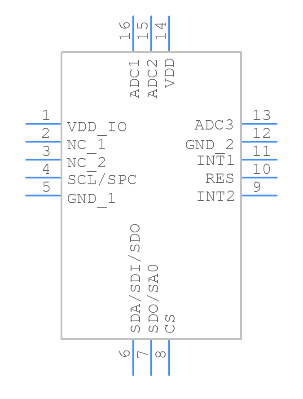
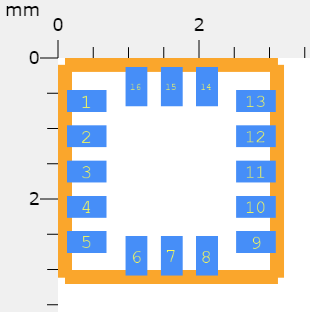
LIS3DH Pinout
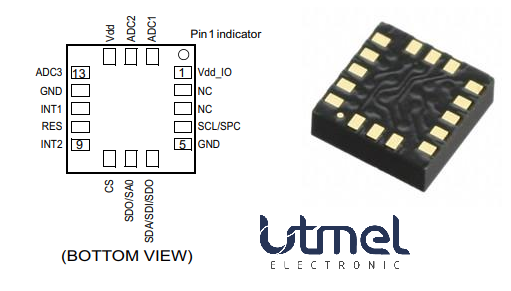

LIS3DH CAD Model
Symbol
Footprint
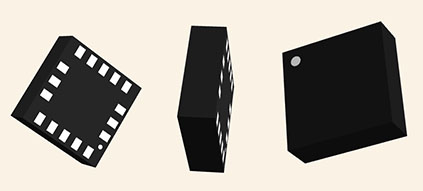
3D Model
LIS3DH Features
Wide supply voltage, 1.71 V to 3.6 V
Independent IO supply (1.8 V) and supply voltage compatible
Ultra-low-power mode consumption down to 2 μA
±2g/±4g/±8g/±16g dynamically selectable full scale
I2C/SPI digital output interface
16-bit data output
2 independent programmable interrupt generators for free-fall and motion detection
6D/4D orientation detection
Free-fall detection
Motion detection
Embedded temperature sensor
Embedded self-test
Embedded 32 levels of 16-bit data output FIFO
10000 g high shock survivability
ECOPACK®, RoHS and "Green" compliant
LIS3DH Functionality
6D / 4D orientation detection
The LIS3DH provides the capability to detect the orientation of the device in space, enabling easy implementation of energy-saving procedures and automatic image rotation for mobile devices. The 4D detection is a subset of the 6D function especially defined to be implemented in mobile devices for portrait and landscape computation. In 4D configuration, the Z-axis position detection is disabled.
"Sleep-to-wake" and "Return-to-sleep"
The LIS3DH can be programmed to automatically switch to low-power mode upon recognition of a determined event. Once the event condition is over, the device returns back to the preset normal or highresolution mode. To enable this function the desired threshold value must be stored inside the ACT_THS (3Eh) register while the duration value is written inside the ACT_DUR (3Fh) register. When the acceleration falls below the threshold value, the device automatically switches to low-power mode (10 Hz ODR). During this condition, the ODR[3:0] bits and the LPen bit inside CTRL_REG1 (20h) and the HR bit in CTRL_REG4 (23h) are not considered. As soon as the acceleration rises above threshold, the module restores the operating mode and ODRs as determined by the CTRL_REG1 (20h) and CTRL_REG4 (23h) settings.
FIFO
The LIS3DH contains a 10-bit, 32-level FIFO. Buffered output allows 4 operation modes: FIFO, Stream, Stream-to-FIFO and FIFO bypass. When FIFO bypass mode is activated, FIFO is not operating and remains empty. In FIFO mode, measurement data from acceleration detection on the x, y, and z axes are stored in the FIFO buffer.
For more information, please check out the datasheet at the end of this article.
Specifications
- TypeParameter
- Lifecycle Status
Lifecycle Status refers to the current stage of an electronic component in its product life cycle, indicating whether it is active, obsolete, or transitioning between these states. An active status means the component is in production and available for purchase. An obsolete status indicates that the component is no longer being manufactured or supported, and manufacturers typically provide a limited time frame for support. Understanding the lifecycle status is crucial for design engineers to ensure continuity and reliability in their projects.
PREVIEW (Last Updated: 8 months ago) - Mounting Type
The "Mounting Type" in electronic components refers to the method used to attach or connect a component to a circuit board or other substrate, such as through-hole, surface-mount, or panel mount.
Surface Mount - Package / Case
refers to the protective housing that encases an electronic component, providing mechanical support, electrical connections, and thermal management.
16-VFLGA - Surface Mount
having leads that are designed to be soldered on the side of a circuit board that the body of the component is mounted on.
YES - Number of Pins16
- Operating Temperature
The operating temperature is the range of ambient temperature within which a power supply, or any other electrical equipment, operate in. This ranges from a minimum operating temperature, to a peak or maximum operating temperature, outside which, the power supply may fail.
-40°C~85°C TA - Packaging
Semiconductor package is a carrier / shell used to contain and cover one or more semiconductor components or integrated circuits. The material of the shell can be metal, plastic, glass or ceramic.
Tray - JESD-609 Code
The "JESD-609 Code" in electronic components refers to a standardized marking code that indicates the lead-free solder composition and finish of electronic components for compliance with environmental regulations.
e4 - Part Status
Parts can have many statuses as they progress through the configuration, analysis, review, and approval stages.
Obsolete - Moisture Sensitivity Level (MSL)
Moisture Sensitivity Level (MSL) is a standardized rating that indicates the susceptibility of electronic components, particularly semiconductors, to moisture-induced damage during storage and the soldering process, defining the allowable exposure time to ambient conditions before they require special handling or baking to prevent failures
3 (168 Hours) - Number of Terminations16
- ECCN Code
An ECCN (Export Control Classification Number) is an alphanumeric code used by the U.S. Bureau of Industry and Security to identify and categorize electronic components and other dual-use items that may require an export license based on their technical characteristics and potential for military use.
EAR99 - TypeDigital
- Terminal Finish
Terminal Finish refers to the surface treatment applied to the terminals or leads of electronic components to enhance their performance and longevity. It can improve solderability, corrosion resistance, and overall reliability of the connection in electronic assemblies. Common finishes include nickel, gold, and tin, each possessing distinct properties suitable for various applications. The choice of terminal finish can significantly impact the durability and effectiveness of electronic devices.
NICKEL/GOLD (NI/AU) - ELECTROLYTIC - HTS Code
HTS (Harmonized Tariff Schedule) codes are product classification codes between 8-1 digits. The first six digits are an HS code, and the countries of import assign the subsequent digits to provide additional classification. U.S. HTS codes are 1 digits and are administered by the U.S. International Trade Commission.
8542.39.00.01 - Voltage - Supply
Voltage - Supply refers to the range of voltage levels that an electronic component or circuit is designed to operate with. It indicates the minimum and maximum supply voltage that can be applied for the device to function properly. Providing supply voltages outside this range can lead to malfunction, damage, or reduced performance. This parameter is critical for ensuring compatibility between different components in a circuit.
1.71V~3.6V - Terminal Position
In electronic components, the term "Terminal Position" refers to the physical location of the connection points on the component where external electrical connections can be made. These connection points, known as terminals, are typically used to attach wires, leads, or other components to the main body of the electronic component. The terminal position is important for ensuring proper connectivity and functionality of the component within a circuit. It is often specified in technical datasheets or component specifications to help designers and engineers understand how to properly integrate the component into their circuit designs.
BOTTOM - Terminal Form
Occurring at or forming the end of a series, succession, or the like; closing; concluding.
BUTT - Peak Reflow Temperature (Cel)
Peak Reflow Temperature (Cel) is a parameter that specifies the maximum temperature at which an electronic component can be exposed during the reflow soldering process. Reflow soldering is a common method used to attach electronic components to a circuit board. The Peak Reflow Temperature is crucial because it ensures that the component is not damaged or degraded during the soldering process. Exceeding the specified Peak Reflow Temperature can lead to issues such as component failure, reduced performance, or even permanent damage to the component. It is important for manufacturers and assemblers to adhere to the recommended Peak Reflow Temperature to ensure the reliability and functionality of the electronic components.
260 - Number of Functions1
- Supply Voltage
Supply voltage refers to the electrical potential difference provided to an electronic component or circuit. It is crucial for the proper operation of devices, as it powers their functions and determines performance characteristics. The supply voltage must be within specified limits to ensure reliability and prevent damage to components. Different electronic devices have specific supply voltage requirements, which can vary widely depending on their design and intended application.
2.5V - Terminal Pitch
The center distance from one pole to the next.
0.5mm - Depth
In electronic components, "Depth" typically refers to the measurement of the distance from the front to the back of the component. It is an important parameter to consider when designing or selecting components for a project, as it determines how much space the component will occupy within a circuit or device. The depth of a component can impact the overall size and layout of the circuit board or enclosure in which it will be installed. It is usually specified in millimeters or inches and is crucial for ensuring proper fit and functionality within the intended application.
3mm - Time@Peak Reflow Temperature-Max (s)
Time@Peak Reflow Temperature-Max (s) refers to the maximum duration that an electronic component can be exposed to the peak reflow temperature during the soldering process, which is crucial for ensuring reliable solder joint formation without damaging the component.
30 - Base Part Number
The "Base Part Number" (BPN) in electronic components serves a similar purpose to the "Base Product Number." It refers to the primary identifier for a component that captures the essential characteristics shared by a group of similar components. The BPN provides a fundamental way to reference a family or series of components without specifying all the variations and specific details.
LIS3 - Pin Count
a count of all of the component leads (or pins)
16 - Output Type
The "Output Type" parameter in electronic components refers to the type of signal or data that is produced by the component as an output. This parameter specifies the nature of the output signal, such as analog or digital, and can also include details about the voltage levels, current levels, frequency, and other characteristics of the output signal. Understanding the output type of a component is crucial for ensuring compatibility with other components in a circuit or system, as well as for determining how the output signal can be utilized or processed further. In summary, the output type parameter provides essential information about the nature of the signal that is generated by the electronic component as its output.
I2C, SPI - Operating Supply Voltage
The voltage level by which an electrical system is designated and to which certain operating characteristics of the system are related.
2.5V - Interface
In electronic components, the term "Interface" refers to the point at which two different systems, devices, or components connect and interact with each other. It can involve physical connections such as ports, connectors, or cables, as well as communication protocols and standards that facilitate the exchange of data or signals between the connected entities. The interface serves as a bridge that enables seamless communication and interoperability between different parts of a system or between different systems altogether. Designing a reliable and efficient interface is crucial in ensuring proper functionality and performance of electronic components and systems.
I2C, SPI - Operating Supply Current
Operating Supply Current, also known as supply current or quiescent current, is a crucial parameter in electronic components that indicates the amount of current required for the device to operate under normal conditions. It represents the current drawn by the component from the power supply while it is functioning. This parameter is important for determining the power consumption of the component and is typically specified in datasheets to help designers calculate the overall power requirements of their circuits. Understanding the operating supply current is essential for ensuring proper functionality and efficiency of electronic systems.
11μA - Resolution
Resolution in electronic components refers to the smallest increment of measurement or change that can be detected or represented by the component. It is a crucial specification in devices such as sensors, displays, and converters, as it determines the level of detail or accuracy that can be achieved. For example, in a digital camera, resolution refers to the number of pixels that make up an image, with higher resolution indicating a greater level of detail. In analog-to-digital converters, resolution is the number of discrete values that can be represented in the digital output, determining the precision of the conversion process. Overall, resolution plays a significant role in determining the performance and capabilities of electronic components in various applications.
2 B - Sensor Type
In electronic components, the parameter "Sensor Type" refers to the specific type of sensor technology used in a particular component to detect and measure physical phenomena such as light, temperature, pressure, motion, or proximity. Different sensor types utilize various principles and mechanisms to convert the detected input into an electrical signal that can be processed by the electronic component. Common sensor types include photodiodes, thermistors, accelerometers, and proximity sensors, each designed for specific applications and environments. Understanding the sensor type is crucial for selecting the right component for a given task and ensuring accurate and reliable sensing capabilities in electronic systems.
3 Axis - Max Supply Voltage (DC)
The parameter "Max Supply Voltage (DC)" in electronic components refers to the maximum voltage that can be safely applied to the component without causing damage. This specification is crucial for ensuring the reliable operation and longevity of the component within a given circuit. Exceeding the maximum supply voltage can lead to overheating, breakdown of internal components, or even permanent damage. It is important to carefully adhere to this specification when designing or using electronic circuits to prevent potential failures and ensure the safety of the components.
3.6V - Min Supply Voltage (DC)
The parameter "Min Supply Voltage (DC)" in electronic components refers to the minimum voltage level required for the component to operate properly. It indicates the lowest voltage that can be safely applied to the component without causing damage or malfunction. This parameter is crucial for ensuring the reliable and stable operation of the component within its specified operating range. It is important for designers and engineers to adhere to the specified minimum supply voltage to prevent potential issues such as erratic behavior, reduced performance, or permanent damage to the component.
1.71V - Axis
In electronic components, the parameter "Axis" typically refers to the orientation or direction along which a specific characteristic or measurement is being considered. For example, in a sensor or accelerometer, the axis may indicate the direction in which the device is measuring acceleration. In a motor or actuator, the axis may refer to the direction of movement or rotation.Understanding the axis of a component is crucial for proper installation, calibration, and operation. It helps in determining how the component will interact with other parts of a system and how its performance can be optimized. Different components may have multiple axes to consider, especially in complex systems where movement or measurements occur in multiple directions.Overall, the axis parameter provides important information about the spatial orientation or directionality of an electronic component, guiding engineers and technicians in effectively utilizing the component within a larger system.
X, Y, Z - Acceleration Range
The "Acceleration Range" parameter in electronic components refers to the range of acceleration levels that the component can withstand without experiencing damage or malfunction. This parameter is particularly important for components that are used in applications where they may be subjected to varying levels of acceleration, such as in automotive or aerospace systems. The acceleration range is typically specified in units of gravity (g) and indicates the maximum and minimum levels of acceleration that the component can tolerate while still operating within its specified performance limits. It is crucial to consider the acceleration range when selecting components for applications where acceleration levels may vary significantly to ensure reliable and safe operation.
±2g, 4g, 8g, 16g - Features
In the context of electronic components, the term "Features" typically refers to the specific characteristics or functionalities that a particular component offers. These features can vary depending on the type of component and its intended use. For example, a microcontroller may have features such as built-in memory, analog-to-digital converters, and communication interfaces like UART or SPI.When evaluating electronic components, understanding their features is crucial in determining whether they meet the requirements of a particular project or application. Engineers and designers often look at features such as operating voltage, speed, power consumption, and communication protocols to ensure compatibility and optimal performance.In summary, the "Features" parameter in electronic components describes the unique attributes and capabilities that differentiate one component from another, helping users make informed decisions when selecting components for their electronic designs.
Adjustable Bandwidth, Selectable Scale, Temperature Sensor - Sensitivity (LSB/g)
The parameter "Sensitivity (LSB/g)" in electronic components refers to the sensitivity of a sensor or device in terms of the number of least significant bits (LSBs) of output change per unit of acceleration (g). LSB is the smallest change in the digital output of a sensor. This parameter helps to quantify the resolution and accuracy of the sensor in detecting changes in acceleration. A higher sensitivity value indicates that the sensor can detect smaller changes in acceleration, while a lower sensitivity value means that larger changes in acceleration are needed to produce a noticeable output change. It is an important specification to consider when selecting a sensor for applications that require precise measurement of acceleration.
1000 (±2g) ~ 83 (±16g) - Height1mm
- Length3mm
- Width3mm
- REACH SVHC
The parameter "REACH SVHC" in electronic components refers to the compliance with the Registration, Evaluation, Authorization, and Restriction of Chemicals (REACH) regulation regarding Substances of Very High Concern (SVHC). SVHCs are substances that may have serious effects on human health or the environment, and their use is regulated under REACH to ensure their safe handling and minimize their impact.Manufacturers of electronic components need to declare if their products contain any SVHCs above a certain threshold concentration and provide information on the safe use of these substances. This information allows customers to make informed decisions about the potential risks associated with using the components and take appropriate measures to mitigate any hazards.Ensuring compliance with REACH SVHC requirements is essential for electronics manufacturers to meet regulatory standards, protect human health and the environment, and maintain transparency in their supply chain. It also demonstrates a commitment to sustainability and responsible manufacturing practices in the electronics industry.
No SVHC - Radiation Hardening
Radiation hardening is the process of making electronic components and circuits resistant to damage or malfunction caused by high levels of ionizing radiation, especially for environments in outer space (especially beyond the low Earth orbit), around nuclear reactors and particle accelerators, or during nuclear accidents or nuclear warfare.
No - RoHS Status
RoHS means “Restriction of Certain Hazardous Substances” in the “Hazardous Substances Directive” in electrical and electronic equipment.
ROHS3 Compliant - Lead Free
Lead Free is a term used to describe electronic components that do not contain lead as part of their composition. Lead is a toxic material that can have harmful effects on human health and the environment, so the electronics industry has been moving towards lead-free components to reduce these risks. Lead-free components are typically made using alternative materials such as silver, copper, and tin. Manufacturers must comply with regulations such as the Restriction of Hazardous Substances (RoHS) directive to ensure that their products are lead-free and environmentally friendly.
Lead Free
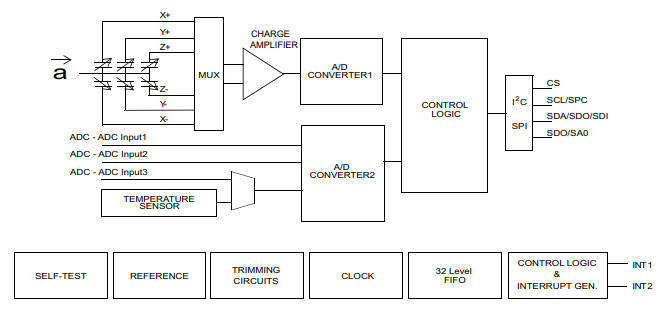
LIS3DH Block Diagram
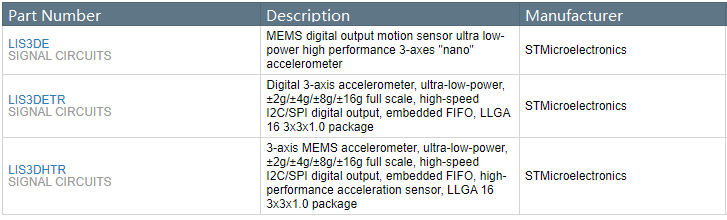
LIS3DH Alternatives
How to use LIS3DH
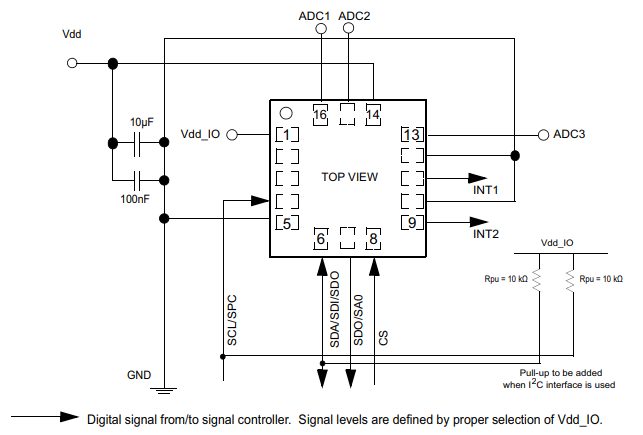
LIS3DH electrical connections
The device core is supplied through the Vdd line while the I/O pads are supplied through the Vdd_IO line. Power supply decoupling capacitors (100 nF ceramic, 10 μF aluminum) should be placed as near as possible to pin 14 of the device (common design practice).
All the voltage and ground supplies must be present at the same time to have proper behavior of the IC (refer to the figure above). It is possible to remove Vdd maintaining Vdd_IO without blocking the communication bus, in this condition the measurement chain is powered off.
The functionality of the device and the measured acceleration data is selectable and accessible through the I2C or SPI interfaces. When using the I2C, CS must be tied high.
ADC1, ADC2 & ADC3 if not used can be left floating or connected to Vdd or GND.
The functions, the threshold and the timing of the two interrupt pins (INT1 and INT2) can be completely programmed by the user through the I2C/SPI interface.
LIS3DH Applications
Motion activated functions
Free-fall detection
Click/double-click recognition
Intelligent power saving for handheld devices
Pedometers
Display orientation
Gaming and virtual reality input devices
Impact recognition and logging
Vibration monitoring and compensation
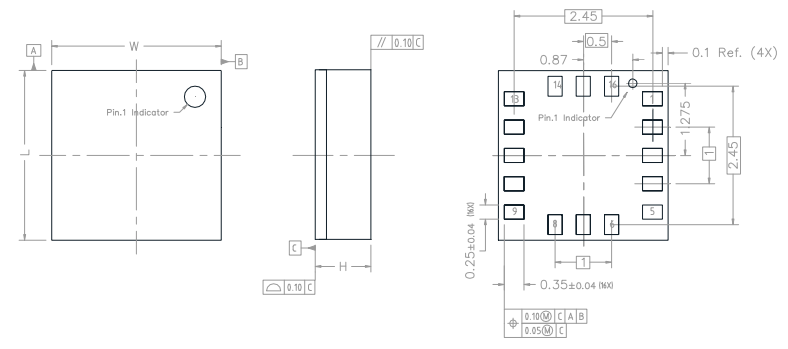

LIS3DH Manufacturer
STMicroelectronics is a global independent semiconductor company and is a leader in developing and delivering semiconductor solutions across the spectrum of microelectronics applications. An unrivaled combination of silicon and system expertise, manufacturing strength, Intellectual Property (IP) portfolio and strategic partners positions the Company at the forefront of System-on-Chip (SoC) technology and its products play a key role in enabling today's convergence trends.
Trend Analysis
Datasheet PDF
- Datasheets :
1.What is LIS3DH?
The LIS3DH is an ultra-low-power high-performance three-axis linear accelerometer belonging to the "nano" family, with digital I2C/SPI serial interface standard output. The device features ultra-low-power operational modes that allow advanced power saving and smart embedded functions.
2.What is a 3-axis accelerometer?
The 3-Axis Accelerometer consists of three –5 to +5 g accelerometers mounted in one small block. Using the appropriate data collection hardware and software, you can graph any of these components, or calculate the magnitude of the net acceleration.
3.Can an accelerometer measure speed?
An accelerometer measures acceleration, not speed. In order to get speed, you will have to integrate the acceleration data over time.
4.How accurate is an accelerometer?
Accelerometers can be used to make very accurate pedometers that can measure walking distance to within ±1%.
 2N2222 Switches: Pinout, Datasheet and Schematic
12 July 202115470
 What is the difference between them: 2N3904 vs. BC547?
10 November 202131877
 CD4051BE: Featurs, Applications, and Datasheet
08 November 20232590
 How to Use CP2102 UART Module to Program Arduino Pro Mini?
17 January 20225417
 A Comprehensive Guide to the Atmel AT89LP51RB2/RC2/IC2 Microcontroller
29 February 2024215
 Exploring the Microchip PIC24F08KL301ESO Microcontroller: A Holistic Analysis
29 February 2024174
 MJE15030G NPN Transistor: Datasheet, Equivalent, and Pinout
28 August 20215082
 LM317LZ Voltage Regulator: Circuits, Pinout, and Datasheet
14 January 20225269
 The Introduction to PCB Inspection Knowledge and Methods
22 December 20214662
 What is NAND Flash?
04 November 202112363
 Ceramic Capacitors Explained: Dielectric Classes, MLCC Construction, and the Parameters That Actually Matter
14 July 20266708
 What are Comparators?
03 December 20206171
 What is a Polypropylene Capacitor?
08 November 202121696
 Structure and Working Principle of Field Effect Transistors
07 April 202540573
 Selection and Optimization of Peripheral Components for DC-DC Boost Regulator
15 April 20222293
 In Circuit Design, What are the Differences Between the 6 Types of Grounding?
25 March 20245306
STMicroelectronics
In Stock: 280000
United States
China
Canada
Japan
Russia
Germany
United Kingdom
Singapore
Italy
Hong Kong(China)
Taiwan(China)
France
Korea
Mexico
Netherlands
Malaysia
Austria
Spain
Switzerland
Poland
Thailand
Vietnam
India
United Arab Emirates
Afghanistan
Åland Islands
Albania
Algeria
American Samoa
Andorra
Angola
Anguilla
Antigua & Barbuda
Argentina
Armenia
Aruba
Australia
Azerbaijan
Bahamas
Bahrain
Bangladesh
Barbados
Belarus
Belgium
Belize
Benin
Bermuda
Bhutan
Bolivia
Bonaire, Sint Eustatius and Saba
Bosnia & Herzegovina
Botswana
Brazil
British Indian Ocean Territory
British Virgin Islands
Brunei
Bulgaria
Burkina Faso
Burundi
Cabo Verde
Cambodia
Cameroon
Cayman Islands
Central African Republic
Chad
Chile
Christmas Island
Cocos (Keeling) Islands
Colombia
Comoros
Congo
Congo (DRC)
Cook Islands
Costa Rica
Côte d’Ivoire
Croatia
Cuba
Curaçao
Cyprus
Czechia
Denmark
Djibouti
Dominica
Dominican Republic
Ecuador
Egypt
El Salvador
Equatorial Guinea
Eritrea
Estonia
Eswatini
Ethiopia
Falkland Islands
Faroe Islands
Fiji
Finland
French Guiana
French Polynesia
Gabon
Gambia
Georgia
Ghana
Gibraltar
Greece
Greenland
Grenada
Guadeloupe
Guam
Guatemala
Guernsey
Guinea
Guinea-Bissau
Guyana
Haiti
Honduras
Hungary
Iceland
Indonesia
Iran
Iraq
Ireland
Isle of Man
Israel
Jamaica
Jersey
Jordan
Kazakhstan
Kenya
Kiribati
Kosovo
Kuwait
Kyrgyzstan
Laos
Latvia
Lebanon
Lesotho
Liberia
Libya
Liechtenstein
Lithuania
Luxembourg
Macao(China)
Madagascar
Malawi
Maldives
Mali
Malta
Marshall Islands
Martinique
Mauritania
Mauritius
Mayotte
Micronesia
Moldova
Monaco
Mongolia
Montenegro
Montserrat
Morocco
Mozambique
Myanmar
Namibia
Nauru
Nepal
New Caledonia
New Zealand
Nicaragua
Niger
Nigeria
Niue
Norfolk Island
North Korea
North Macedonia
Northern Mariana Islands
Norway
Oman
Pakistan
Palau
Palestinian Authority
Panama
Papua New Guinea
Paraguay
Peru
Philippines
Pitcairn Islands
Portugal
Puerto Rico
Qatar
Réunion
Romania
Rwanda
Samoa
San Marino
São Tomé & Príncipe
Saudi Arabia
Senegal
Serbia
Seychelles
Sierra Leone
Sint Maarten
Slovakia
Slovenia
Solomon Islands
Somalia
South Africa
South Sudan
Sri Lanka
St Helena, Ascension, Tristan da Cunha
St. Barthélemy
St. Kitts & Nevis
St. Lucia
St. Martin
St. Pierre & Miquelon
St. Vincent & Grenadines
Sudan
Suriname
Svalbard & Jan Mayen
Sweden
Syria
Tajikistan
Tanzania
Timor-Leste
Togo
Tokelau
Tonga
Trinidad & Tobago
Tunisia
Turkey
Turkmenistan
Turks & Caicos Islands
Tuvalu
U.S. Outlying Islands
U.S. Virgin Islands
Uganda
Ukraine
Uruguay
Uzbekistan
Vanuatu
Vatican City
Venezuela
Wallis & Futuna
Yemen
Zambia
Zimbabwe
![LIS244AL]() LIS244AL
LIS244ALSTMicroelectronics
![AIS2120SXTR]() AIS2120SXTR
AIS2120SXTRSTMicroelectronics
![IIS2DLPCTR]() IIS2DLPCTR
IIS2DLPCTRSTMicroelectronics
![LIS2DH12TR]() LIS2DH12TR
LIS2DH12TRSTMicroelectronics
![LIS3DHTR]() LIS3DHTR
LIS3DHTRSTMicroelectronics
![LIS331DLHTR]() LIS331DLHTR
LIS331DLHTRSTMicroelectronics
![LIS2DE12TR]() LIS2DE12TR
LIS2DE12TRSTMicroelectronics
![LIS344ALHTR]() LIS344ALHTR
LIS344ALHTRSTMicroelectronics
![LIS2DHTR]() LIS2DHTR
LIS2DHTRSTMicroelectronics
![AIS328DQTR]() AIS328DQTR
AIS328DQTRSTMicroelectronics


