

 Product
 Brand
Brand Articles
 Tools
Tools
PMEG6010CEJ Schottky Diode: Datasheet PDF, Application, Alternative

Schottky Diode Rectifier Fast Recovery =< 500ns, > 200mA (Io) 660mV @ 1A 150°C Max 50μA @ 60V 2-Termination Tape & Reel (TR) SC-90, SOD-323F Surface Mount
Unit Price: $0.047847
Ext Price: $0.05


Schottky Diode Rectifier Fast Recovery =< 500ns, > 200mA (Io) 660mV @ 1A 150°C Max 50μA @ 60V 2-Termination Tape & Reel (TR) SC-90, SOD-323F Surface Mount
PMEG6010CEJ Schottky Diode belongs to 1 A very low VF MEGA Schottky barrier rectifiers. This article unlocks its pinout, datasheet, application, alternatives and more details about PMEG6010CEJ.
PMEG6010CEJ Pinout
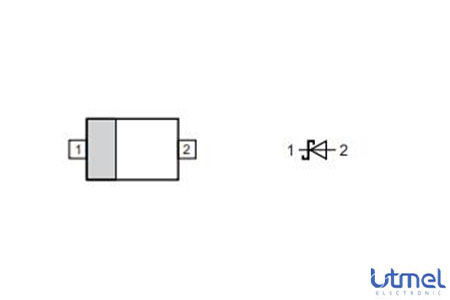
| Pin | Name |
| 1 | CATHODE |
| 2 | ANODE |
PMEG6010CEJ CAD Model
Symbol

PMEG6010CEJ Symbol
Footprint

PMEG6010CEJ Footprint
3D Model

PMEG6010CEJ 3D Model
PMEG6010CEJ Description
PMEG6010CEJ belongs to Planar Maximum Efficiency General Application (MEGA) Schottky barrier rectifiers with an integrated guard ring for stress protection, encapsulated in small and flat lead Surface-Mounted Device (SMD) plastic packages.
PMEG6010CEJ Feature
■ Forward current: IF ≤ 1 A
■ Reverse voltage: VR ≤ 60 V
■ Very low forward voltage
■ Small and flat lead SMD plastic packages
PMEG6010CEJ Application
■ Low voltage rectification
■ High-efficiency DC-to-DC conversion
■ Switch-mode power supply
■ Reverse polarity protection
■ Low power consumption applications
PMEG6010CEJ Alternatives
PMEG6010CEJ Test Circuit
The test circuit of PMEG6010CEJ is shown below
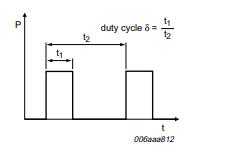
PMEG6010CEJ Test Circuit
Specifications
- TypeParameter
- Factory Lead Time4 Weeks
- Mounting Type
The "Mounting Type" in electronic components refers to the method used to attach or connect a component to a circuit board or other substrate, such as through-hole, surface-mount, or panel mount.
Surface Mount - Package / Case
refers to the protective housing that encases an electronic component, providing mechanical support, electrical connections, and thermal management.
SC-90, SOD-323F - Surface Mount
having leads that are designed to be soldered on the side of a circuit board that the body of the component is mounted on.
YES - Number of Pins2
- Diode Element Material
The parameter "Diode Element Material" refers to the specific semiconductor material used in the construction of a diode. This material determines the electrical characteristics and performance of the diode, including its forward voltage drop, reverse breakdown voltage, and switching speed. Common diode element materials include silicon, germanium, and gallium arsenide, each offering different advantages for various applications. The choice of material impacts the diode's efficiency, thermal stability, and overall suitability for specific electronic circuits.
SILICON - Number of Elements1
- Power Dissipation (Max)0.35W
- Packaging
Semiconductor package is a carrier / shell used to contain and cover one or more semiconductor components or integrated circuits. The material of the shell can be metal, plastic, glass or ceramic.
Tape & Reel (TR) - Published2007
- JESD-609 Code
The "JESD-609 Code" in electronic components refers to a standardized marking code that indicates the lead-free solder composition and finish of electronic components for compliance with environmental regulations.
e3 - Part Status
Parts can have many statuses as they progress through the configuration, analysis, review, and approval stages.
Active - Moisture Sensitivity Level (MSL)
Moisture Sensitivity Level (MSL) is a standardized rating that indicates the susceptibility of electronic components, particularly semiconductors, to moisture-induced damage during storage and the soldering process, defining the allowable exposure time to ambient conditions before they require special handling or baking to prevent failures
1 (Unlimited) - Number of Terminations2
- ECCN Code
An ECCN (Export Control Classification Number) is an alphanumeric code used by the U.S. Bureau of Industry and Security to identify and categorize electronic components and other dual-use items that may require an export license based on their technical characteristics and potential for military use.
EAR99 - Terminal Finish
Terminal Finish refers to the surface treatment applied to the terminals or leads of electronic components to enhance their performance and longevity. It can improve solderability, corrosion resistance, and overall reliability of the connection in electronic assemblies. Common finishes include nickel, gold, and tin, each possessing distinct properties suitable for various applications. The choice of terminal finish can significantly impact the durability and effectiveness of electronic devices.
Tin (Sn) - Max Operating Temperature
The Maximum Operating Temperature is the maximum body temperature at which the thermistor is designed to operate for extended periods of time with acceptable stability of its electrical characteristics.
150°C - Min Operating Temperature
The "Min Operating Temperature" parameter in electronic components refers to the lowest temperature at which the component is designed to operate effectively and reliably. This parameter is crucial for ensuring the proper functioning and longevity of the component, as operating below this temperature may lead to performance issues or even damage. Manufacturers specify the minimum operating temperature to provide guidance to users on the environmental conditions in which the component can safely operate. It is important to adhere to this parameter to prevent malfunctions and ensure the overall reliability of the electronic system.
-65°C - HTS Code
HTS (Harmonized Tariff Schedule) codes are product classification codes between 8-1 digits. The first six digits are an HS code, and the countries of import assign the subsequent digits to provide additional classification. U.S. HTS codes are 1 digits and are administered by the U.S. International Trade Commission.
8541.10.00.50 - Terminal Position
In electronic components, the term "Terminal Position" refers to the physical location of the connection points on the component where external electrical connections can be made. These connection points, known as terminals, are typically used to attach wires, leads, or other components to the main body of the electronic component. The terminal position is important for ensuring proper connectivity and functionality of the component within a circuit. It is often specified in technical datasheets or component specifications to help designers and engineers understand how to properly integrate the component into their circuit designs.
DUAL - Terminal Form
Occurring at or forming the end of a series, succession, or the like; closing; concluding.
FLAT - Peak Reflow Temperature (Cel)
Peak Reflow Temperature (Cel) is a parameter that specifies the maximum temperature at which an electronic component can be exposed during the reflow soldering process. Reflow soldering is a common method used to attach electronic components to a circuit board. The Peak Reflow Temperature is crucial because it ensures that the component is not damaged or degraded during the soldering process. Exceeding the specified Peak Reflow Temperature can lead to issues such as component failure, reduced performance, or even permanent damage to the component. It is important for manufacturers and assemblers to adhere to the recommended Peak Reflow Temperature to ensure the reliability and functionality of the electronic components.
260 - Time@Peak Reflow Temperature-Max (s)
Time@Peak Reflow Temperature-Max (s) refers to the maximum duration that an electronic component can be exposed to the peak reflow temperature during the soldering process, which is crucial for ensuring reliable solder joint formation without damaging the component.
40 - Base Part Number
The "Base Part Number" (BPN) in electronic components serves a similar purpose to the "Base Product Number." It refers to the primary identifier for a component that captures the essential characteristics shared by a group of similar components. The BPN provides a fundamental way to reference a family or series of components without specifying all the variations and specific details.
PMEG6010 - Pin Count
a count of all of the component leads (or pins)
2 - Qualification Status
An indicator of formal certification of qualifications.
Not Qualified - Configuration
The parameter "Configuration" in electronic components refers to the specific arrangement or setup of the components within a circuit or system. It encompasses how individual elements are interconnected and their physical layout. Configuration can affect the functionality, performance, and efficiency of the electronic system, and may influence factors such as signal flow, impedance, and power distribution. Understanding the configuration is essential for design, troubleshooting, and optimizing electronic devices.
SINGLE - Speed
In electronic components, "Speed" typically refers to the rate at which data can be processed or transferred within the component. It is a measure of how quickly the component can perform its functions, such as executing instructions or transmitting signals. Speed is often specified in terms of frequency, such as clock speed in processors or data transfer rate in memory modules. Higher speed components can perform tasks more quickly, leading to improved overall performance in electronic devices. It is an important parameter to consider when designing or selecting electronic components for specific applications.
Fast Recovery =< 500ns, > 200mA (Io) - Diode Type
In electronic components, the parameter "Diode Type" refers to the specific type or configuration of a diode, which is a semiconductor device that allows current to flow in one direction only. There are various types of diodes, each designed for specific applications and functions. Common diode types include rectifier diodes, zener diodes, light-emitting diodes (LEDs), and Schottky diodes, among others. The diode type determines the diode's characteristics, such as forward voltage drop, reverse breakdown voltage, and maximum current rating, making it crucial for selecting the right diode for a particular circuit or application. Understanding the diode type is essential for ensuring proper functionality and performance in electronic circuits.
Schottky - Current - Reverse Leakage @ Vr
Current - Reverse Leakage @ Vr is a parameter that describes the amount of current that flows in the reverse direction through a diode or other semiconductor component when a reverse voltage (Vr) is applied across it. This leakage current is typically very small, but it is important to consider in electronic circuits as it can affect the overall performance and reliability of the component. The reverse leakage current is influenced by factors such as the material properties of the semiconductor, temperature, and the magnitude of the reverse voltage applied. Manufacturers provide this parameter in datasheets to help engineers and designers understand the behavior of the component in reverse bias conditions.
50μA @ 60V - Voltage - Forward (Vf) (Max) @ If
The parameter "Voltage - Forward (Vf) (Max) @ If" refers to the maximum voltage drop across a diode when it is forward-biased and conducting a specified forward current (If). It indicates the maximum potential difference the diode can withstand while allowing current to flow in the forward direction without breaking down. This value is crucial for designing circuits as it helps determine how much voltage will be lost across the diode during operation. Higher Vf values can lead to reduced efficiency in power applications, making this parameter essential for optimizing circuit performance.
660mV @ 1A - Forward Current
Current which flows upon application of forward voltage.
1A - Operating Temperature - Junction
Operating Temperature - Junction refers to the maximum temperature at which the junction of an electronic component can safely operate without causing damage or performance degradation. This parameter is crucial for determining the reliability and longevity of the component, as excessive heat can lead to thermal stress and failure. Manufacturers specify the operating temperature range to ensure that the component functions within safe limits under normal operating conditions. It is important for designers and engineers to consider the operating temperature - junction when selecting and using electronic components to prevent overheating and ensure optimal performance.
150°C Max - Output Current-Max
Output Current-Max is a parameter in electronic components that specifies the maximum amount of current that can be safely drawn from the output of the component without causing damage. It is an important specification to consider when designing circuits to ensure that the component can handle the required current without overheating or failing. Exceeding the maximum output current can lead to performance issues, component damage, or even complete failure of the circuit. It is crucial to adhere to the specified maximum output current to ensure the reliable operation of the electronic component and the overall circuit.
1A - Voltage - DC Reverse (Vr) (Max)
Voltage - DC Reverse (Vr) (Max) is a parameter in electronic components that specifies the maximum reverse voltage that the component can withstand without breaking down. This parameter is crucial for components like diodes and transistors that are often subjected to reverse voltage during operation. Exceeding the maximum reverse voltage can lead to the component failing or getting damaged. Designers need to consider this parameter when selecting components to ensure the reliability and longevity of their circuits.
60V - Current - Average Rectified (Io)
The parameter "Current - Average Rectified (Io)" in electronic components refers to the average value of the rectified current flowing through the component. This parameter is important in determining the average power dissipation and thermal considerations of the component. It is typically specified in datasheets for diodes, rectifiers, and other components that handle alternating current (AC) and convert it to direct current (DC). Understanding the average rectified current helps in selecting the appropriate component for a given application to ensure reliable operation and prevent overheating.
1A DC - Peak Reverse Current
The maximum voltage that a diode can withstand in the reverse direction without breaking down or avalanching.If this voltage is exceeded the diode may be destroyed. Diodes must have a peak inverse voltage rating that is higher than the maximum voltage that will be applied to them in a given application.
50μA - Capacitance @ Vr, F
Capacitance @ Vr, F refers to the capacitance value of a capacitor measured at a specified rated voltage (Vr). It indicates how much electrical charge the capacitor can store per volt when subjected to this voltage. This parameter is essential for understanding the behavior of capacitors in circuits, particularly under different voltage conditions, and ensures that the component operates within its safe limits. The unit of measurement is Farads (F), which quantifies the capacitor's ability to hold an electrical charge.
68pF @ 1V 1MHz - Reverse Voltage
the voltage drop across the diode if the voltage at the cathode is more positive than the voltage at the anode
60mV - Max Forward Surge Current (Ifsm)
Max Forward Surge Current (Ifsm) is a parameter used to specify the maximum peak current that a diode or other electronic component can withstand for a short duration during a surge event. Surge currents can occur due to sudden changes in voltage or power supply fluctuations, and the Ifsm rating helps determine the component's ability to handle such transient overloads without being damaged. It is important to consider the Ifsm rating when selecting components for applications where surge currents are expected, such as in power supplies, motor drives, and other high-power circuits. Exceeding the Ifsm rating can lead to overheating, degradation, or failure of the component, so it is crucial to ensure that the chosen component can safely handle the expected surge currents in the circuit.
10A - Max Junction Temperature (Tj)
Max Junction Temperature (Tj) refers to the maximum allowable temperature at the junction of a semiconductor device, such as a transistor or integrated circuit. It is a critical parameter that influences the performance, reliability, and lifespan of the component. Exceeding this temperature can lead to thermal runaway, breakdown, or permanent damage to the device. Proper thermal management is essential to ensure the junction temperature remains within safe operating limits during device operation.
150°C - Ambient Temperature Range High
This varies from person to person, but it is somewhere between 68 and 77 degrees F on average. The temperature setting that is comfortable for an individual may fluctuate with humidity and outside temperature as well. The temperature of an air conditioned room can also be considered ambient temperature.
150°C - Height800μm
- RoHS Status
RoHS means “Restriction of Certain Hazardous Substances” in the “Hazardous Substances Directive” in electrical and electronic equipment.
ROHS3 Compliant
Parts with Similar Specs
- ImagePart NumberManufacturerPackage / CaseCurrent - Average Rectified (Io)RoHS StatusMoisture Sensitivity Level (MSL)Diode TypeNumber of TerminationsTerminal PositionNumber of PinsView Compare
![PMEG6010CEJ,115]()
PMEG6010CEJ,115
SC-90, SOD-323F
1A (DC)
ROHS3 Compliant
1 (Unlimited)
Schottky
2
DUAL
2
![STPS1L40A]()
DO-214AC, SMA
-
ROHS3 Compliant
1 (Unlimited)
Schottky
2
DUAL
2
![STPS1L60A]()
DO-214AC, SMA
-
ROHS3 Compliant
1 (Unlimited)
Schottky
2
DUAL
2
![STPS1L60MF]()
DO-214AC, SMA
-
ROHS3 Compliant
1 (Unlimited)
Schottky
2
DUAL
2


PMEG6010CEJ Package
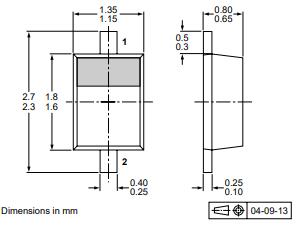
PMEG6010CEJ Package outline SOD323F (SC-90)
PMEG6010CEJ Manufacturer
Nexperia is a dedicated global leader in Discretes, Logic and MOSFETs devices. This new company became independent at the beginning of 2017. Focused on efficiency, Nexperia produces consistently reliable semiconductor components at a high volume: 85 billion annually. The company’s extensive portfolio meets the stringent standards set by the Automotive industry. And industry-leading small packages, produced in their own manufacturing facilities, combine power and thermal efficiency with best-in-class quality levels. Built on over half a century of expertise, Nexperia has 11,000 employees across Asia, Europe and the U.S. supporting customers globally.
The more similar parts from Nexperia are as follows:
Datasheet PDF
- PCN Packaging :
- Datasheets :
- PCN Assembly/Origin :
- PCN Design/Specification :
- RohsStatement :
Trend Analysis
What is Schottky barrier rectifier?
The Schottky diode or Schottky Barrier Rectifier is named after the German physicist “Walter H. Schottky”, which is a semiconductor diode designed with metal by the semiconductor junction. It has a low-forward voltage drop and a very rapid switching act. ... Actually, it is one of the oldest semiconductor devices in reality.
What are Schottky barrier diodes used for?
Schottky diodes are used for their low turn-on voltage, fast recovery time and low-loss energy at higher frequencies. These characteristics make Schottky diodes capable of rectifying a current by facilitating a quick transition from conducting to blocking state.
What is the name of the Schottky barrier rectifiers?
Planar Maximum Efficiency General Application.
 STM32H743VIT6 Microcontroller: 480MHz, 100-LQFP, Pinout and Datasheet
10 February 202213665
 TSOP4838: Description, datasheet, and features
15 March 20224558
 1N4005 Diode: Datasheet, Pinout, and Equivalents
30 August 202111591
 SSH-003T-P0.2 Socket : JST SSH-003T-P0.2, Datasheet PDF, Feature
25 March 20222074
 IRF3205 Power MOSFET: Pinout, Application and Datasheet
01 September 202130242
 TPS22810DRVR Load Switch: Package, Pinout, and Datasheet
29 March 20221711
 74HC04D Hex Inverter: Pinout, Features and Datasheet
20 November 20217686
 A Beginner’s Guide to Using STM32F767ZIT6 in Industrial and Medical Projects
24 July 2025275
 When Designing a Power Supply, How to Consider the Selection of Topology?
07 March 20224466
 What is an Auto Transformer and Its Working?
01 April 20219182
 FPGA in Industry and Communication: Key Players, Technologies, and Future Trends
07 March 20252332
 What is Digital Counter?
01 September 202012930
 Good news | Warm Congratulations to UTMEL Electronic for Obtaining the Letter of Authorization from XKB Connectivity
21 July 20253647
 Global Power Technology Authorized Distributor | UTMEL Electronics
21 November 20234231
 Xilinx FPGAs: From Getting Started to Advanced Application Development
09 September 20254904
 Revolutionizing Automotive Traction: A Comprehensive Review of Multiphase Drives for Next-Generation Vehicles
04 May 20234276
Nexperia USA Inc.
In Stock: 18585
Minimum: 1 Multiples: 1
Qty
Unit Price
Ext Price
1
$0.047847
$0.05
10
$0.045138
$0.45
100
$0.042583
$4.26
500
$0.040173
$20.09
1000
$0.037899
$37.90
Not the price you want? Send RFQ Now and we'll contact you ASAP.
Inquire for More Quantity
![BAT54,215]() BAT54,215
BAT54,215Nexperia USA Inc.
![BAS316,115]() BAS316,115
BAS316,115Nexperia USA Inc.
![BAS21,215]() BAS21,215
BAS21,215Nexperia USA Inc.
![PMLL4148L,115]() PMLL4148L,115
PMLL4148L,115Nexperia USA Inc.
![BAS516,115]() BAS516,115
BAS516,115Nexperia USA Inc.
![BAS16,215]() BAS16,215
BAS16,215Nexperia USA Inc.
![BAT46WJ,115]() BAT46WJ,115
BAT46WJ,115Nexperia USA Inc.
![BAV21,113]() BAV21,113
BAV21,113Nexperia USA Inc.
![BAS321,115]() BAS321,115
BAS321,115Nexperia USA Inc.
![BAS16LD,315]() BAS16LD,315
BAS16LD,315Nexperia USA Inc.


