Product
 Brand
Brand Articles
 Tools
Tools
SRAM vs DRAM: Key Differences and Applications Guide
Summary: SRAM (Static RAM) delivers ultra-fast access speeds and low latency, making it ideal for CPU cache memory, though it is expensive and has low storage density. Conversely, DRAM (Dynamic RAM) offers high-density, cost-effective storage suitable for main system memory, but requires constant refreshing which slows performance. Choosing between them depends entirely on whether your application prioritizes rapid data retrieval or large-scale capacity.
When choosing between SRAM and DRAM for your system, understanding their differences is crucial. SRAM Chips offer faster access speeds and lower power consumption compared to DRAM, making them ideal for cache memory. DRAM, while slower, provides greater memory capacities and is more affordable, which suits it for main memory. This distinction stems from their unique designs: SRAM delivers rapid data retrieval for frequently accessed information, while DRAM prioritizes cost-effective storage. Selecting the right type of RAM depends on your system's performance needs, budget, and energy efficiency requirements.
What Is SRAM and How Does It Work?
What Are SRAM Chips?
SRAM chips, or Static Random Access Memory chips, are a type of volatile memory designed for high-speed data storage and retrieval. Unlike DRAM, SRAM does not require periodic refresh cycles to retain data. Instead, it uses flip-flop circuits made of 4-6 transistors to store each bit of information. This design ensures faster access times and reliable performance, making SRAM chips ideal for applications where speed is critical.
One key feature of SRAM is its ability to hold data as long as power is supplied. This characteristic simplifies its data access model and eliminates the need for additional refresh circuitry. However, the use of multiple transistors per bit makes SRAM less dense and more expensive compared to DRAM. Despite this, its performance and reliability make it a preferred choice for specific use cases.
What Are the Key Characteristics of SRAM?
The primary characteristics of SRAM include static data retention, ultra-fast access speeds, and low idle power consumption. Here are some notable features:
Static Data Storage: SRAM holds data statically, meaning it does not require refresh cycles like DRAM. This results in faster and more efficient data access.
High Speed: SRAM is typically four times faster than DRAM, making it suitable for applications requiring rapid data processing.
Low Power Consumption: While idle, SRAM consumes minimal power, which enhances energy efficiency.
Volatile Memory: Like other RAM types, SRAM loses its data when power is removed.
Storage Mechanism: Each SRAM cell consists of six transistors arranged in a feedback loop, allowing quick individual addressing of memory cells.
| Feature | Description |
|---|---|
| Data Storage | Data is held statically, eliminating the need for refresh cycles unlike DRAM. |
| Type of Memory | SRAM is a type of Random Access Memory, allowing random access to any memory location. |
| Storage Mechanism | Utilizes flip-flops for data storage, with each flip-flop composed of 4-6 transistors. |
| Cache Memory Usage | Commonly used as cache memory in CPUs due to its speed and static data storage capabilities. |
| One-Bit SRAM Architecture | Consists of six transistors arranged to form a latch for storing bits, with specific access lines. |
These characteristics of SRAM make it a reliable choice for high-speed memory applications, especially in embedded systems and computing devices.
What Are the Common Applications of SRAM?
SRAM is primarily used in applications requiring instantaneous data access, such as CPU cache memory and high-speed networking buffers. Its high speed and reliability make it indispensable in the following areas:
Cache Memory: SRAM is widely used as cache memory in CPUs and GPUs. It ensures quick access to frequently used data, improving overall system performance.
Embedded Systems: Many microcontrollers and digital signal processors rely on SRAM for fast data storage and retrieval.
High-Speed Buffers: SRAM serves as a buffer in hard drives and other storage devices, enabling smooth data transfer.
AI and Machine Learning: SRAM-based Compute-in-Memory (CIM) circuits are increasingly used in AI applications. These circuits enhance processing speeds for tasks like neural network computations.
For example, SRAM is used in CPU register files, internal caches, and external burst mode caches. It also finds applications in automotive electronics, industrial subsystems, and scientific equipment. In AI, SRAM-based macros support edge computing by accelerating machine learning tasks.
While SRAM offers numerous advantages, its higher cost and lower density compared to DRAM limit its use to specific high-performance scenarios.
What Is DRAM and How Does It Work?
What Is DRAM?
Dynamic Random Access Memory, or DRAM, is a type of volatile memory widely used in modern computing systems. Unlike SRAM, DRAM stores data using a combination of capacitors and transistors. Each memory cell in DRAM consists of one capacitor and one transistor, which allows it to store a single bit of data. However, the charge in the capacitor leaks over time, requiring the memory to be refreshed periodically to retain information.
This design makes DRAM highly efficient in terms of storage density. You can store billions of bits on a single chip, making it ideal for applications requiring large amounts of memory. DRAM operates by reading and writing data through specific voltage states, which are managed by a memory controller. This controller ensures that the data remains accessible despite the constant need for refreshing.
What Are the Key Characteristics of DRAM?
The defining characteristics of DRAM are its high storage density, cost-effectiveness, and the need for continuous electrical refreshing. Here are some key features:
High Density: DRAM's architecture allows for a higher number of memory cells per chip, resulting in greater storage capacity.
Periodic Refreshing: DRAM requires frequent refreshing to maintain data, which adds complexity to its circuitry.
Cost-Effectiveness: Compared to SRAM, DRAM is more affordable due to its simpler cell design.
Volatility: Like all RAM types, DRAM loses its data when power is removed.
Power Consumption: The need for refreshing increases power usage, making DRAM less energy-efficient than SRAM.
| Feature | SRAM | DRAM |
|---|---|---|
| Performance | Faster speed of read/write data | Slower speed of read/write data |
| Density | Lower density | Higher density |
| Power usage | Uses less power | Uses more power |
| Storage capacity | Lower capacity | Higher capacity |
| Volatility | Volatile, no need to refresh | Volatile, needs to refresh |
| Physical placement | Processors or between a processor and main memory | Motherboard |
| Data life | Longer data life | Shorter data life |
These characteristics of DRAM highlight its advantages in terms of storage capacity and cost, though its performance and power efficiency lag behind SRAM.
What Are the Common Applications of DRAM?
DRAM is universally applied as the main system memory in personal computers, smartphones, and enterprise servers. Its ability to store large amounts of data at a lower cost makes it indispensable in the following areas:
Web Search Engines: Search engines like Google use DRAM to process queries quickly by storing data entirely in memory.
Social Networks: Platforms such as Facebook rely on DRAM to store user data for fast access and seamless performance.
AI Systems: IBM's Watson utilized DRAM during the 'Jeopardy!' challenge to store and process vast amounts of data in real time.
| Application | Description |
|---|---|
| Web Search Engines | Popular search engines like Google utilize DRAM to service queries entirely from memory. |
| Social Networks | Facebook stores most of its social-network data in DRAM for quick access and performance. |
| AI Systems | IBM's Watson used DRAM to store all its data during the 'Jeopardy!' challenge for rapid processing. |
DRAM's versatility and affordability make it a cornerstone of modern computing, powering everything from personal devices to large-scale enterprise systems.
Advantages and Disadvantages of SRAM and DRAM
What Are the Advantages of SRAM?
The main advantages of SRAM are its unmatched access speed and low idle power consumption. Its speed allows data to be accessed and written much faster than DRAM, making SRAM ideal for cache memory in processors where quick data retrieval is essential. Another advantage is its low power consumption. Since SRAM does not require refreshing, it uses less energy, which is beneficial for battery-powered devices.
The static nature of SRAM also simplifies its design. It does not need complex circuitry for periodic refreshing, which reduces latency and ensures consistent performance. Additionally, SRAM is highly reliable due to its robust architecture. These features make it suitable for applications like embedded systems, high-speed buffers, and AI tasks requiring rapid data processing.
| Feature | SRAM | DRAM |
|---|---|---|
| Speed | Much faster | Slower compared to SRAM |
| Power Consumption | Low power consumption | High power consumption |
| Cost | Very expensive | Cheaper compared to SRAM |
| Storage Capacity | Low storage capacity | High storage capacity |
| Memory Density | Low memory density | High memory density |
| Refresh Requirement | Does not need refreshing | Requires refreshing |
What Are the Disadvantages of SRAM?
The most significant disadvantages of SRAM are its high manufacturing cost and low storage density. SRAM is much more expensive to produce than DRAM because each memory cell requires multiple transistors. This limits its use to applications where speed and reliability outweigh cost concerns.
Another disadvantage of SRAM is its low storage capacity. Due to its complex design, SRAM chips cannot achieve the same memory density as DRAM. This makes it unsuitable for applications requiring large amounts of memory, such as main memory in computers. These disadvantages of SRAM highlight why it is often reserved for specialized tasks rather than general-purpose memory.
What Are the Advantages of DRAM?
The primary advantages of DRAM are its exceptional cost-effectiveness and high memory density. DRAM is cheaper to manufacture because each memory cell uses only one transistor and one capacitor. This allows DRAM to offer higher storage capacities at a lower price, making it the go-to choice for main memory in most systems.
Another advantage of DRAM is its high memory density. You can store more data on a single chip, which is crucial for devices like laptops, smartphones, and servers. While DRAM is slower than SRAM, its affordability and capacity make it indispensable for applications requiring large-scale memory storage.
What Are the Disadvantages of DRAM?
The main disadvantages of DRAM include slower access speeds and higher active power consumption due to constant refresh cycles. While DRAM is widely used for its affordability and high storage capacity, it comes with several drawbacks that you should consider when choosing memory for your system.
Slower Speed: DRAM operates at a slower speed compared to SRAM. This happens because DRAM requires constant refreshing to retain data. The refresh cycles interrupt data access, reducing overall performance. If your system demands high-speed memory, DRAM might not meet your needs.
Higher Power Consumption: DRAM consumes more power than SRAM. The periodic refreshing process increases energy usage, which can be a concern for battery-powered devices like laptops and smartphones. If energy efficiency is a priority, this could be a significant drawback.
Shorter Data Retention: DRAM stores data dynamically using capacitors. These capacitors lose charge quickly, requiring frequent refreshes to maintain information. This design makes DRAM less reliable for applications where data stability is critical.
Complex Circuitry: The need for refresh cycles adds complexity to DRAM's design. This complexity can lead to higher latency and reduced efficiency in certain scenarios. For systems requiring consistent and predictable performance, this could pose a challenge.
Note: The disadvantages of DRAM often make it less suitable for tasks requiring high speed, low power consumption, or long-term data stability. However, its cost-effectiveness and storage capacity still make it a popular choice for many applications.
Understanding the disadvantages of DRAM helps you make informed decisions about its suitability for your system. By weighing these factors against your specific requirements, you can determine whether DRAM aligns with your performance and energy goals.
Key Differences Between SRAM and DRAM
Which Is Faster: SRAM or DRAM?
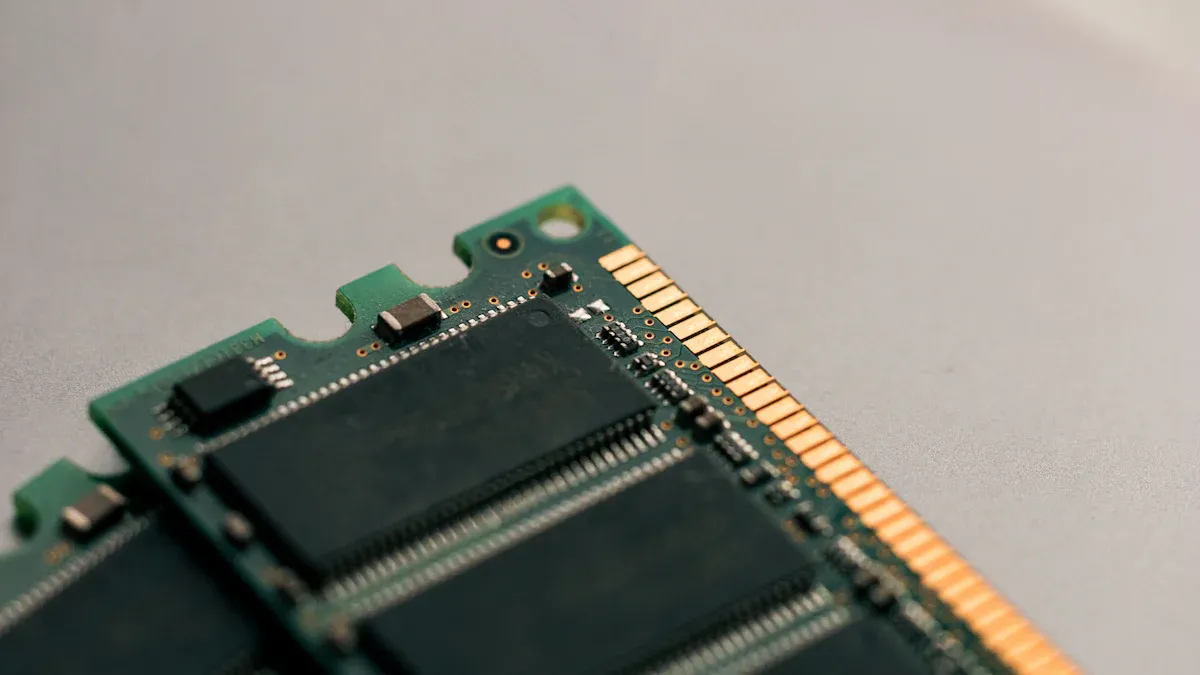
SRAM is significantly faster than DRAM, typically offering access times of 10 nanoseconds compared to DRAM's 60 nanoseconds. SRAM delivers faster access times, making it ideal for applications requiring rapid data retrieval, such as cache memory in processors. DRAM, on the other hand, operates at slower speeds due to its need for periodic refresh cycles. These refresh operations interrupt data access, reducing overall performance.
To illustrate the difference, consider the average access times for each type of memory:
| Memory Type | Average Access Time |
|---|---|
| DRAM | 60 nanoseconds |
| SRAM | 10 nanoseconds |
This disparity highlights why SRAM is often used in high-speed computing tasks, while DRAM is better suited for applications where storage capacity takes precedence over speed. If your system demands quick data processing, SRAM is the superior choice.
Which Is More Cost-Effective: SRAM or DRAM?
DRAM is vastly more cost-effective than SRAM, making it the standard choice for high-capacity main memory. DRAM technology is more affordable than SRAM, giving it a competitive advantage in applications requiring large-scale memory. Its simple architecture, which uses only one transistor and one capacitor per memory cell, reduces manufacturing costs and allows for higher densities.
DRAM's affordability makes it the preferred choice for main memory in consumer electronics.
The single transistor requirement of DRAM enables cost-effective production, making it accessible for devices like laptops and smartphones.
In contrast, SRAM's complex design, which uses multiple transistors per memory cell, drives up production costs. This limits its use to specialized applications where speed and reliability outweigh budget concerns. If affordability is your priority, DRAM is the better option.
How Does Power Consumption Compare Between SRAM and DRAM?
SRAM generally consumes less idle power than DRAM because it does not require periodic refresh cycles. This makes SRAM more energy-efficient, especially in idle states. DRAM, however, necessitates refresh operations to prevent data loss due to capacitance leakage. These refresh cycles significantly increase dynamic energy consumption, particularly as storage capacity grows.
Studies comparing energy efficiency provide valuable insights:
| Comparison | Energy Savings | Performance Improvement |
|---|---|---|
| Hybrid approach vs. conventional SRAM L2 cache | 32% | 5.9% |
| Proposed architecture vs. state-of-the-art DRAM LLC | 82% | 6.8% |
Additionally, techniques like Smart Refresh have been developed to mitigate DRAM's energy demands. For example:
| Technique | Energy Savings | Context |
|---|---|---|
| Smart Refresh | 52.6% (refresh operations) | 2GB DRAM |
| Overall energy saving | 25.7% | SPLASH-2, SPECint2000, Biobench benchmarks |
If your system prioritizes energy efficiency, SRAM is the better choice. However, DRAM's advancements in energy-saving techniques make it a viable option for applications requiring large memory capacities.
Which Memory Offers Better Density and Scalability?
DRAM offers vastly superior density and scalability compared to SRAM. SRAM uses multiple transistors per memory cell, which limits its density and makes it less scalable for applications requiring large amounts of memory. However, its low latency and fast access times make it perfect for high-speed tasks like cache memory and register files.
DRAM, on the other hand, excels in density and scalability. Each DRAM cell uses just one capacitor and one transistor, allowing manufacturers to pack billions of cells onto a single chip. This makes DRAM the go-to choice for systems needing large-scale memory, such as laptops, servers, and smartphones. Over the years, DRAM has scaled effectively to meet growing demands. However, shrinking capacitor sizes have introduced challenges like increased refresh power and higher error rates.
Emerging technologies are addressing these challenges. For example:
3D stacked DRAM architectures are being developed to provide higher bandwidth for modern applications.
These advancements aim to improve scalability while maintaining performance.
If your system requires high-density memory for large-scale applications, DRAM is the better choice. But for tasks demanding speed and reliability, SRAM remains unmatched.
How Do You Choose Between SRAM and DRAM for Specific Applications?
Choosing between SRAM and DRAM depends entirely on whether your system prioritizes processing speed or storage capacity. SRAM’s speed and low idle power consumption make it ideal for applications where performance is critical. You’ll find SRAM in:
Cache memory: It stores frequently accessed data for processors, ensuring faster performance.
Embedded systems: Many microcontrollers rely on SRAM for quick data retrieval.
AI and machine learning: SRAM-based circuits enhance processing speeds for neural networks.
DRAM, with its high density and affordability, is better suited for applications requiring large memory capacities. Common uses include:
Main memory: DRAM powers the primary memory in most computers and mobile devices.
Enterprise systems: Servers and data centers use DRAM to handle vast amounts of data efficiently.
Consumer electronics: Devices like gaming consoles and smart TVs rely on DRAM for smooth operation.
Understanding your system’s requirements will help you decide which type of RAM to use. If you need fast, reliable memory for specific tasks, go with SRAM. For cost-effective, high-capacity memory, DRAM is the way to go.
Applications and Market Trends of SRAM and DRAM in 2026
How Is SRAM Used in Emerging 2026 Technologies?
SRAM continues to play a pivotal role in emerging technologies, especially in areas requiring high-speed and low-power memory solutions. Its static nature and rapid access times make it indispensable for cutting-edge applications like artificial intelligence (AI), edge computing, and autonomous vehicles. For instance, SRAM-based Compute-in-Memory (CIM) architectures are revolutionizing AI by enabling faster neural network computations. These architectures reduce latency and improve energy efficiency, which are critical for real-time decision-making in AI systems.
The global demand for SRAM is also driven by advancements in hyperscale data centers and military applications. In North America, hyperscale data centers dominate the market, leveraging radiation-hardened SRAM for enhanced reliability. However, the high cost of specialized SRAM fabrication, which can increase hardware costs by 40-60%, poses challenges for widespread adoption. Despite this, SRAM remains a key component in high-speed routers, where it accounts for 18-22% of total hardware costs.
| Region | Market Share | Key Insights |
|---|---|---|
| North America | 22% | Dominated by hyperscale data centers and military applications, with a focus on radiation-hardened SRAM. |
| Europe | 8% | Growth constrained by reliance on Asian foundries; premium pricing for automotive-grade memory. |
| Emerging Markets | N/A | Influence through material sourcing, notably lithium, affecting global production costs. |
The global SRAM market, valued at approximately USD 12.8 billion in 2025, is projected to reach USD 19.6 billion by 2034, fueled by its integration into AI, high-performance computing (HPC), and edge devices. As emerging memory technologies are projected to grow 2.2 times their current size over the next decade, SRAM will remain a cornerstone of innovation in these fields.
How Does DRAM Power Modern Consumer Electronics?
DRAM continues to dominate the consumer electronics market due to its high density and cost-effectiveness. Devices like smartphones, tablets, and gaming consoles rely heavily on DRAM to deliver seamless performance. In 2025, the consumer electronics segment continued to account for over 32% of global revenue in the semiconductor memory market. This trend is expected to grow as the demand for advanced memory solutions increases.
The global DRAM market, valued at approximately USD 128.9 billion in 2025, is projected to reach over USD 242 billion by 2033. This growth reflects a compound annual growth rate (CAGR) of over 8.2% from 2025 to 2033. The rising popularity of 5G technology and augmented reality (AR) applications further drives the need for DRAM in consumer devices. For example, smartphones equipped with DRAM can handle complex tasks like real-time video processing and AR gaming with ease.
Key Trends in DRAM for Consumer Electronics:
Increased adoption in 5G-enabled devices.
Enhanced performance for AR and virtual reality (VR) applications.
Growing use in smart home devices and wearables.
The affordability and scalability of DRAM make it the preferred choice for manufacturers aiming to balance performance and cost. As the global DRAM market size is expected to exceed USD 242 billion by 2033, DRAM will continue to power the next generation of consumer electronics.
How Are SRAM and DRAM Utilized in Enterprise Systems?
In enterprise systems, both SRAM and DRAM play crucial roles in meeting the demands of modern computing. SRAM excels in applications requiring high-speed data access, such as cache memory in servers and network equipment. Its low latency ensures quick retrieval of frequently accessed data, which is vital for maintaining system performance in data-intensive environments.
DRAM, on the other hand, provides the scalability needed for large-scale data storage. Enterprise systems, including cloud storage and HPC platforms, rely on DRAM to handle vast amounts of information efficiently. For example, a 10PB QLC SSD-based storage system using DRAM can save approximately USD 30.3 million over 10 years, with a 47% reduction in total cost of ownership over five years.
Projected Growth in Enterprise Memory Applications:
Significant growth in SRAM and DRAM driven by demand in AI, HPC, cloud storage, and edge computing.
The DRAM market is expected to nearly double by 2033, reaching over USD 242 billion.
The combination of SRAM and DRAM in enterprise systems ensures a balance between speed and capacity. While SRAM enhances processing speeds, DRAM provides the storage density needed for large-scale operations. Together, they form the backbone of modern enterprise computing, enabling businesses to meet the challenges of a data-driven world.
What Are the Use Cases for SRAM and DRAM in AI and Machine Learning?
Artificial intelligence (AI) and machine learning (ML) systems rely heavily on memory technologies like SRAM and DRAM to process vast amounts of data efficiently. These systems demand rapid data access and high storage capacities, making the choice of memory critical for their performance.
SRAM in AI Applications
SRAM plays a vital role in AI applications that require high-speed data processing. Its fast read/write speeds and low latency make it ideal for tasks like neural network computations and real-time decision-making. For example, SRAM-based architectures are often used in Compute-in-Memory (CIM) systems. These systems integrate memory and computation, reducing the time needed to access data and improving energy efficiency. This advantage is particularly useful in edge computing, where devices like autonomous vehicles and IoT sensors need to process data locally without delays.
SRAM also excels in AI hardware accelerators. These accelerators use SRAM to store weights and intermediate results during computations. The speed of SRAM ensures that AI models can perform complex tasks, such as image recognition or natural language processing, without bottlenecks. While SRAM's cost limits its use in large-scale systems, its performance makes it indispensable for specialized AI applications.
DRAM in AI and Machine Learning
DRAM dominates AI and ML systems that require large-scale memory storage. Its high density and affordability make it the preferred choice for applications like training deep learning models. These models often involve billions of parameters, requiring extensive memory capacity to store and process data. DRAM's scalability allows AI systems to handle these demands efficiently.
Major mobile manufacturers have integrated DRAM into AI-powered applications, enabling features like facial recognition and voice assistants. For instance, smartphones equipped with DRAM can process real-time data for augmented reality (AR) and virtual reality (VR) applications. DRAM's role in high-performance computing is equally significant. In 2025, it continued to account for nearly half of the global revenue in the semiconductor memory market, highlighting its importance in AI-driven technologies.
Comparing SRAM and DRAM for AI
When choosing between SRAM and DRAM for AI systems, you need to consider their speed and capacity. SRAM offers faster read/write speeds, making it suitable for tasks requiring immediate data access. DRAM, while slower, provides the storage density needed for large-scale computations. For example, SRAM is ideal for inference tasks where speed is critical, while DRAM is better suited for training models that require extensive memory.
The complexity of AI architecture design often involves balancing these memory options. SRAM's speed enhances performance in edge devices, while DRAM's capacity supports centralized systems like data centers. By understanding the strengths of each type, you can optimize your AI system for specific use cases.
Tip: If your AI application prioritizes speed and energy efficiency, SRAM is the better choice. For tasks requiring large-scale data storage, DRAM provides the scalability you need.
Choosing between SRAM and DRAM depends on your system's needs. SRAM offers high-speed data access and low idle power, making it ideal for cache memory. DRAM provides greater storage capacity at a lower cost, which suits it for main memory. Understanding these differences ensures you select the right memory type.
| Feature | SRAM | DRAM |
|---|---|---|
| Speed | High-speed data access | Slower due to refresh cycles |
| Cost | Higher cost per bit | Lower cost per bit |
| Power Consumption | Low idle power, higher active | Higher idle power, lower active |
| Application Suitability | Ideal for cache and quick access | Suitable for main memory |
Evaluate your performance, budget, and energy needs to make the best choice.
Frequently Asked Questions
What is the main difference between SRAM and DRAM?
The primary difference lies in their architecture and performance. SRAM uses multiple transistors per cell, offering ultra-fast speeds and low latency without needing refresh cycles. DRAM uses a single transistor and capacitor, requiring constant refreshing but providing significantly higher storage density at a lower cost.
Why does DRAM need to be refreshed constantly?
DRAM stores data using microscopic capacitors that naturally leak electrical charge over time. To prevent data loss, the system's memory controller must periodically read and rewrite the data, a process known as refreshing. This constant refreshing is why DRAM operates slower than static memory.
Which type of memory is better for gaming?
DRAM is the standard choice for gaming because modern titles require massive amounts of memory capacity to load high-resolution textures and complex environments. While SRAM is much faster, its high cost and low storage density make it entirely impractical for use as main gaming memory.
Why is SRAM more expensive to manufacture than DRAM?
SRAM is significantly more expensive because each memory cell requires four to six transistors to store a single bit of data. This complex design takes up more physical space on the silicon wafer, reducing overall memory density and increasing production costs compared to DRAM's single-transistor design.
 UTMEL
UTMEL
We are the professional distributor of electronic components, providing a large variety of products to save you a lot of time, effort, and cost with our efficient self-customized service. careful order preparation fast delivery service
 How to Use an External Hard Drive?UTMEL24 June 20218973
The external hard drive is a compact and portable hard drive storage which can be plugged in or unplugged at any time. It mainly uses USB or IEEE1394 interfaces. It can transmit data with the system at a higher speed. The IEEE 1394 interface transfer rate is 50-100 MB/s.
Read More Introduction to RAID (Redundant Arrays of Independent Disks)UTMEL01 July 20218551
RAID (Redundant Arrays of Independent Disks) means "a redundant array composed of independent disks". The RAID is the combination of many independent disks that combined into a large-capacity disk group. It uses the bonus effect of individual disks to provide data to enhance the performance of the entire disk system.
Read More What is NAND Flash?UTMEL04 November 202111331
NAND Flash is a better storage device than hard disk drives and is particularly evident in low-volume applications up to 4GB. As the quest continues for lower power consumption, lighter weight, and better performance, NAND is proving to be very attractive. Its development goal is to reduce the cost per bit of storage and increase storage capacity.
Read More Memory Chip: The Key to Smart ConnectivityUTMEL03 November 20212552
In today's post, we talk about memory chips, especially their emerging applications in the AIoT smart interconnect space.
Read More Emerging Storage Technologies: MRAM, RRAM, and PCRAMUTMEL08 January 202611283
The semiconductor industry is turning to emerging memories that offer higher storage performance, lower cost, and the ability to move toward process miniaturization. Three of these memories stand out -- MRAM, RRAM, and PCRAM.
Read More
Subscribe to Utmel !