Product
 Brand
Brand Articles
 Tools
Tools
An Artificial Brain Chip With 86 Billion Physical Neurons

Elon Musk's Neuralink brain chip demo explained
What if, when we try to build AI, we neither use code to model neurons nor Python to model neural networks, but instead use a form very similar to our biological brains, i.e., physical synapses to connect actual physical neurons? Could neural networks be created in this way that is 1,000 times more energy-efficient than existing AI frameworks?
That's exactly what Rain Neuromorphics wants to do: build a non-biological but very human artificial brain. This artificial brain consumes less energy and learns faster than existing AI projects. In short, it's a bit like a real-world human. Plus, it's made with an analog chip, not a digital one.

Gordon Wilson, CEO of Rain Neuromorphics, told the author, "We have two very important tasks, one is to build the brain and the other is to really understand it. Ultimately, we want to think of it as something like Lego blocks, and because of the low power consumption, we will be able to connect them together through chip integration, advanced packaging, and other technologies, and scale these systems to the scale of the brain - 86 a billion neurons, 500 trillion synapses - with low enough power consumption to be able to exist in autonomous devices in."
Wilson seems to have a habit of describing something so shocking and world-changing in a very quiet and humble manner that it can be quiet enough to overlook the sheer magnitude of the ideas contained within. And the above plan is nothing less than the Frankenstein Project. Wilson and co-founders Jack Kendall and Juan Nino started the company four years ago with a small seed round of funding. Late last year, the team built a demo chip and proved at least some of their theory about building brain-simulating hardware for AI workloads with a fully simulated chip. Just a month ago, the team secured $25 million in funding. The funding will be used to complete the previous chip design and get it into a manufacturable, market-ready product.
And this time, one of the investors is Sam Altman, a heavyweight in artificial intelligence and CEO of Open AI. The key to this project is that Rain Neuromorphics is building an analog chip. This is very different from 99.9% of the computer chips on the market. The latter reduces reality to binary: on or off, 0 or 1. These chips must use very precise digital mathematics to simulate facts, relationships, and actions in a computer program. In contrast, analog chips present reality in a very natural way.
"The digital chip ...... builds on the bottom 0s and 1s, on the Boolean logic of on or off, and then all the other logic is built on top of that," Wilson explains. "When you zoom in and look at the bottom of the analog chip, there are no 0s or 1s there, but rather a gradient of information. There are voltages, currents, and resistances there, physical quantities that need to be measured, and that represent the mathematical operations that are being performed. We're going to use the relationships between these physical quantities and then perform these very complex neural operations." How does this work? The answer is to let the physics do the work of the computation, rather than brute-forcing the latter to execute through a reality mapping consisting of ones and zeros.

So when you build up a neural network and model it according to the efficient learning, data storage, and decision execution patterns of the human brain, you are measuring the conclusions more than arriving at them step by step through the artificial neurons and synapses that have been built. "In the analog chip ...... we activate neurons represented by voltage," Wilson said. "We represent the weight of the synapse with resistors that are made up of memory resistors. When a voltage passes through a resistor, there is a natural multiplicative relationship between the voltage and the resistor. In order to receive the current, you need to read out the current, and that's your output. So the analog chip works by first understanding the physical relationship between these amounts of power, and then using those amounts of power to do the math, i.e., letting the physics do the math." This sounds both unimaginably complex and extremely simple, perhaps a bit like our brains.
Rain Neuromorphics claims that building chips with things that resemble the biological neurons, dendrites, and neural networks in the brain is also key to getting huge efficiencies: that's 1,000 times more efficient than existing digital chips from companies like Nvidia. This 1,000-fold improvement comes from two sources: a 10-fold reduction in energy consumption, and a 100-fold increase in speed. If the two can be combined, it can provide similar results to digital hardware while reducing energy demand by three orders of magnitude.
Energy use can make a difference in different environments. In server farms, more energy can impact cost and heat, triggering additional cooling requirements. In mobile or edge applications, energy may be scarce or difficult to deliver, making energy-efficient applications more attractive than power-hungry chips.
"I think this will be the first step toward low-power reasoning and low-power devices, but we don't want devices to just be pre-programmed and then do what they're prescribed to do," Wilson said. "We want devices to learn on their own. We want the device's brain to be able to adapt to its changing environment and its changing self." Analog chips can achieve faster speeds than digital chips because computing essentially works for human purposes, i.e., to move from input to output at "wire speed. Partially analog chips can achieve some of the "wire speed" function in some specific operations, but still incur "speeding tickets" when switching to or from the digital state.
The challenge with a fully analog chip is that it can operate at high speed while also having extreme idiosyncrasies. A digital chip can do "anything," while an analog chip can only do what it was designed to do. Essentially, Rain Neuromorphics is building a general-purpose analog chip because they are building a chip that mimics the human brain by connecting individual neurons to synapses based on a small-world network model. This network pattern ensures that neurons have short and long connections, creating a very efficient and effective connectivity grid (think Kevin Bacon's six-degree segmentation theory).

Next, these chips teach themselves how to do a variety of tasks, just as we learn in childhood and adult stages ...... Our training data is usually only one or two samples. "The brain needs very few samples to train and learn," Wilson said. "By learning once to twice on one or two examples, we can generalize very well. So learning/training is very, very effective."
Of course, there's a lot of work to do with this process, and there are many competitors in the market. NVIDIA is a major market player, and also IBM is developing neuromorphic chips, namely the Loihi chip that Intel is using to make better drones and real-world navigation systems. Rain Neuromorphics, it hopes to be on the market by 2025.
Related News
1、MediaTek, Qualcomm announce joining Russia sanctions
2、Automotive chips rose across the board!
3、Apple M1 Ultra -- The Technology Behind the Chip Interconnection
4、Foxconn Announces Investment of $9 Billion to Build A Chip Factory in Saudi Arabia
5、Japanese Companies Increase Investment in Power Semiconductors
 UTMEL
UTMEL
We are the professional distributor of electronic components, providing a large variety of products to save you a lot of time, effort, and cost with our efficient self-customized service. careful order preparation fast delivery service
 UTMEL 2024 Annual gala: Igniting Passion, Renewing BrillianceUTMEL18 January 20244866
As the year comes to an end and the warm sun rises, Utmel Electronics celebrates its 6th anniversary.
Read More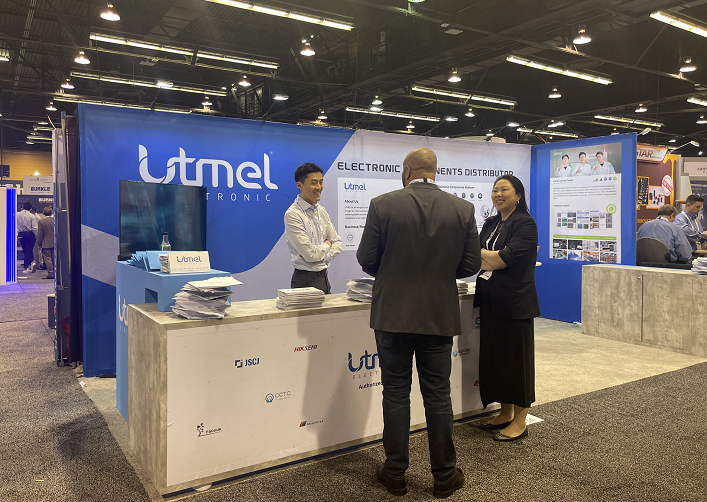 Electronic Components Distributor Utmel to Showcase at 2024 IPC APEX EXPOUTMEL10 April 20245864
Utmel, a leading electronic components distributor, is set to make its appearance at the 2024 IPC APEX EXPO.
Read More Electronic components distributor UTMEL to Showcase at electronica ChinaUTMEL07 June 20244445
The three-day 2024 Electronica China will be held at the Shanghai New International Expo Center from July 8th to 10th, 2024.
Read More Electronic components distributor UTMEL Stands Out at electronica china 2024UTMEL09 July 20244822
From July 8th to 10th, the three-day electronica china 2024 kicked off grandly at the Shanghai New International Expo Center.
Read More A Combo for Innovation: Open Source and CrowdfundingUTMEL15 November 20195394
Open source is already known as a force multiplier, a factor that makes a company's staff, financing, and resources more effective. However, in the last few years, open source has started pairing with another force multiplier—crowdfunding. Now the results of this combination are starting to emerge: the creation of small, innovative companies run by design engineers turned entrepreneurs. Although the results are just starting to appear, they include a fresh burst of product innovation and further expansion of open source into business.
Read More
Subscribe to Utmel !
![62MR500TB]() 62MR500TB
62MR500TBBI Technologies
![3150W201P]() 3150W201P
3150W201PTE Connectivity
![3366S-1-503]() 3366S-1-503
3366S-1-503Bourns
![PT10LV10-24948]() PT10LV10-24948
PT10LV10-24948Amphenol
![PT15WH06-00921]() PT15WH06-00921
PT15WH06-00921Amphenol
![PT15NV18-01144]() PT15NV18-01144
PT15NV18-01144Amphenol
![PT15NV18-06714]() PT15NV18-06714
PT15NV18-06714Amphenol
![PT10MH01-24746]() PT10MH01-24746
PT10MH01-24746Amphenol
![PT15NH06-00839]() PT15NH06-00839
PT15NH06-00839Amphenol
![PT15YV18-01169]() PT15YV18-01169
PT15YV18-01169Amphenol