Product
 Brand
Brand Articles
 Tools
Tools
Four Proximity Sensors PK, Who can Win?

Photoelectric Sensor Explained (with Practical Examples)
| Topics covered in this article: |
| Ⅰ. Ultrasonic proximity sensors |
| Ⅱ. Photoelectric sensors |
| Ⅲ. Laser rangefinder |
| Ⅳ. Inductive sensors |
| Ⅴ. Summary |
There are various common proximity sensor systems, each with its own set of operating conditions and benefits for assessing detection, distance, and proximity. This article presents an overview of four different tiny, fixed embedded system solutions, as well as their basic operating principles, to assist engineers in deciding which one to use based on their design needs.
Proximity sensors allow you to sense the existence and distance of items without having to touch them. The sensor sends out an electromagnetic field, light, or ultrasonic waves that are reflected by or pass through the item before returning to the sensor, Due to the lack of mechanical elements, proximity sensors have a substantial advantage over typical limit switches in terms of durability and longevity.
When looking for the best proximity sensor technology for a certain application, cost, range, size, refresh rate or delay, and material impacts, as well as what factors are most relevant to the design, are all factors to consider.
Ⅰ. Ultrasonic proximity sensors
Ultrasonic proximity sensors, as the name implies, emit ultrasonic sound pulses called "chirps" that are used to detect the presence of objects and to determine distances between them. They are made up of a transmitter and a receiver, and their function is based on the echolocation concept (Figure 1).

Figure. 1 How Ultrasonic Sensors Work
The sensor can measure the distance to an object by measuring the time it takes for a chirp to reflect off a surface and return, also known as "time of flight" (ToF). Although the transmitter and receiver are usually located next to each other, echolocation can still be used if the transmitter and receiver are separated. Ultrasonic transceivers are devices that integrate transmit and receive functionalities into a single package in some instances.
The color and transparency of objects have no effect on ultrasonic sensor readings since sound is employed instead of electromagnetic radiation. They also have the advantage of not emitting light, making them ideal for both dark and bright areas. Sound waves spread out over time and distance like ripples on water, and depending on the application, this expansion of the detecting region, or field of view (FoV), can be a gain or a drawback. Ultrasonic proximity sensors, on the other hand, can provide a cost-effective, adaptable, and safe solution with high levels of precision, relatively high refresh rates, and the ability to broadcast hundreds of chirps per second.
One of the most significant drawbacks of ultrasonic sensors is that variations in air temperature can impact the speed of sound waves, limiting measuring accuracy. However, by measuring the temperature of the air between the transmitter and receiver and modifying the calculations as necessary, it can be balanced. Another constraint is that ultrasonic sensors cannot be used in a vacuum since there is no air to transmit sound in a vacuum. Soft materials also don't reflect sound as well as hard surfaces, reducing precision. Finally, while ultrasonic sensor technology is comparable to sonar in concept, it cannot be used underwater.
Ⅱ. Photoelectric sensors
For detecting the presence of things, photoelectric sensors are a viable option. They are usually infrared-based, and common uses include garage door sensors and people counting in stores, but they can also be used in a variety of other industrial settings.
Photosensors can be used in a variety of ways (Figure 2).
In a through-beam system, the emitter emits a beam on one side of the item, and the detector detects the beam on the other side. If the beam is broken, there is anything in the way.
The emitter and detector are placed on one side of the object, while the mirror is placed on the other.
The diffuse reflection type, like the mirror reflection type, has the emitter and detector on the same side, but without a mirror, any detected item would reflect the produced light back. This isn't an accurate technique to estimate distance.

Figure. 2 Photoelectric Sensors – Through-Beam, Retro-Reflective, and Diffuse
The photosensors can be configured as through-beam or retro-reflective if the application requires a longer sensing range and lower latency. However, they necessitate meticulous installation and alignment, making system installation difficult in a crowded area. Smaller objects are better detected with diffuse-type implementations, which can also be mobile detectors.
Photoelectric sensors may be utilized in unclean conditions, such as those found in industrial settings, and they have a longer lifespan than other options due to the lack of moving parts. The sensor's performance may be maintained as long as the lens is protected and kept clean. While they can identify most items, clear and shiny surfaces, as well as water, can cause complications. Other drawbacks include the inability to calculate precise distances and, depending on the light source, the inability to distinguish specific colored objects (such as red objects when using infrared).
Ⅲ. Laser rangefinder
Laser ranging (LRF), which was previously an expensive choice, has recently become a more viable solution in many applications. High-power sensors work in the same way as ultrasonic sensors, but instead of sound waves, they use a laser beam.
Due to the ultra-fast propagation speed of photons, determining ToF accurately is difficult. Techniques like interferometry can assist preserve accuracy while lowering costs in this case (Figure 3). Due to the utilization of electromagnetic beams, laser rangefinder sensors frequently have exceptionally long measuring ranges (up to thousands of feet) and extremely fast response times.

Figure. 3 Laser Rangefinder Sensor Implementation Using Interferometry
These sensors have ultra-low latency and ultra-long range capabilities, but they also have drawbacks. Lasers need a lot of power, so they're not suited for battery-powered or portable applications, and there are also worries about eye health. Another factor to consider is that FoVs are narrow, and they, like photosensors, do not perform well on water or glass. Despite the fact that the cost of this technology has fallen, it remains one of the more expensive solutions.
Ⅳ. Inductive sensors
Inductive sensors have been around for a long time, but they are currently becoming more popular. However, because they employ a magnetic field to identify objects, they only work on metallic items, unlike other proximity-sensing technologies (Figure 4). Metal detectors are an example of typical use.

Figure. 4 How an Inductive Sensor Works
The detection range varies depending on how the sensor is configured. Counting the rotation of gear by sensing the presence of gear teeth near the sensor could be a short-range application. Longer-range uses could include counting automobiles using inductive sensors embedded in the road surface, or even ultra-long-range detection of space plasma.
Inductive sensors are employed as proximity sensors in shorter-range applications and can give incredibly high refresh rates since they are based on the principle of sensing variations in electromagnetic fields. On ferrous materials like iron and steel, this sensor operates better.
Inductive sensors are a cost-effective alternative for a variety of applications. However, the restrictions of the materials they can sense, as well as the fact that they are susceptible to numerous types of interference, must be taken into mind.
Ⅴ. Summary
Ultrasonic sensors are frequently the best overall technology when considering all proximity sensing application issues (Figure 5). They are inexpensive, can detect the presence of objects, precisely compute distances, and are simple to operate, all of which are obvious advantages.

Figure. 5 Comparison of Four Proximity Sensor Technologies
 UTMEL
UTMEL
We are the professional distributor of electronic components, providing a large variety of products to save you a lot of time, effort, and cost with our efficient self-customized service. careful order preparation fast delivery service
1. What are the application areas of inductive sensors?
Inductive sensors are mainly used to measure small displacements. Any parameters that can be converted into displacement changes such as pressure, force, differential pressure, acceleration, vibration, strain, flow, thickness, and liquid can be measured by inductive sensors.
2. What are the types of laser rangefinders?
Laser rangefinders are divided into two categories, one is handheld laser rangefinders, which have relatively short measurement distances, generally 40-250 meters, with high measurement accuracy. The other type is the laser rangefinder telescope. This type of laser rangefinder has a long measurement distance, generally 500-2000 meters, and the longest measurement distance can reach 20 kilometers.
3. What are the characteristics of photoelectric sensors?
Advantage 1: The detection distance is long.
Advantage 2: There are few restrictions on the detected objects.
Advantage 3: The response time is short.
Advantage 4: high resolution.
Advantage 5: non-contact detection can be achieved.
Advantage 6: It can realize the discrimination of color.
Advantage 7: easy to adjust.
4. What is an ultrasonic sensor?
Ultrasonic sensors are sensors developed using the characteristics of ultrasonic waves. Ultrasonic is a kind of mechanical wave whose vibration frequency is higher than that of sound wave. It is generated by the vibration of the transducer chip under the excitation of voltage. It has high frequency, short wavelength, small diffraction phenomenon, especially good directionality and can be directed as a ray. characteristics of dissemination.
5. What are the main types of inductive sensors?
There are generally three types of inductive sensors: variable reluctance sensor self-inductance, differential transformer sensor mutual inductance, eddy current sensor eddy current.
 The Key Role of Electronic Components in IoT DevicesUTMEL01 September 20236129
The article discusses the pivotal role of electronic components in Internet of Things (IoT) devices. IoT devices work by capturing real-world data using sensors, processing it through a microcontroller, and then sending it to the cloud for further analysis.
Read More Accelerometer Sensors Guide: Working Principle, Circuit Design, Specifications, and ApplicationsUTMEL25 June 2026804
A practical accelerometer sensor guide covering working principles, MEMS and piezoelectric types, datasheet specifications, circuit design, mounting, applications, and selection.
Read More 2026 ADAS Sensors: Supply Outlook and Alternative SourcingUTMEL18 July 2026989
Automotive cleanroom assembly integrating advanced driver assistance systems. The automotive industry faces a structural semiconductor deficit in 2026, driven not by pandemic-era demand shocks but by AI data centers absorbing global foundry capacity on legacy nodes (40nm-90nm) where 95% of automotive-grade components are manufactured. Video demonstrations of these systems show a "machine view" overlay with red crosshairs tracking pedestrian movement and sudden cut-ins before traditional collision thresholds are triggered.
Read More Magnetic Sensors for Position Detection: Hall Effect vs. AMR vs. TMR Engineering GuideUTMEL21 August 2026453
This guide compares Hall effect, AMR, and TMR magnetic sensors for position detection in motor control and robotics. It explains their physical principles, key performance metrics, and selection criteria. Hall effect suits low-cost commutation, AMR offers high-speed angle sensing, and TMR provides maximum precision and low power, with practical integration advice.
Read More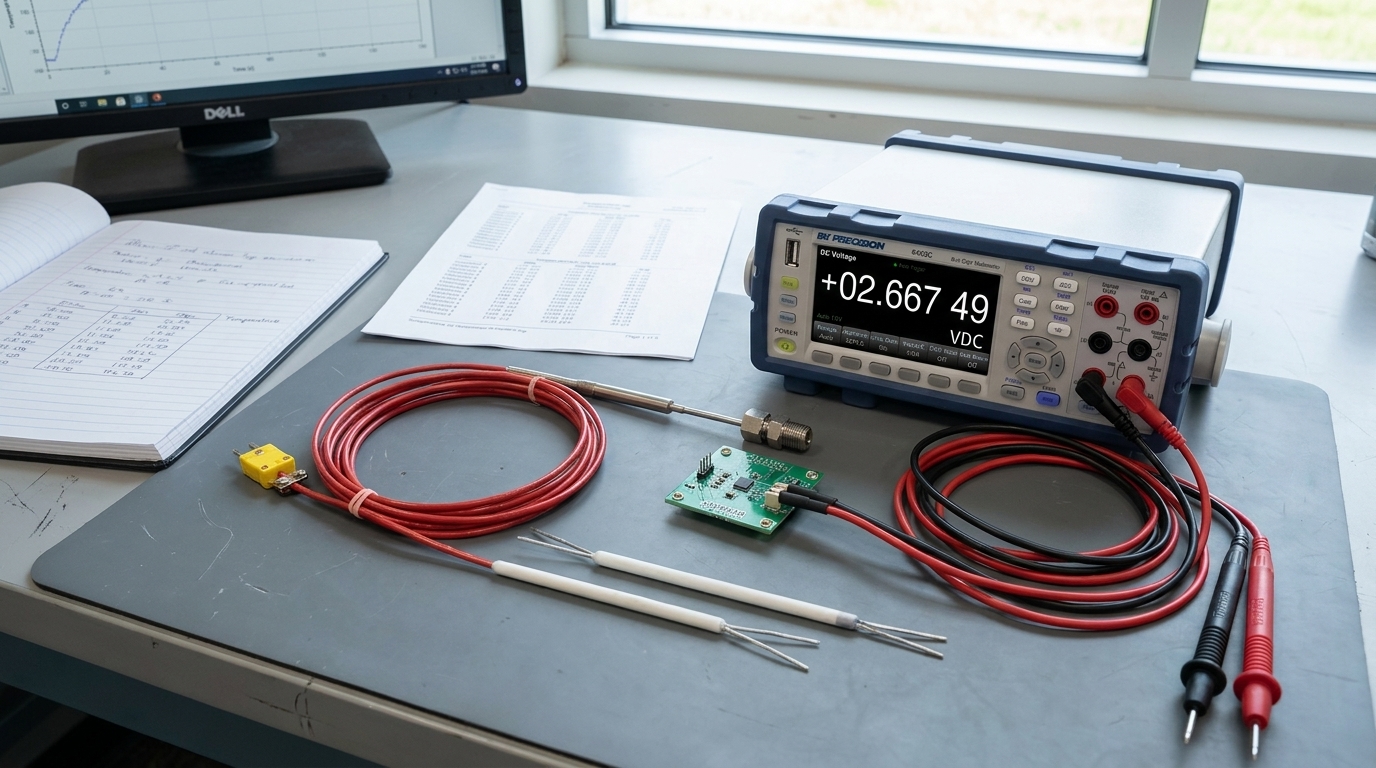 Temperature Sensor Types Comparison: Thermocouple, RTD, and Semiconductor IC Selection GuideUTMEL17 August 2026350
This comprehensive selection guide compares thermocouples, platinum RTDs, and semiconductor ICs across measurement range, accuracy limits, and signal conditioning complexity. It covers fundamental operating physics, mathematical transfer functions, lead-wire compensation topologies, and power budgets. Engineers will find practical design checklists, benchtop multimeter diagnostic techniques, and an architectural decision workflow to optimize system performance and bill-of-materials cost.
Read More
Subscribe to Utmel !