Product
 Brand
Brand Articles
 Tools
Tools
2026 Semiconductor and Electronic Components Price Trends
Quick answer
Semiconductor prices are not moving in one direction across every category in 2026. The strongest pressure is concentrated in memory and AI-related logic, where demand, capacity allocation, product mix, and advanced packaging are changing quickly. Microcontrollers, analog ICs, power devices, and passive components are also growing in selected applications, but current company disclosures do not support a claim that every supplier or part number has received the same broad price increase.
The practical rule for buyers is simple: use market forecasts to decide where to look, then use current part-level quotations to decide what to buy. A defensible purchase decision should identify the exact manufacturer part number, package, grade, quantity, quote validity, lead time, source, traceability requirements, and commercial terms. Revenue growth, factory utilization, or a strong earnings report is not itself a price quotation.
Updated: August 14, 2026. This article uses the latest public information available on that date. Forecasts and supplier conditions can change, so active bills of materials should be checked against current manufacturer notices and live quotations.
2026 semiconductor market at a glance
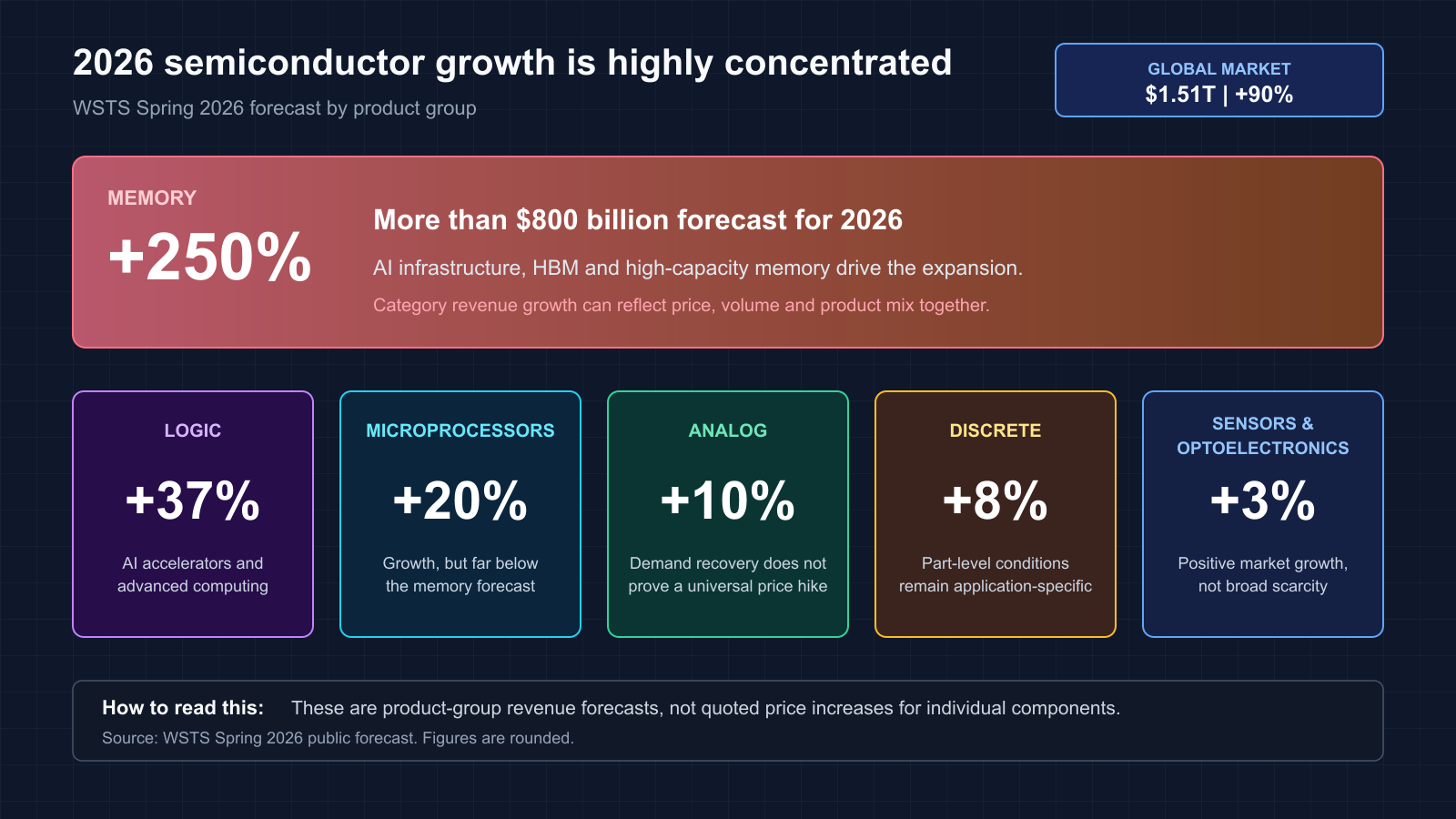
The latest public WSTS Spring 2026 forecast projects worldwide semiconductor sales of approximately $1.51 trillion in 2026, up 90% year over year. The headline is dramatic, but the product-group detail matters more: WSTS expects memory sales to rise about 250% and exceed $800 billion, while logic grows 37%. Microprocessors, analog, discrete semiconductors, and sensors and optoelectronics are forecast to grow at much lower rates.
| Product group | WSTS 2026 sales forecast | Useful interpretation | What it does not prove |
|---|---|---|---|
| Memory | About +250% | Exceptional expansion led by AI infrastructure, HBM, and high-capacity memory | That every DRAM, NAND, NOR, or managed-memory SKU rises by the same percentage |
| Logic | +37% | Strong demand for AI accelerators and advanced computing | A universal foundry or logic-device price increase |
| Microprocessors | +20% | Healthy growth, but far below the memory forecast | That all CPUs or MCUs are scarce |
| Analog | +10% | Broad demand recovery is visible | A fixed increase across ADI, TI, NXP, Infineon, or other catalogs |
| Discrete semiconductors | +8% | Positive category growth | That all MOSFETs, diodes, or power modules share one price trend |
| Sensors and optoelectronics | +3% | More moderate growth | Broad shortage or allocation across the entire category |
Price, revenue, volume, and product mix are different
A supplier can report rapid revenue growth without applying the same price increase to every product. Revenue can rise because the company ships more units, sells a richer mix of higher-value devices, adds capacity, improves utilization, changes currency exposure, or raises selected prices. Several of these factors can operate at the same time.
This distinction is especially important in 2026 because HBM and advanced AI products carry much more value than many traditional components. A shift toward these products can lift a supplier's revenue and gross margin while a mature or consumer-oriented product remains available at a stable or lower price. Conversely, a low-volume legacy part can become expensive even when its broader category is growing slowly.
Buyers should therefore separate three evidence layers:
Market signal: Industry forecasts show where demand and revenue are expanding.
Supplier signal: Earnings releases and capacity plans show which businesses are benefiting or constrained.
Part-level evidence: A dated quotation, product-change notice, allocation notice, or authorized-channel listing shows the actual commercial condition for a specific item.
Memory: the clearest area of 2026 price pressure
Memory is the strongest and most defensible area of the 2026 upcycle. WSTS expects the category to account for more than half of the projected semiconductor market. Micron's fiscal third-quarter 2026 results described strong demand and tight industry supply, and the company reported HBM4 in high-volume shipments for its lead customer's platform. That supports the conclusion that AI infrastructure is pulling advanced memory capacity and value upward.
However, memory is not a single product. HBM, server DDR5, client DRAM, mobile DRAM, SLC or serial NAND, 3D NAND, managed memory, and enterprise SSDs have different customers, qualification cycles, package constraints, and supply-demand balances. A buyer should not apply an HBM headline directly to a legacy memory device.
For every memory item, confirm density, organization, interface generation, speed grade, voltage, package, temperature range, error-correction requirements, controller compatibility, endurance, lifecycle, and qualification status. The Utmel guide to NAND Flash provides additional background on NAND architectures and applications.
Procurement implication: Refresh quotations more frequently for HBM-adjacent server memory, high-capacity modules, enterprise storage, and constrained legacy items. Do not assume that one percentage applies to the entire memory bill of materials.
Foundry and advanced packaging: demand is strong, but price claims need contracts
TSMC reported second-quarter 2026 revenue of $40.20 billion and guided third-quarter revenue to $44.6 billion to $45.8 billion. Its public materials continue to describe robust demand for advanced technologies and AI-related capacity. This supports close monitoring of leading-edge logic, HBM base dies, and advanced packaging.
It does not prove that every wafer node increased by a published percentage. Foundry pricing depends on process node, wafer volume, mask set, design rules, specialty options, geographic site, packaging, test, yield assumptions, long-term commitments, and customer agreements. Mature-node capacity can also behave differently by voltage class, embedded memory option, automotive qualification, or fab.
Advanced packaging is similarly specific. CoWoS and other high-density integration platforms can become critical bottlenecks for AI accelerators, but conventional wire-bond, flip-chip, wafer-level, and lead-frame packages have different capacity pools. Buyers planning packaged semiconductor supply should review the role of outsourced semiconductor assembly and test providers without treating all OSAT services as interchangeable.
Procurement implication: Ask suppliers which process, fab, assembly site, substrate, and test flow constrain the quoted item. A general foundry headline is less useful than a confirmed production path and delivery schedule.
MCUs and analog ICs: recovery does not equal a universal price increase
Public results show stronger demand in 2026, but they do not support the old claim that all MCU and analog suppliers raised prices by fixed percentages. NXP reported second-quarter revenue of $3.50 billion, up 19% year over year, with growth across its end markets. It also reported 11 weeks of channel inventory, compared with 9 weeks a year earlier. Those figures describe a growing business with meaningful inventory in the channel, not a blanket shortage.
Analog Devices reported fiscal second-quarter revenue of $3.623 billion, up 37% year over year, and record bookings across industrial, automotive, and communications markets. This is a strong demand signal. It still does not show that every ADI converter, amplifier, power-management IC, or interface device received the same price adjustment.
MCU and analog conditions are often part-specific because product lifecycles are long and qualification requirements are demanding. Older packages, automotive grades, safety-qualified devices, proprietary mixed-signal functions, and products tied to a single firmware platform can carry more risk than recently introduced general-purpose parts.
Procurement implication: Track exact orderable codes and channel inventory. Distinguish a supplier's financial recovery from a notice affecting a specific product family, package, manufacturing site, or customer agreement.
Passive components and power devices: selective strength, not one market-wide surge
AI servers and automotive electronics are increasing demand for selected capacitors, inductors, filters, power modules, and thermal-management components. Murata reported that revenue from capacitors, including MLCCs, rose 12.6% for the year ended March 31, 2026. It said MLCC revenue increased across a wide range of applications, mainly servers.
The same Murata report also identified falling product selling prices as a factor that reduced profit. That is direct evidence against treating stronger MLCC revenue as proof of a universal price increase. Product mix, volume, utilization, and price can move differently within one supplier.
Power semiconductors also need segmentation. Low-voltage MOSFETs, high-voltage silicon MOSFETs, IGBTs, silicon-carbide devices, rectifiers, and power modules serve different applications and use different manufacturing processes. Automotive qualification, module packaging, substrate supply, and thermal requirements can matter more than the direction of the broad discrete-semiconductor market.
Procurement implication: For capacitors, compare capacitance, rated voltage, dielectric, case size, temperature behavior, DC bias, ripple current, reliability grade, and termination. For power devices, verify voltage, current, safe operating area, switching behavior, package, thermal impedance, gate drive, qualification, and lifecycle. The Utmel tantalum capacitor introduction explains why capacitor families cannot be compared on capacitance alone.
Trade, logistics, and landed cost can change independently of chip prices
Tariffs, export controls, origin rules, licensing requirements, currency, freight, insurance, and regional inventory can change the landed cost or availability of a component without changing the manufacturer's base price. The effect depends on the product classification, source country, destination, end use, customer, and date.
Procurement teams should avoid adding a universal geopolitical surcharge to the bill of materials. Instead, record the quoted Incoterm, currency, tax and duty assumptions, shipping point, destination, export-control classification, and quote validity. Compliance questions should be reviewed by qualified trade professionals using current rules.
How to verify a 2026 component quote
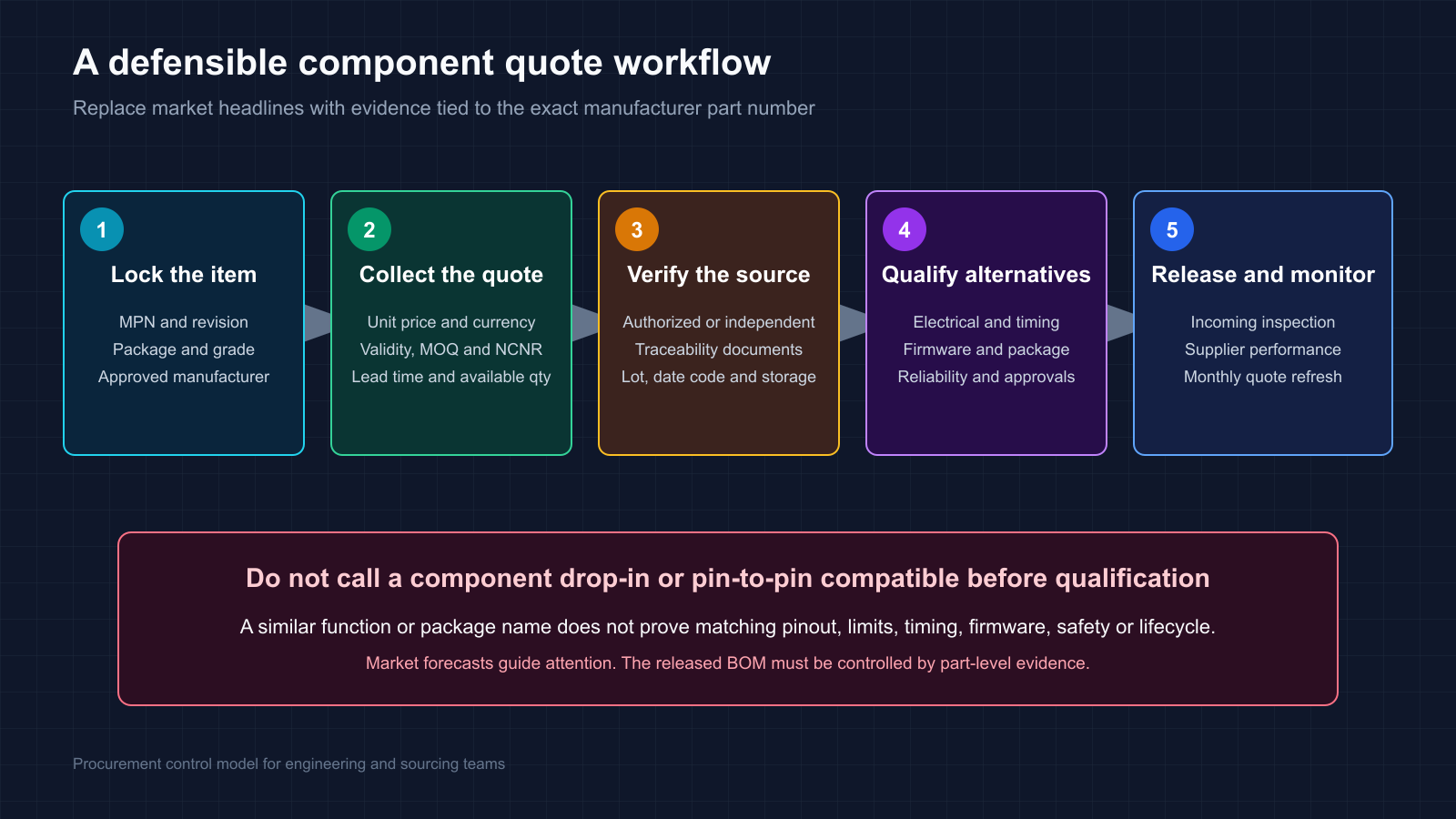
A useful market report should lead to better purchasing controls, not panic buying. The following fields make quotations comparable and auditable.
| Field | What to record | Why it matters |
|---|---|---|
| Exact item | Manufacturer, full MPN, revision, package, grade | Similar descriptions can refer to electrically different products |
| Commercial basis | Unit price, currency, quantity break, MOQ, NCNR status | A price is meaningful only with its quantity and cancellation terms |
| Timing | Quote date, validity, stock quantity, lead time, delivery schedule | Short-lived spot inventory should not be treated as recurring supply |
| Source | Manufacturer, authorized distributor, or independent source | The source determines traceability and risk controls |
| Traceability | Lot, date code, country of origin, chain-of-custody documents | Required evidence varies by quality system and application |
| Technical status | Datasheet revision, lifecycle, PCN, qualification, moisture sensitivity | A low price is not useful if the device cannot be released to production |
| Landed cost | Freight, duty, tax, insurance, testing, storage, handling | The lowest unit quote may not produce the lowest delivered cost |
Alternatives, multi-sourcing, and source qualification
Multi-sourcing can reduce risk, but an alternative is not automatically a replacement. Two MCUs from NXP, STMicroelectronics, Renesas, Infineon, Microchip, or another manufacturer may provide a similar function while using different pinouts, electrical limits, clocks, peripherals, startup behavior, firmware tools, safety documentation, errata, and qualification records. A board should not be described as accepting a pin-to-pin equivalent until engineering has verified the exact devices.
The same rule applies to analog ICs, power devices, memories, connectors, and passives. Package similarity does not establish compatibility. Alternatives should pass a documented review of electrical, mechanical, thermal, firmware, reliability, regulatory, and lifecycle requirements, followed by appropriate prototype and production testing.
Independent distribution can help when authorized supply is unavailable, but it changes the evidence required. Define acceptable traceability, inspection, electrical testing, destructive physical analysis, return rights, storage conditions, and approval authority before placing the order. Use the Utmel component catalog to identify available parts and submit inquiries, then confirm the source and quality documentation required for your application.
A 30-60-90 day procurement plan
First 30 days: establish the evidence baseline
Normalize manufacturer names and full orderable part numbers in the BOM.
Identify single-source, obsolete, allocated, long-lead, and safety-critical items.
Refresh quotations for high-value memory, AI-related logic, advanced packaging dependencies, and constrained legacy parts.
Record quote validity, lead time, MOQ, NCNR status, and source type.
Days 31 to 60: reduce technical and commercial exposure
Prioritize alternative qualification by production impact, not by headline percentage.
Review lifecycle notices, process changes, assembly sites, and authorized-channel availability.
Set inventory targets using demand variability, replenishment time, service level, shelf life, and cash constraints.
Define enhanced inspection and testing for purchases outside the authorized channel.
Days 61 to 90: control and monitor
Approve qualified alternatives in engineering change control.
Negotiate scheduled deliveries or supply agreements for items with stable demand.
Review quote changes monthly and immediately after a PCN, allocation notice, tariff change, or demand revision.
Measure supplier delivery performance and incoming-quality results rather than relying only on market commentary.
Frequently asked questions
Are all semiconductor prices rising in 2026?
No. WSTS forecasts exceptional revenue growth for memory and strong growth for logic, but much lower growth for analog, discrete, and sensor categories. Even within one category, price direction can differ by part, package, customer agreement, quantity, source, and region.
Does WSTS's 250% memory forecast mean my DRAM or NAND will cost 250% more?
No. The WSTS figure is a product-group sales forecast. It combines changes in price, unit volume, capacity, and product mix. Obtain a current quotation for the exact memory device before changing a budget or purchase plan.
Is HBM capacity taking supply away from standard memory?
HBM and high-capacity server products require substantial advanced DRAM and packaging resources, so they influence supplier investment and product mix. The effect on a specific standard-memory part still depends on its technology, fab, package, lifecycle, inventory, and demand.
Are MCU and analog IC shortages returning?
Supplier results from NXP and Analog Devices show strong 2026 demand and business growth. They do not establish a market-wide shortage. Monitor exact MPN availability, channel inventory, lead time, and supplier notices instead of assuming every MCU or analog IC is constrained.
Are MLCC prices rising because of AI servers?
AI servers are increasing demand for selected high-capacitance and high-performance components. Murata reported higher capacitor revenue, mainly supported by servers, but it also reported falling product selling prices as a profit headwind. This is why buyers need part-level quotes rather than a universal MLCC increase.
Should buyers increase safety stock now?
Only after a part-level risk review. Safety stock should reflect replenishment time, demand variability, production impact, source concentration, shelf life, storage conditions, lifecycle, and cash cost. A broad market forecast alone is not enough to set inventory.
Can a similar MCU replace an unavailable device?
Not without qualification. Verify pinout, electrical limits, clocks, peripherals, memory map, firmware, debug tools, package, temperature grade, reliability, safety documentation, errata, and lifecycle. Similar function does not prove drop-in compatibility.
How often should component quotations be refreshed?
Use a frequency matched to risk. Monthly review is reasonable for high-value or constrained items, while stable commodity parts may need less frequent review. Refresh immediately after a supplier notice, demand change, allocation event, tariff change, or major change in available inventory.
Official sources used for this update
 UTMEL
UTMEL
We are the professional distributor of electronic components, providing a large variety of products to save you a lot of time, effort, and cost with our efficient self-customized service. careful order preparation fast delivery service
 Power Semiconductor Procurement After the Nexperia Shake-Up—NXP for Stability, ON for Technology, or Nexperia for Value?UTMEL04 November 20254802
The recent supply chain turmoil surrounding Netherlands-based Nexperia has sent shockwaves through the global semiconductor industry, forcing procurement professionals to re-evaluate their sourcing strategies.
Read More AI Computing Power Gap: How Token Consumption is Reshaping Server Component SourcingUTMEL23 June 2026886
As global token consumption drives the transition to high-density 100kW+ AI data centers, power delivery networks require advanced Wide-Bandgap semiconductors (SiC/GaN) and high-capacitance MLCCs. This shift has triggered a component procurement crisis with lead times exceeding 24 weeks. To bypass shortages, hardware buyers must abandon just-in-time manufacturing and leverage independent global distributor networks to secure critical power and passive components.
Read More The BSPDN Revolution: Overcoming IR Drop in Sub-2nm GAAFET Nodes with Backside Power DeliveryUTMEL25 June 2026782
As semiconductor manufacturing enters the sub-2nm era, Backside Power Delivery Networks (BSPDN) are replacing traditional front-side routing to overcome critical IR drop bottlenecks. By separating power and signal delivery, chipmakers like Intel and TSMC drastically improve performance and density in GAAFET designs. However, this radical shift introduces manufacturing complexities, thermal challenges, and demands advanced packaging and power management solutions.
Read More Power Management ICs Trends 2026: AI Demand, Supply Risks, and Sourcing StrategiesUTMEL06 July 20261248
As AI server racks surpass 100kW by 2026, data centers are shifting toward wide-bandgap semiconductors like SiC and GaN. However, this demand has triggered a critical shortage of mature-node Power Management ICs (PMICs). To prevent production halts, sourcing teams must abandon 'just-in-time' models, implement proactive 'just-in-case' strategies, and rapidly qualify pin-to-pin alternative components to secure their supply chains.
Read More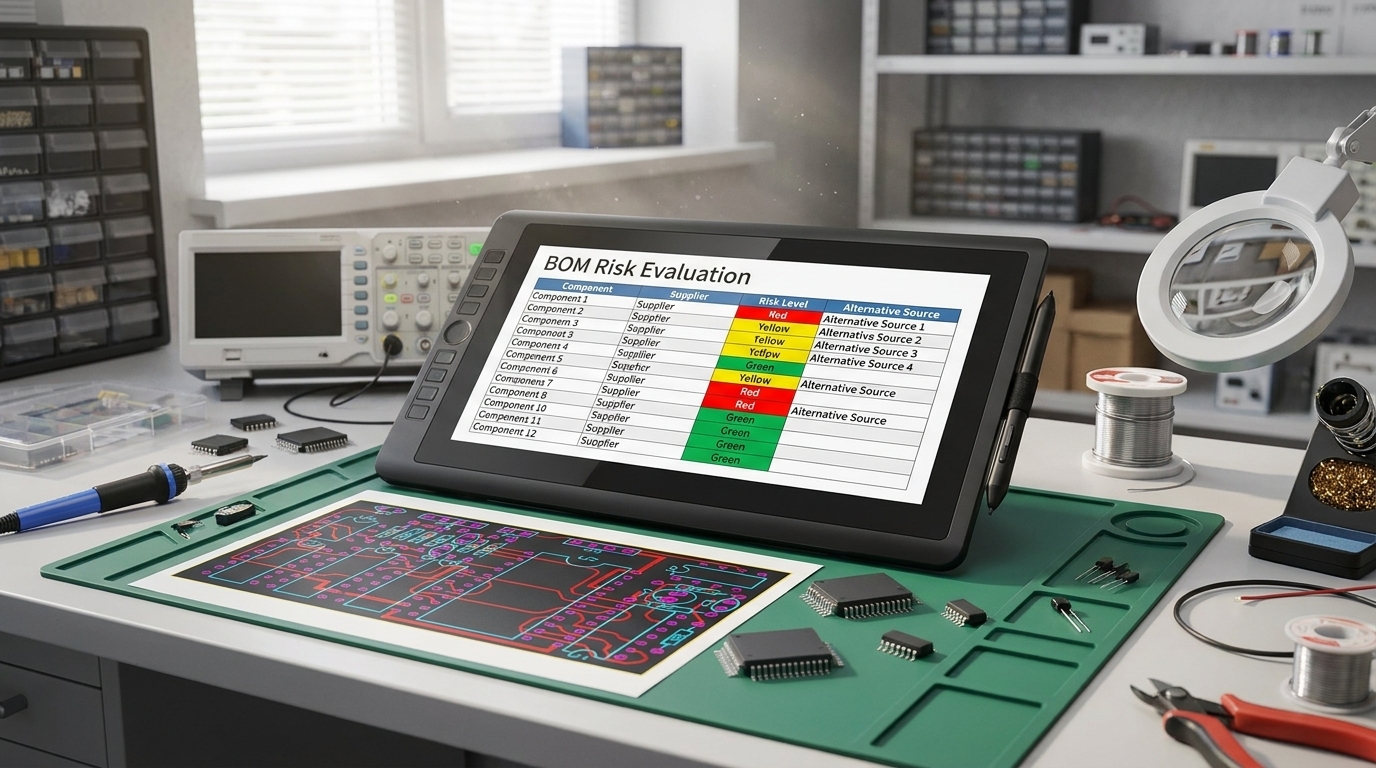 onsemi Synaptics Acquisition Impact: BOM Risk Checklist and Second-Source Strategy for Edge AI DesignsUTMEL27 July 2026284
The onsemi acquisition of Synaptics provides hardware program managers a 12-to-18-month window before potential product cancellations occur in mid-2027. This guide outlines how to audit BOM exposure across overlap and non-core product lines, calculate Last-Time-Buy volumes including hidden storage costs, establish proactive second-sourcing triggers, and implement supply chain monitoring to prevent line-down events.
Read More
Subscribe to Utmel !
![120PSB-]() 120PSB-
120PSB-Visual Communications Company - VCC
![BLM03AG800SN1D]() BLM03AG800SN1D
BLM03AG800SN1DMurata Electronics
![W9006M]() W9006M
W9006MPulseLarsen Antennas
![109-1073H]() 109-1073H
109-1073HSanyo Denki America Inc.
![BLM03BB220SN1D]() BLM03BB220SN1D
BLM03BB220SN1DMurata Electronics
![MMZ0603S100CT000]() MMZ0603S100CT000
MMZ0603S100CT000TDK Corporation
![CL05B104KB54PNC]() CL05B104KB54PNC
CL05B104KB54PNCSamsung Electro-Mechanics
![FLUKE-54-2 60HZ]() FLUKE-54-2 60HZ
FLUKE-54-2 60HZFluke Electronics
![169341-1]() 169341-1
169341-1TE Application Tooling
![314253-1]() 314253-1
314253-1TE Application Tooling