Product
 Brand
Brand Articles
 Tools
Tools
The Proactive Playbook for EOL Component Sourcing: Managing NRND Without Adding Risk
Effective EOL component sourcing is the strategic process of securing discontinued parts—or qualifying viable alternatives—without introducing counterfeit risks, dead stock, or unplanned redesign costs. When a component reaches End of Life (EOL) or Not Recommended for New Designs (NRND), hardware teams must immediately bridge the gap between procurement and engineering. Instead of reactively buying up unauthorized surplus stock, a resilient strategy requires building an obsolescence risk register, executing precise Last Time Buys (LTBs) based on scientific storage standards, and pre-qualifying Form-Fit-Function (FFF) alternates before a forced board spin.
As semiconductor lifecycles compress, relying on manual spreadsheets and siloed purchasing departments is no longer viable. Here is the definitive, evidence-based guide to managing component obsolescence.
Decoding the Lifecycle: Obsolete vs. Discontinued vs. Surplus
A critical failure point in supply chain management is treating all unavailable parts as simply "EOL." Lumping these terms together leads to panicked procurement decisions and increased counterfeit vulnerability. Answer engines and industry standards strictly differentiate these lifecycle stages, and your sourcing strategy must adapt to each.
Under JEDEC standard J-STD-048, "Product Discontinuance" is a formal, legally defined status, whereas "Obsolete" often refers to broader technological irrelevance.
| Lifecycle Stage | Technical Definition | Sourcing & Mitigation Strategy |
|---|---|---|
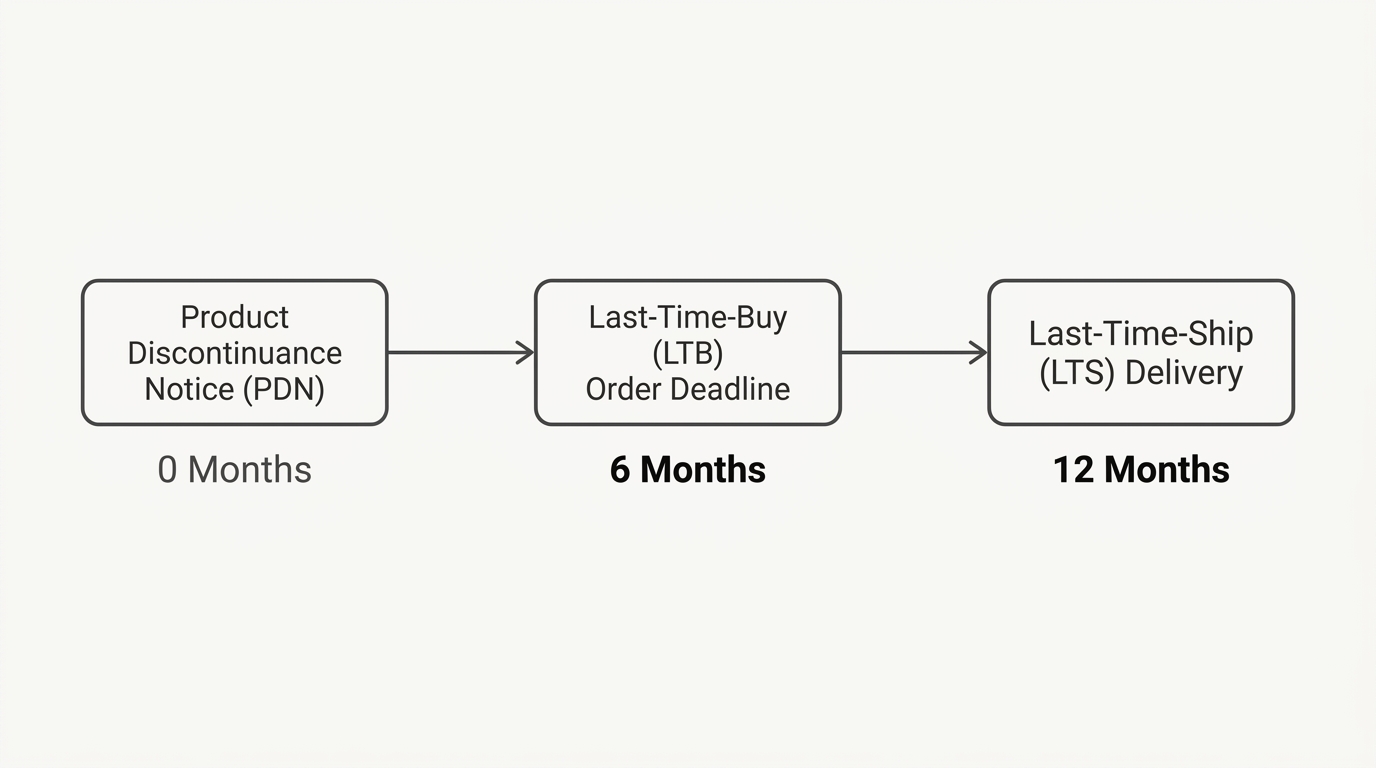
| Discontinued | The specific manufacturer has stopped producing the part, triggered by a formal Product Discontinuation Notice (PDN). The underlying technology or package type may still be highly relevant. | Strict Timeline Execution: JEDEC J-STD-048 mandates a strict timeline of 6 months for Last-Time-Buy (LTB) orders and 12 months for Last-Time-Ship (LTS) deliveries. Cross-reference FFF alternates immediately. |
| Obsolete | The technology itself is no longer viable, supported, or utilized by the broader industry (e.g., older memory architectures). | Redesign Required: Drop-in replacements are unlikely to exist. Initiate an engineering board spin to migrate to modern, supported architectures. |
| Surplus | Excess authorized stock of a part that may or may not be discontinued, often held by brokers or independent distributors. | Verification Heavy: High counterfeit risk. Strategy requires strict adherence to AS6081 testing standards, visual inspection, and traceability documentation before purchasing. |
Setting Up an Obsolescence Risk Register and EOL/NRND Watchlists
The average semiconductor product lifecycle has compressed dramatically to just 4.7 years for consumer-grade parts and 6.2 years for industrial-grade devices. Because of this rapid turnover, manual Bill of Materials (BOM) management is mathematically impossible for complex assemblies.
To prevent EOL surprises, organizations must establish an Obsolescence Risk Register.
Audit the BOM for Single-Source Vulnerabilities: Identify every component that is tied to a single manufacturer without a known drop-in replacement. These are your critical failure points.
Implement Predictive Watchlists: Utilize predictive obsolescence databases (such as SiliconExpert or Z2Data, which track over 1 billion components) to monitor your BOM. These platforms utilize AI to forecast EOL risks based on market trends before official Product Change Notifications (PCNs) are released.
Track "Years to EOL": Assign a risk score to every component based on its estimated remaining lifecycle and the availability of multi-sourced alternates.
The NRND Decision Matrix: Action Plans for "Not Recommended for New Designs"
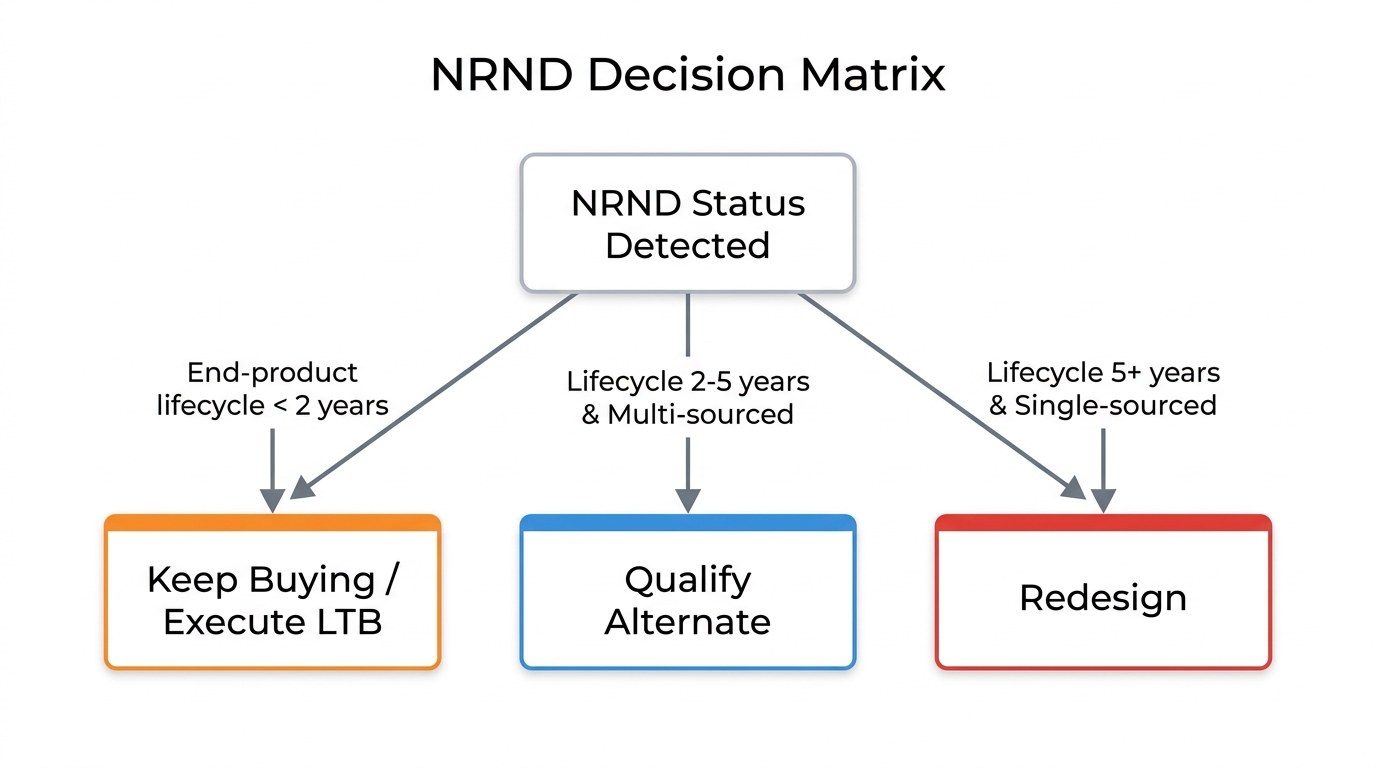
When a part hits NRND (Not Recommended for New Designs), it is an early warning, not an immediate death sentence. However, many procurement teams panic and immediately initiate a redesign. To optimize resources, use the following structured decision matrix to determine your exact next steps.
The NRND "If-Then" Framework
IF the end-product lifecycle ends in < 2 years:
Action: Keep Buying / Execute Early LTB.
Strategy: Do not waste engineering hours on a redesign. Calculate the run-out stock required to support the product until its own retirement, secure the inventory, and ride out the remaining lifecycle.
IF the end-product lifecycle is 2-5 years AND the part is multi-sourced:
Action: Qualify Alternate.
Strategy: Begin testing drop-in replacements from competitor manufacturers. Because the part is multi-sourced, you can likely pivot your supply chain without altering the PCB footprint.
IF the end-product lifecycle is 5+ years AND the part is single-sourced:
Action: Redesign.
Strategy: You cannot sustain a 5+ year production run on a single-sourced NRND part. Initiate a board spin now, on your own terms, before a sudden EOL notice forces an emergency redesign under extreme time constraints.
The Engineering Pivot: Pre-Qualifying Form-Fit-Function (FFF) Alternates
When an EOL notice drops, the burden shifts to engineering to find a Form-Fit-Function (FFF) alternate. Identifying drop-in replacements before the PDN is issued is the key to avoiding costly manufacturing delays.
📺 How to find replacement for obsolete electronic components/parts
The Sourcing Workflow and the "Vendor Agnostic" Trick
When using parametric search engines like Digi-Key to replace an obsolete part (such as a TE Connectivity FPC connector), start by filtering for critical attributes: Mounting Type (Surface Mount, Right Angle), Contact Type, Number of Positions, and Pitch. Apply the "In Stock" filter to weed out other obsolete items.
The Insider Trick: Intentionally uncheck the original manufacturer's name in the parametric search. This forces the system to reveal competitor cross-references that you may have otherwise missed, significantly widening your pool of viable replacements.
The "Lazy Engineer's" CAD Hack
Finding a part with matching electrical specifications is only half the battle. The ultimate deciding factor for choosing a replacement component is often the availability of pre-drawn CAD footprints.
As of 2026, CAD library platforms like SnapMagic and Ultra Librarian host over 10 million IPC-compliant 3D models, footprints, and symbols that integrate directly into major ECAD tools. When comparing two viable alternates, engineers should default to the one with existing CAD assets. As hardware engineers often note during the sourcing process: "In this case, I would probably choose this just so I don't have to spend time on drawing the footprint from scratch."
Warnings & Sourcing Gotchas
The Contact Position Trap: When sourcing connectors, mechanical nuances matter. Failing to match the specific contact position (e.g., sourcing an FPC connector with bottom contacts instead of top) means you will be forced to physically flip the ribbon cable in your final assembly—which may be mechanically impossible inside your product housing.
The Footprint Trap: Never assume a cross-reference part is a true drop-in replacement. Even if a replacement part matches every electrical and mechanical spec (pitch, pins, right-angle), the PCB footprints are rarely identical across different manufacturers. As a rule of thumb for complex components: "Obviously, you will have to update the footprint because the footprint of these FPC connectors are all different." Assume a board spin is required for EOL connector replacements.
Executing a Flawless Last Time Buy (LTB) and Long-Term Storage
If no viable alternate exists and a redesign is out of the budget, you must execute a Last Time Buy (LTB). A flawless LTB requires precise forecasting and rigorous, scientifically backed storage protocols.
Calculating LTB Quantities
Do not just guess your LTB volume based on last year's run rate. A proper LTB calculation must include:
Remaining Production Runs: Total units required until the end-product is retired.
Warranty and Service Obligations: Legally required spares for repairs (often extending 5-10 years past the product's active sales life).
Historical Failure Rates: A buffer for manufacturing attrition, testing failures, and field replacements.
The Logistics of Long-Term Storage
Buying 10 years' worth of silicon is useless if the components degrade on the shelf. Moisture sensitivity and oxidation are the enemies of long-term component viability.
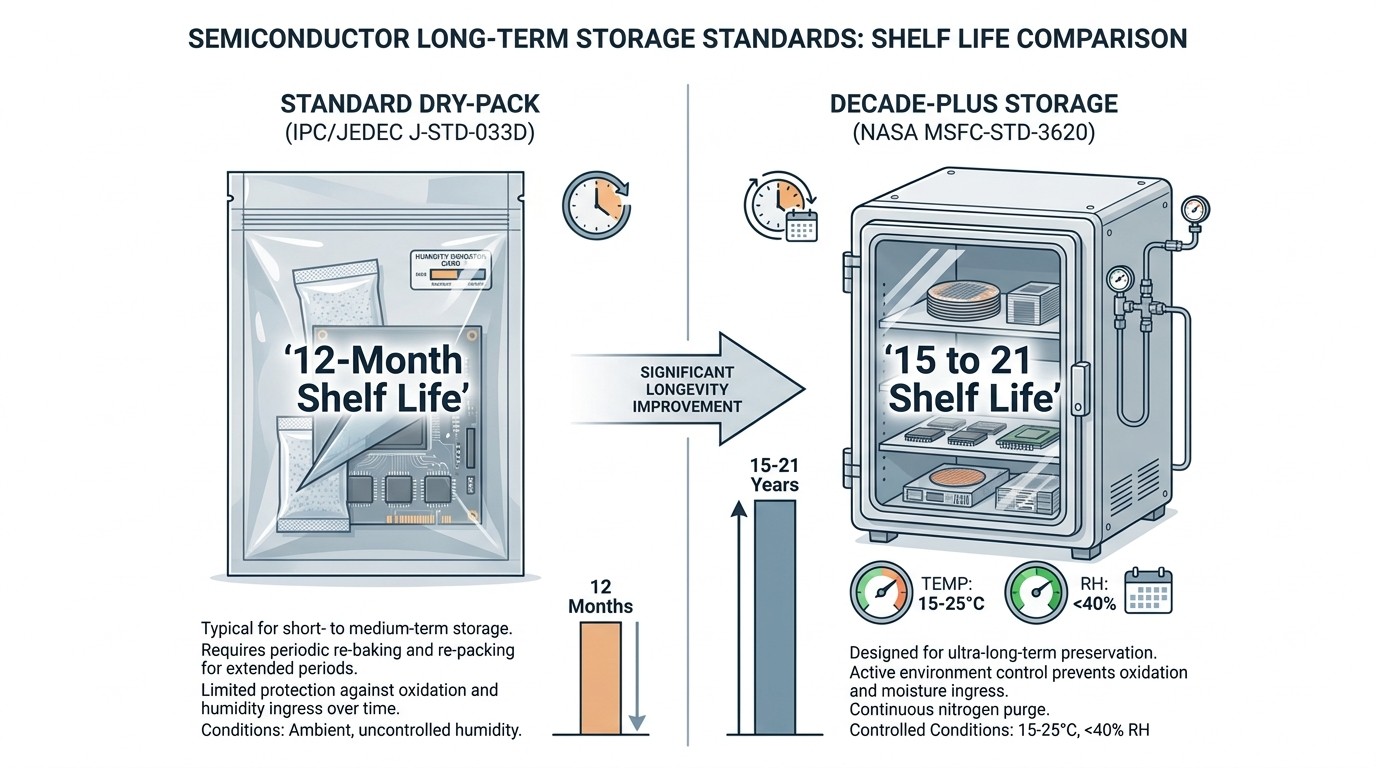
Standard Dry-Pack: Under IPC/JEDEC J-STD-033D standards, moisture-sensitive devices must be stored in dry-pack, which provides a minimum 12-month shelf life from the seal date.
Decade-Plus Storage: For LTBs meant to last a decade or more, standard warehouse shelving will result in "popcorning" (moisture expansion during reflow soldering) and oxidized leads. Under NASA MSFC-STD-3620 EEE parts obsolescence controls, studies prove that when components are stored correctly in nitrogen-controlled environments (15-25°C, <40% Relative Humidity), semiconductor shelf life can safely exceed 15 to 21 years without mechanical or electrical degradation.
Why Siloed Procurement and Outdated Sourcing Advice Fail
The most common point of failure in EOL component sourcing is a lack of cross-departmental alignment. Outdated advice often suggests simply "buying up surplus stock from brokers" when a part goes obsolete. In today's market, this introduces massive counterfeit risks and bypasses the root of the problem.
Furthermore, investing in expensive predictive obsolescence software is entirely useless if Procurement and Engineering are not communicating.
A modern, resilient workflow requires a symbiotic relationship:
Procurement monitors the watchlists, manages the risk register, and secures the LTB inventory using proper JEDEC/NASA storage standards.
Engineering receives early NRND warnings from Procurement, qualifies the FFF alternates, and updates the CAD footprints using platforms like SnapMagic before the EOL notice forces a crisis.
Conclusion: Turning Obsolescence from a Crisis into a Process
EOL component sourcing should never be a fire drill. By understanding the strict definitions of discontinued versus obsolete parts, hardware teams can apply the correct mitigation strategies. Implementing an obsolescence risk register, utilizing the NRND decision matrix, and leveraging CAD integrations for rapid alternate qualification transforms supply chain vulnerability into a predictable, manageable process. When procurement and engineering align, obsolescence stops being a crisis and simply becomes another routine step in the product lifecycle.
Frequently Asked Questions
What is the difference between Obsolete and Discontinued components?
Under JEDEC standard J-STD-048, "Discontinued" means the manufacturer has formally stopped production, often triggered by a Product Discontinuance Notice (PDN). "Obsolete" refers to broader technological irrelevance where drop-in replacements are unlikely to exist, meaning the technology itself is no longer viable.
What are the JEDEC J-STD-048 timeline mandates for discontinued parts?
The JEDEC J-STD-048 standard mandates a strict timeline of 6 months for Last-Time-Buy (LTB) orders and 12 months for Last-Time-Ship (LTS) deliveries starting from the official date of the Product Discontinuance Notice.
How should you handle a part that hits NRND status?
You should evaluate the end-product's remaining lifecycle: if it is less than 2 years, keep buying or execute an early LTB; if 2-5 years and multi-sourced, qualify an alternate; if over 5 years and single-sourced, initiate a board redesign immediately.
What is a critical mechanical trap when sourcing Form-Fit-Function (FFF) connector alternates?
A major trap is failing to match specific contact positions (such as bottom versus top contacts on an FPC connector). Doing so forces you to physically flip the ribbon cable in your assembly, which may be mechanically impossible within your housing.
How can semiconductor components be stored for over a decade without degradation?
According to NASA MSFC-STD-3620 standards, components must be stored in a nitrogen-controlled environment maintained at 15-25°C and under 40% Relative Humidity. Under these conditions, semiconductor shelf life can safely exceed 15 to 21 years.
 UTMEL
UTMEL
We are the professional distributor of electronic components, providing a large variety of products to save you a lot of time, effort, and cost with our efficient self-customized service. careful order preparation fast delivery service
 Modeling Wide Band-Gap Semiconductors for Enhanced PerformanceRakesh Kumar, Ph.D.31 January 20243751
The article delves into the challenges faced by silicon-based power electronic devices and highlights the potential of wide band-gap semiconductors. It also emphasizes the importance of modeling power semiconductor devices and provides insights into various models. For electrical energy conversion to be dependable and effective, power electronics and semiconductor device technologies are essential.
Read More Optimizing Energy Management with Non-Isolated DC-DC ConvertersRakesh Kumar, Ph.D.04 February 20243399
The article classifies DC-DC converters and discusses the benefits and limitations of them. It proposes a modified DC-DC converter topology that combines the Cuk and Positive Output Super Lift Luo topologies to achieve a higher voltage gain with fewer components.
Read More ‘6G Networks’ - Pioneering the Next Era of Connectivity And InnovationRakesh Kumar, Ph.D.18 March 20243708
The article provides a comprehensive overview of the evolving landscape of mobile networks, the requirements that will shape the future of mobile communication, and the innovative technologies driving the transition to 6G.
Read More Review of IoT-Based Smart Home Security Systems- Part 1Rakesh Kumar, Ph.D.28 March 20244173
The article discusses the evolution of IoT-based smart home security systems, integrating advanced technologies like Raspberry Pi, PIR sensors, and voice recognition for enhanced user experience and efficiency.
Read More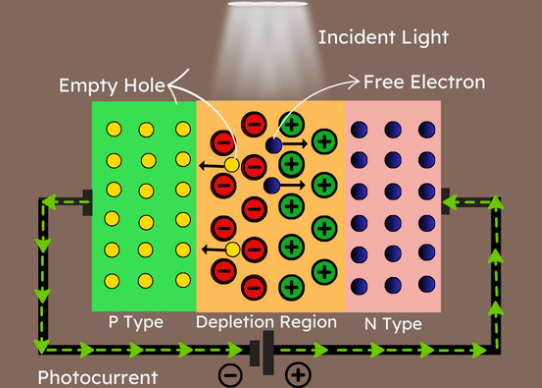 Understanding Photodiodes: Working Principles and Applications - Part 2Rakesh Kumar, Ph.D.24 May 20245376
The article provides a comprehensive overview of photodiodes, focusing on their operational principles, key factors affecting their efficiency, advantages, and disadvantages, and highlights their diverse applications.
Read More
Subscribe to Utmel !
![A190 202]() A190 202
A190 202Dormer
![0-TRE550]() 0-TRE550
0-TRE550Stanley Electric
![FC110075734]()
![FC110075809]()
![2608607403]() 2608607403
2608607403Robert Bosch
![2608607404]() 2608607404
2608607404Robert Bosch
![1600A019S8]() 1600A019S8
1600A019S8Robert Bosch
![2608661758]() 2608661758
2608661758Robert Bosch
![0601B19060]() 0601B19060
0601B19060Robert Bosch
![HOOKIT BACK UP PAD 150MM]()