

 Product
 Brand
Brand Articles
 Tools
Tools
AMS1117 1A Low Dropout Voltage Regulator: Datasheet, 3.3 V Regulators and Pinout


PMIC SOT-223
AMS1117-3.3V, 1A, SOT-223 Voltage Regulator IC is a series of low dropout three-terminal regulators with a dropout of 3.3V at 1A load current. This article mainly covers the datasheet, power, pinout, specifications, and other details about the 3.3V AMS1117 3.3v regulator. Furthermore, there is a huge in stock. Welcome your RFQ!

How to use AMS1117
AMS1117 Pinout

AMS1117 Pinout
| Pin Number | Pin Name | Description |
| 1 | Adjust/Ground | This pin adjusts the output voltage, if it is a fixed voltage regulator it acts as ground |
| 2 | Output Voltage (Vout) | The regulated output voltage set by the adjusted pin can be obtained from this pin |
| 3 | Input Voltage (Vin) | The input voltage which has to be regulated is given to this pin |
What is AMS1117?
The AMS1117 is a popular 3-pin voltage regulator with an SMD package that comes in a variety of variants to meet both fixed and variable voltage requirements. The IC has a maximum current of 1A and a range of output voltages of 1.5V to 5V. When operating at maximum current, it also boasts a low drop-off voltage of 1.3V.
AMS1117 CAD Model

AMS1117 Symbol
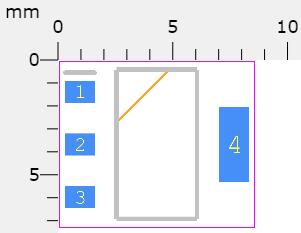
AMS1117 Footprint
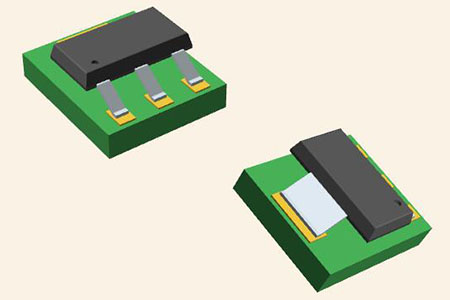
AMS1117 3D Model
Specifications
- TypeParameter
- Package / Case
refers to the protective housing that encases an electronic component, providing mechanical support, electrical connections, and thermal management.
SOT-223 - Surface Mount
having leads that are designed to be soldered on the side of a circuit board that the body of the component is mounted on.
YES - Number of Pins2
- Operating Temperature (Max)
The parameter "Operating Temperature (Max)" in electronic components refers to the maximum temperature at which the component can safely operate without experiencing damage or performance degradation. This specification is crucial for ensuring the reliability and longevity of the component in various operating conditions. Exceeding the maximum operating temperature can lead to thermal stress, reduced efficiency, and ultimately failure of the component. It is important for designers and engineers to consider this parameter when selecting and using electronic components to ensure proper functionality and prevent potential issues related to overheating.
125°C - Operating Temperature (Min)
The parameter "Operating Temperature (Min)" in electronic components refers to the minimum temperature at which the component is designed to operate effectively and reliably. This specification indicates the lowest temperature at which the component can function within its specified performance limits. Operating below this minimum temperature may result in reduced efficiency, slower response times, or even complete failure of the component. It is important to consider the operating temperature range of electronic components to ensure proper functionality and longevity in various environmental conditions.
-40°C - Power Dissipation (Max)1.2W
- Number of Terminations3
- ECCN Code
An ECCN (Export Control Classification Number) is an alphanumeric code used by the U.S. Bureau of Industry and Security to identify and categorize electronic components and other dual-use items that may require an export license based on their technical characteristics and potential for military use.
EAR99 - Terminal Position
In electronic components, the term "Terminal Position" refers to the physical location of the connection points on the component where external electrical connections can be made. These connection points, known as terminals, are typically used to attach wires, leads, or other components to the main body of the electronic component. The terminal position is important for ensuring proper connectivity and functionality of the component within a circuit. It is often specified in technical datasheets or component specifications to help designers and engineers understand how to properly integrate the component into their circuit designs.
DUAL - Terminal Form
Occurring at or forming the end of a series, succession, or the like; closing; concluding.
GULL WING - Number of Functions1
- JESD-30 Code
JESD-30 Code refers to a standardized descriptive designation system established by JEDEC for semiconductor-device packages. This system provides a systematic method for generating designators that convey essential information about the package's physical characteristics, such as size and shape, which aids in component identification and selection. By using JESD-30 codes, manufacturers and engineers can ensure consistency and clarity in the specification of semiconductor packages across various applications and industries.
R-PDSO-G3 - Number of Outputs1
- Max Supply Voltage
In general, the absolute maximum common-mode voltage is VEE-0.3V and VCC+0.3V, but for products without a protection element at the VCC side, voltages up to the absolute maximum rated supply voltage (i.e. VEE+36V) can be supplied, regardless of supply voltage.
15V - Nominal Supply Current
Nominal current is the same as the rated current. It is the current drawn by the motor while delivering rated mechanical output at its shaft.
5mA - Current - Output
Current - Output is a parameter in electronic components that refers to the maximum amount of current that can be delivered by the output of the component. It is a crucial specification as it determines the capability of the component to supply power to connected devices or circuits. The current output rating is typically specified in amperes (A) and is important for ensuring that the component can safely and effectively power the load it is connected to without overheating or failing. Designers and engineers must consider the current output rating when selecting components to ensure compatibility and reliable operation of the overall system.
1A - Voltage - Output
Voltage - Output is a parameter that refers to the electrical potential difference between the output terminal or pin of an electronic component and a reference point, typically ground. It indicates the level of voltage that the component is capable of providing at its output under specified operating conditions. This parameter is crucial in determining the performance and functionality of the component in a circuit, as it directly affects the signal or power being delivered to other components or devices connected to the output. Engineers and designers use the voltage output specification to ensure compatibility and proper functioning of the component within the overall system.
3.3V - Output Voltage 1
Output Voltage 1 is a parameter commonly found in electronic components such as voltage regulators, power supplies, and amplifiers. It refers to the voltage level that is produced or delivered by the component at a specific output terminal or pin. This parameter is crucial for determining the performance and functionality of the component in a circuit. The specified output voltage should meet the requirements of the connected devices or components to ensure proper operation and compatibility. It is important to carefully consider and verify the output voltage 1 specification when selecting and using electronic components in a design or application.
3.3V - Max Input Voltage
Max Input Voltage refers to the maximum voltage level that an electronic component can safely handle without getting damaged. This parameter is crucial for ensuring the proper functioning and longevity of the component. Exceeding the specified maximum input voltage can lead to overheating, electrical breakdown, or permanent damage to the component. It is important to carefully adhere to the manufacturer's guidelines regarding the maximum input voltage to prevent any potential issues and maintain the reliability of the electronic device.
15V - Dropout Voltage
Dropout voltage is the input-to-output differential voltage at which the circuit ceases to regulate against further reductions in input voltage; this point occurs when the input voltage approaches the output voltage.
1.1V - Regulator Type
In electronic components, the "Regulator Type" parameter refers to the specific type of voltage regulator used in a circuit. Voltage regulators are devices that maintain a constant output voltage regardless of changes in input voltage or load conditions. The regulator type can vary based on the design and functionality of the voltage regulator, such as linear regulators, switching regulators, or programmable regulators. Each type has its own advantages and limitations in terms of efficiency, cost, size, and performance characteristics. Selecting the appropriate regulator type is crucial to ensure stable and reliable operation of the electronic circuit.
FIXED POSITIVE SINGLE OUTPUT LDO REGULATOR - Max Junction Temperature (Tj)
Max Junction Temperature (Tj) refers to the maximum allowable temperature at the junction of a semiconductor device, such as a transistor or integrated circuit. It is a critical parameter that influences the performance, reliability, and lifespan of the component. Exceeding this temperature can lead to thermal runaway, breakdown, or permanent damage to the device. Proper thermal management is essential to ensure the junction temperature remains within safe operating limits during device operation.
125°C - Height1.8mm
- Length6.505mm
- Width3.505mm
- RoHS Status
RoHS means “Restriction of Certain Hazardous Substances” in the “Hazardous Substances Directive” in electrical and electronic equipment.
Non-RoHS Compliant
AMS1117 Features
Three Terminal Adjustable or Fixed Voltages* 1.5V, 1.8V, 2.5V, 2.85V, 3.3V and 5.0V
Output Current of 1A
Operates Down to 1V Dropout
Line Regulation: 0.2% Max
Load Regulation: 0.4% Max.
SOT-223, TO-252, and SO-8 packages are available
Alternatives for AMS1117
LM1117, LM317, LM7805, NTE9060
AMS1117 Applications
High-Efficiency Linear Regulators
Used for Positive voltage regulations
5V to 3.3V Linear Regulator
Variable power supply
Current limiting circuits
Reverse polarity circuits
Commonly used in Desktop PC, DVD and other consumer products
Used in motor control circuits
Where to Use AMS1117
The AMS1117 is a voltage regulator with a linear output. Since it is accessible as a DCY Package, it is noted for its tiny form factor (SMD Component). The LM1117 comes in a variety of packages and output voltages. All of the ICs, however, are rated for a maximum current of 1A. The table below will assist you in selecting the correct part number for your IC.
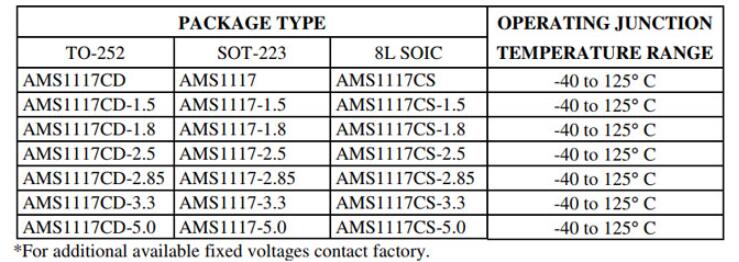
The IC is well-known for being used to regulate 5V and 3.3V in Arduino boards. So, if you're seeking a voltage regulator for SMD components, this IC might be the one for you.
How to Use AMS1117
The AMS1117 is relatively simple to operate. If the voltage regulator is a fixed voltage regulator, simply supply power to the IC through the VIN pin, and the regulated output can be found on the Vout pin. In this situation, the Adj/Ground pin is only used as a ground pin and is grounded. A capacitor can also be added to the output side of the circuit to filter out noise. Below is a circuit diagram for a variable output regulator.

AMS1117 Circuit
To determine the output voltage of an adjustable type voltage regulator, two external resistors are required. The output voltage of the regulator is determined by the resistors R1 and R2. A reference circuit schematic with adjustable voltage is presented below. The CAdj capacitor is an optional component that can be used to increase ripple rejection. The input and output noise is filtered by the other two capacitors.
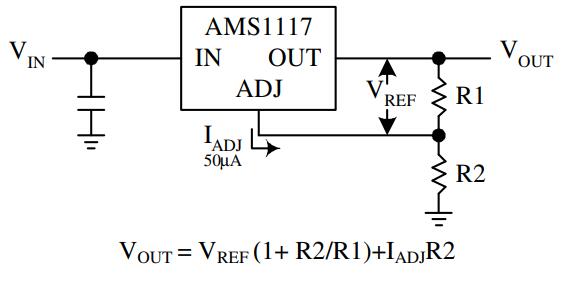
AMS1117 Circuit
Below are the formulas for calculating the output voltage of the AMS1117 regulator. R1 and R2 should be set to the output voltage required for your project. It's important to remember that R1 should be smaller than 1k. If you wish to change the voltage in real-time, use a variable resistor at R2.
VOUT = VREF (1 + R2/R1) + IADJR2
The AMS1117, which can be used as a fixed voltage or variable voltage regulator, is frequently used in battery charging circuits and can also be programmed to give negative voltage if necessary. More application circuits for this IC can be found in the datasheet at the bottom of this page.
AMS1117 Dimensions

AMS1117 Dimensions
AMS1117 Manufacturer
Advanced Monolithic Systems (AMS) has grown rapidly as a manufacturer of high-quality products and reliable services. Based on their goal of "complete customer satisfaction", they aspire to build a solid relationship with their customers. AMS is dedicated to providing innovative and cost-effective products and reliable services to meet the highest expectation of customers. After their dedication to success and quality, AMS will win a high reputation.
What is AMS1117 3.3V?
AMS1117-3.3 is a cost-effective, low dropout (LDO) Voltage Regulator designed to provide current up to 1 amp.
What is the use of AMS1117?
The AMS1117 is a common voltage regulator mainly used for high-efficiency linear regulation and post-regulation switching supplies. This 3-pin device is also used as a battery charger and comes with an output voltage range from 1.5V to 5V. It returns a low dropout voltage of 1.3A when it operates at maximum current.
Why use AMS1117?
Learn all about the AMS1117, a type of linear voltage regulator often used for varying voltage flow in a circuit. The AMS1117 is a type of linear voltage regulator that is used in the circuit for varying the voltage flow from the input to the output of the circuit.
How does AMS1117 work?
The AMS1117 series develops a 1.25V reference voltage between the output and the adjusted terminal. Placing a resistor between these two terminals causes a constant current to flow through R1 and down through R2 to set the overall output voltage. This current is normally the specified minimum load current of 10mA.
 Decoding the Microchip PIC16CR74IPT 8-bit Microcontroller: A Thorough Investigation
29 February 2024223
 FT900 Embedded Microcontroller: Datasheet, Application, Pinout
03 August 20212123
 Atmel SAM D20E / SAM D20G / SAM D20J Microcontroller: A Comprehensive Overview
28 February 2024247
 NEMA17 Stepper Motor: Datasheet pdf, 1.5 A 1.8° Stepper Motor and Dimensions
29 November 202119612
 LM5002MAX/NOPB: Pinout, High-Voltage, CAD Model
21 February 20221066
 74HC373 Octal D-type Transparent Latch: Datasheet pdf, Schematics and Pinout
18 December 20218321
 74HC595N Shift Register: Pinout, Datasheet, and Functional Logic Diagram
27 August 202116539
 MPL3115A2 Pressure Sensor: Datasheet, Pinout and Schematic
25 August 20213348
 OLED, QLED, MicroLED: Who is the Next Generation Display Technology?
02 September 20223796
 What is an Electromagnetic Relay?
13 October 202012400
 Strain Gauges: Structure, Working Principle and Common Types
16 December 202014420
 How to Avoid Common Mistakes When Choosing Electrical Fuses
14 July 20251398
 What is an Instrumentation Amplifier?
27 March 202513792
 Ultimate Guide to KVM Switches: Definition, Usage, and 2025 Trends
18 December 202514539
 What are the Commonly Used Anti-Jamming Technologies for Sensors?
27 December 20211737
 What is the Difference between DCS and PLC?
28 June 20224968
Advanced Monolithic Systems
In Stock: 1203
United States
China
Canada
Japan
Russia
Germany
United Kingdom
Singapore
Italy
Hong Kong(China)
Taiwan(China)
France
Korea
Mexico
Netherlands
Malaysia
Austria
Spain
Switzerland
Poland
Thailand
Vietnam
India
United Arab Emirates
Afghanistan
Åland Islands
Albania
Algeria
American Samoa
Andorra
Angola
Anguilla
Antigua & Barbuda
Argentina
Armenia
Aruba
Australia
Azerbaijan
Bahamas
Bahrain
Bangladesh
Barbados
Belarus
Belgium
Belize
Benin
Bermuda
Bhutan
Bolivia
Bonaire, Sint Eustatius and Saba
Bosnia & Herzegovina
Botswana
Brazil
British Indian Ocean Territory
British Virgin Islands
Brunei
Bulgaria
Burkina Faso
Burundi
Cabo Verde
Cambodia
Cameroon
Cayman Islands
Central African Republic
Chad
Chile
Christmas Island
Cocos (Keeling) Islands
Colombia
Comoros
Congo
Congo (DRC)
Cook Islands
Costa Rica
Côte d’Ivoire
Croatia
Cuba
Curaçao
Cyprus
Czechia
Denmark
Djibouti
Dominica
Dominican Republic
Ecuador
Egypt
El Salvador
Equatorial Guinea
Eritrea
Estonia
Eswatini
Ethiopia
Falkland Islands
Faroe Islands
Fiji
Finland
French Guiana
French Polynesia
Gabon
Gambia
Georgia
Ghana
Gibraltar
Greece
Greenland
Grenada
Guadeloupe
Guam
Guatemala
Guernsey
Guinea
Guinea-Bissau
Guyana
Haiti
Honduras
Hungary
Iceland
Indonesia
Iran
Iraq
Ireland
Isle of Man
Israel
Jamaica
Jersey
Jordan
Kazakhstan
Kenya
Kiribati
Kosovo
Kuwait
Kyrgyzstan
Laos
Latvia
Lebanon
Lesotho
Liberia
Libya
Liechtenstein
Lithuania
Luxembourg
Macao(China)
Madagascar
Malawi
Maldives
Mali
Malta
Marshall Islands
Martinique
Mauritania
Mauritius
Mayotte
Micronesia
Moldova
Monaco
Mongolia
Montenegro
Montserrat
Morocco
Mozambique
Myanmar
Namibia
Nauru
Nepal
New Caledonia
New Zealand
Nicaragua
Niger
Nigeria
Niue
Norfolk Island
North Korea
North Macedonia
Northern Mariana Islands
Norway
Oman
Pakistan
Palau
Palestinian Authority
Panama
Papua New Guinea
Paraguay
Peru
Philippines
Pitcairn Islands
Portugal
Puerto Rico
Qatar
Réunion
Romania
Rwanda
Samoa
San Marino
São Tomé & Príncipe
Saudi Arabia
Senegal
Serbia
Seychelles
Sierra Leone
Sint Maarten
Slovakia
Slovenia
Solomon Islands
Somalia
South Africa
South Sudan
Sri Lanka
St Helena, Ascension, Tristan da Cunha
St. Barthélemy
St. Kitts & Nevis
St. Lucia
St. Martin
St. Pierre & Miquelon
St. Vincent & Grenadines
Sudan
Suriname
Svalbard & Jan Mayen
Sweden
Syria
Tajikistan
Tanzania
Timor-Leste
Togo
Tokelau
Tonga
Trinidad & Tobago
Tunisia
Turkey
Turkmenistan
Turks & Caicos Islands
Tuvalu
U.S. Outlying Islands
U.S. Virgin Islands
Uganda
Ukraine
Uruguay
Uzbekistan
Vanuatu
Vatican City
Venezuela
Wallis & Futuna
Yemen
Zambia
Zimbabwe