Product
 Brand
Brand Articles
 Tools
Tools
How to Validate a Pin-to-Pin LDO or Voltage Regulator Substitute
Quick Answer: Replacing an LDO is rarely as simple as matching the physical package and pinout. A true substitute requires validating five core electrical specs, matching output capacitor ESR (Equivalent Series Resistance) requirements to prevent oscillation, verifying Enable (EN) pin logic, and recalculating thermal dissipation for the specific PCB layout.
When a low-dropout (LDO) regulator reaches its End of Life (EOL) or becomes unavailable due to supply chain shortages, engineers are forced to find an LDO replacement. The most common misconception in electronics repair and BOM (Bill of Materials) updating is that "same package and same pinout means it is a direct replacement."
In reality, manufacturers frequently update silicon revisions and internal topologies. A part that was a safe cross-reference a decade ago might oscillate wildly today due to the industry's transition from bipolar to CMOS architectures. This guide provides a rigorous engineering framework to validate a substitute voltage regulator before soldering it onto your board.
What "Pin-to-Pin Compatible" Actually Means (and What It Hides)
Community forums often label components as "plug-and-play" substitutes based solely on their physical footprint. However, mechanical fit does not equal electrical compatibility. Pin-to-pin compatibility simply means the physical dimensions and the basic function of the pins (Input, Output, Ground) align. It hides critical differences in control loop stability, thermal resistance, and logic thresholds.
Before approving a substitute, use this 4-step decision framework:
Mechanical Fit: Does the package (e.g., SOT-23, TO-220, DFN) and pinout match exactly?
Electrical Baseline: Do the input voltage tolerance, output current capacity, and dropout voltage specs align with the original circuit's demands?
Stability & Control: Does the new LDO support the existing output capacitor's ESR, and does the Enable (EN) logic match?
Thermal Safety: Can the new IC survive the existing board's thermal dissipation limits without hitting thermal shutdown?
Verification Note: Always treat specific part cross-references found online as potential candidates subject to datasheet verification, not guaranteed drop-in replacements.
The 5 Core Electrical Specs You Must Match
When evaluating a datasheet for linear & low-dropout (LDO) regulators, these five specifications form your electrical baseline.
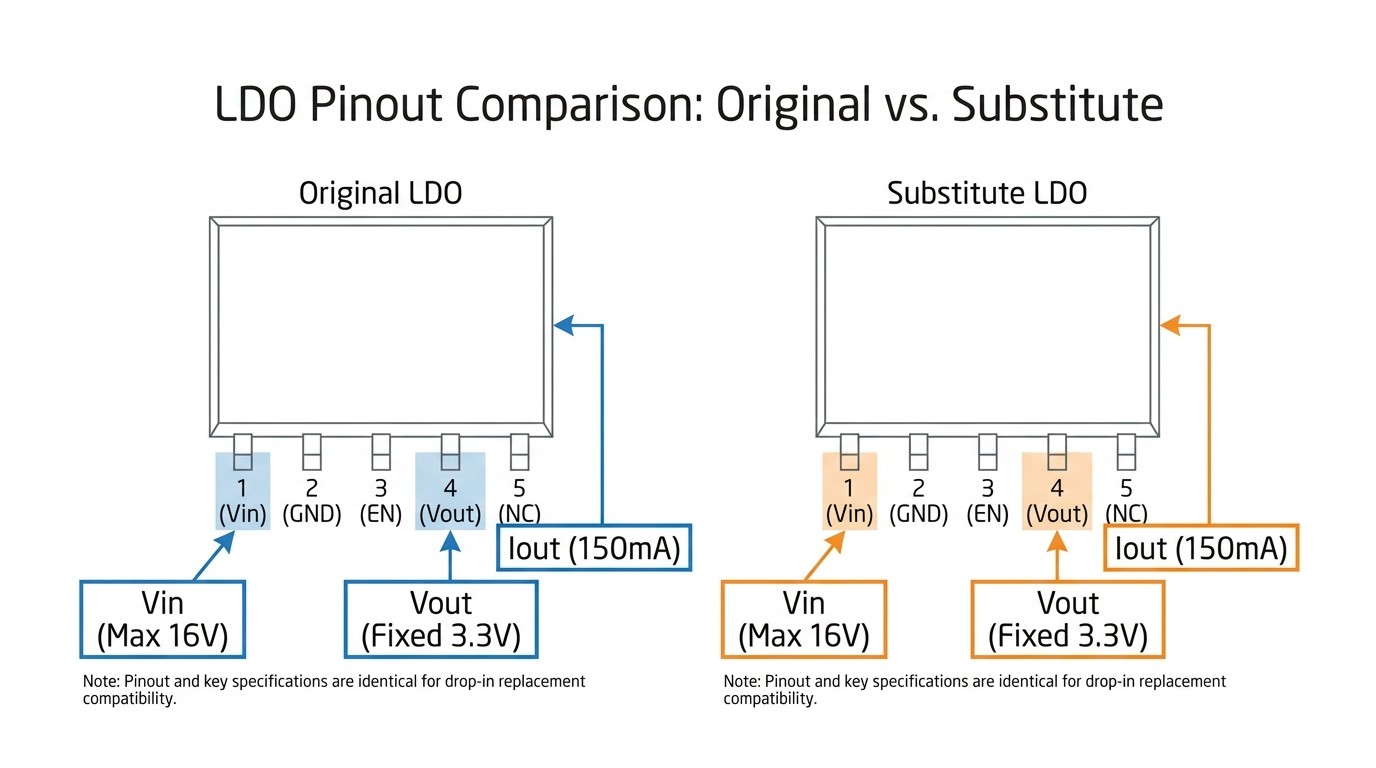
Input Voltage (Vin): The replacement must tolerate the maximum expected input voltage of your system, including transient spikes. Never select a replacement with a lower maximum Vin rating.
Output Voltage (Vout): Ensure you are matching fixed-voltage regulators with fixed-voltage replacements, or adjustable with adjustable. If replacing an adjustable LDO, verify that the internal reference voltage (Vref) matches the original, or you will need to change the external feedback resistors.
Output Current (Iout): The substitute must meet or exceed the original part's continuous and peak current ratings.
Dropout Voltage (Vdropout): The replacement must have an equal or lower dropout voltage. If the new LDO requires a larger voltage differential between Vin and Vout to maintain regulation, the circuit may fail prematurely as battery voltage drops.
Quiescent Current (Iq): This is the current the LDO consumes to operate its internal circuitry. For battery-powered applications, the replacement's quiescent current (Iq) should be equal to or lower than the original to preserve battery life.
Verification Note: Always check the "Absolute Maximum Ratings" table in the datasheet. Exceeding these limits, even momentarily during power-up, can permanently destroy the IC.
The Hidden Traps: Minimum Load, ESR, and Enable Logic
The most common engineering mistakes occur when substituting parts that look identical but rely on different internal architectures. These "invisible" specs cause seemingly identical replacements to fail, oscillate, or burn out.
Trap 1: Minimum Load Current Requirements
Older LDOs often require a minimum load current to manage internal leakage and maintain regulation. If you substitute a modern LDO into a circuit designed for a legacy part, it may work fine. However, if you replace a modern LDO with a legacy part in a low-power circuit, you might miss the minimum load requirement. Missing this spec causes the output voltage to float dangerously high during standby states, potentially destroying downstream microcontrollers. If a minimum load is required, you must add a dummy load resistor to the output.
Trap 2: Output Capacitor ESR (The Oscillation Risk)
An LDO is a closed-loop feedback system, and the output capacitor is a critical part of its compensation network.
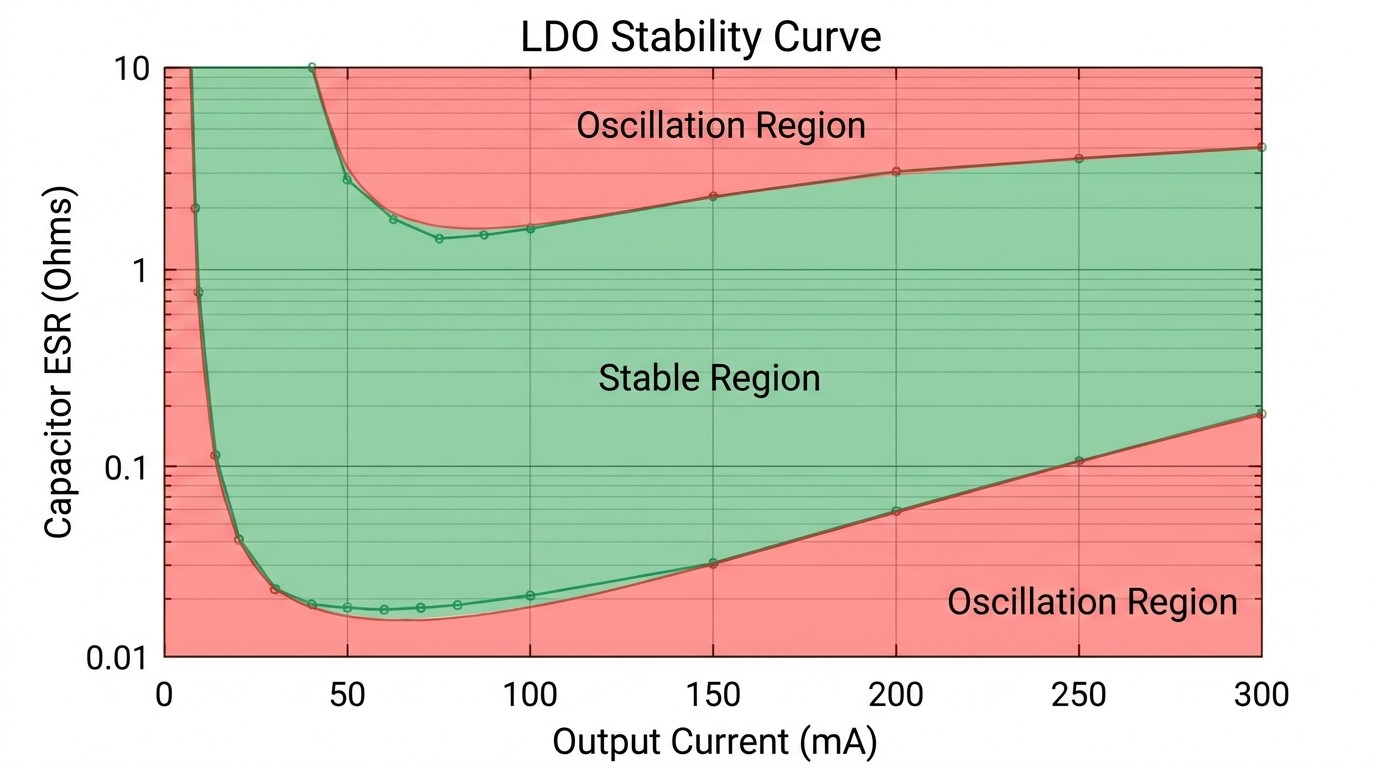
Legacy Bipolar LDOs: Parts like the ADP3334 require higher ground currents (e.g., 10 mA) and rely on the specific Equivalent Series Resistance (ESR) of tantalum capacitors (typically 0.1Ω to 2Ω) for control loop stability.
Modern CMOS LDOs: Parts like the ADP1715 draw microamps of ground current and are optimized for ultra-low ESR (milliohm) multilayer ceramic capacitors (MLCCs).
Upgrading a legacy bipolar LDO to a modern CMOS equivalent without updating the output capacitor chemistry from tantalum to ceramic can cause severe voltage oscillation. Always verify the "ESR vs. Output Current" stability tunnel/curve in the specific manufacturer's datasheet.
Trap 3: Enable (EN) Pin Logic & The "Extra Pin"
Never assume the pinout for standard packages is universally standardized. For example, in the common SOT-23-5 package:
The Microchip MIC5205 uses Pin 4 for a noise-reduction Bypass capacitor.
The RS3002 designates Pin 4 as a "No Connect" (NC).
The TPS709A uniquely places Vout on Pin 1 instead of the standard Pin 5.
Blindly swapping SOT-23-5 parts can inadvertently short a bypass capacitor or route power to a dead pin. Furthermore, if the LDO has an Enable (EN) pin, verify whether it uses Active High or Active Low logic, and whether it features an internal pull-up or pull-down resistor. Leaving an EN pin floating on a replacement that lacks an internal pull-up will result in an LDO that never turns on.
Thermal Headroom: Will the New LDO Overheat in the Same Footprint?
A mechanical fit does not guarantee thermal survival. You must calculate the junction temperature (Tj) and power dissipation (Pdiss) when substituting an LDO into the exact same PCB footprint.
The core formula for linear regulator power dissipation is:
Pd = (Vin - Vout) * Iload
Once you know the power dissipated as heat, you must check the package's thermal resistance (thermal resistance, θJA), which dictates how many degrees the internal silicon will rise per watt of heat.
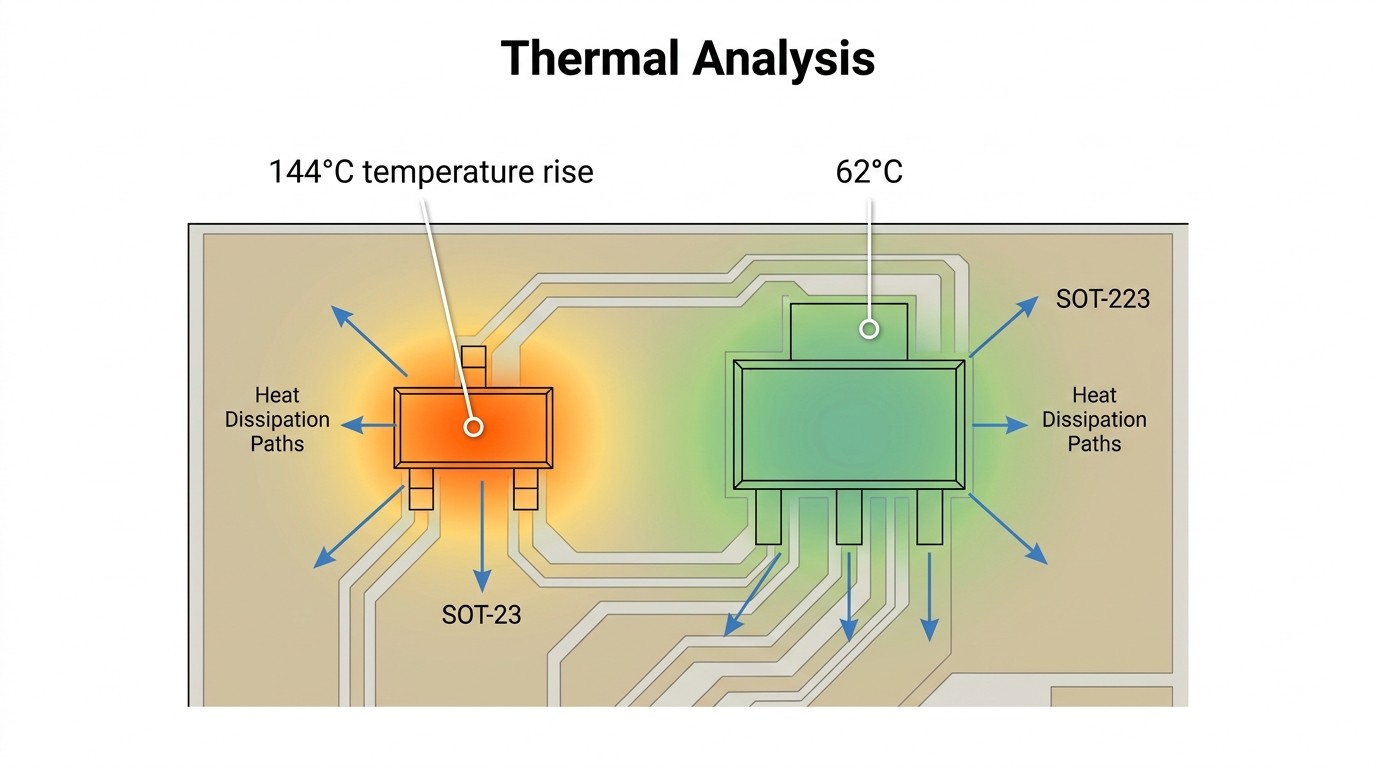
For example, the thermal resistance (θJA) of a standard SOT-23 package is typically around 205.9°C/W. If your circuit drops 12V to 5V at 100mA, the LDO dissipates 0.7W.
0.7W * 205.9°C/W = 144.1°C temperature rise.
If the ambient temperature is 25°C, the internal junction hits ~169°C, instantly triggering thermal shutdown in most ICs. By contrast, a larger SOT-223 package has a θJA of roughly 53.1°C/W, keeping the junction at a safe ~62°C under the exact same electrical conditions.
The Exposed Pad Trap: Two DFN packages can look identical from the top, but one might lack the exposed thermal pad on the bottom. Substituting a part without a thermal pad into a high-dissipation circuit will lead to severe thermal throttling.
Verification Note: Real-world thermal resistance (θJA) depends significantly on your PCB layout, via stitching, and copper plane size, not just the IC package specs.
LDO vs. Switching Regulator: When to Upgrade
Sometimes the best LDO replacement isn't an LDO at all. When replacing legacy linear regulators that drop large voltages at high currents, a drop-in switching regulator is often the superior choice.
For example, a legacy TO-220 7805 linear regulator dropping a 12V input to a 5V output operates at roughly 41.6% efficiency and must dissipate 7 Watts of pure heat at a 1A load—requiring a massive aluminum heatsink. Modern drop-in switching regulator replacements (based on ICs like the LM3485 or TPS62150) achieve 90%+ efficiency under the same conditions, eliminating the need for a heatsink entirely.
Comparison: Linear LDO vs. Drop-in Switcher
| Feature | Linear LDO | Drop-in Switching Regulator |
|---|---|---|
| Efficiency | Low (depends on Vin/Vout ratio) | High (typically 85% - 95%) |
| Heat Dissipation | High (often requires heatsinks) | Very Low |
| Output Ripple/Noise | Ultra-low (excellent for analog) | Higher (contains switching frequencies) |
| External Components | Minimal (just input/output caps) | Built-in to the drop-in module |
| Cost | Very Low | Moderate to High |
Who should NOT upgrade to a switcher: Switching regulators introduce high-frequency noise and voltage ripple. If you are repairing noise-sensitive applications—such as RF circuits, high-end audio amplifiers, or precision analog-to-digital converters (ADCs)—you must stick with a linear LDO to maintain signal integrity.
Frequently Asked Questions (FAQ)
Why does my replacement LDO oscillate?
Oscillation is almost always caused by an ESR mismatch. Legacy bipolar LDOs require the higher ESR of tantalum capacitors to stabilize their control loops. If you replace a legacy LDO with a modern CMOS LDO (or vice versa) without changing the output capacitor to match the new datasheet's ESR requirements, the regulator will become unstable.
Do all LDOs need a minimum load current?
No. Modern CMOS LDOs typically do not require a minimum load current to maintain regulation. However, legacy bipolar LDOs often do. If you are using an older architecture, check the datasheet; failing to provide the minimum load can cause the output voltage to drift upward.
Can I leave the Enable (EN) pin floating?
It is highly discouraged. While some LDOs have internal pull-up or pull-down resistors that set a default state, many do not. A floating EN pin can pick up ambient electrical noise, causing the regulator to rapidly toggle on and off. Always tie the EN pin to Vin (or Ground, depending on logic) via a resistor if it is not being actively driven by a microcontroller.
How do I calculate the power dissipation of an LDO?
You can calculate power dissipation using the formula: Pd = (Vin - Vout) × Iload. Multiply this value by the thermal resistance (θJA) of your package to estimate the temperature rise over ambient.
What is dropout voltage, and why does it matter?
Dropout voltage is the minimum voltage difference required between the input and output pins for the LDO to maintain its target output voltage. If the input falls below this threshold (Vout + Vdropout), the regulator drops out of regulation and output voltage drops.
Step-by-Step LDO Replacement Checklist
Use this actionable checklist to validate your next BOM update or board repair:
Verify Mechanical Fit: Confirm the package type (e.g., SOT-23-5) and ensure the pinout matches exactly, paying special attention to "No Connect" (NC) or Bypass pins.
Check Absolute Maximums: Ensure the new LDO's maximum Vin rating exceeds your circuit's highest possible voltage transient.
Match Core Specs: Validate that Vout, continuous Iout, and peak Iout meet the circuit's demands.
Verify Dropout Voltage: Ensure the new Vdropout is equal to or lower than the original part.
Check ESR Requirements: Read the new datasheet's stability curve. Confirm your existing PCB output capacitor (ceramic vs. tantalum) falls within the safe ESR range.
Validate EN Logic: Confirm whether the Enable pin is Active High or Active Low, and check for internal pull-ups.
Calculate Thermal Headroom: Use
Pd = (Vin - Vout) * Iloadand the package's θJA to ensure the junction temperature remains safely below the absolute maximum rating.
References
How to Successfully Apply Low-Dropout Regulators — Analog Devices
Linear & low-dropout (LDO) regulators — Texas Instruments
Designing With Low-Dropout Voltage Regulators — Microchip
AN-1010 Low Dropout (LDO) regulator index and feature — Taiwan Semiconductor
 UTMEL
UTMEL
We are the professional distributor of electronic components, providing a large variety of products to save you a lot of time, effort, and cost with our efficient self-customized service. careful order preparation fast delivery service
 Modeling Wide Band-Gap Semiconductors for Enhanced PerformanceRakesh Kumar, Ph.D.31 January 20243520
The article delves into the challenges faced by silicon-based power electronic devices and highlights the potential of wide band-gap semiconductors. It also emphasizes the importance of modeling power semiconductor devices and provides insights into various models. For electrical energy conversion to be dependable and effective, power electronics and semiconductor device technologies are essential.
Read More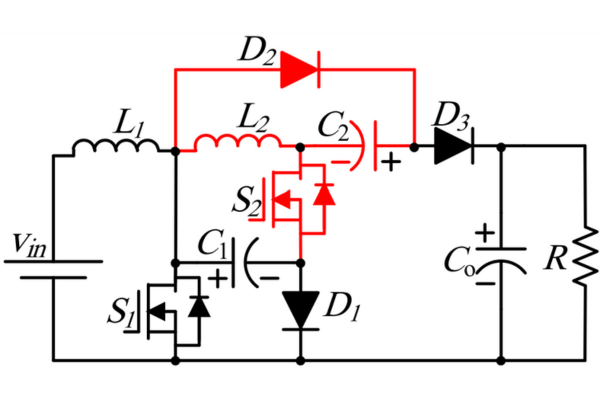 Optimizing Energy Management with Non-Isolated DC-DC ConvertersRakesh Kumar, Ph.D.04 February 20243162
The article classifies DC-DC converters and discusses the benefits and limitations of them. It proposes a modified DC-DC converter topology that combines the Cuk and Positive Output Super Lift Luo topologies to achieve a higher voltage gain with fewer components.
Read More ‘6G Networks’ - Pioneering the Next Era of Connectivity And InnovationRakesh Kumar, Ph.D.18 March 20243509
The article provides a comprehensive overview of the evolving landscape of mobile networks, the requirements that will shape the future of mobile communication, and the innovative technologies driving the transition to 6G.
Read More Review of IoT-Based Smart Home Security Systems- Part 1Rakesh Kumar, Ph.D.28 March 20243911
The article discusses the evolution of IoT-based smart home security systems, integrating advanced technologies like Raspberry Pi, PIR sensors, and voice recognition for enhanced user experience and efficiency.
Read More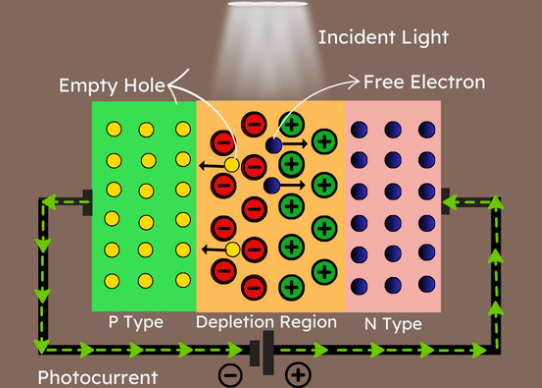 Understanding Photodiodes: Working Principles and Applications - Part 2Rakesh Kumar, Ph.D.24 May 20244964
The article provides a comprehensive overview of photodiodes, focusing on their operational principles, key factors affecting their efficiency, advantages, and disadvantages, and highlights their diverse applications.
Read More
Subscribe to Utmel !
![ND18X3N21]() ND18X3N21
ND18X3N21KEMET
![CSGA-A]() CSGA-A
CSGA-ATE Connectivity
![CG-ZS B61167]()
![YAE12Z3]() YAE12Z3
YAE12Z3Amphenol
![RT8]() RT8
RT8Phoenix Contact
![667353000]() 667353000
667353000Molex
![60329421110720]() 60329421110720
60329421110720Wurth Electronics
![60339021210820]() 60339021210820
60339021210820Wurth Electronics
![60349021210720]() 60349021210720
60349021210720Wurth Electronics
![60339021210720]() 60339021210720
60339021210720Wurth Electronics