Product
 Brand
Brand Articles
 Tools
Tools
Smart Sensors: Definition, Structures and Applications

Ultimate Guide to Smart Home Sensors + ideas
Ⅰ. The structure and characteristics of a smart sensor
Sensors are crucial tools for gathering information, just as human face features. It is crucial to the development of science and technology, national security, and industrial productivity. However, the development speed of sensors as "facial features" lags considerably behind that of computers as "brains" due to their faster development.
Sensors must have high precision, high reliability, strong stability, specific data processing capabilities, as well as self-inspection, self-calibration, and self-compensation as measurement and control systems become more automated and intelligent. Such demands can no longer be met by conventional sensors.
Additionally, it is challenging to enhance the material process alone in order to make high-performance sensors. To make up for its shortcomings, sensor technology must be combined with computer technology. The combination of microprocessors (or microcomputers) and sensors to create powerful smart sensors has significantly changed sensor technology . dubbed Intelligentsensor (smart sensor) or Smartsensor in other countries (smart, alert, intelligent sensor). Additionally, conventional sensors often only measure one parameter, and occasionally a tiny multi-function sensor is needed to monitor several parameters simultaneously. Scientists from several nations have recently focused on this area of research and have created some multipurpose sensors.
01 Smart sensor
In today's international scientific and technological communities, smart sensors are a hot study area, but there is no agreed-upon description. The distinction between the two words (Intelligentsensor or Smartsensor), which are referred to collectively as smart sensors, is not covered in this article.
Currently, researchers both domestically and internationally tend to agree that conventional sensors and microprocessors make up intelligent sensors (or microcomputers). To maximize the data collection, the device's internal behavior is changed. The smart sensor has the following capabilities:
(1) Self-compensation ability:
The software automatically compensates the sensor nonlinearity, temperature drift, time drift, response time, etc.
(2) Self-calibration function
After the operator inputs a zero value or a certain standard value, the self-calibration software can automatically calibrate the sensor online.
(3) Self-diagnosis function
After the power is turned on, the sensor can be self-tested to check whether each part of the sensor is normal, and can diagnose faulty components.
(4) Numerical processing function
According to the program inside the smart sensor, the data can be automatically processed, such as statistical processing, outlier elimination, etc.
(5) Bidirectional communication function
The microprocessor and the fundamental sensor create a closed loop. In addition to receiving and processing the sensor's data, the microprocessor also sends information back to the sensor so it can modify and regulate the measurement process.
(6) Information storage and memory function
(7) Digital output function
output a digital signal that is simple to connect to a computer or bus.
Currently available smart sensors only do some of the aforementioned features. While smart sensors incorporate data processing, data display, and measurement signal conditioning (such as filtering, amplification, and A/D conversion), traditional sensors can only be employed as sensitive components to detect changes in physical quantities. It contains practically all of the instrumentation's features. It is clear that the capabilities of smart sensors have been expanded to include instrumentation.
Early smart sensors processed and transformed their output signals before sending them over an interface to the CPU for processing.In order to give the sensor some artificial intelligence in the 1980s, the intelligent sensor primarily used the microprocessor as its central processing unit and combined the interface circuit, the microelectronic computer memory, and the sensor signal conditioning circuit onto a single chip. The sensor can now achieve miniaturization, structural integration, array type, digital type, ease of use, simplicity of operation, self-diagnosis function, memory and information processing function, data storage function, multi-parameter measurement function, network communication function, and logical thinking and judgment function thanks to further advancements in intelligent measurement technology made in the 1990s.
Smart sensors can be broadly categorized into three types: judgment-based sensors, learning-based sensors, and creative-based sensors.
02 The structure of a smart sensor
Sensors, microprocessors (or microcomputers), and accompanying circuitry make up the majority of smart sensors.
The sensor transforms the physical quantity being measured into a corresponding electrical signal, which is then sent to the signal conditioning circuit to be amplified, filtered, and converted from analog to digital before being sent to the microcomputer. The brain of the smart sensor is the computer. It has the ability to not only compute, store, and process the sensor's measurement data, but also to change the sensor via a feedback loop. Due to the computer's ability to fully utilize the functionalities of diverse software, it can execute jobs that are challenging for hardware, significantly reducing the complexity of sensor manufacture, enhancing sensor performance, and decreasing sensor cost.
According to the structure, the smart sensor's structure can be integrated, separate, or fall into one of three categories: integrated, hybrid, or modular. An integrated intelligent sensor is a compact, highly integrated silicon chip that combines one or more sensitive devices, a microprocessor, and a signal processing circuit. At the present state of the art, it is challenging to create such an integrated sensor. To create a hybrid smart sensor, the sensor, microcontroller, and signal processing circuit are arranged on separate chips (HybridSmart2Sensor).
These constructions are numerous. Numerous separate modules may potentially make up the main smart sensor.For instance, if the sensor, output circuit module, display circuit module, signal conditioning circuit module, and microcomputer are all combined in the same case, the group is taller and the volume is bigger, but currently It remains a useful structural form on a technical level.
Ⅱ. Wide range of application fields of smart sensors
01 Application in smart agriculture
The majority of agricultural projects are carried out in the field due to the unique nature of the environment, making correction operations very inconvenient and labor costs extremely high. As a result, there are very strict requirements for the stability of sensor data, and the smart sensor is the most efficient sensor.
02 Application in Industrial Automation
Various sensors are employed in modern industrial production, particularly in the automated production process, to monitor and manage various production process parameters so that the machinery can operate in a normal or optimal state and the products may attain the highest quality. One could argue that industrial automation is impossible without good smart sensors.
03 Application in Robot
Robots of today now possess limbs and sensory abilities that are similar to those of humans, as well as some level of intellect and adaptable action plans. They are capable of operating without human intervention. The role of sensors in all of this is evident. Robots need sensors to perceive their surroundings. helper.
04 Application in smart medical
Medical smart sensors are becoming more and more important as facial features for gathering vital sign data due to the advancement of smart sensors. For instance, the role of smart sensors is indispensable in image processing, clinical chemical testing, monitoring and monitoring of vital sign parameters, diagnosis and treatment of respiratory, neurological, and cardiovascular diseases, and it will be practically ubiquitous in future medical equipment.
05 Application in smart home appliances
Future households will be heavily influenced by the smart home trend, and smart home appliances will become standard items for many households. Future home products like TV dramas, fans, air conditioners, washing machines, laundry dryers, refrigerators, wardrobes, etc. could all use smart sensors. It serves as the fundamental tool for establishing communication between individuals and home equipment and serves as the cornerstone of the domestic Internet of Things.
Ⅲ. Three shortcomings of the development of Chinese smart sensor industry
01 The key technology has not yet broken through
It is exceedingly challenging to overcome the many disciplines, theories, materials, and process knowledge that go into sensor design technology. Due to a talent shortage, expensive research and development expenses, and intense enterprise competition, my country has not yet made significant advancements in some common critical sensor technologies.
02 Insufficient capacity for industrialization
Because Chinese companies lack advanced technical capabilities and the formation of industry norms has not yet taken place, domestic sensor products are not matched and do not form a series, repeated manufacturing, ruthless rivalry, and industrialisation result from this. It can only rely on imports for a considerable amount of time because the degree is not proportionate to the variety and series.
03 Resources are not concentrated
More than 1,600 sensor businesses exist in my nation at the moment, but the majority of them are small and micro businesses with low profitability and a lack of technology-driven leading businesses, which eventually results in the realization of capital, technology, enterprise design, industrial structure, market, and other aspects. Resources cannot be efficiently concentrated under a decentralized state, and industrial progress has taken a long time to advance.
04 Lack of high-end talents
The money, technology, and industrial base are relatively shaky because the sensor sector is still in its early stages of development. It also involves numerous disciplines, necessitates a broad variety of knowledge, and sees the constant emergence of new technologies, making it challenging to recruit top personnel. The lack of talent in the sector is also a result of my nation's ineffective and inappropriate talent training system.
Ⅳ. Development and Trend of Intelligent Sensor Technology
01 Towards high precision
The need for sensors is growing along with the advancement of automated production. To guarantee the dependability of industrial automation , new sensors with high sensitivity, high precision, quick reaction, and good interchangeability must be created.
02 Towards high reliability and wide temperature range
The anti-interference and other performance characteristics of electronic equipment are directly influenced by the sensor's dependability. The development of highly reliable sensors with a broad temperature range will remain a priority. It will be promising to create sensors using novel materials, such ceramics.
03 Towards miniaturization
The capabilities of various control instruments are increasing, and the smaller the sensor itself is, the better. This is because each component's volume requirements are decreasing. The creation of novel materials and processing techniques is necessary for this. The number of sensors built of silicon materials is still quite minimal. In contrast to silicon accelerometers built of various micro-processing technologies, such as lasers, which are very small in size and consistently interchangeable, traditional accelerometers are typically made of gravity blocks and springs, which are huge in size, unstable, and short-lived. Sex is superior.
04 Towards micro power consumption and passive development
Sensors often convert non-electricity to electricity, and thus cannot function without a power source. They frequently use batteries or solar power when operating in remote locations in the field. The development of passive sensors and sensors with micro-power consumption is inevitable. development strategy that can increase system longevity and save energy The development of chips with low power loss is currently accelerating. An example of this is the T12702 operational amplifier, whose operating voltage is only 2.5 V and whose static power consumption is under 1.5 A.
05 Towards intelligent digital development
With the advancement of modernisation, the sensor's function has surpassed its conventional purpose. Its output is now a digital signal processed by a microcomputer, some of which even have control functions, rather of a single analog signal (such as 0–10mV). It is referred to as a digital sensor.
06 To network development
Networking is a key area for sensor development, and its benefits and significance are increasingly becoming more clear. Network sensors will unquestionably advance electrical technologies.
One of the key technologies in the growth of the Internet of Things is smart sensors. They not only provide existing industries new life, but they also set the sensor industry trend. They are essential to many industries, including those in agricultural, marine, aerospace, and industrial. A new generation of smart sensors will emerge as a result of advancements in artificial neural networks, artificial intelligence, and other technologies. These sensors have a very bright future in terms of advancement.
 UTMEL
UTMEL
We are the professional distributor of electronic components, providing a large variety of products to save you a lot of time, effort, and cost with our efficient self-customized service. careful order preparation fast delivery service
1. What is a smart sensor?
Smart sensors are sensors with information processing functions. The intelligent sensor has a microprocessor, which has the ability to collect, process and exchange information. It is the product of the combination of sensor integration and microprocessor.
2. What is the output of the smart sensor?
Most of the commonly used sensor outputs are analog, with voltage or current, and special ones with charge, ICP-type sensors are AC and DC coupled signals.
3. What is the difference between smart sensors and ordinary sensors?
The intelligent sensor contains a conversion circuit, which directly outputs digital signals, which is convenient for processing and transmission. Ordinary sensors only carry analog signals.
 The Key Role of Electronic Components in IoT DevicesUTMEL01 September 20236233
The article discusses the pivotal role of electronic components in Internet of Things (IoT) devices. IoT devices work by capturing real-world data using sensors, processing it through a microcontroller, and then sending it to the cloud for further analysis.
Read More Accelerometer Sensors Guide: Working Principle, Circuit Design, Specifications, and ApplicationsUTMEL25 June 20261028
A practical accelerometer sensor guide covering working principles, MEMS and piezoelectric types, datasheet specifications, circuit design, mounting, applications, and selection.
Read More 2026 ADAS Sensors: Supply Outlook and Alternative SourcingUTMEL18 July 20261165
Automotive cleanroom assembly integrating advanced driver assistance systems. The automotive industry faces a structural semiconductor deficit in 2026, driven not by pandemic-era demand shocks but by AI data centers absorbing global foundry capacity on legacy nodes (40nm-90nm) where 95% of automotive-grade components are manufactured. Video demonstrations of these systems show a "machine view" overlay with red crosshairs tracking pedestrian movement and sudden cut-ins before traditional collision thresholds are triggered.
Read More Magnetic Sensors for Position Detection: Hall Effect vs. AMR vs. TMR Engineering GuideUTMEL21 August 2026575
This guide compares Hall effect, AMR, and TMR magnetic sensors for position detection in motor control and robotics. It explains their physical principles, key performance metrics, and selection criteria. Hall effect suits low-cost commutation, AMR offers high-speed angle sensing, and TMR provides maximum precision and low power, with practical integration advice.
Read More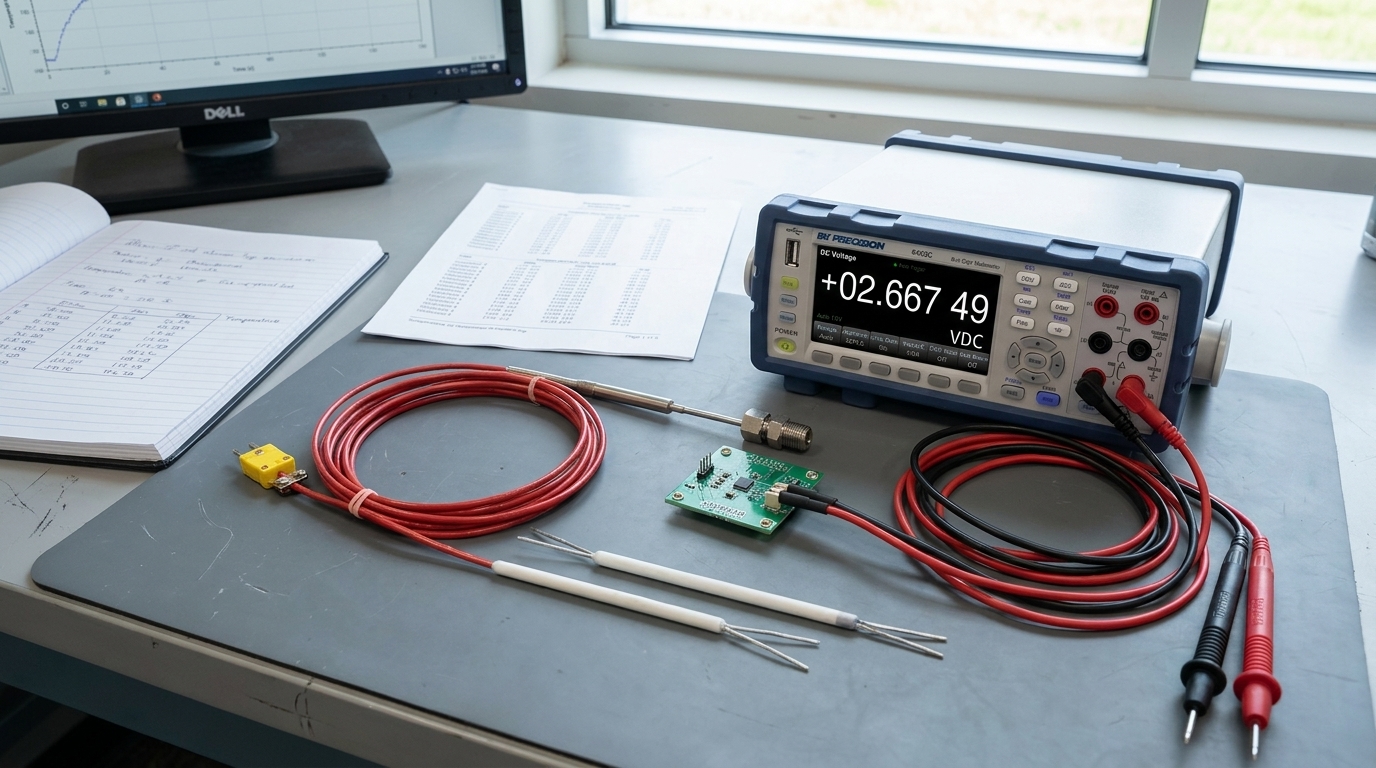 Temperature Sensor Types Comparison: Thermocouple, RTD, and Semiconductor IC Selection GuideUTMEL17 August 2026493
This comprehensive selection guide compares thermocouples, platinum RTDs, and semiconductor ICs across measurement range, accuracy limits, and signal conditioning complexity. It covers fundamental operating physics, mathematical transfer functions, lead-wire compensation topologies, and power budgets. Engineers will find practical design checklists, benchtop multimeter diagnostic techniques, and an architectural decision workflow to optimize system performance and bill-of-materials cost.
Read More
Subscribe to Utmel !