

 Product
 Brand
Brand Articles
 Tools
Tools
Edge AI and Embodied AI: Why Intelligence Is Moving Into Devices and Robots
Quick answer
Edge AI is about where AI computation happens. It runs models on local hardware such as sensors, smartphones, cameras, industrial controllers, smart home devices, vehicles, and robots instead of sending every request to the cloud. Embodied AI is about what the AI is connected to: a body, machine, vehicle, robot, or physical environment that can perceive, reason, and act.
The two concepts are different, but they are becoming inseparable in practical systems. A smart camera can be edge AI without being embodied AI. A robot controlled mostly from the cloud can be embodied AI without being a strong edge AI system. But a useful humanoid robot, collaborative robot, autonomous mobile robot, drone, or smart appliance often needs both: local AI for low latency and embodied intelligence for physical interaction.
Why AI is moving from the cloud to the edge
The cloud remains essential for training large models, fleet learning, heavy simulation, centralized analytics, and model updates. But many real-world AI tasks are not comfortable with a round trip to a server. A home security camera, warehouse robot, smart thermostat, wearable health device, vehicle perception module, or industrial sensor may need to decide immediately, preserve user privacy, reduce bandwidth, and keep working when connectivity is weak.
Edge Impulse defines edge AI as running AI algorithms on devices at the edge of the internet or other networks, noting benefits such as reduced bandwidth, lower latency, and additional data privacy. IBM similarly frames edge AI around local processing, real-time analytics, privacy, resilience, and smart home and security use cases. The practical takeaway is simple: when the signal is local, time-sensitive, private, or expensive to transmit continuously, edge AI becomes attractive.
This is why low-power machine learning accelerators, neural processing units, sensor hubs, and AI-enabled microcontrollers are becoming more important. Qualcomm describes its AI Engine as a heterogeneous system combining NPU, GPU, CPU, and sensing hub blocks for on-device AI across phones, vehicles, XR, IoT, robotics, and other devices. NXP highlights edge AI processors and eIQ toolkits for smart thermostats, industrial robotics, intelligent vehicles, building automation, and surveillance. TI introduced microcontrollers with an integrated TinyEngine NPU in 2026, positioning them for edge AI in devices ranging from wearables and home electrical systems to physical AI and humanoid robots.
What embodied AI adds
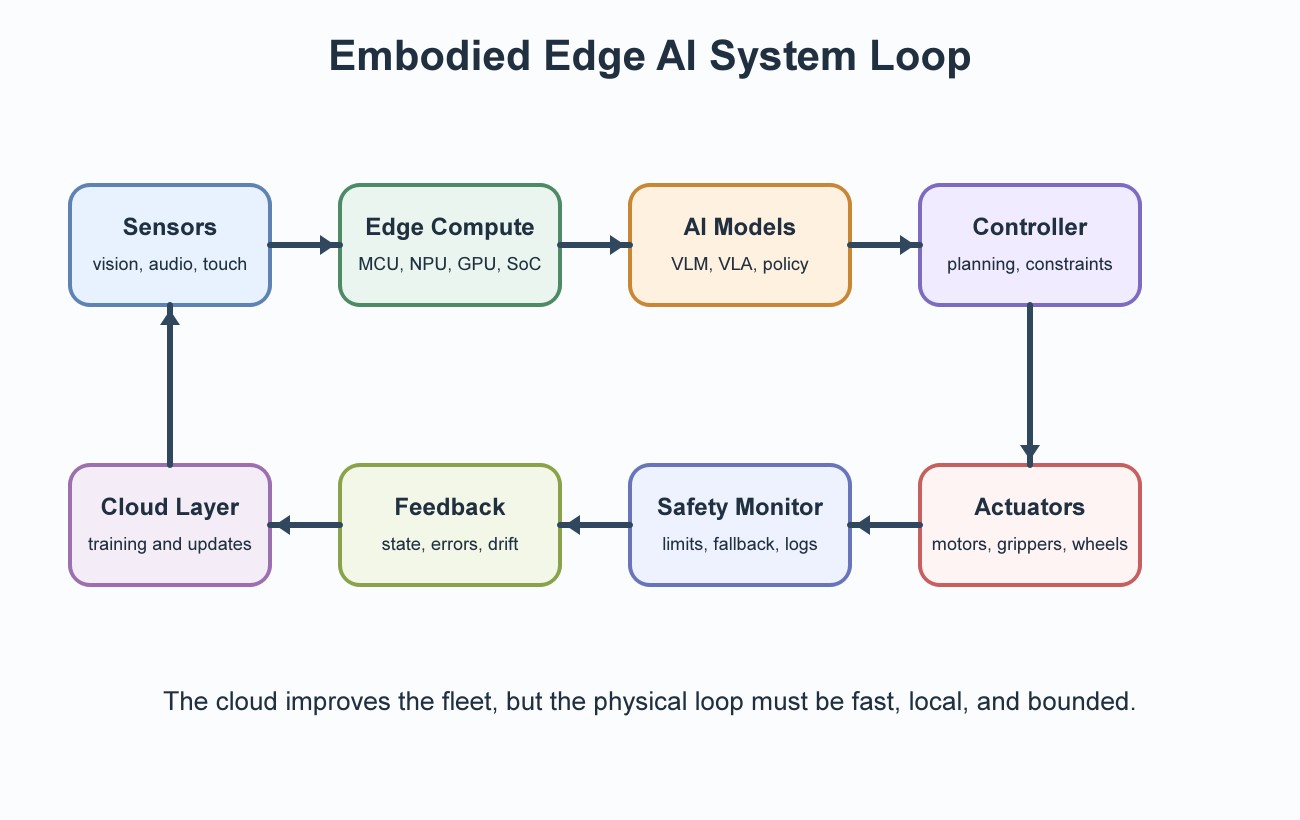
Embodied AI changes the question from "Can the model answer?" to "Can the system act safely and usefully in the world?" NVIDIA defines embodied AI as AI integrated into physical systems, including robots, autonomous vehicles, factories, and warehouses, where machine learning, sensors, and computer vision allow systems to perceive, reason, and act in real environments.
That physical loop makes embodied AI harder than ordinary software AI. The system must interpret noisy sensor data, understand spatial constraints, plan under uncertainty, control motors or actuators, avoid unsafe behavior, and learn from a world that does not pause while the model thinks. Simulation, synthetic data, reinforcement learning, imitation learning, and real robot data all matter because physical mistakes can damage property, interrupt production, or injure people.
Research activity is moving quickly. Ai2 describes a simulation-first stack for embodied research that connects indoor scenes, object assets, and physics-grounded grasp annotations to robot manipulation workflows. Surveys of vision-language-action models explain how VLA systems connect language, visual understanding, and action generation for embodied tasks. Newer research on world action models goes one step further by combining predictive world modeling with action generation, so a robot can reason not only about the next command but also about possible future states.
The useful distinction: where, body, loop
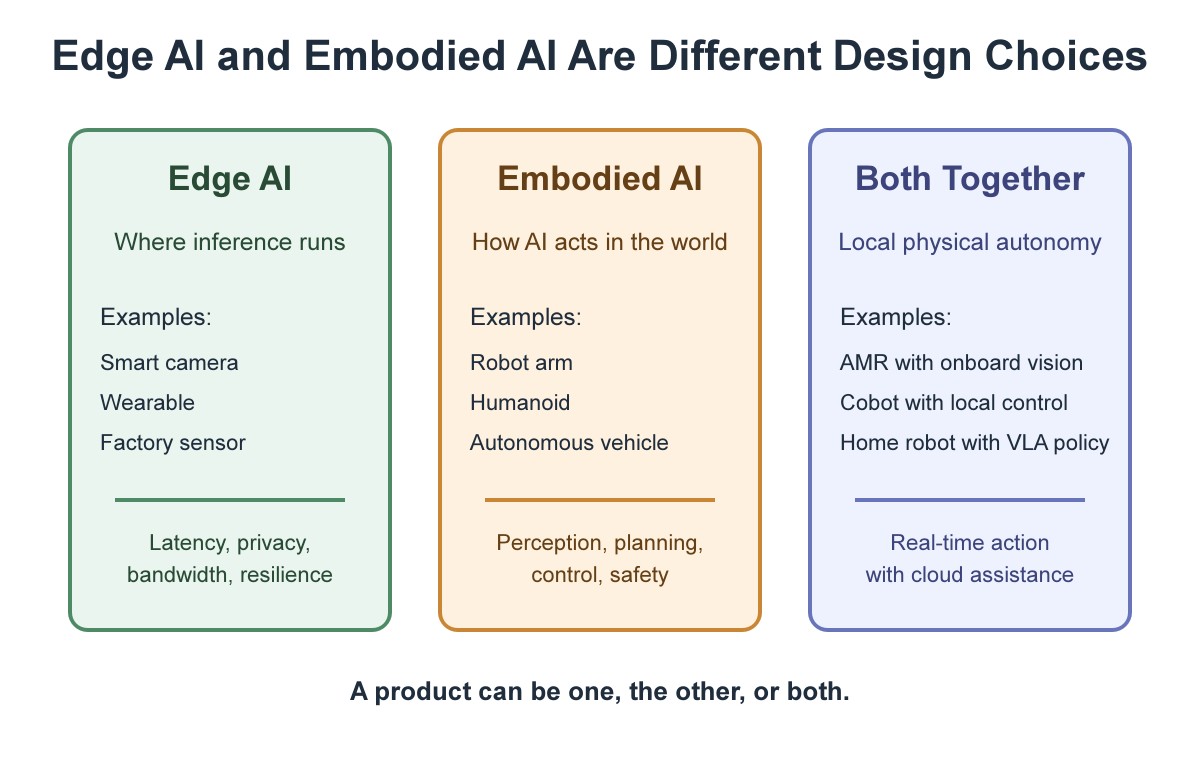
Many articles describe Edge AI and Embodied AI as if one is simply a subset of the other. That is not quite right. They answer different design questions.
| Concept | Main question | Typical hardware | Primary value | Common risk |
|---|---|---|---|---|
| Edge AI | Where does inference happen? | MCUs, NPUs, GPUs, cameras, gateways, phones, sensors, robots | Low latency, privacy, lower bandwidth, offline resilience | Power, memory, thermal, model update, hardware limits |
| Embodied AI | Can the AI perceive and act through a body? | Robots, drones, vehicles, manipulators, smart machines, sensor-actuator systems | Physical autonomy, manipulation, mobility, real-world interaction | Safety, control, sim-to-real gap, uncertain environments |
| Embodied Edge AI | Can the physical agent think locally enough to act safely? | Robots and machines with onboard AI compute, sensors, controls, and connectivity | Real-time autonomy with reduced cloud dependence | System integration, verification, fleet management, cost, power budget |
Why embodied AI increases demand for dedicated edge AI chips
Embodied systems put pressure on compute in a way ordinary digital AI often does not. A chatbot can wait a few seconds. A robot arm moving near a human worker cannot. A smart door lock, home robot, or autonomous cart may also need always-on sensing without draining the battery or overheating the enclosure.
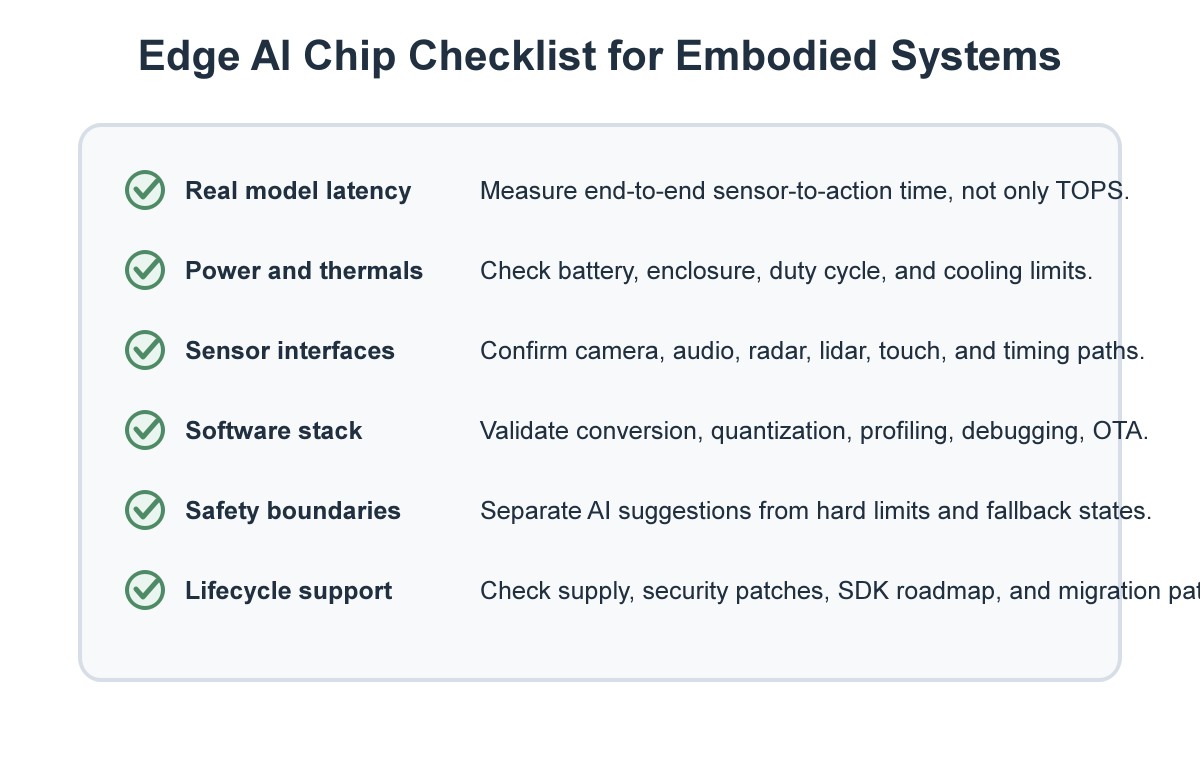
That demand does not mean every product needs the largest TOPS number available. For edge and embodied products, raw AI throughput is only one part of the decision. Engineers also need to evaluate memory bandwidth, model compatibility, sensor interfaces, deterministic latency, power consumption, thermal design, safety partitioning, toolchain maturity, security, over-the-air update strategy, and unit economics.
Arm's Ethos-U85 illustrates the direction of travel: support for transformer-based models at the edge, scalable MAC configurations, and improved energy efficiency for higher performance edge AI use cases. Qualcomm emphasizes heterogeneous on-device AI, including sensing hubs for always-on sensor processing. NXP points to heterogeneous acceleration across MCUs and application processors. TI is pushing NPU acceleration into microcontrollers. Together, these examples show a broader hardware trend: AI acceleration is moving down the power stack, from data centers and large GPUs toward embedded devices, sensor-rich endpoints, and robots.
Where LAM, VLA, and world models fit
The phrase large action model is often used in industry discussions to describe models that translate goals, instructions, perception, and context into action. It is useful as a direction, but it is not yet as standardized as terms like LLM or VLM. In robotics research, the more precise terms currently include vision-language-action models and world action models.
VLA models aim to connect visual observations and language instructions to robot actions. World action models, an emerging research framing, add predictive modeling of how the physical world may evolve under intervention. This matters for embodied AI because physical action is not just classification. A robot needs to predict whether grasping, pushing, turning, walking, or handing over an object will produce the desired result.
For chip and module buyers, the implication is practical: embodied AI workloads will not be limited to simple image classification. Future edge platforms may need to support multimodal perception, small language models, VLMs, action policies, sensor fusion, world-model-assisted planning, and safety monitors. Some of those tasks will run locally. Others will remain cloud-assisted. The winning architecture will usually be hybrid, not purely edge or purely cloud.
Consumer electronics and smart home: the quiet proving ground
Consumer electronics and smart home products are an important proving ground because they impose strict constraints: small enclosures, low power, privacy expectations, intermittent connectivity, and cost-sensitive bills of materials. Edge AI can let a doorbell identify events locally, a thermostat infer occupancy patterns, a wearable detect motion or health-related signals, an appliance adapt to usage, and a home camera reduce unnecessary video uploads.
These products also show why sensor integration matters. Useful local AI is not only about the model. It depends on microphones, cameras, radar, inertial sensors, time-of-flight sensors, touch sensors, environmental sensors, and the low-power processing path that keeps them active without waking the whole system. The more intelligence sits near the sensor, the more a device can filter noise, react quickly, and send only useful events upstream.
Robotics and industrial automation: where edge and embodiment converge
Robotics makes the convergence obvious. Morgan Stanley's 2026 analysis frames humanoids as moving from a long-term ambition toward early industrial deployment, while also warning that broad adoption remains years away. That balance is important. Embodied AI is advancing, but real deployments must still solve reliability, cost, safety certification, maintenance, and integration with existing workflows.
Collaborative robots, humanoids, autonomous mobile robots, drones, inspection machines, and smart factory systems need local perception and control because the physical environment is dynamic. A robot may use the cloud for fleet analytics, training updates, large-scale simulation, and long-term learning, but the near-real-time loop usually belongs on or near the machine. This is the strongest reason embodied AI increases demand for dedicated edge AI silicon and modules.
How to choose an edge AI platform for embodied AI
Choosing a platform should start with the physical task, not the benchmark score. A smart home sensor, robot vacuum, collaborative arm, humanoid torso, warehouse AMR, and autonomous drone have different latency, power, safety, mechanical, and sensing requirements.
Define the action loop. List what the system must sense, decide, and control within each time window.
Separate real-time and non-real-time AI. Keep safety-critical perception and control local; leave model updates, analytics, and heavy retraining to the cloud when appropriate.
Measure the model, not only the chip. Confirm operator support, quantization behavior, memory footprint, thermal headroom, and real input-output latency.
Plan for sensors early. Camera, audio, radar, lidar, touch, inertial, and environmental inputs may drive the hardware choice as much as the neural model does.
Design for updates and drift. Edge models need monitoring, version control, rollback, and security controls because real-world data changes.
Validate safety separately from intelligence. A powerful model is not a safety case. Embodied systems need constraints, monitors, fallback modes, and testing under abnormal conditions.
Common mistakes to avoid
Mistake 1: Treating Edge AI as just offline AI
Offline operation is one benefit, but edge AI is also about latency, bandwidth, privacy, resilience, and cost. Many systems will still use the cloud for training, orchestration, and updates.
Mistake 2: Treating Embodied AI as just robotics branding
Embodiment changes the engineering problem. It adds sensors, actuation, control, safety, physical uncertainty, and real-world feedback. A demo is not the same as a deployable product.
Mistake 3: Buying TOPS without checking the workload
TOPS can be useful, but it does not guarantee low latency for a specific model, sensor pipeline, memory pattern, or control loop. Test the deployed model on the intended hardware.
Mistake 4: Ignoring the software stack
Edge AI adoption often succeeds or fails on tooling: model conversion, quantization, profiling, debugging, OTA updates, security, and integration with robotics middleware or embedded software.
Mistake 5: Assuming every embodied system needs a giant model onboard
Some products need small specialized models, deterministic controllers, and cloud-assisted learning rather than a large local foundation model. The right architecture is usually workload-specific.
The likely direction: hybrid physical intelligence
The most realistic future is not cloud AI versus edge AI. It is hybrid physical intelligence. Cloud systems will train, simulate, coordinate, and improve models across fleets. Edge devices will handle the immediate perception and control loops. Embodied systems will turn those loops into useful physical behavior.
For electronics companies, module suppliers, robot makers, and smart device teams, this means the edge AI platform is becoming a strategic design choice. It affects product responsiveness, privacy posture, bill of materials, energy budget, safety architecture, and the pace at which new embodied AI features can be deployed.
The companies that treat edge AI only as a chip feature may miss the larger opportunity. The companies that treat embodied AI only as a robot demo may underestimate the hardware and software discipline required. The useful view is systems-level: sensors, local accelerators, models, controls, cloud learning, and safety mechanisms working together.
FAQ
Is Edge AI the same as Embedded AI?
No. The terms overlap, but they are not identical. Embedded AI usually emphasizes AI inside an embedded system such as an MCU-based device. Edge AI emphasizes local or near-local processing at the network edge. Many embedded AI systems are edge AI systems, but edge AI can also run on gateways, phones, PCs, cameras, vehicles, and robots.
Does Embodied AI always require Edge AI?
No. Some embodied systems can rely heavily on cloud compute, especially in controlled environments or research settings. But practical robots and autonomous machines often need local AI for latency, safety, privacy, and resilience.
Will humanoid robots drive edge AI chip demand?
They are likely to increase demand for specialized local compute, but humanoids are only one part of the story. Collaborative robots, AMRs, drones, vehicles, smart appliances, and industrial machines may represent broader near-term demand for edge AI hardware.
What should buyers verify before selecting an edge AI module?
Verify real model latency, supported operators, memory use, thermal behavior, power draw, sensor interfaces, software tooling, security support, update strategy, long-term availability, and whether the supplier can support the intended production volume.
Bottom line
Edge AI gives intelligence a local runtime. Embodied AI gives intelligence a body and a physical feedback loop. Together, they explain why AI hardware is moving closer to sensors, actuators, and end devices. The opportunity is large, but the winners will not be chosen by model size or TOPS alone. They will be chosen by how well the full system senses, thinks, acts, updates, and stays safe under real-world constraints.
Sources and references used for this guide
Edge Impulse, Introduction to edge AI
Source type: edge AI platform documentation.
Used for: definition of edge AI and benefits such as lower latency, reduced bandwidth, and privacy.
Caution: Educational documentation from a platform provider, so use for concepts rather than neutral vendor ranking.IBM Think, What Is Edge AI?
Source type: technology explainer from enterprise vendor.
Used for: edge AI components, benefits, smart home/security examples, and cloud-versus-edge framing.
Caution: Vendor perspective; market-size figures were not used as core claims.NVIDIA Glossary, What Is Embodied AI?
Source type: vendor glossary and technical explainer.
Used for: embodied AI definition, sense-reason-act framing, simulation, humanoid, AMR, AV, and physical AI context.
Caution: NVIDIA is a major supplier in this market; avoid using it for neutral ranking claims.Ai2, Embodied AI
Source type: research institution project page.
Used for: simulation-first embodied research and robot manipulation context.
Caution: Project-specific scope; not a market overview.A Survey on Vision-Language-Action Models for Embodied AI
Source type: research survey on arXiv.
Used for: VLA framing and the link between language, vision, and action generation.
Caution: arXiv preprint; use as research signal, not industry standardization.World Action Models: The Next Frontier in Embodied AI
Source type: research survey on arXiv.
Used for: emerging WAM framing and predictive world modeling for action generation.
Caution: recently submitted preprint; terminology is still evolving.Qualcomm AI Engine
Source type: vendor product and technology page.
Used for: heterogeneous on-device AI architecture, sensing hub, and device categories including IoT and robotics.
Caution: Vendor claims should be verified with product datasheets for a specific design.Arm Ethos-U85
Source type: semiconductor IP product page.
Used for: transformer support at the edge, scalable MAC range, and energy-efficiency direction in edge NPUs.
Caution: IP-level claims must be checked against actual SoC implementation.NXP, AI and Machine Learning MCUs and Processors
Source type: semiconductor vendor application page.
Used for: edge AI examples including smart thermostats, robotics, vehicles, building automation, and surveillance.
Caution: Vendor portfolio page; use for supported application categories, not independent comparison.Texas Instruments, MCUs with TinyEngine NPU
Source type: vendor news release.
Used for: example of NPU acceleration moving into microcontrollers and low-power edge devices.
Caution: Performance numbers are vendor claims and should be verified against datasheets and benchmarks.Morgan Stanley, Embodied AI and the Rise of Humanoid Robots
Source type: investment research article.
Used for: cautiously framed industry context on humanoid robots moving toward early deployment while broad adoption remains years away.
Caution: Investment perspective; do not treat as engineering validation.Edge AI Foundation
Source type: industry foundation website.
Used for: ecosystem context around edge AI education, collaboration, and the former tinyML Foundation.
Caution: Broad ecosystem source, not a technical specification.
 UTMEL
UTMEL
We are the professional distributor of electronic components, providing a large variety of products to save you a lot of time, effort, and cost with our efficient self-customized service. careful order preparation fast delivery service
 Improving the Energy Conversion Efficiency of Triboelectric NanogeneratorsSaumitra Jagdale19 November 20243222
There is a huge growth in demand for self-sustaining electronic devices, as the traditional power-generating devices fail in remote and harsh environments due to the periodic requirement of battery changes. Also, these devices are frequency specific; some work only in high frequency and some in low frequency. Triboelectric nanogenerators (TENGs) provide a promising solution by efficiently converting mechanical energy into electricity as they are versatile, compact, and cheap, making them a popular choice.
Read More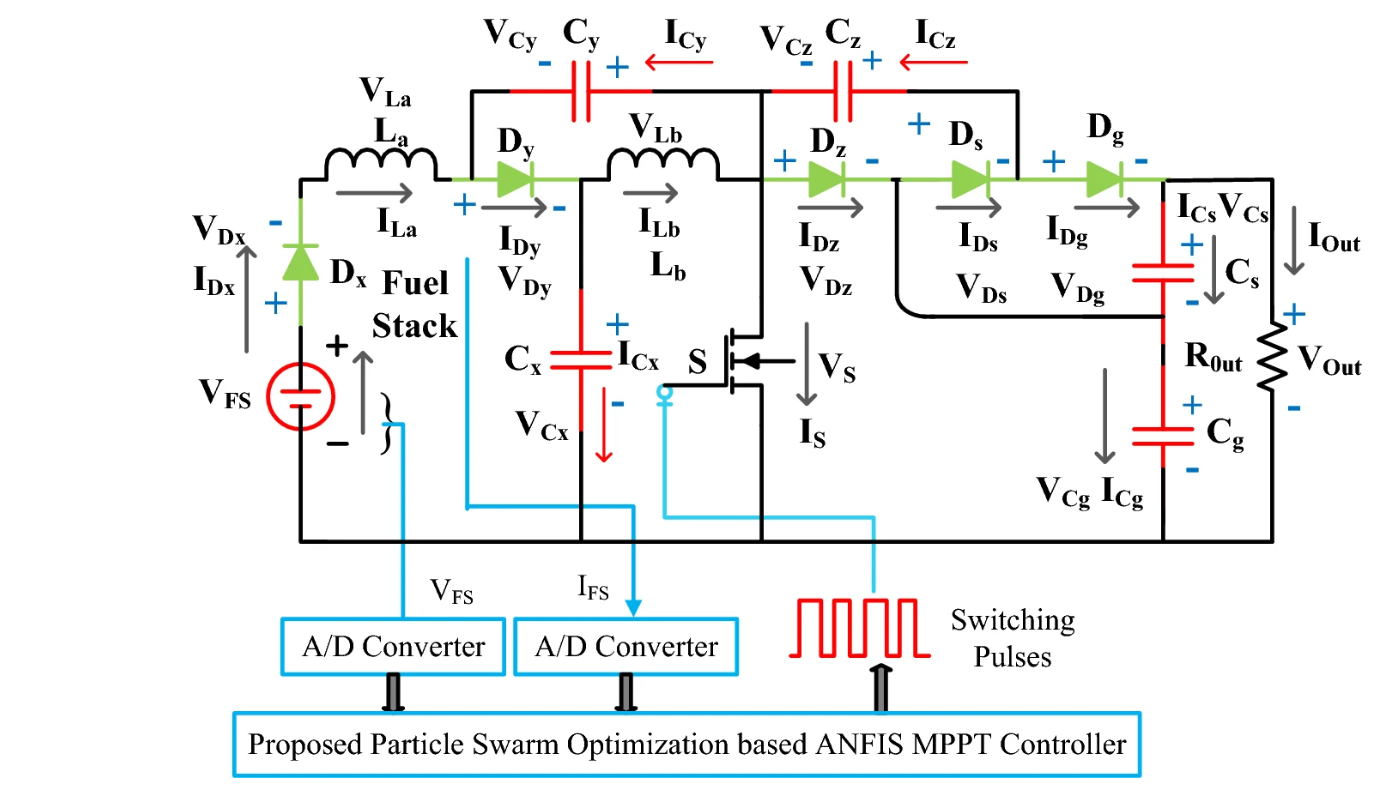 Methodologies for Increasing Efficiency of Fuel Stack Technology for Energy GenerationSaumitra Jagdale19 November 20243077
Presently, power companies are moving towards renewable energy systems. Conventional energy sources are more expensive because they require a vast network to be maintained and huge human resources. Also, they harm the environment by releasing several harmful gases. As the industry’s focus shifts toward renewable energy sources, energy systems powered by Proton Exchange Membrane Fuel Stacks (PEMFS) are gaining traction.
Read More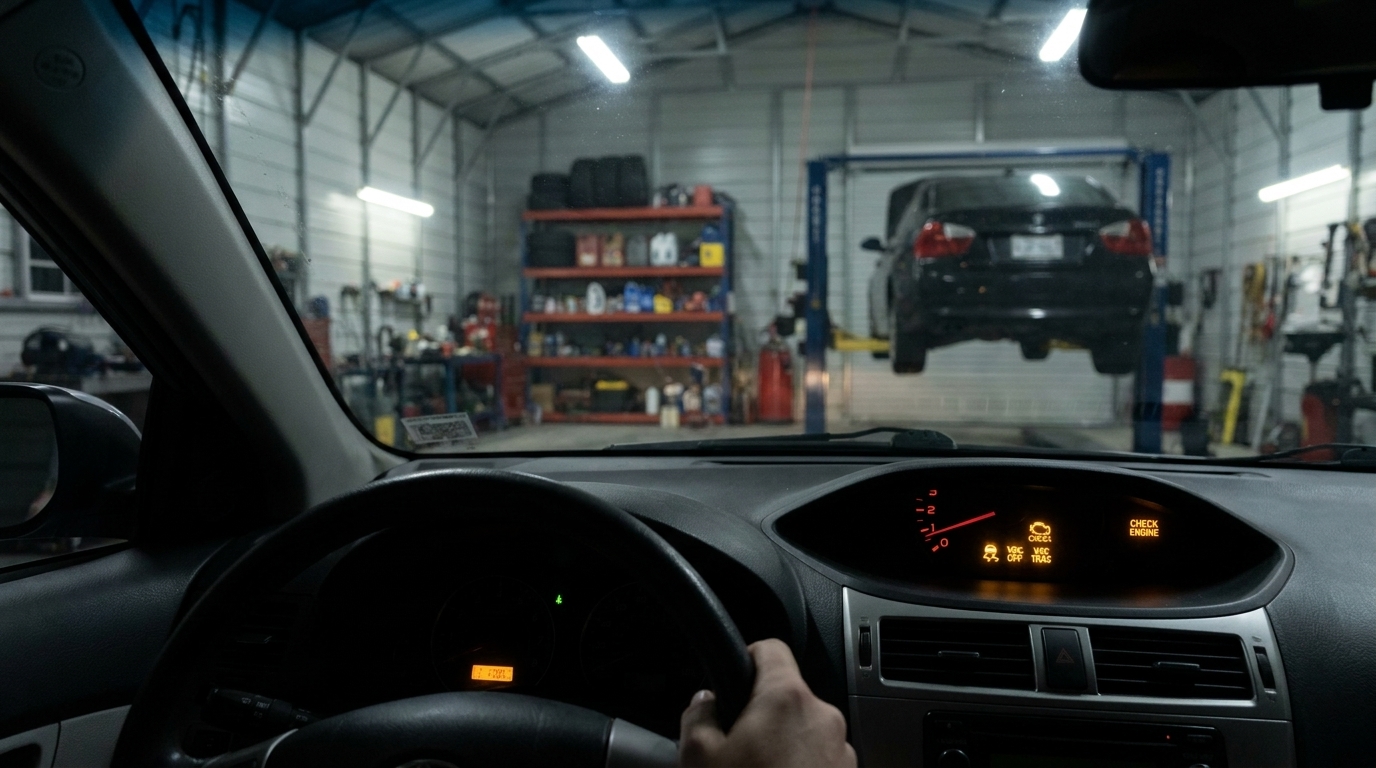 VSC Light Meaning, Causes, and Step-by-Step DiagnosticsUTMEL19 May 20262849
A VSC (Vehicle Stability Control) light indicates the system is disabled, often as a fail-safe triggered by unrelated engine faults like a loose gas cap. While the stability system prevents lateral skidding, it shuts down when sensor data is unreliable. Proper diagnosis requires an ABS-capable OBD2 scanner. Resolving the root engine code, checking wheel speed sensors, or performing a zero-point calibration usually restores system function.
Read More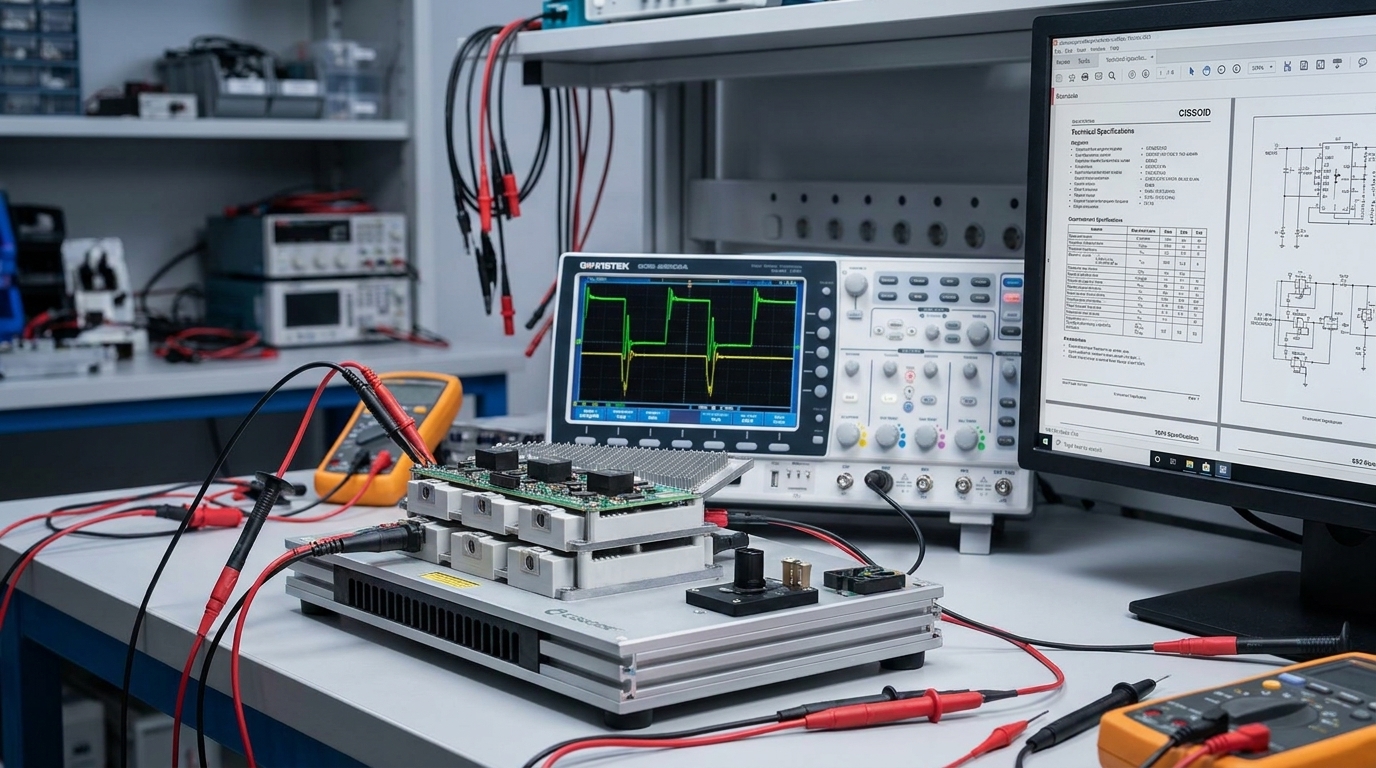 What JEDEC JEP203 and JEP204 Actually Change for SiC Qualification Engineers and Component BuyersUTMEL29 July 2026413
Summary: When JEDEC published JEP203 and JEP204 on June 3, 2026[1], most coverage treated them as an announcement. They are better understood as the first shared language the silicon carbide industry has had for two problems that have quietly consumed engineering hours since the first commercial SiC MOSFETs shipped: short-circuit evaluation that produces numbers you can compare across suppliers, and a consolidated reference of stress procedures so qualification engineers stop reinventing test plans from scratch. This article explains what changes on Monday morning and what to ask suppliers for now.
Read More 2nm vs 3nm Chips: What the Latest Process Nodes Mean for PerformanceUTMEL19 August 20261144
The shift from 3nm to 2nm process nodes marks a fundamental change in transistor architecture, moving from FinFET to Gate-All-Around (GAA) nanosheets. This transition delivers meaningful improvements in performance, power, and density, but also introduces new challenges like SRAM scaling limits, thermal density, and backside power delivery. The article compares TSMC, Samsung, and Intel approaches, offering a practical decision framework for engineering teams.
Read More
Subscribe to Utmel !
![1205448]() 1205448
1205448Phoenix Contact
![CD-2001-1-SET]() CD-2001-1-SET
CD-2001-1-SETPanduit Corp
![Z80-255]() Z80-255
Z80-255Harwin Inc.
![CT-2500CH]() CT-2500CH
CT-2500CHPanduit Corp
![1034]() 1034
1034Keystone Electronics
![4414]() 4414
44143M
![516-280-201]() 516-280-201
516-280-201EDAC Inc.
![09990000622]() 09990000622
09990000622HARTING
![2-2151375-1]() 2-2151375-1
2-2151375-1TE Application Tooling
![DCE.91.132.BVC]() DCE.91.132.BVC
DCE.91.132.BVCLEMO


